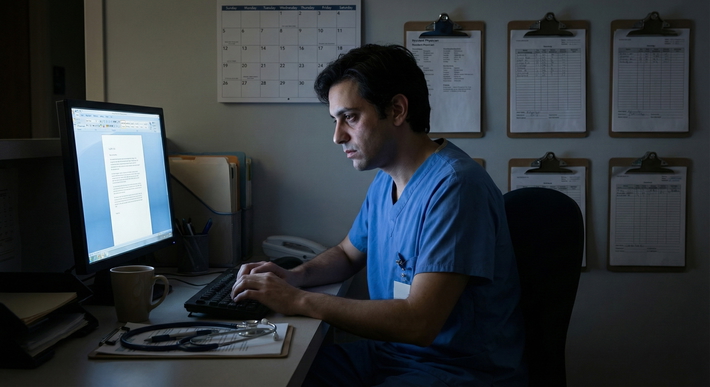
The hard truth is this: if an accommodation truly compromises patient safety, it will not stand. The real question is whether your request actually conflicts with safety—or whether people are using “patient safety” as a lazy excuse to avoid making changes.
Let’s sort that out.
The core rule: safety is not optional, but neither are your rights
Here’s the non-negotiable framework you’re operating in:
You have a legal right (in most jurisdictions, especially under the ADA in the US) to reasonable accommodations if you are qualified to perform the essential functions of your role or training position.
Institutions have a legal and ethical obligation to protect patients from unsafe care.
When those two seem to collide, the solution is not “shrug and say no.” The solution is:
- identify the real safety risk,
- test whether a different accommodation or workflow can remove that risk,
- document the reasoning, not just the intuition.
When schools or hospitals skip that middle step, they’re not protecting safety—they’re dodging work.
Step 1: Be brutally clear on what’s essential vs preferred
Most conflicts start because nobody has clearly defined the “essential functions” of your role.
Examples:
Internal medicine resident
- Essential: assess patients, make clinical decisions, respond to emergencies within a defined time, communicate effectively, write orders.
- Non-essential: stand for 12 straight hours, push a stretcher, physically run down the hall.
OR nurse
- Essential: maintain sterile field, handle instruments safely, respond to intraoperative changes rapidly, follow critical protocols.
- Non-essential: lift all patients alone, carry heavy equipment without help, stand for every case without breaks.
If your requested accommodation affects something truly essential and there’s no safe workaround, you’ll hit a hard wall. But I’ve seen too many “essential” lists bloated with tradition and culture, not evidence.
Your first move: ask—politely but directly—for a written list of essential functions for your specific role or rotation. Not a generic HR one-pager from 2010. The current one being applied to you.
Step 2: Separate real safety risks from vague discomfort
“Patient safety” gets thrown around like a conversation-ender. You do not have to accept that.
You do have to take it seriously and dissect it.
Ask the person raising the concern:
- “What specific safety risk are you worried about?”
- “Can you give me an example—what scenario would actually be unsafe?”
- “Has this type of situation occurred before here? What happened?”
- “What evidence or standards are you using—policy, guidelines, cases?”
If they cannot move beyond vague statements (“We just need everyone able to respond”), you’re not dealing with an evidence-based safety issue. You’re dealing with discomfort, bias, or habit.
Then you work from specifics.
Common conflict scenarios and what usually happens
Let’s talk about actual situations I’ve seen or that come up over and over.
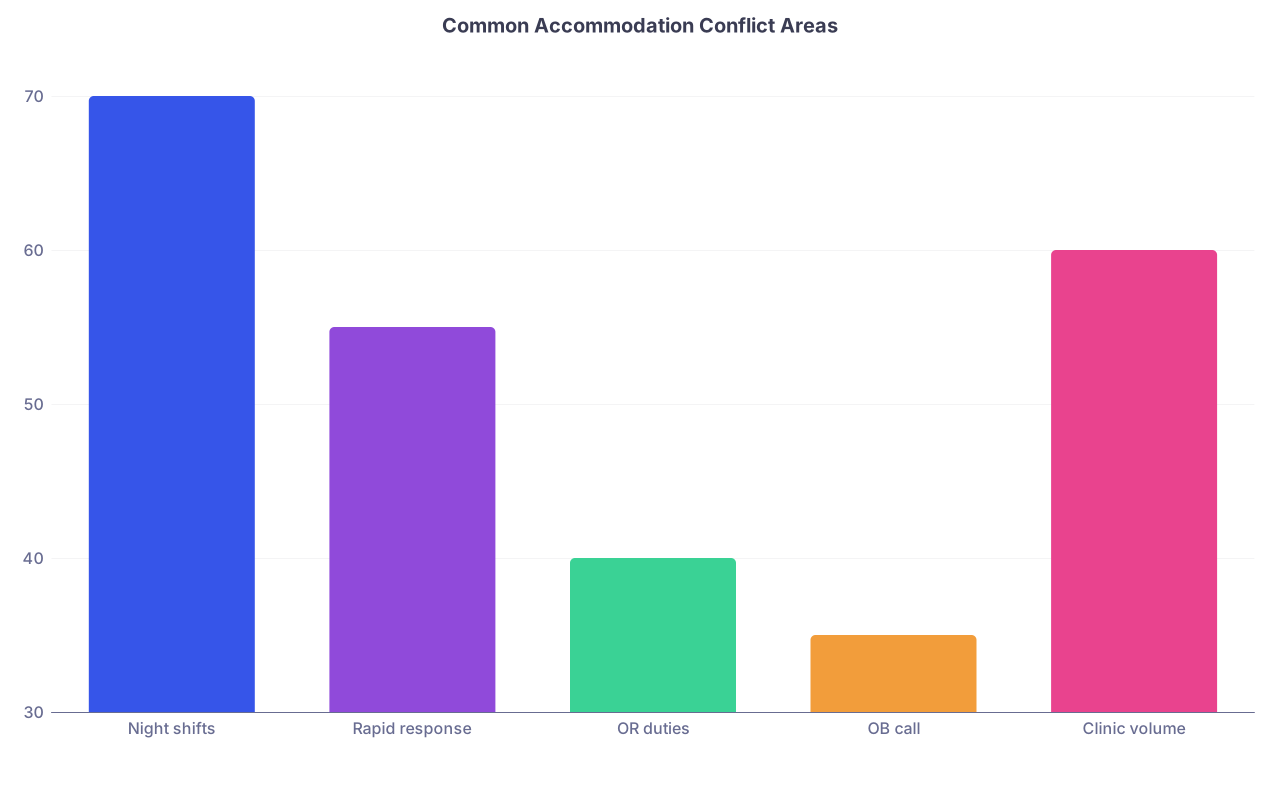
| Category | Value |
|---|---|
| Night shifts | 70 |
| Rapid response | 55 |
| OR duties | 40 |
| OB call | 35 |
| Clinic volume | 60 |
These percentages are rough, but they match where people most often claim “safety” concerns.
1. “I can’t do overnight call because of my disability”
Typical examples: seizure disorder triggered by sleep deprivation, severe diabetes management needs, mental health conditions destabilized by nights.
Institution’s knee-jerk: “Everyone has to take equal call; coverage must be fair for patient safety.”
Reality:
- Safety concerns are real: you impaired at 3 a.m. is dangerous.
- The “everyone equal” argument is not a safety argument. That’s fairness and staffing, which are separate issues.
Possible solutions:
- Trade overnight call for more daytime or weekend call.
- Take shorter call shifts, with handoff at midnight or 10 p.m.
- Serve in an at-home backup role for non-urgent tasks.
- Shift to services with less or no overnight call (for part of training).
What usually happens if handled properly:
- If you can meet the program’s core competency requirements via adjusted scheduling, this is typically seen as a reasonable modification that does not compromise safety.
- If the specialty requires independent overnight duty (e.g., some rural EM setups) and no safe coverage model exists, the institution might argue the overnight component is an essential function. Then we’re in hard-conversation territory: can the role be modified, or is this specialty/program fundamentally incompatible?
2. “I can’t physically run to codes or lift patients”
Mobility impairments, cardiopulmonary conditions, or severe joint pain are classic here.
The lazy response: “Then you can’t be in acute care. Patient safety.”
The accurate breakdown:
- The essential function is timely response and effective contribution to the code—not physically sprinting or lifting without help.
- Most code teams already have distributed roles: compressor, airway, meds, recorder, team leader. Not everyone needs to perform high-exertion tasks.
Potential accommodations:
- You respond via wheelchair or mobility device and fill team leader, medication, or documentation roles.
- Explicit team planning that others handle compressions and heavy physical tasks.
- Use of transport staff and lift devices for routine transfers, which, honestly, should be happening already.
Where it truly breaks:
- If the environment cannot guarantee that someone else will be available for the physical tasks you absolutely must be able to perform in emergencies, that could be a true safety conflict.
- But hospitals almost always have teams. Lone-clinician emergency scenarios are edge cases, not the norm.
3. “I need extra time or different tools that may delay care”
Examples: using speech-to-text, needing more time for documentation, or requiring extra time for some procedural steps due to motor or visual limitations.
Institution concern: “Any delay could harm patients.”
This is where people routinely exaggerate risk.
You need to separate:
- Tasks where a delay is clinically significant (stat orders, emergency response, acute airway management).
- Tasks where efficiency is nice but not safety-critical (routine documentation, discharge summaries, clinic notes).
Reasonable safety-focused adjustments:
- You do non-urgent documentation using assistive tools and extra time.
- You avoid specific time-critical procedures where your adaptation causes delay, but still do others.
- You participate in emergency care in roles that do not depend on your slower step (for example, you manage meds while someone else does hands-on procedure).
Where it truly conflicts:
- If the core of your role is time-critical procedures you can’t safely perform at necessary speed even with support (e.g., primary trauma surgeon, certain interventional roles), that may be a genuine safety wall.
Step 3: Build a concrete, safety-aware accommodation plan
Do not walk into the discussion with only a general ask like “I need lighter duties” or “I can’t do X.”
Walk in with a draft plan that shows you’ve thought about safety:
- List the essential functions you can perform fully and independently.
- Identify the functions where you need modification.
- For each risky scenario, spell out:
- the risk,
- your proposed workaround,
- who else would be involved,
- how you would ensure timely, safe care.
Example for a resident with mobility limitations:
- Risk: Cannot physically perform chest compressions in codes.
- Proposal:
- I will respond to codes and serve as team leader / airway / meds / documentation.
- Unit staff and other responders will be responsible for compressions and patient lifting.
- Charge nurse will ensure compressor role is always assigned to someone physically able.
That level of specificity changes the conversation. It forces the institution to engage with an actual plan, not just a theoretical fear.
Step 4: Understand the limits — when “no” might be defensible
You’re not going to like this part, but you need to hear it clearly.
There are real boundaries.
An institution can legally and ethically:
- Deny an accommodation that removes an essential function of the job/training.
- Deny an accommodation that creates a direct threat to patient safety that can’t be reduced by reasonable measures.
- Deny an accommodation that requires fundamentally altering the program or position (for example, eliminating all procedural work from a procedural specialty).
Clear examples:
- A surgeon who cannot safely perform surgery, even with assistive tools and reasonable modifications, cannot be “accommodated” into non-operative surgery and still be called a surgeon.
- An anesthesiology resident who, due to a disability, cannot reliably recognize and respond to airway emergencies in time—even with team support—cannot safely complete core anesthesiology training.
The key is that this must be based on:
- evidence,
- specific risks,
- real program requirements, not just fear or culture.
If you get a “no,” you’re entitled to:
- a clear explanation of what risk they’re relying on,
- what alternatives were considered,
- whether there are different roles, tracks, or specialties where your abilities do align with essential functions safely.
Step 5: Bring in the right people early
If your accommodation request even might touch patient safety, don’t try to negotiate one-on-one with a single attending in a hallway.
You want:
- Disability office or HR (someone who actually understands accommodation law/policy).
- A clinical supervisor who knows the workflow.
- Risk management or patient safety officer, if the institution has one.
- You. Not just as a passive observer, but as the person who knows your own capabilities and limitations.
That group can do what’s called an “interactive process”:
- Map out tasks,
- Identify true safety-critical areas,
- Brainstorm alternatives,
- Document the decisions.
If your institution tries to short-circuit this—“we talked about it as a department and decided it’s unsafe”—you’re not getting a real analysis. Push back and request a formal interactive process with appropriate offices present.
Step 6: What if they still say no?
Then you focus on two things:
- Documentation.
- Options.
Ask for:
- The decision in writing.
- The specific safety risks cited.
- Which alternative accommodations were considered and why they were rejected.
- Clarification about whether you are qualified for any role/path within the institution or specialty that would be safe.
From there, your options (depending on your jurisdiction and context):
| Option | When To Consider It |
|---|---|
| Internal appeal | Decision seems rushed or poorly justified |
| Disability office escalation | You were never offered a real interactive process |
| Ombuds / professionalism office | There are fairness or bias concerns |
| External legal/advocacy counsel | Clear evidence of discrimination or rights violations |
| Specialty/role reevaluation | The core demands truly conflict with your limitations |
I’ve seen people, after a hard “no,” successfully:
- move into related specialties that align better with their capacities,
- negotiate a different track or focus (e.g., outpatient-heavy),
- or force a program to revisit a knee-jerk safety decision that wasn’t well grounded.
Step 7: How to frame this conversation so you’re taken seriously
Like it or not, the way you present this matters.
Do:
- Lead with your commitment to patient safety and professionalism.
- Be specific about your capabilities, not just your limitations.
- Bring potential solutions, not just problems.
- Show that you understand the realities of the clinical environment.
Do not:
- Frame it solely as “my right vs your policy.”
- Minimize genuine risks (“I’m sure it’ll be fine” is not reassuring).
- Wait until you’ve already failed or had an incident before asking.
You’re arguing that the best way to protect patients is to accommodate you properly so you can function at your safest, most effective level. That’s not self-serving. That’s accurate.
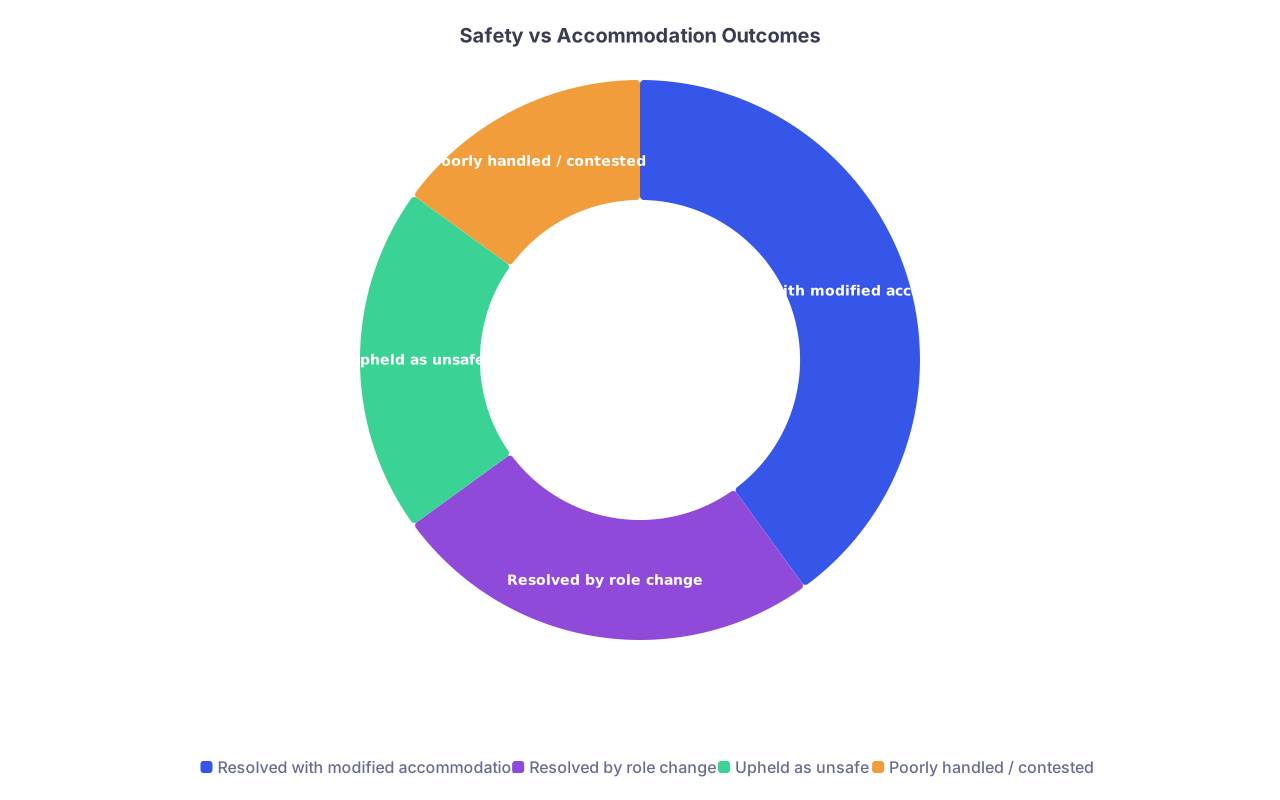
| Category | Value |
|---|---|
| Resolved with modified accommodation | 40 |
| Resolved by role change | 25 |
| Upheld as unsafe | 20 |
| Poorly handled / contested | 15 |
FAQ: “What if my requested accommodation conflicts with patient safety?”
1. What should I do first if someone says “your accommodation is unsafe”?
Ask them to describe the specific safety risk and scenario in detail, then request a formal meeting that includes disability services/HR and a clinical supervisor. You want a structured, documented interactive process—not an informal “no” based on instinct.
2. Can a program just say “this specialty is too physical for you” and end it there?
Not without analysis. They have to tie their decision to clearly defined essential functions and real safety risks that cannot be mitigated by reasonable accommodations. A blanket “this specialty isn’t for disabled people” is not acceptable.
3. What if I can do most of the job but not emergencies?
If the emergency role is truly an essential function (for example, overnight in-house call where you’re the only doctor on site), that can be a legitimate barrier. The question is whether the role can be restructured so you’re never the sole responder, or whether a different track without that requirement exists.
4. How do I avoid being seen as dangerous to patients just because I disclosed a disability?
Tie every part of the conversation to your track record and your plan. Bring evaluations, feedback, and evidence of safe practice. Then present a detailed accommodation proposal that shows you’ve thought through risks more seriously than anyone else in the room.
5. Who actually decides if something is a “direct threat” to patient safety?
Legally and practically, it’s the institution—but they’re supposed to decide it based on objective medical evidence, job requirements, and the possibility of mitigating risk with accommodations. It’s not supposed to be a single person’s gut feeling or bias.
6. What can I do today if I’m worried my future accommodation might be seen as unsafe?
Start by getting a copy of the essential functions for your desired role or specialty. Then draft your own “safety-aware accommodation plan” that maps your limitations, your strengths, and your proposed solutions. Bring that draft to disability services or a trusted mentor and refine it before you ever file a formal request.
Now, take 15 minutes and write down the top three tasks in your current or future role that might raise safety questions—then next to each, sketch one concrete, safety-conscious way you could still contribute. That’s your starting blueprint.