The hard truth: if you genuinely cannot meet a program’s essential functions, even with reasonable support, the institution can legally say no. But that’s not the end of the story for your career or your life.
Here’s what actually happens, what rights you still have, and what smart next steps look like.
1. What “Essential Functions” Really Mean (Not Just a Scare Phrase)
Before you panic, you need to know what you’re being measured against.
“Essential functions” are the core tasks and abilities a role or program has decided are non‑negotiable. In education and healthcare, they often show up as:
- Technical standards (for med school, nursing, PT, etc.)
- Job descriptions (for residencies, staff roles, clinical jobs)
- Competency frameworks (ACGME Milestones, EPAs, board requirements)
They’re usually grouped into areas like:
- Cognitive: decision‑making, clinical reasoning, attention, memory
- Physical: mobility, fine motor skills, stamina, lifting/positioning
- Communication: verbal, written, nonverbal, documentation
- Professionalism: reliability, ethics, boundaries, teamwork
- Safety: not posing a direct threat to patients or others that can’t be mitigated
And here’s the key point most people miss:
You do not have to perform them in the same way as everyone else. You have to achieve the result, with or without accommodations.
Examples:
- You don’t need to handwrite a note if you can dictate accurately into the EMR.
- You don’t need to auscultate every heart if your role can be structured around ultrasound or team‑based care.
- You don’t need to stand for 8 hours straight in the OR if sit‑stand options and rotation changes are reasonable for that program.
The legal standard is:
Can you meet the essential functions with reasonable accommodations without causing:
- Undue hardship to the institution, or
- A direct threat to patient or student safety that can’t be reduced?
If the honest answer is no, then we’re in the “what happens now?” territory.
2. How Schools and Employers Decide You’re Not Meeting Them
Most people don’t get an email saying “you have failed essential functions.” It comes wrapped in other language:
- “Failure to meet professionalism standards”
- “Unable to perform required duties despite support”
- “Not meeting clinical milestones”
- “Unsafe independent practice”
The actual process often looks like this:

| Step | Description |
|---|---|
| Step 1 | Performance Concern |
| Step 2 | Meeting with Supervisor |
| Step 3 | Referral to Disability or HR |
| Step 4 | Interactive Process |
| Step 5 | Trial Accommodations |
| Step 6 | Continue with Plan |
| Step 7 | Committee or HR Review |
| Step 8 | Revise Accommodations |
| Step 9 | Separation or Program Change |
| Step 10 | Improvement? |
| Step 11 | Can Essential Functions Be Met? |
If you’ve reached the point where the program, after trying accommodations, concludes you still cannot:
- They are not required to keep you in the role indefinitely.
- They are required to base that decision on:
- Current, objective evidence (not fear or bias)
- A real assessment of accommodations (not “we don’t do that here”)
- A case‑by‑case analysis (not blanket rules about your diagnosis)
If they skip those steps, you may have a legal claim. But even with perfect process, the outcome might still be: continuation is not possible.
3. What Actually Happens If You Can’t Meet Them
Let me walk through concrete scenarios. These are close to what I’ve seen happen in real institutions.
Scenario A: You’re a medical student who cannot perform core clinical tasks
Maybe a new neurological condition, a worsening psychiatric illness, or progressive vision loss. Even with accommodations, you can’t:
- Safely assess patients independently
- Be present enough hours to complete clerkships
- Meet minimal speed and reliability for core tasks
Likely outcomes:
- Academic/clinical review committee meeting
- Required leave of absence (medical or administrative)
- Conditional return plan that may or may not be realistic
- If still unable: voluntary withdrawal or dismissal
Sometimes the school offers:
- Option to complete a non‑clinical degree (e.g., M.S. or research‑only path)
- Help transferring into public health, policy, or basic science tracks
But they’re not obligated to create a non‑clinical MD just for you. They’re tied to accreditation standards.
Scenario B: You’re a resident and cannot safely provide patient care
This one is brutal. You might be:
- Missing critical diagnoses
- Unable to handle call or night shifts, even with schedule changes
- Too cognitively or emotionally impaired to make safe decisions
What usually follows:
- Performance remediation plan
- Occupational health and/or mental health eval
- Formal accommodations trial (reduced call, specific rotations, extra supervision)
If it still doesn’t work:
- Nonrenewal of contract or termination “for cause”
- Program may offer:
- Time to find another path
- Letters describing your strengths in non‑clinical domains
- Program is not obligated to graduate you or sign off on board eligibility if you can’t meet competencies.
Scenario C: You’re an employee in a clinical or academic role
Here the ADA is front and center. The employer must:
- Engage in an interactive process
- Consider reasonable accommodations
- Not just reject you because “this seems hard”
But if after trying (or clearly analyzing and rejecting unworkable options) they conclude:
- You can’t perform essential duties even with accommodations
- Or accommodations would be an undue hardship or a direct safety threat
Then they can legally:
- Reassign you to a vacant, suitable role you’re qualified for
- This is often overlooked but powerful.
- If no such role exists, end your employment.
A clean version of this process looks like:
| Context | Typical Final Outcome | Secondary Options |
|---|---|---|
| Medical school | Withdrawal or dismissal | Transfer to nonclinical degree |
| Residency | Nonrenewal or termination | Help exploring other careers |
| Clinical job | Separation from position | Reassignment if role available |
| Academic role | Modified duties or exit | Shift to research/teaching only |
4. Your Rights Don’t End Just Because You’re Struggling
Not meeting essential functions is not the same as:
- Losing all legal protection
- Waiving your right to fair treatment
- Admitting you’re at fault
You still have rights to:
A real interactive process
Not a rubber‑stamp “no.” They must:- Talk with you
- Review documentation
- Consider specific accommodations
- Explain decisions in a grounded way
Freedom from discrimination and harassment
They cannot:- Push you out just because you disclosed a disability
- Retaliate because you asked for accommodations
- Treat you worse than others with similar performance problems who don’t have disabilities
Confidentiality
Your diagnosis is not for your whole department to gossip about.Access to documentation
You can and should request:- Written explanation of decisions
- Copies of evaluations
- Policies they claim to be following
If they’re sloppy or biased, that’s where attorneys, OCR complaints, or EEOC charges come in. Sometimes even a quiet consult with a disability rights attorney changes how seriously they take your case.
5. Smart Moves If You Think You Can’t Meet the Functions
Here’s where people either protect their future or burn it down with panic and silence.
Step 1: Get brutally honest clinical input
Not from your class group chat. From:
- Your treating physician(s)
- A specialist in your condition
- Sometimes neuropsych testing, OT/PT assessments, or psych evaluations
Ask very specific questions:
- “With realistic accommodations, what kind of work schedule is sustainable?”
- “Are surgical, call‑heavy, or high‑acuity roles realistic?”
- “Is this expected to improve, remain stable, or worsen?”
Vague reassurance like “we’ll see” doesn’t help you plan.
Step 2: Clarify what this program actually requires
Do not guess. Ask for:
- Written technical standards / essential functions
- Any relevant policy on modified duties, leaves, or part‑time options
- For residency: how ACGME Milestones are interpreted in your program
Then map yourself honestly:
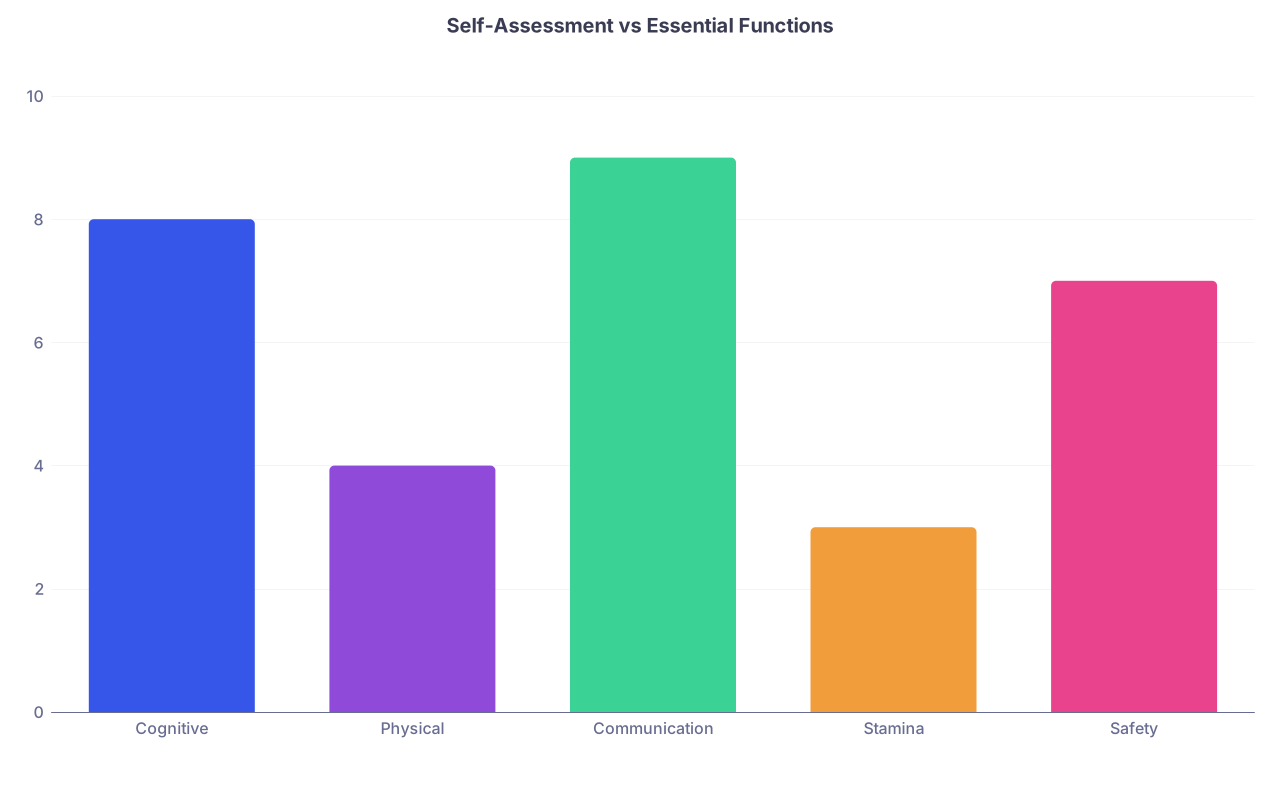
| Category | Value |
|---|---|
| Cognitive | 8 |
| Physical | 4 |
| Communication | 9 |
| Stamina | 3 |
| Safety | 7 |
Think: with accommodations, how close can you realistically get to a “yes” in each domain?
Step 3: Use the system on purpose, not reactively
You should be talking to:
- Disability services (for students and residents, where available)
- HR and Occupational Health (for employees)
- A trusted faculty member or mentor who actually understands disability—not the “just work harder” crowd
Push for an explicit accommodations plan, in writing:
- What is being provided
- What’s being modified
- How success will be judged
- Timeline for reassessment
Step 4: Plan for multiple possible futures
Do this early, not after you’re dismissed.
Think in three tracks:
Best‑case clinical path
Example: Internal medicine with outpatient focus, no heavy procedures.Modified clinical or adjacent path
Examples:- Non‑procedural specialties (psych, PM&R, pathology, radiology)
- Hospital quality, informatics, clinical documentation improvement
Non‑clinical but still in healthcare
Examples:- Medical education
- Public health
- Policy and advocacy
- Research or pharma/biotech
A simple brainstorm can help you see you’re not boxed into one identity.

6. What If You’re Forced Out? Then What?
If you’ve already been dismissed, non‑renewed, or terminated, you still have choices. They’re not all glamorous, but they’re real.
Option 1: Legal review (quietly, not on Twitter)
Talk confidentially with:
- A disability rights attorney, or
- A clinic at a law school that handles these cases
You’re looking for answers to:
- Did they actually assess reasonable accommodations?
- Did they follow their own policies?
- Did they apply standards consistently across people?
- Is there evidence of bias or retaliation?
Sometimes the only realistic “win” is a clean record, neutral reference language, or more time on health insurance before separation. Sometimes there is a legitimate case.
Option 2: Rebuild in a different program or context
People do successfully:
- Transfer to less physically demanding specialties or schools
- Move into roles that don’t require the same functions
- Re-train in related fields (e.g., MPH, informatics, counseling, health admin)
You’re not starting from zero. Prior clinical education still counts:
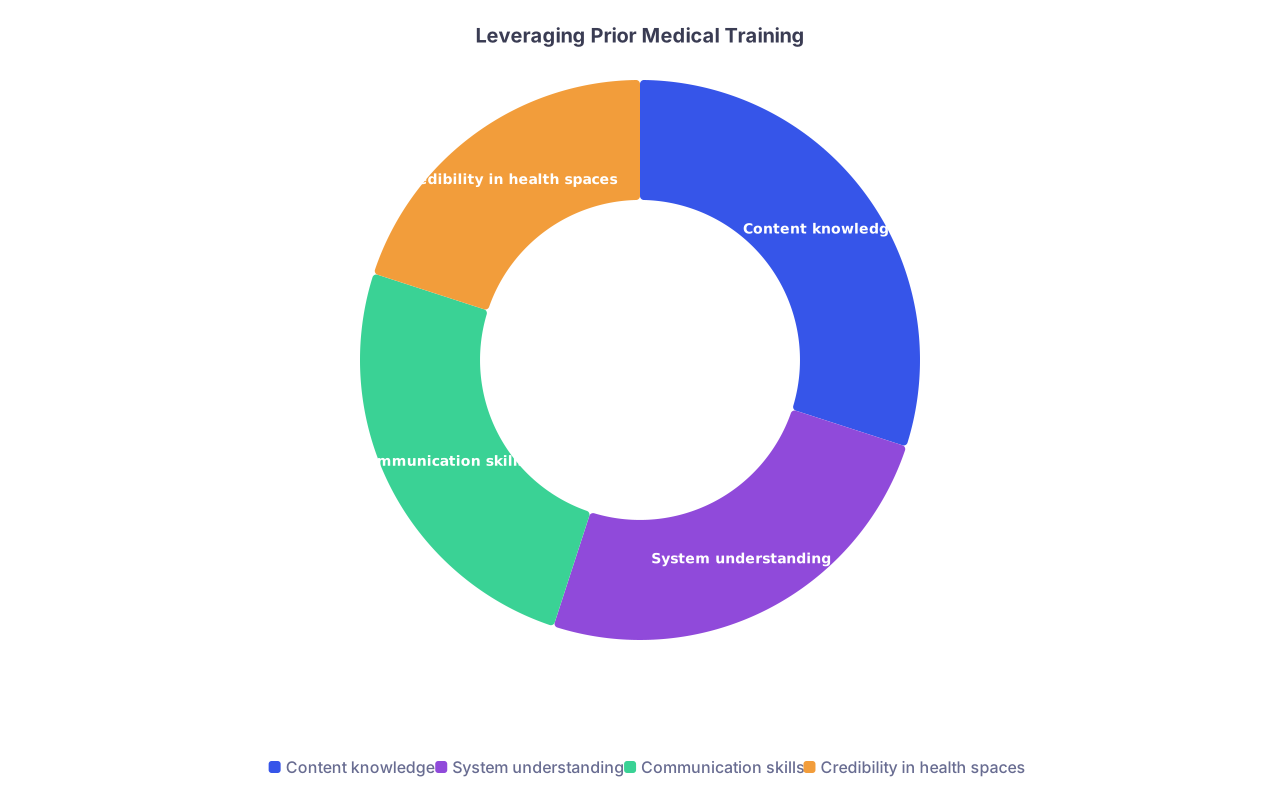
| Category | Value |
|---|---|
| Content knowledge | 30 |
| System understanding | 25 |
| Communication skills | 25 |
| Credibility in health spaces | 20 |
That background is gold in health policy, education, advocacy, and tech.
Option 3: Redefine what “success in medicine” looks like
This sounds like self‑help fluff until you watch an ex‑resident become:
- A powerhouse disability advocate influencing national policy
- A medical educator reshaping curricula
- A health tech product lead using their lived experience to design accessible systems
You don’t need an MD after your name, or board certification, to improve patient care at scale.
7. Hard Lines vs Negotiables: What You Can and Cannot Change
Some essential functions are truly nonnegotiable in specific roles. You’re not going to be:
- An anesthesiologist who cannot safely monitor a patient’s status
- An ED physician who can’t function under time pressure at any level
- A surgeon who cannot use their hands or be physically present in an OR, with no realistic accommodation pathway
But a lot of what’s treated as “essential” is actually tradition, laziness, or resistance to change.
Examples that are often negotiable:
- Standing vs sitting in clinic or rounds
- Call schedules and night float structure
- Documentation methods (dictation, scribes, adaptive tech)
- Remote participation in some conferences or meetings
- Reducing or modifying procedural requirements if accrediting bodies allow alternatives
This is where knowing accreditation rules matters. Programs sometimes say “we can’t” when the truth is “we don’t want to change how we’ve always done it.”
8. Bottom Line: If You Truly Cannot Meet Essential Functions
Here’s the core reality:
- The law protects you from unfair treatment.
- The law does not guarantee a particular role, specialty, or job if—even with accommodations—you cannot do its essential tasks safely and reliably.
If that’s where you are, the most productive shift is:
From: “How do I force them to keep me?”
To: “Given my actual body and brain, where can I thrive and still contribute meaningfully?”
Use your lived experience with disability as an asset, not a source of shame. Health care desperately needs people who understand from the inside what access, limits, and adaptation look like.


FAQ: What Happens if I Can’t Meet “Essential Functions” Even With Support?
Can a school or employer dismiss me if I can’t meet essential functions, even with accommodations?
Yes. If you genuinely cannot perform the essential functions of the role or program, even with reasonable accommodations—and if you pose a direct safety risk that can’t be mitigated—they can legally dismiss, non‑renew, or separate you. They must base this on objective evidence and a real assessment of accommodations, not on assumptions about your diagnosis.What if they refused accommodations or didn’t really try to help?
That’s different. If they never engaged in a meaningful interactive process, never considered specific options, or applied standards inconsistently, you may have a strong disability discrimination claim. In that case you should talk with disability services (if you’re still enrolled/employed), document everything, and seriously consider a consult with a disability rights attorney or relevant agency (OCR, EEOC).Does failing to meet essential functions mean I can never work in healthcare?
No. It means you may not be able to work in that specific role or path (e.g., a particular specialty, residency, or front‑line clinical job). Plenty of people pivot successfully into public health, quality improvement, informatics, education, policy, research, pharma, device development, and advocacy. Your clinical knowledge and lived experience are still valuable.Can they force me to disclose my diagnosis to my program director or colleagues?
Typically no. Disability services and occupational health keep your medical details confidential. Supervisors are told what accommodations are approved, not your diagnosis. There are rare safety‑critical situations where more information is shared, but routine disclosure to everyone is not appropriate and can be a red flag.If I’m dismissed, can I ever try again in another program or specialty?
Sometimes, yes. It depends on why you were dismissed, what’s changed (treatment, stability, functional status), and how future programs interpret your record. Some people successfully reapply to less physically or cognitively demanding specialties or pivot into different training programs altogether. You’ll need honest medical input, documentation of improvement, and a very clear explanation of what’s different this time.
Key points:
- If you truly cannot meet essential functions even with accommodations, the institution can end your role—but they still owe you a fair, individualized process free of discrimination.
- Your career in healthcare might change shape, but it doesn’t have to end; there are many clinically adjacent and non‑clinical paths where your experience is an asset, not a liability.