What happens when you technically got into clinical rotations, but your body or brain can’t (and shouldn’t have to) do medicine the old-school, able-bodied way?
That’s the real question behind “What counts as a reasonable accommodation?” in clinical rotations. Not the brochure version. The “Will they say I’m unsafe?” version. The “Am I going to be quietly pushed out?” version.
Let’s answer it directly.
The Legal + Practical Definition (Plain English)
You’ll hear this phrase everywhere: “reasonable accommodations that do not fundamentally alter the program or pose an undue burden.”
Here’s what that actually means for clinical rotations:
A reasonable accommodation in clinical rotations is:
A change in
- how you do tasks,
- where you do them, or
- what tools/support you use
That lets you meet the essential functions of the rotation
Without:
- creating a significant safety risk that can’t be managed, or
- fundamentally changing what the rotation is designed to teach.
So there are three guardrails:
- You still have to meet technical standards / core competencies
- The accommodation can’t seriously compromise patient safety
- The school doesn’t have to do things that would rebuild the whole rotation from scratch
But here’s the thing schools love to gloss over:
“Reasonable” is broad. Students are often told “we don’t do that” when the law would say “actually, you probably should.”
What’s Typically Considered Reasonable in Clinical Rotations
Let’s get specific. These are accommodations I’ve seen students actually get in medicine and related clinical training.
1. Schedule and Workload Adjustments
Reasonable:
- Later start time for students with morning medication side effects, as long as core duties are covered
- Reduced continuous hours with breaks for:
- diabetes management
- POTS
- chronic pain
- migraines
- Time-limited leave or partial days during flares, with a clear plan to make up missed requirements
- No overnight calls for certain documented conditions, replaced with daytime duties of similar educational value
Usually still reasonable, but schools resist:
- A 4-day clinical week instead of 5, with extended rotation length to hit the same requirements
- No 24–28 hour call, converted to shorter shifts with more total days
Not reasonable:
- A schedule so limited you can’t see routine patient care (e.g., only coming 2 afternoons a week forever)
- Refusing all weekend or evening work in specialties where that’s a core part of training (e.g., OB, EM)
2. Physical/Environmental Modifications
Reasonable:
- Assistive devices: canes, crutches, braces, wheelchairs, voice-to-text tools, ergonomic tools
- Guaranteed access to seating during long cases or rounds (stools, ability to sit while charting or examining when safe)
- Assigned patient rooms or clinic spaces that are physically accessible
- Extra time to move between locations (or adjusted expectations so you’re not penalized for not sprinting between floors)
- Permission to avoid heavy lifting or repositioning patients if there’s another safe way to participate in care
- Use of elevators instead of stairs, even when the team takes stairs
Usually still reasonable:
- Moving you to a clinic-heavy site of a rotation instead of a very physically demanding floor
- Arranging scribe-style note entry if hand function is limited, while you still generate the content
Not reasonable:
- Expecting the OR team to reconfigure everything for you if it makes the sterile field unsafe or impossible
- Eliminating all physical patient contact in a rotation whose whole point is physical exam and bedside care
3. Cognitive / Learning / Processing Support
Reasonable:
- Extra time for:
- written or electronic documentation
- post-call note completion
- in-training written exams or quizzes
- Alternate formats for some tasks:
- written sign-out instead of rapid-fire verbal, if the team can integrate that safely
- visual aids, checklists, or templates for complex tasks
- Structured expectations:
- getting patient lists ahead of rounds
- written task lists from residents/attendings instead of just verbal “to-do” dumps
- Quiet or low-distraction space to write notes when possible
Often reasonable but contested:
- Permission to record teaching (with all necessary consent and privacy rules, usually excluding patient encounters)
- Replacing some “pimping” style on-the-spot questioning with planned question sessions or written response options
Not reasonable:
- Never being required to present a patient orally
- Complete exemption from writing notes or clinical documentation in a clerkship that teaches exactly that
4. Sensory, Communication, and Technology-Based Accommodations
Reasonable examples:
- ASL interpreters for teaching rounds, conferences, and non-confidential interactions
- Captioning for all required videos and recorded content
- Amplification devices or preferential positioning for students with hearing loss
- Screen readers, larger-print materials, or high-contrast displays for students with low vision
- Permission to use:
- tablets
- phones
- speech-to-text
- adapted keyboards
during clinical work if they’re used for patient care / notes and comply with privacy policies
For students with hearing or speech-related disabilities, many schools and boards now accept:
- Using interpreters for:
- patient interviews
- team discussions
- case presentations
- Access to remote interpreters (VRI) in clinics where in-person isn’t feasible
Not reasonable:
- Refusing to allow any electronic aids because “we’ve never done that” or “it looks unprofessional”
- Blocking interpreters in teaching spaces where no PHI is discussed
5. Mental Health, Neurodivergence, and Non-Visible Disabilities
This is where students get gaslit the most.
Reasonable:
- Protected time for therapy or psychiatry appointments, arranged around clinical duties
- Predictable break access for:
- panic disorder
- PTSD triggers
- medication side effects
- Written instruction and feedback rather than only vague verbal comments
- Avoidance of specific non-essential triggers (e.g., barring you from managing a particular trauma-type case if it’s not central to the rotation and creates genuine risk for you)
Often reasonable with good planning:
- Gradual ramp-up of workload at the start of a rotation
- Adjusted call patterns if sleep deprivation destabilizes a documented condition
Not reasonable:
- Being fully excused from time-sensitive or stressful situations in EM, ICU, or surgery if those situations are the very core of the rotation
- Never interacting with agitated or distressed patients across your entire education
When Does an Accommodation Become “Unreasonable”?
Three main ways:
It fundamentally alters what the rotation is teaching
If the core skill of the rotation is:
- rapid decision making in emergencies (EM, code team)
- standing and operating for long stretches (certain surgical subspecialties)
- direct physical exams and bedside procedures
And your requested accommodation removes that entire category of experience, the school can say no.
Example:
- Asking for a surgery rotation where you never scrub or step into the OR at all.
- Asking for EM where you only do chart review in a quiet room.
It creates a non-mitigable safety risk
This one gets abused as an excuse, so be careful. But genuine examples:
- A condition that causes unpredictable loss of consciousness while doing procedures on awake patients, without any mitigation plan
- Needing sedating medications during the clinical day that significantly impair your ability to recognize emergencies, even with accommodations
The law doesn’t require a program to accept unmanageable risk to patients.
It’s a truly undue administrative/financial burden
This bar is high. “Inconvenient” or “new for us” is not undue burden.
More plausible examples:
- A very small rural site can’t get reliable interpreter access at all
- A rotation would have to be completely restructured only for you, in a way that’s logistically impossible
This should be rare, and schools should be able to document why they can’t do it.
Who Decides What’s Reasonable – and How?
Here’s the process at most US med schools, whether they admit it or not:

| Step | Description |
|---|---|
| Step 1 | Student submits documentation |
| Step 2 | Disability office review |
| Step 3 | Interactive meeting |
| Step 4 | Proposed accommodations list |
| Step 5 | Clerkship director input |
| Step 6 | Refine for safety and logistics |
| Step 7 | Final accommodation plan |
| Step 8 | Communicate to site |
Key points:
You do not negotiate directly with attendings or residents.
You work with the disability services office or similar central office.
They look at:
- your documentation
- the school’s technical standards
- specifics of each clerkship
Then they propose accommodations to clerkship leadership and finalize what’s “reasonable” for that setting.
If something gets denied, you can (and often should) appeal or ask for the reasoning in writing. That’s not being difficult. That’s being smart.
Examples: What Different Schools Commonly Approve
| Category | Often Approved | Often Resisted |
|---|---|---|
| Schedule | Extra breaks, no 24h call | 4-day weeks, no nights at all |
| Physical | Seating, elevator use, devices | No physical exam at all |
| Cognitive | Extra time for notes/tests | No oral presentations ever |
| Sensory | Interpreters, captions, devices | Banning all “pimping” questions |
| Mental health | Protected appointments, breaks | Total avoidance of all stressors |
Strategy: How to Ask for (and Actually Get) Reasonable Accommodations
You’re not just at the mercy of whatever the school feels like doing. How you frame things matters.
1. Translate symptoms into functional limitations
Bad:
“I have chronic pain.”
Better:
“When I stand more than 45–60 minutes without a chance to sit, my pain escalates to the point that I can’t focus reliably on patient care tasks.”
2. Connect limitations to specific accommodations
Link them tightly:
Limitation: difficulty standing for long periods
Accommodation: guaranteed access to a stool or chair in the OR/clinic when not directly needed at bedside, and the ability to sit for teaching portions of rounds
Limitation: slower written processing speed
Accommodation: 50% extra time for in-rotation written exams and 30 extra minutes after clinic to complete documentation
3. Pre-plan rotation-specific needs
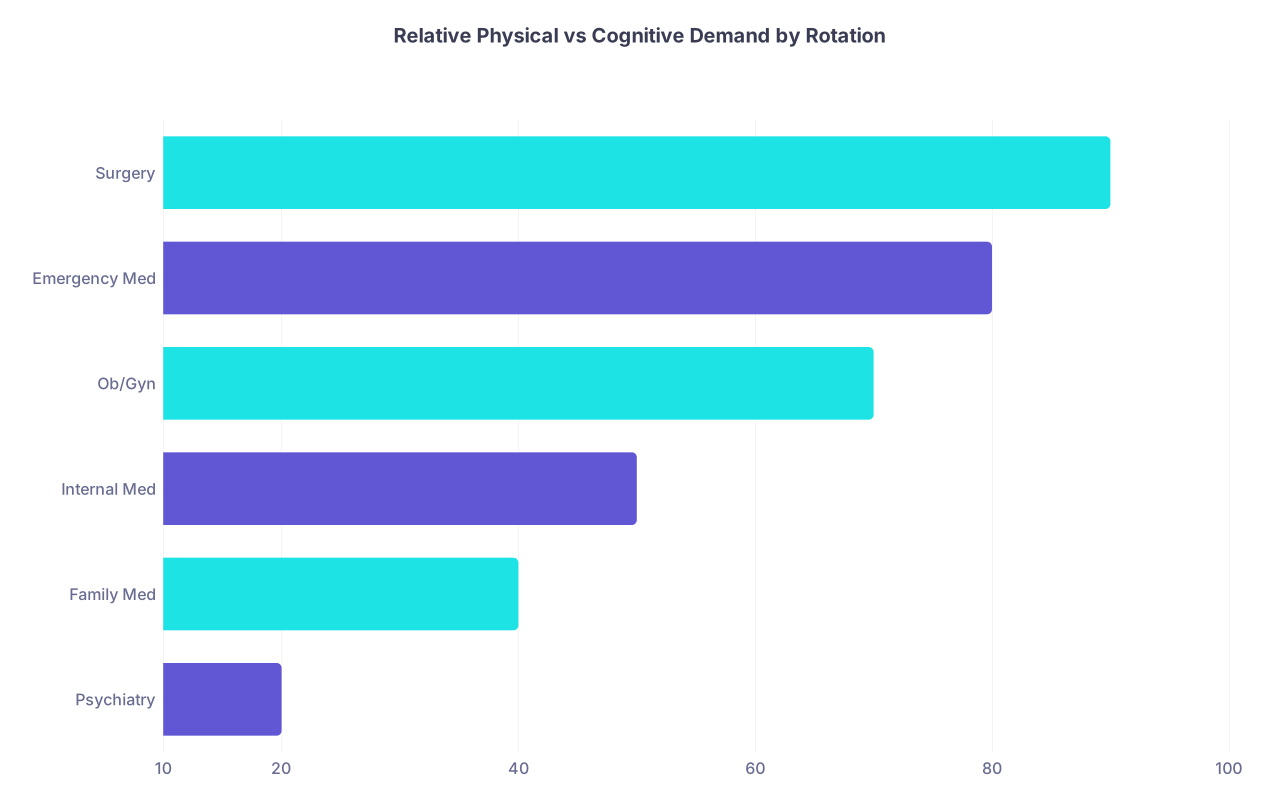
Map common rotations and what’s realistic:
| Category | Value |
|---|---|
| Psychiatry | 20 |
| Family Med | 40 |
| Internal Med | 50 |
| Ob/Gyn | 70 |
| Emergency Med | 80 |
| Surgery | 90 |
(Think: higher number = more physically intense on average.)
Before each rotation, ask:
- What parts of this rotation are core?
- Where can I realistically adjust, and where do I need an alternate assignment or different site?
Then talk to disability services months in advance, not the week before.
4. Get the reasoning in writing
If they say no to something, ask:
- “Can you explain whether this is being denied as a fundamental alteration, safety concern, or undue burden?”
- “Can you document that in my file?”
This changes the conversation. It forces them to think like a regulated institution, not just a cranky clerkship director.
What About Licensure and Future Practice?
Big fear: “If I need accommodations in clinicals, does that mean I can’t safely be a doctor?”
No. Not automatically. Not even close.
You should think in three layers:
- Current rotation demands
- Residency demands in your chosen specialty
- Ultimate attending-level practice you want
You might need significant accommodations to get through:
- Surgery clerkship
- EM
- OB
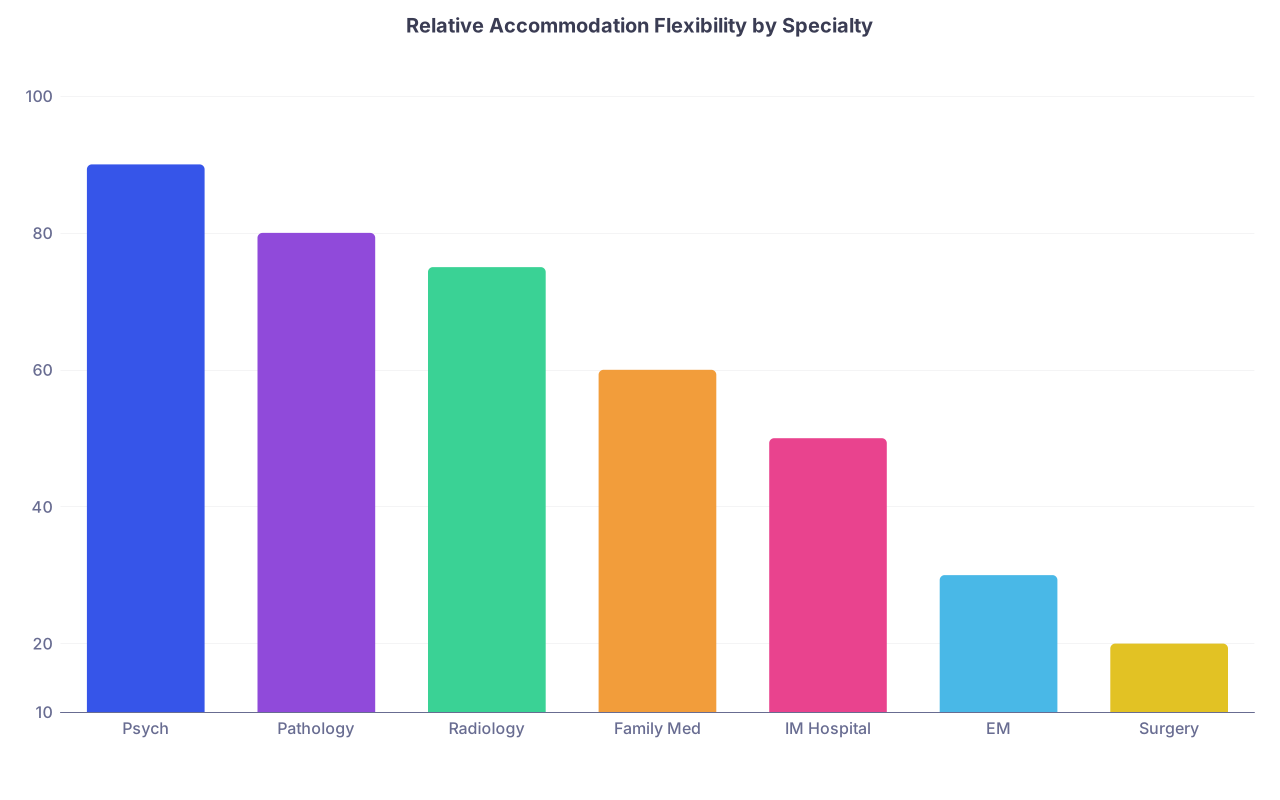
…and still be an excellent psychiatrist, radiologist, pathologist, outpatient internist, telemedicine doc, etc.
| Category | Value |
|---|---|
| Psych | 90 |
| Pathology | 80 |
| Radiology | 75 |
| Family Med | 60 |
| IM Hospital | 50 |
| EM | 30 |
| Surgery | 20 |
Higher = easier to sustain accommodations long term.
The key is to be honest with yourself about:
- What your body/brain can handle on a routine basis
- Which environments are realistically modifiable vs fundamentally incompatible
You’re not obligated to chase a specialty that destroys you, just to prove a point.
The Future: Where This Is All Going
We’re not heading toward fewer disabled trainees. The opposite.
Telehealth, team-based care, digital documentation, and remote monitors all mean this:
- Plenty of “essential functions” can now be done with tech support, not raw physical stamina.
- Programs that cling to old models (“everyone must run 10 miles on rounds”) are going to get pressure—from students, from courts, and from workforce realities.
Expect more:
- Built-in remote case conferences
- Shared note templates and AI-assisted documentation
- Flexible call models
- Residency programs explicitly recruiting disabled trainees
But we’re not there yet everywhere. So for now, you’re living in the messy middle: old expectations, new legal landscape.
Quick Decision Framework: Is My Request Probably Reasonable?
Use this as a gut-check:

| Step | Description |
|---|---|
| Step 1 | Proposed accommodation |
| Step 2 | Likely unreasonable |
| Step 3 | Borderline - needs negotiation |
| Step 4 | Usually reasonable |
| Step 5 | Can I still meet core skills? |
| Step 6 | Does it create major safety risk? |
| Step 7 | Does it require total redesign of rotation? |
If you land at G, and the school says no with no clear explanation, that’s a red flag—not of you, but of them.

FAQs
1. Do I have to disclose my disability to attendings or residents?
No. Your formal disclosure is to disability services, not every supervisor. Many schools send attendings a list of functional accommodations (“student may sit during rounds”), not diagnoses. You can choose to share more if it helps build understanding, but that’s your call.
2. Can a program fail me if I use accommodations?
They can fail you if you don’t meet rotation objectives, even with accommodations. They can’t fail you because you have accommodations or because you used them. If you suspect that’s happening, you request a grade review and get disability services involved immediately.

3. What if my school only offers accommodations for exams, not for clinicals?
That’s not acceptable under modern disability law. Accommodations must extend to all major components of the program, including clinical rotations. You may need to escalate:
- disability office →
- dean of students / dean of education →
- university ADA/504 coordinator →
- external advocacy or legal advice if needed.
4. Can I change accommodations between rotations?
Yes, and you probably should. Reasonable accommodations are context-specific. What you need on psych is not what you need in surgery. You don’t have to lock in a single permanent configuration for all time.
5. Will having accommodations hurt my residency chances?
Most of the time, programs don’t know your specific med school accommodations. They see your performance and letters. Where it can matter is if you’ll need similar or greater accommodations in residency; then you’ll eventually need to disclose to GME or the program. That’s a strategic conversation, but it’s not an automatic rejection.
6. What should I do if my request is denied as “unreasonable” but I disagree?
Ask, in writing, for:
- The specific reason (safety, fundamental alteration, undue burden)
- The evidence or standards they’re using
- Any alternative accommodations they’d consider
Then: involve disability services leadership, your dean, and if needed, the university ADA/504 office. You can also seek independent legal or advocacy help. Don’t just accept “unreasonable” as a magic word that ends discussion.
Bottom line:
- Reasonable accommodations in clinical rotations are broader than most students are told.
- The real test is whether you can still meet the core skills of the rotation safely, not whether you can do things the traditional way.
- You’re allowed to ask, to push back, and to build a medical career that works with your body and brain—not against them.