
How specific does your doctor actually need to be in that disability letter—diagnosis, test results, intimate details—or will a vague “they need accommodations” note cut it?
Here’s the blunt answer:
Vague letters get denied. Oversharing can hurt you. The sweet spot is functionally specific but medically discreet.
Let’s walk through exactly what that means—and how to get a letter that actually works for school, work, housing, or licensing boards.
The Core Rule: Function, Not Drama
Organizations—employers, schools, boards, housing—do not care about your life story. They care about three things:
- Do you have a qualifying medical condition or disability?
- How does it functionally limit what you can do?
- What specific accommodations are medically reasonable and necessary?
If your physician letter does not clearly answer those three, it is weak.
Where people go wrong:
One-sentence notes like: “Patient needs accommodations for medical reasons.”
Translation: useless.Overly detailed notes: test values, trauma history, medications list, psychiatric episodes.
Translation: risky, and often unnecessary.
You want your letter to be:
- Specific about functional limitations
- Clear about recommended accommodations
- Minimal but honest about diagnosis
- Careful with sensitive or stigmatizing details
What “Specific Enough” Actually Looks Like
Let’s make this concrete. Think of “specific” on three levels: diagnosis, impairment, and accommodation.
1. Diagnosis: How Much to Say?
Here’s the rule I use:
Say enough to establish legitimacy and chronicity. Not so much that it broadcasts your entire chart.
For many settings, this is appropriate:
- “chronic neurological condition”
- “chronic musculoskeletal condition affecting mobility”
- “longstanding mental health disability”
- “autoimmune disorder affecting stamina and joint function”
- “neurodevelopmental condition affecting attention and processing speed”
But sometimes they do want named diagnoses (especially standardized testing boards and licensing bodies). Examples:
- ADHD (inattentive type), diagnosed [year]
- Generalized Anxiety Disorder, diagnosed [year]
- Type 1 Diabetes Mellitus, diagnosed [year]
- Crohn’s Disease, diagnosed [year]
- Severe bilateral knee osteoarthritis, diagnosed [year]
If there’s stigma or sensitive content (e.g., PTSD from assault, specific psychiatric history), your physician can usually describe the functional category rather than the traumatic details.
Bad:
“Patient has PTSD after sexual assault last year…”
Better:
“Patient carries a diagnosis of post-traumatic stress disorder, which significantly impacts concentration, sleep, and tolerance of unexpected stimuli.”
That is specific enough for function; private enough for dignity.
2. Functional Limitations: This Is Where Detail Matters Most
If you want to know where to be very specific, it’s this section. Not the diagnosis. The impact.
You want your letter to answer questions like:
- What can you not reliably do compared to an average person?
- Under what conditions do your symptoms flare?
- How long can you sustain certain activities?
- What happens if accommodations are not provided?
Concrete examples:
- “The patient can sit for about 20–30 minutes before needing to change position due to pain.”
- “Symptoms significantly worsen with prolonged standing, typically after 10–15 minutes.”
- “The patient has unpredictable but severe migraine attacks 2–4 times per month, often requiring rest in a dark, quiet room for several hours.”
- “Processing of written information is slower than peers; the patient typically needs 1.5 to 2 times the usual time for reading and written tasks.”
- “Concentration declines markedly in noisy or distracting environments.”
Compare that to the useless classic:
“Patient has back pain and would benefit from accommodations.”
No. That reads like a template. It will get questioned or rejected.
3. Requested Accommodations: Specific, Rational, Linked to Function
This is the other place your letter must be specific.
Bad:
“Patient would benefit from accommodations at work.”
Better:
“Given the above limitations, I recommend the following accommodations, which are medically necessary and reasonable:
- Ability to change position (sit/stand) as needed throughout the workday.
- Access to a lumbar-supportive chair.
- No requirement to lift more than 10–15 pounds.
- Flexibility to work from home during acute pain flares, approximately 2–4 days per month.”
Notice the structure:
- Clear connection between symptom and request
- Concrete, measurable requests
- Not a demand for a specific job or role, but for adjustments
Same thing for academic settings:
- “1.5x extended time on written exams due to significantly slower reading speed and cognitive fatigue.”
- “Reduced-distraction testing environment (small room, minimal noise).”
- “Permission to use noise-cancelling headphones for independent work.”
- “Access to lecture recordings when available, due to attention and processing deficits.”
What To Leave Out: Where Specificity Backfires
Let me be blunt: some physicians overshare. Some patients demand it. Both can backfire spectacularly.
Things that usually should not be in the letter unless clearly required:
- Full medication lists with doses and frequencies
- Irrelevant lab values or imaging details
- Graphic descriptions of trauma
- Exact suicide attempts, hospitalizations, or legal history when not directly relevant
- Highly stigmatizing or speculative language (“manipulative behavior,” “borderline traits,” “drug-seeking”)
You’re not trying to prove to a jury that you’re sick. You’re trying to show the organization what changes they need to make so you can perform.
Good test:
If a stranger in HR or student services read this sentence out loud in a meeting, would you deeply regret including it? If yes, cut or rephrase.
How Specific Letters Differ by Setting
Different bodies expect different levels of precision. Here’s how they typically stack up:
| Setting | Diagnosis Detail | Function Detail | Accommodation Detail |
|---|---|---|---|
| Employer (ADA) | Low–Moderate | High | High |
| University/College | Moderate | High | High |
| K–12 (504/IEP) | Moderate | High | High |
| Standardized Testing Orgs | High (often named) | Very High | Very High |
| Housing (ESA/ADA) | Low–Moderate | Moderate–High | Moderate |
And standardized testing bodies (USMLE, NBME, MCAT, LSAT, etc.) are the most demanding. They want:
- Clear DSM/ICD diagnoses
- Documented history (not “diagnosed last week for this exam”)
- Objective data: testing, scales, timelines
- Reasoning that ties specific deficits to requested accommodations
They will absolutely reject “needs extra time because of anxiety.” That is nowhere near specific enough.
Sample Phrasing: Weak vs Strong Letters
Let’s do a side-by-side. Same patient, different letter quality.
Weak example
“To whom it may concern,
My patient has ADHD and anxiety and requires accommodations at school. They should receive extra time on exams and any other accommodations deemed appropriate.
Sincerely,
Dr. X”
This will get flagged or ignored.
Stronger example
“To whom it may concern,
I am the treating physician for [Name], whom I have followed since 2020 for ADHD (primarily inattentive type) and generalized anxiety disorder. These are chronic, well-documented conditions.
Due to these conditions, [Name] experiences:
- Marked difficulty sustaining attention during lengthy exams
- Slower reading speed and reduced working memory capacity
- Significant test-related anxiety that worsens under strict time pressure, leading to incomplete exams despite adequate knowledge
As a result, [Name] typically requires approximately 1.5 times the standard time to complete written exams and benefits from a low-distraction testing environment.
Based on my ongoing clinical assessment, the following accommodations are medically appropriate and necessary:
- 1.5x extended time for all timed written examinations
- Testing in a reduced-distraction setting (small room with minimal noise and traffic)
- Brief breaks during longer exams (e.g., one 5–10 minute break per 60–90 minutes), during which exam content is inaccessible
These accommodations enable [Name] to demonstrate their actual knowledge and skills, reducing the impact of their documented disabilities rather than conferring any unfair advantage.
Sincerely,
Dr. X, MD
Specialty, License #, Contact”
See the difference? Specific. Functional. Just enough medical detail.
How To Talk To Your Doctor About “How Specific”
You do not need to show up with a legal treatise. But you should be direct.
Say something like:
“This is for my employer / school / board. They told me they need documentation of my diagnosis, functional limitations, and the accommodations you recommend. I want to be clear but also keep unnecessary private details out. Can you focus on what I can and cannot do, and link that to specific accommodations?”
“The testing organization is asking for detailed justification of extra time. They want specifics about how my symptoms affect test-taking—reading speed, attention, fatigue—not just the diagnosis.”
“Please avoid including my entire medication list or trauma details unless absolutely required. I just need enough to support reasonable accommodations.”
If your physician looks lost, that’s not unusual. Many were never trained to write good disability letters. You can even show them an example format (like the one above) and say, “Something like this, tailored to me.”
Where Technology and the Future Fit In
Since you asked under “Future of Medicine,” let me say this: disability documentation is going to change.
We’re already seeing:
- Standardized electronic templates that prompt physicians to describe function, not just diagnosis.
- Patient portals where you can see and sometimes edit which details are shared.
- Objective digital measures (typing speed, eye tracking, wearables) that may one day back up claims of fatigue, pain, or cognitive slowing.
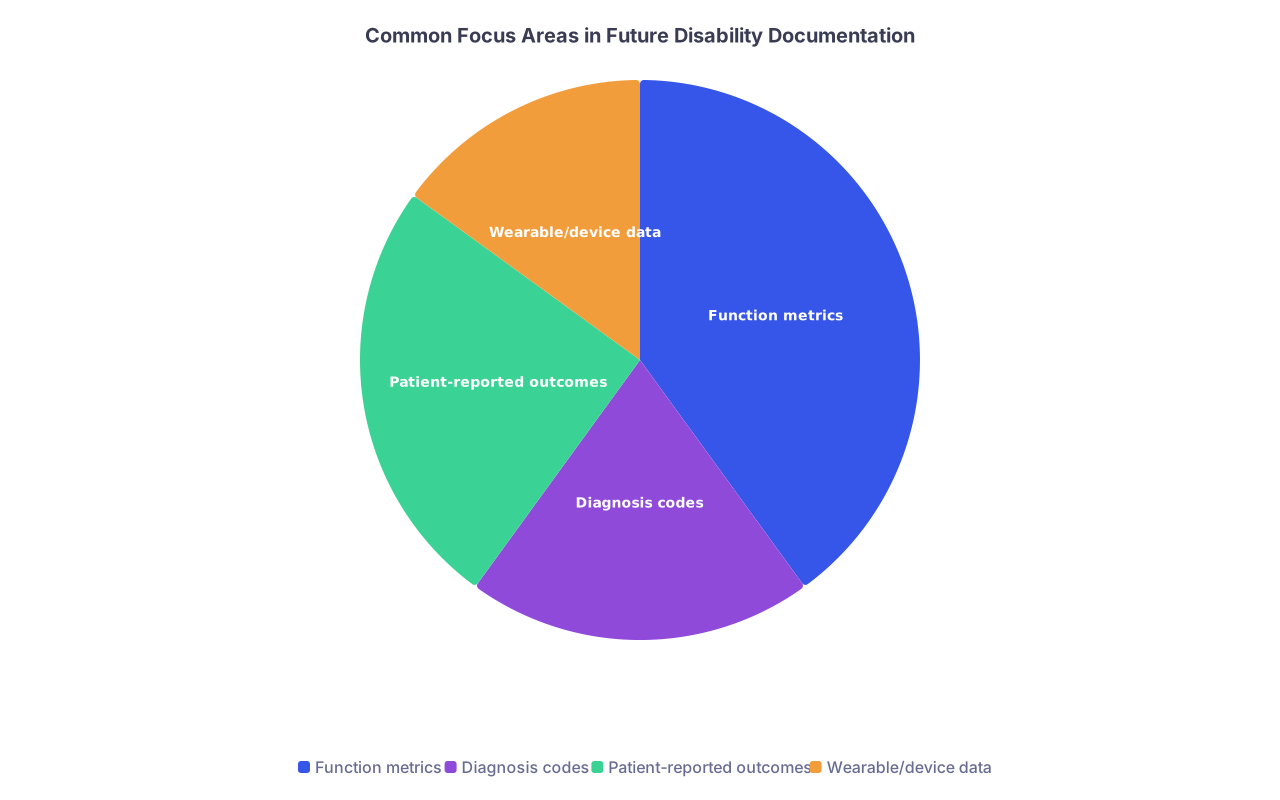
| Category | Value |
|---|---|
| Function metrics | 40 |
| Diagnosis codes | 20 |
| Patient-reported outcomes | 25 |
| Wearable/device data | 15 |
But one thing is not going away:
Decision-makers will still ask, “What can this person reasonably do, and what do they need to participate?” That is the heart of “how specific” your letter should be.
Process Overview: From Request to Letter
Here’s the basic flow most people actually go through:
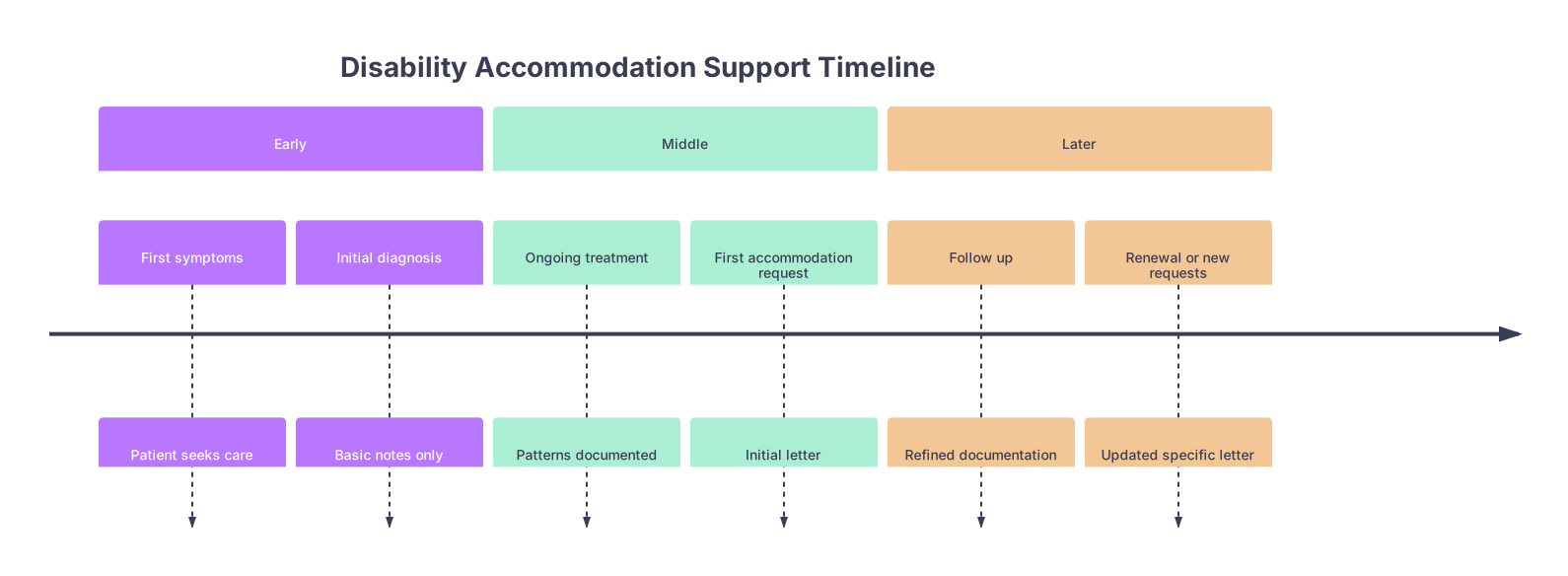
| Period | Event |
|---|---|
| Early - First symptoms | Patient seeks care |
| Early - Initial diagnosis | Basic notes only |
| Middle - Ongoing treatment | Patterns documented |
| Middle - First accommodation request | Initial letter |
| Later - Follow up | Refined documentation |
| Later - Renewal or new requests | Updated specific letter |
If the organization pushes back with “not enough detail,” the answer is usually not “dump your entire chart.” It’s “tighten the description of function and rationale.”
Quick Comparison: Vague vs Effective Letters
| Area | Vague Letter | Effective Letter |
|---|---|---|
| Diagnosis | “Has medical issues.” | “Chronic migraine disorder diagnosed 2019.” |
| Functional impact | “Has trouble working.” | “Can sit 20–30 min; flares with screens >1 hr.” |
| Accommodations | “Needs support.” | “Remote work 2–3 days/month during flares.” |
| Justification link | None | Clear symptom-to-request connection |
| Privacy | Over/under shares | Shares only what supports accommodations |
Visual: Timeline of Building Support
| Period | Event |
|---|---|
| Early - First symptoms | Patient seeks care |
| Early - Initial diagnosis | Basic notes only |
| Middle - Ongoing treatment | Patterns documented |
| Middle - First accommodation request | Initial letter |
| Later - Follow up | Refined documentation |
| Later - Renewal or new requests | Updated specific letter |
Common Mistakes That Get Letters Rejected
You want to avoid these. I see them constantly:
- Letter never states the diagnosis category at all
- No start date or sense of how long the condition has existed
- Zero functional description (“has depression” and nothing else)
- Accommodation request that’s disconnected from the described limitation
- Physician openly stating they’ve only met you once for this purpose
- Overly advocacy-toned letters that sound more like a character reference than medical documentation
If the person reviewing your file can’t answer, “What is this person’s limitation, and what are they asking for, and why?,” the letter failed. That’s how specific it must be.
Frequently Asked Questions
1. Does my doctor have to name my exact diagnosis?
Not always. For many workplaces and housing situations, a general diagnostic category (“chronic musculoskeletal condition,” “psychiatric disability”) plus clear functional limitations is enough. Standardized testing boards and licensing bodies often do require a named diagnosis and supporting evidence. If you’re not sure, ask the organization what level of detail they require.
2. Can I ask my physician not to mention certain sensitive information?
Yes. You can and should talk about your privacy preferences. Your doctor still has to be honest, but they usually have flexibility in phrasing and how much history they include. They can often describe functional impact instead of graphic details (e.g., “history of trauma-related disorder” rather than describing the trauma itself).
3. Is a single short note enough for exam accommodations?
Almost never. Most exam boards want a comprehensive letter: diagnosis, history, treatment, functional impairment, prior accommodations, and a careful rationale for each requested change (like extra time). A one-paragraph note nearly always leads to delays or denials.
4. What if my doctor thinks accommodations are “overkill”?
Then you have a mismatch between your experience and their perception. You can clarify your symptoms and how they affect real tasks, and you can share the specific criteria the organization uses. If they still refuse to support what you need, you may need a second opinion from another qualified provider who knows your condition better and takes it seriously.
5. How often should disability letters be updated?
That depends on the condition and the organization. Chronic, stable conditions may need updates every 1–3 years. Progressive or variable conditions may require more frequent updates. Many schools and boards specify how recent documentation must be (e.g., within 1–3 years). Check their policy and plan follow-ups with your physician accordingly.
6. Can I see and suggest edits before my doctor finalizes the letter?
You can absolutely ask to review the letter for factual accuracy—dates, spelling, wrong details. But remember, your doctor must keep clinical judgment and honesty. You can say, “This part feels too personal; is there another way to phrase it that still meets their requirements?” Most good clinicians are open to that.
7. What should I bring to my appointment to help my doctor be specific?
Bring: the organization’s documentation guidelines, past accommodation approvals or denials, a short written summary of your day-to-day limitations (with concrete examples), and a list of the specific accommodations you’re requesting. That gives your physician everything they need to write a letter that’s precise, defensible, and actually useful.
Open the last disability letter or note you have (or the email request you’re about to send your doctor) and underline every sentence that talks about diagnosis vs. every sentence that talks about functional limitations and specific accommodations. If function is missing or vague, that’s your first fix—start rewriting your talking points for your next appointment around what you can and cannot reliably do.