The belief that you must have used accommodations in college to get USMLE accommodations is flat‑out wrong.
You can absolutely get accommodations on the USMLE even if you never used (or even requested) them in college, med school, or anywhere else. But you’re going to have to prove your case in a very specific, very evidence‑heavy way.
Let me walk you through how this really works, what you’re up against, and how to stack the deck in your favor.
Short Answer: Yes, You Can – But It’s Harder
Here’s the core rule: USMLE (NBME) doesn’t care about your history of requesting accommodations as much as it cares about your history of impairment and documentation.
They ask two basic questions:
- Do you have a documented disability under the ADA?
- Are the requested accommodations reasonable and necessary to provide equal access?
Prior accommodations are helpful supporting evidence, not a legal requirement.
So:
- Not using accommodations in college does not automatically disqualify you.
- But it does create a credibility problem you have to fix head‑on.
They will look at your file and think: “If this disability is as limiting as claimed, why no prior accommodations?” You need a good, well‑documented answer to that.
How USMLE Thinks About Accommodations (Reality, Not Website-Speak)
USMLE is paranoid about “score inflation” and “unfair advantage.” They approve accommodations when they’re convinced of three things:
- Your diagnosis is real (not vague “I struggle with tests”).
- Your functional limitations are current, measurable, and significant.
- The specific accommodation requested directly addresses those limitations.
They’re not moved by:
- Vibes (“I’ve always been a slow reader”).
- Sympathy.
- Letters that say “this student is great and works hard.”
They want data.
And this is where not having prior accommodations becomes an issue. Prior testing accommodations at school or on standardized exams basically tell them: “Other institutions already vetted this; we’re not the first ones.” Without that, you’re asking them to be the first to buy in. They’ll scrutinize you harder.
The “No Prior Accommodations” Problem – And How To Fix It
If you never used accommodations before, you need to answer one question extremely clearly in your application:
“Why now?”
And “Because the USMLE is high‑stakes” is not enough by itself. Everyone says that.
Here are legitimate, believable explanations that can work when backed with evidence:
- You were only recently properly diagnosed (e.g., adult ADHD, learning disability, visual condition).
- Your symptoms got significantly worse in med school (e.g., new onset depression/anxiety, long COVID, worsening autoimmune disease, concussion, flare of a neuro condition).
- You had stigma, lack of awareness, cultural barriers, or poor access to evaluation before.
- You coped with brute force and overwork in undergrad, but the time pressure and volume on high‑stakes exams has now exposed the limits of compensation.
The explanation alone is not enough. You need to tie that story to hard evidence:
- Neuropsych testing
- Medical records
- Treatment history
- Performance patterns
What Documentation You Actually Need (If You Never Used Accommodations)
Let’s be specific. For most USMLE accommodation requests, your file should have these pillars:
Clear diagnostic evaluation
- For ADHD/LD: comprehensive psychoeducational or neuropsychological evaluation, ideally within the last 3–5 years.
- For psychiatric conditions: detailed letter from a psychiatrist or psychologist, with history, severity, and functional impact.
- For medical/physical/sensory conditions: specialist notes, objective findings, test results, imaging, etc.
Functional impact under test‑like conditions
USMLE cares less about “I have ADHD” and more about:- Slow processing speed scores
- Working memory deficits
- Reading rate way below peers
- Endurance issues, pain, or visual limitations that impair test‑taking
Educational and testing history
Even if you never used accommodations, you still want:- Transcripts with comments about inconsistent performance, withdrawals, or course load changes (if relevant)
- Any pattern: great in untimed work, worse on timed multiple‑choice exams
- Past standardized test scores (SAT, ACT, MCAT, others) that show a dip on timed sections
Explanation of no prior accommodations
This is where you or your clinician spells it out. Example:- “Student grew up in a culture where mental health and learning differences were heavily stigmatized. They avoided seeking help despite struggles.”
- “Symptoms were mild earlier; student could compensate with extended study time and lower‑stakes exams. The pace and volume of medical training have unmasked deficits.”
If your clinician letter just says “Student has ADHD, please grant time and a half,” expect a denial. They need to build the full argument.
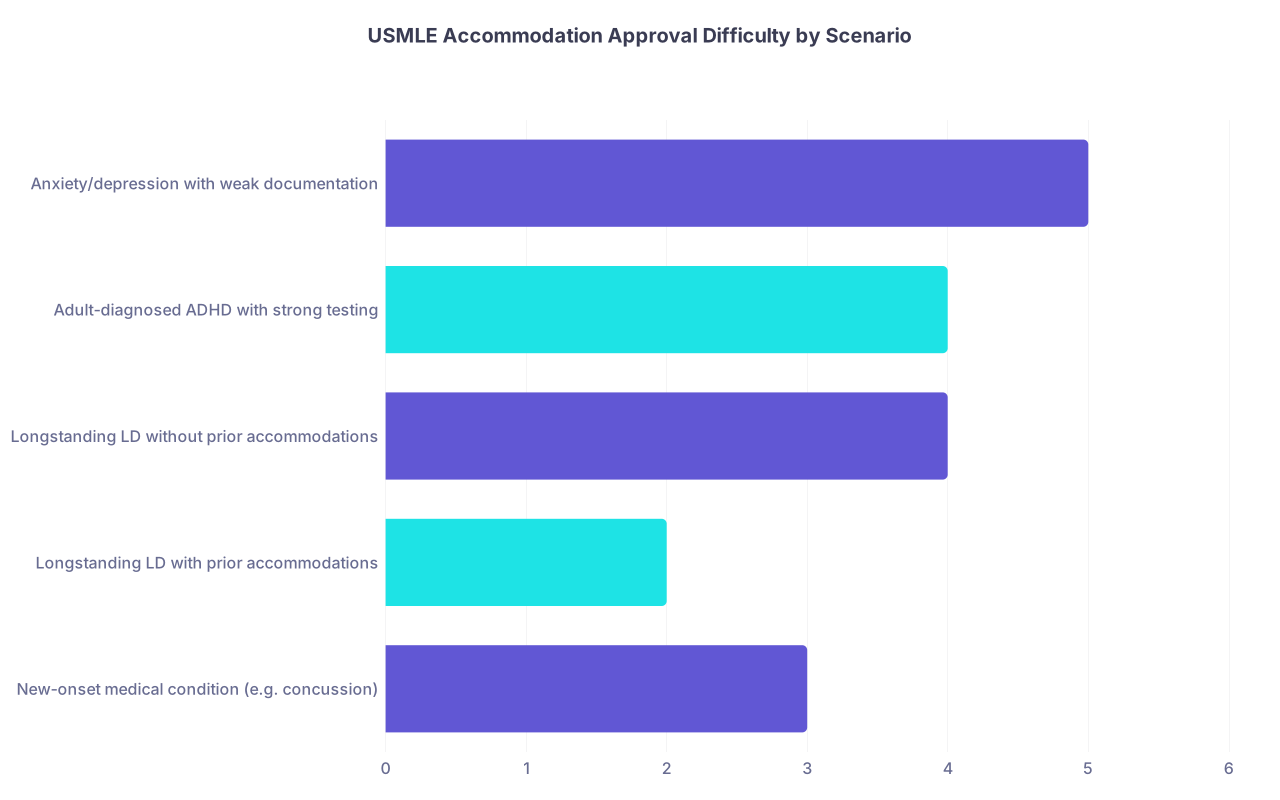
Common Disability Categories – And How “No Prior Accommodations” Plays Out
| Category | Value |
|---|---|
| New-onset medical condition (e.g. concussion) | 3 |
| Longstanding LD with prior accommodations | 2 |
| Longstanding LD without prior accommodations | 4 |
| Adult-diagnosed ADHD with strong testing | 4 |
| Anxiety/depression with weak documentation | 5 |
(Scale 1 = easier, 5 = much harder; this is based on typical patterns, not guarantees.)
Learning Disabilities (LD) and ADHD
This is where lack of history matters the most.
USMLE expects:
- A childhood onset history.
- School struggles that match the diagnosis.
- Ideally some prior accommodations in high school, college, or standardized testing.
If you show up at 26 with your first LD/ADHD diagnosis and zero record of prior issues, they’ll suspect over‑diagnosis or “diagnosis for convenience.”
To make this work, you need:
- Strong, high‑quality neuropsych testing (not just a 1–2 page note).
- Collateral history: old report cards, teacher comments, parent statements.
- Clear demonstration of deficits compared to population norms.
Can they still approve you without prior accommodations? Yes. I’ve seen it happen. But the documentation had to be bulletproof and very detailed.
Psychiatric Conditions (Anxiety, Depression, PTSD, etc.)
For purely psychiatric requests (e.g., extra break time, reduced distractions), USMLE tends to be more skeptical without:
- Longitudinal treatment history (therapy, meds, follow‑ups).
- Evidence that symptoms are persistent and impairing, not just “I’m stressed about Step 1.”
If symptoms really worsened only recently (e.g., during clerkships), that’s explainable:
- Show a clear timeline in medical records.
- Tie symptoms to functional impairment (panic during exams, physical manifestations, inability to complete blocks).
Again, the issue isn’t that you didn’t use accommodations before; it’s that they want to distinguish real ongoing disability from normal high‑stakes exam anxiety.
Medical/Physical Conditions
Here, prior accommodations matter less.
Examples:
- New vision problem.
- Chronic pain that worsened in med school.
- Seizure disorder, migraine, GI disease, POTS, long COVID.
For these, USMLE cares most about:
- Objective evidence (lab/imaging, specialist notes).
- Stability of condition.
- Clear rationale tying the requested accommodation (e.g., extra breaks, separate room, ergonomic seating) to the impairment.
Lots of applicants never needed accommodations before because the condition is new or now worse. That’s acceptable when your documentation is solid.
What To Say About Not Using College Accommodations
Let’s be concrete. You (or your clinician) should directly address this in the narrative.
Bad explanation:
- “I didn’t know I could ask for accommodations.”
USMLE will internally think: you made it through college and med school without them, so why are they necessary now?
Better, specific explanations:
- “Student was evaluated in high school but denied accommodations, and family decided to ‘just work harder.’ They avoided services in college due to stigma and fear of records affecting future career.”
- “Symptoms were milder in college; student could manage with extra out‑of‑class study time. The block‑based, dense exam schedule in medical school revealed deficits in timed test conditions that were not previously apparent.”
- “Student came from a low‑resource background; there was no access to formal testing. Diagnosis was only made once they had access to comprehensive evaluation in medical school.”
Then link that to evidence. Always.
How To Structure a Strong USMLE Accommodation Request (Step‑By‑Step)
Here’s the practical framework I’d actually use with someone in your position:

| Step | Description |
|---|---|
| Step 1 | Recognize need on exams |
| Step 2 | Collect prior records |
| Step 3 | Get updated eval or specialist note |
| Step 4 | Clarify diagnosis and functional limits |
| Step 5 | Draft explanation of no prior accommodations |
| Step 6 | Select specific accommodations needed |
| Step 7 | Complete USMLE forms and attach evidence |
| Step 8 | Submit early before desired exam window |
| Step 9 | If denied, review reasons and appeal |
Collect what you already have
Old report cards, MCAT score reports, prior evaluations, medical notes, therapist notes. Anything that shows a pattern.Get an updated, high‑quality evaluation
- Don’t use a quick, one‑page “screening.”
- For cognitive/learning issues, get a full battery from someone who regularly writes reports for standardized test accommodations.
- For medical/psychiatric conditions, see a specialist who understands functional limitations, not just diagnosis codes.
Clarify your story in writing
Draft a personal statement (short, 1–2 pages) that answers:- What do you struggle with specifically on exams?
- How has this shown up over time?
- Why didn’t you seek/receive accommodations before?
- Why are they necessary now?
This isn’t about emotion. It’s about coherence and credibility.
Ask your clinician to align with USMLE standards
Hand them the USMLE disability guidelines and forms. Many clinicians write nice, heartfelt letters that are completely useless for USMLE. They need to include:- Specific tests and scores (for LD/ADHD).
- Observable functional impairments.
- Direct link between impairment and requested accommodation.
Request only what you genuinely need
Over‑asking (“I want double time, stop‑the‑clock breaks, and a private room”) without strong justification can sink your application. Tight, targeted requests are more believable.
Typical Outcomes If You Didn’t Use College Accommodations
Let’s be honest about the patterns I’ve seen:
Well‑documented medical condition, no prior accommodations
Frequently approved, especially for things like breaks, small room, or ergonomic modifications.Recent, high‑quality LD/ADHD evaluation, no prior accommodations, strong history of struggles
Tough but definitely winnable. Expect probing and maybe an initial denial with chance to appeal.Thin documentation, generic ADHD/anxiety note, no prior accommodations, strong academic record
Often denied. The file screams “I’m anxious about Step 1,” not “I have a documented disability.”
USMLE vs. Your Med School: Don’t Confuse the Two
Your med school disability office might grant accommodations far more easily than USMLE. They know you, they see you in person, they can be more flexible.
USMLE is anonymous, rigid, and frankly skeptical.
So even if you get accommodations in med school first, that doesn’t guarantee USMLE will follow. But it can help:
- It shows recent use of accommodations.
- It creates a paper trail: diagnosis, implementation, observed benefit.
If you haven’t yet, consider going through your school’s disability office now. It can strengthen your future USMLE file, even if your USMLE application is months away.
Quick Comparison: Prior vs No Prior Accommodations
| Scenario | Overall Difficulty | Key Risk |
|---|---|---|
| Prior accommodations + strong testing | Lower | Over-requesting |
| Prior accommodations + weak documentation | Moderate | Insufficient detail |
| No prior + strong, recent eval | Moderate–High | Credibility gap |
| No prior + thin documentation | Very High | Likely denial |
| New medical condition, strong records | Moderate | Linking to request |
Bottom Line
You do not lose the right to USMLE accommodations just because you didn’t use them in college.
But if you’re applying with no prior accommodation history, you must:
- Be honest and specific about why you didn’t use them before.
- Back your story with serious, objective documentation.
- Show clear, current functional impairment in test‑like conditions.
- Request accommodations that are tightly matched to those impairments.
If you try to wing it with a brief “doctor’s note” and a vague claim of being a “slow test taker,” you’re almost certainly getting denied.
If you treat this like a legal‑level brief—carefully assembled evidence, consistent story, targeted request—you give yourself a real shot.
FAQ (Exactly 5 Questions)
1. Will USMLE automatically deny my request if I never had SAT/ACT/MCAT accommodations?
No. They do not have a rule that prior standardized test accommodations are required. But prior accommodations make their job easier, so without them, they look harder at your documentation and history. You just need stronger, more detailed evidence to compensate.
2. Can I get accommodations if I was just diagnosed with ADHD in medical school?
Yes, that’s possible. You’ll need a comprehensive neuropsychological evaluation, clear evidence of childhood‑onset symptoms (even if undiagnosed), and a credible explanation for why the diagnosis and accommodations are happening only now (e.g., resource limitations, stigma, compensating in earlier education). Many such requests are denied when documentation is superficial, so invest in a proper evaluation.
3. My therapist says I have test anxiety. Is that enough for extra time?
Almost never. USMLE rarely grants extra time purely for “test anxiety.” They want to see a diagnosed anxiety disorder, long‑term treatment records, and clear evidence that under standard conditions your symptoms substantially limit major life activities. Extra breaks or a reduced‑distraction environment are sometimes more realistic than extended time.
4. Should I apply for accommodations through my med school first, before USMLE?
If you have time, yes, it often helps. Getting school accommodations creates a recent, formal record that your disability impacts your education and that accommodations are considered necessary. It’s not required, and USMLE won’t automatically mirror what your school does, but it can strengthen your narrative and documentation.
5. What’s the single most important thing I can do today to help a future USMLE accommodation request?
Schedule a proper evaluation with someone who routinely writes reports for board or standardized test accommodations (neuropsychologist, psychiatrist, or relevant specialist). Ask them directly: “I may apply for USMLE accommodations. Can you evaluate and document me in a way that meets those standards?” Then start gathering old records now.
Open a blank document today and outline your “Why now?” story and your specific exam‑day struggles. That’s the backbone your evaluator and your USMLE application both need.