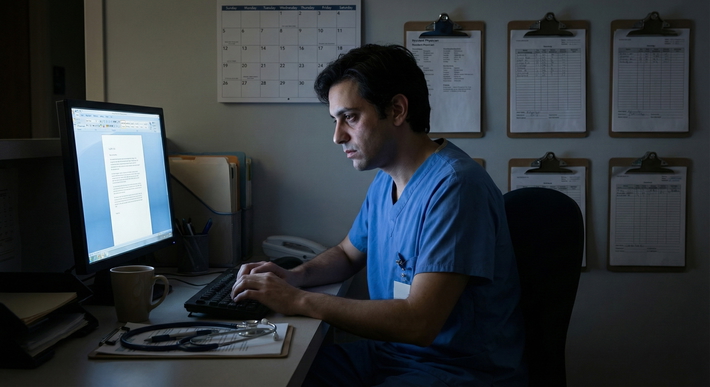
It’s 8:30 pm. You just hit “submit” on your disability documentation upload for your med school or residency program. Your neuropsych eval, your diagnosis, maybe therapy letters—your entire story. And now you’re staring at the screen thinking:
“Who exactly is about to read all of this? Will my clerkship director see my psych diagnosis? Will my PD know about my ADHD meds? Is this going to follow me into fellowship?”
You’re not wrong to ask. Most schools and programs are terrible at clearly explaining who sees what. So let’s clean that up.
Here’s the answer you’re looking for: in a well-run medical training institution, very few people see your actual disability records, and the people directly supervising you usually see only your accommodations, not your diagnosis or documentation. But there are important exceptions, and some programs blur boundaries more than they should.
I’ll walk you through the usual structure, the specific roles, the legal lines, and the red flags.
The Core Rule: Documentation vs. Accommodation
Start with this distinction:
Disability records = your paperwork
Diagnoses, evals, letters from clinicians, test reports, prior IEP/504, med lists if included, etc.Accommodation information = what changes you’re granted
Extra time, quiet room, modified call, accessible housing, assistive tech, note-taking support, etc.
Good institutions treat these as two completely different layers.
Your records are tightly held. Your accommodations are shared on a need-to-know basis.
If a school or program can’t explain that separation clearly, that’s a warning sign.
Who Actually Sees Your Disability Records?
Let’s be blunt: in a properly set up system, the only people who should see your full disability documentation are:
- Disability / Accessibility Services Office (DSO) staff
- Sometimes, a central student affairs or learner affairs dean who co-manages accommodations policies
- Very rarely, legal/compliance staff if something becomes a dispute or investigation
That’s it. Not your clerkship director. Not the residency program director. Not your faculty advisor. Not your chief resident. Not the dean writing your MSPE (unless they also run disability services, which is increasingly rare and frankly not ideal).
Here’s how that usually breaks down.
1. Disability/Accessibility Services Staff
This is your primary gatekeeper.
They:
- Receive and store your documentation
- Decide if you qualify as having a disability under ADA/Section 504
- Determine what accommodations are reasonable
- Communicate those accommodations forward to relevant academic or clinical leaders, without disclosing diagnosis unless absolutely necessary
They do see everything you upload. That’s their job. In most systems, they’re bound by:
- FERPA (if you’re a student)
- Internal confidentiality policies
- Professional standards (many have counseling, rehab, or education backgrounds)
If you’re worried about anyone, it shouldn’t be them. If disability services is doing their job, they are your firewall.
2. Certain Deans or Student Affairs Leaders (Sometimes)
This varies.
At some medical schools:
- The DSO is central (serves the entire university), and med school deans only see generic accommodation approvals like “student is approved for disability-related academic adjustments.”
- At others, there’s a med-school-specific ombudsperson or “Associate Dean for Student Support” who co-signs on clinical accommodations and may review documentation.
Do they always see your full psych report? Not necessarily. Sometimes they just see:
- A summary from DSO: “Meets criteria as a student with a disability; accommodations recommended: X, Y, Z.”
You’re allowed to ask:
- “Who, by role, has access to the full documentation I’m submitting?”
- “Do any deans or program directors see my diagnostic reports, or just the accommodations?”
If they dance around that question, push for a direct answer.
3. Legal / Compliance / Risk Management (If There’s a Dispute)
If you:
- File a formal grievance, or
- File with OCR (Office for Civil Rights), or
- Threaten or bring legal action,
then your disability records may be reviewed by:
- University counsel
- Compliance / risk management
- Equal opportunity / Title IX-type offices
They’re stuck playing defense for the institution. They are not part of your day-to-day training.
Outside these roles, nobody else should be routinely reading your actual documentation.
Who Sees Your Accommodation Information?
Whole different group. They generally do not see your diagnosis, only the functional impacts and approved adjustments.
Here’s who typically sees accommodation information (not full records).
| Role | Sees Documentation? | Sees Accommodations? |
|---|---|---|
| Disability Services Staff | Yes | Yes |
| Student Affairs Dean | Sometimes summary | Yes |
| Course/Clerkship Director | No | Yes, if relevant |
| Residency Program Director | Rarely, if at all | Sometimes, if needed |
| Attendings/Preceptors | No | Minimal, if needed |
| Exam/Testing Coordinators | No | Yes |
Let’s unpack those.
Course Directors and Clerkship Directors (Medical School)
They’ll often see something like:
- “Student approved for extended test time”
- “Student may need to type exams on a laptop”
- “Student permitted to take short breaks during long assessments”
- “Student excused from back-to-back overnight calls; schedule adjustments required”
They should not see:
- Your psych dx
- Your full neuropsych report
- Your medication list
- Your therapy notes
Do some schools violate this? Yes. Sometimes by ignorance, sometimes by sloppiness. I’ve seen clerkship directors CC’d on emails that include way too much medical detail. That’s not best practice, and it’s challengeable.
Program Directors (Residency)
This is where people get nervous, especially with visible or schedule-impacting accommodations.
Two main scenarios:
USMLE/board exam accommodations before residency
- PDs and GME leadership might be aware you sat with accommodations (e.g., extended time, separate room) if you tell them or if there’s scheduling impact for in-training exams.
- They do not automatically get your disability records from NBME/USMLE.
Workplace / scheduling accommodations during residency
- Night float modifications, reduced call, extra clinic support, leave related to disability, ergonomic changes, etc.
- PD and maybe chief residents will know what adjustments they have to make. They don’t inherently need to know your label, just the constraints.
You’re allowed to say:
- “I’m requesting these work-related accommodations because of a health condition. I’ve coordinated documentation through GME/Employee Health/Disability Services.”
You don’t owe your PD your DSM code.
Special Cases: When Diagnosis Might Be Explicitly Known
There are a few situations where someone beyond disability services might know or infer your disability.
1. If You Voluntarily Disclose
You tell your PD, your attending, a dean, or your classmates:
- “I have ADHD.”
- “I’m blind in one eye.”
- “I’m undergoing chemo.”
Once you’ve shared it, they know. Disabled students sometimes share to build trust or seek informal support. Just be intentional about why and with whom.
2. Safety-Critical or Infection-Control Situations
If your disability or condition:
- Has significant implications for patient safety and cannot be reasonably accommodated quietly, or
- Involves communicable disease with specific duty restrictions,
then occupational health or risk management may be involved, and sometimes key leaders are briefed more specifically.
That still doesn’t mean every attending on your schedule gets your entire chart. They should only get the level of detail needed to protect patients and keep you safe at work.
3. Very Small Programs or Combined Roles
In some smaller institutions:
- The “disability contact” is also a dean or sometimes the PD in a small residency. This is not ideal but it exists.
- In that case, yes, the same human wearing multiple hats may see your documentation.
If that’s your situation, you should:
- Ask concretely: “When you’re acting in your disability-services role, how is my documentation kept separate from your evaluation of my academic performance?”
If their answer is “uhhh,” you have a problem.
Digital Systems, FERPA, and Privacy Reality Check
Let’s ground this.
Your records live in one or more of these:
- The university disability office database
- A secure drive / EMR-like student health system
- Sometimes a GME/HR-like system for employee-side accommodations in residency
These are protected records. For students, FERPA governs educational records. For residents, it gets fuzzy: you’re both learner and employee, so ADA and employment law matter too.
You should expect:
- Documentation is not casually accessible to random admins
- Faculty logins to LMS/gradebooks don’t show your diagnosis
- Accommodation notices are phrased functionally (“may record lectures,” “needs front-row seating,” “requires step-free access”) rather than medically
You should not assume:
- Perfection. Humans gossip. Emails get forwarded.
- That no one will ever infer your condition from the pattern of accommodations.
If you’re asking, “Will people figure something out about me?” the honest answer is: maybe. But that’s different from your full documentation being visible to half the department.
Red Flags and How to Push Back
Some things are just wrong:
- A clerkship director asking to see your full neuropsych report “to understand you better.”
- A PD insisting you tell them your exact diagnosis as a condition for honoring accommodations already approved by the institution.
- Disability documentation stored in your standard academic file or evaluation system.
- Your diagnosis being mentioned in dean’s letters or performance evaluations without your explicit, informed consent.
If you see this, you have options:
- Ask disability services: “Is this consistent with your policies? Who is allowed to see what?”
- Put things in writing: “For clarity, my understanding is that my documentation is confidential to disability services and not part of my academic file. Please confirm.”
- If needed, escalate to:
- University ADA/504 coordinator
- Office for Equity or Compliance
- External: Office for Civil Rights (OCR)
Practical Steps: How to Get Clarity at Your Institution
Do this before you dump your whole life story into a portal.
Ask directly (email or meeting):
- “Who, by role, will have access to my disability documentation?”
- “Who will receive information about my accommodations, and what exactly will they be told?”
- “Is my diagnosis disclosed to faculty or program leadership?”
Request examples:
- “Show me a redacted sample of what a clerkship director or PD receives when I’m granted accommodations.”
Negotiate the minimum necessary disclosure:
- “I’m fine with them knowing I have approved accommodations; I’m not OK with diagnosis disclosure unless legally necessary. Can you confirm that boundary?”
Keep your own records:
- Save all accommodation letters and emails.
- Document any breaches or weird questions.
You’re not annoying for asking this. You’re doing what a responsible physician-in-training should do: understanding privacy, risk, and systems.
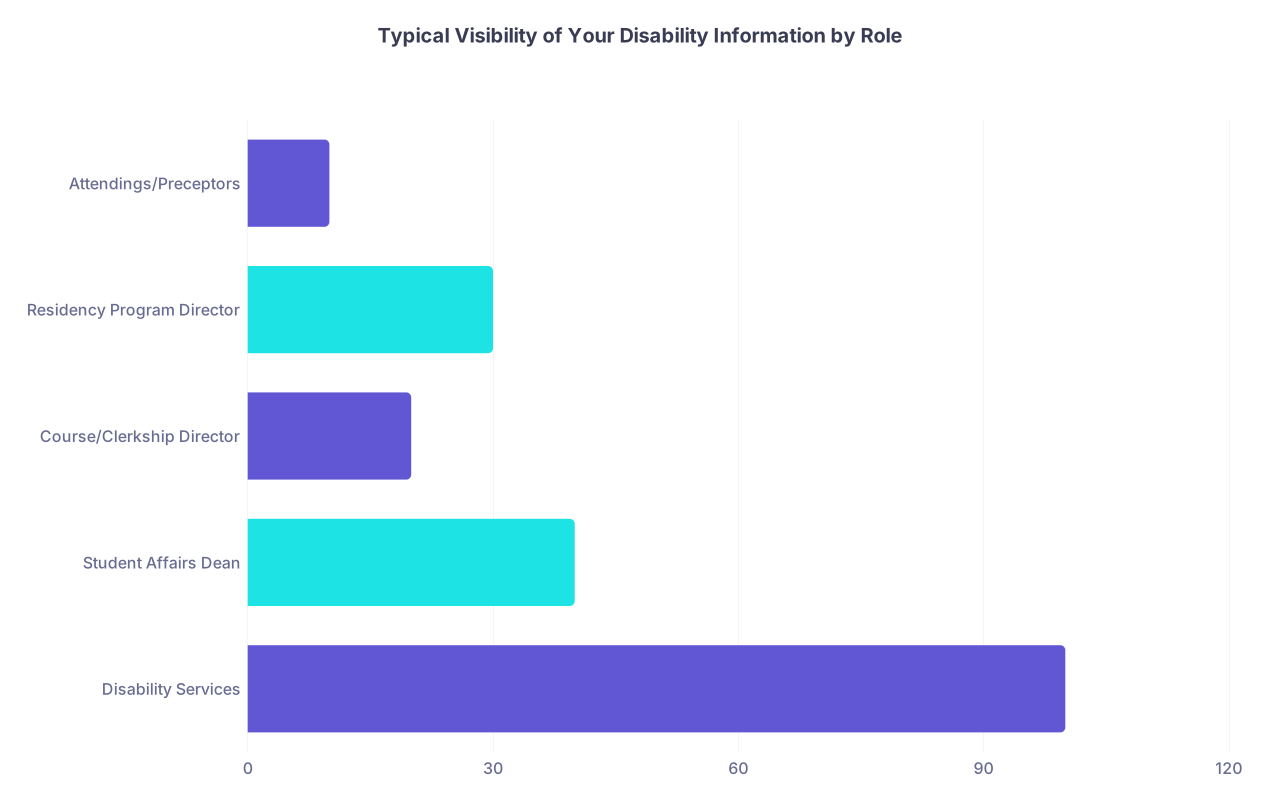
| Category | Value |
|---|---|
| Disability Services | 100 |
| Student Affairs Dean | 40 |
| Course/Clerkship Director | 20 |
| Residency Program Director | 30 |
| Attendings/Preceptors | 10 |
How This Might Evolve: Future of Disability Privacy in Medicine
We’re in a transition era.
On one side:
- Legacy culture: “If you want help, you have to tell everyone everything, and we’ll decide if we feel generous.”
- Informal deals: “Just talk to your PD, we’ll work something out but nothing formal.”
On the other:
- Modern approach: centralized disability offices, clear ADA frameworks, minimal disclosure, formal processes.
Where it’s heading:
- More centralized, firewall-style models where documentation stays in one office, and everyone else just gets accommodation instructions.
- Cleaner separation between evaluation (grades, ACGME milestones) and support (accommodations, wellness, mental health).
- More standardized language in clinical training: “This learner has approved accommodations from our central office; here’s what you must implement.”
You’re early in that shift. You will still run into faculty who think:
- “If I don’t know the diagnosis, how can I judge competence?”
Answer: you don’t need the diagnosis to judge whether someone is meeting the same performance standards with reasonable supports. That’s the entire point of accommodations.

| Step | Description |
|---|---|
| Step 1 | You submit documentation |
| Step 2 | Disability Services |
| Step 3 | No disability record shared |
| Step 4 | Accommodations decided |
| Step 5 | Student Affairs Dean |
| Step 6 | Course or Clerkship Director |
| Step 7 | Residency PD or Coordinator |
| Step 8 | Implementation support |
| Step 9 | Schedule or exam changes |
| Step 10 | Workplace adjustments |
| Step 11 | Qualifies? |
FAQs: Who Sees My Disability Records in Medical Training?
Will my attending physicians know I have a disability?
Usually no. Most attendings do not get a list that says “this resident/student is disabled.” They might notice practical things—like you not taking overnight call or taking extra time on in-service exams—but they typically aren’t told your diagnosis or even officially that you have accommodations unless that knowledge is essential for logistics or safety.Will my residency program director see my actual documentation?
In a good system, no. Your PD might know you have approved accommodations and what they are (e.g., schedule changes, ergonomic equipment), especially if they affect staffing or call schedules. They shouldn’t be reading your psych eval or neuropsych report. Those stay with disability services, GME disability office, or employee health.Does my disability show up in my MSPE or dean’s letter?
It should not, unless you explicitly choose to disclose it and work with a dean to frame it in a particular way (for example, as part of a narrative about advocacy or resilience). Disability-related leaves, delayed graduations, or modified pathways might be described neutrally (“extended curriculum”), but the underlying diagnosis is usually not spelled out. If you’re worried, ask to review exactly how any delays or leaves will be described.Do licensing boards (state boards) see my school disability records?
No, they do not automatically receive your school’s disability documentation. They may ask you health or impairment-related questions on licensure applications, but that’s a separate process. Whether and how you answer those is a legal/ethical issue and sometimes worth discussing with a lawyer or trusted mentor who knows your state’s board culture.If I get testing accommodations on USMLE, do residency programs find out?
USMLE and NBME do not broadcast your accommodations to programs. Your score report does not list “extended time” or similar. However, if you need similar accommodations for in-training exams or board prep, you may need to work with your program or GME office, and then PDs may know you’re testing with adjustments. That still doesn’t mean they see your diagnostic paperwork.Can I keep my diagnosis completely private but still get accommodations?
You must share enough documentation with disability services (or the relevant office) to justify accommodations under law. But beyond that office, yes, you can and should limit who knows your actual diagnosis. You can often phrase things to others as “I have approved accommodations through the university/GME; here’s what’s been authorized,” without naming the condition.What should I do today if I’m about to submit records and I’m worried about who will see them?
Email or meet with your disability services office and literally ask: “Before I submit, please confirm who, by role, has access to my full documentation and who will only see accommodation information. Also, can I see a redacted example of what faculty or PDs receive?” Do that first, in writing. Then decide what to submit, and keep copies of everything you send.
Here’s your next concrete step:
Open your email right now and send one message to your school’s or hospital’s disability/learner support office asking, in plain language, who sees your documentation and what exactly faculty and PDs are told. Get that answer in writing before you upload another page.