Mental health conditions absolutely can qualify you for exam and residency accommodations—and a lot of people are not getting support they’re legally entitled to.
If you take nothing else from this: anxiety, depression, ADHD, PTSD, bipolar disorder and other psychiatric diagnoses are squarely within the definition of disability under U.S. law (and many other countries’ laws) when they substantially limit key life activities like concentrating, sleeping, thinking, or regulating emotions. That means they can be the basis for accommodations on:
- High‑stakes exams (USMLE, COMLEX, in‑training exams, board certifying exams)
- Medical school and residency rotations
- Call schedules and duty hours
- Licensing processes
Let’s walk through how this actually works in medicine, what’s realistic, and where people get burned.
1. Yes, mental health conditions are disabilities under the law
You do not need a wheelchair or a white cane to “count” as disabled.
Under the Americans with Disabilities Act (ADA) and similar laws elsewhere, a disability is a physical or mental impairment that substantially limits one or more major life activities. Major life activities explicitly include:
- Concentrating
- Thinking
- Learning
- Communicating
- Sleeping
- Working
- Caring for oneself
Serious mental health diagnoses very often impair at least one of those. That’s why conditions like:
- Generalized anxiety disorder
- Major depressive disorder
- ADHD
- PTSD
- Bipolar disorder
- OCD
- Panic disorder
- Eating disorders
- Autism spectrum disorder (yes, often classified as neurodevelopmental, but functionally similar in the accommodation world)
are routinely recognized as disabilities for exam and training supports—if they’re properly documented.
The limiting factor is almost never “is this a real condition?” The limiting factors are:
- Is the documentation strong and specific enough?
- Is the requested accommodation clearly tied to functional limitations?
- Does the accommodation maintain essential standards and patient safety?
If those are handled well, mental health–based accommodations are absolutely on the table.
2. What kinds of supports are actually granted?
Let’s get concrete. Here’s what I’ve seen granted repeatedly for medical students and residents with mental health conditions (when well‑documented).
For exams (USMLE, COMLEX, in‑training, specialty boards)
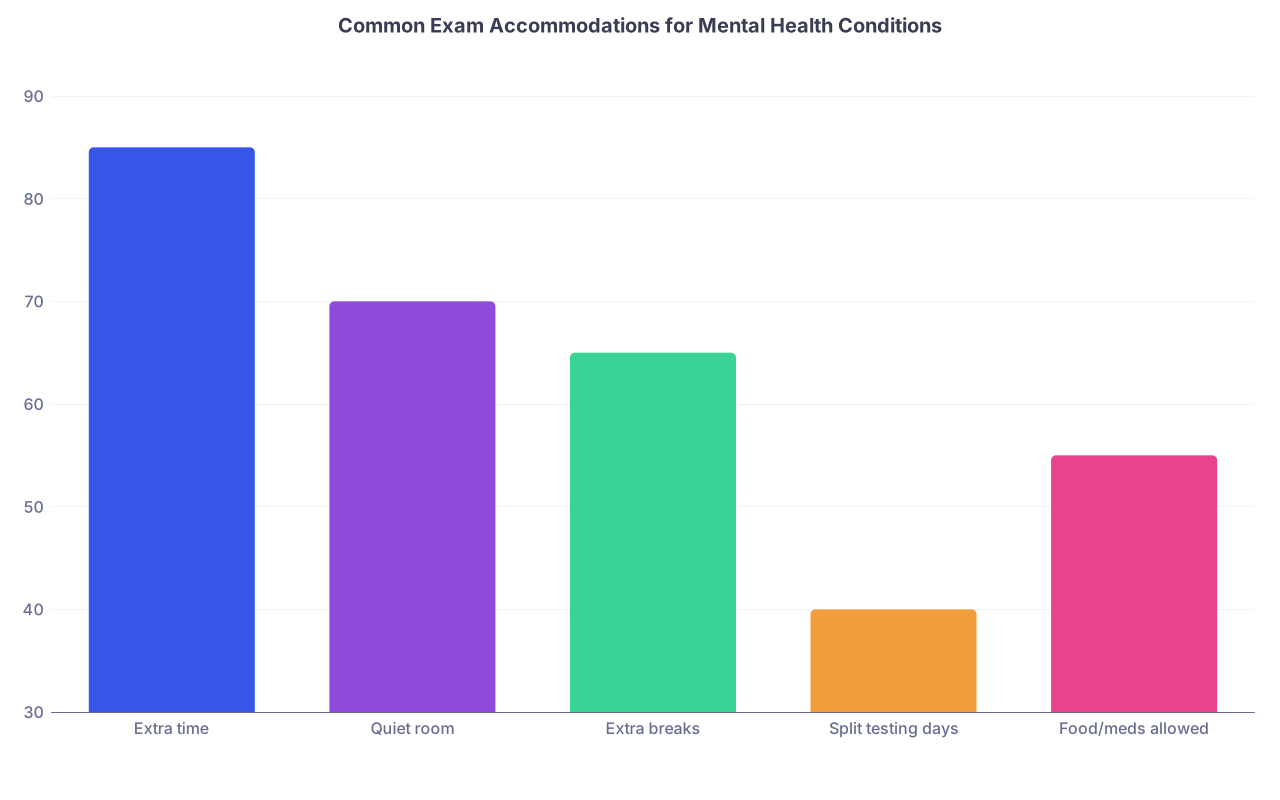
Common exam accommodations for mental health conditions include:
- Extra time (often 50% more; 100% is harder but possible in more severe cases)
- Testing in a reduced‑distraction or private room
- Permission for breaks as needed (for panic/anxiety, PTSD, GI issues from meds)
- Ability to take food, drink, or medication into the room
- Use of noise‑canceling headphones or earplugs
- Separate testing over more days (e.g., Step 2 spread across multiple days)
High‑stakes exams are bureaucratic and conservative. They want:
- Longitudinal documentation (not “diagnosed last week” unless clearly severe)
- Testing data (neuropsych, standardized scales) where appropriate
- Clear history: specific examples of symptoms impacting academic functioning
- Evidence that accommodations have been used before (and helped)
| Category | Value |
|---|---|
| Extra time | 85 |
| Quiet room | 70 |
| Extra breaks | 65 |
| Split testing days | 40 |
| Food/meds allowed | 55 |
Numbers are approximate based on patterns I’ve seen in med/grad students. Extra time and distraction‑reduced settings are the workhorses.
For medical school and residency training
On the training side, accommodations are a different beast. You’re not just sitting in a testing cubicle; you’re in a clinical system with scheduling, safety issues, and team dynamics.
Typical supports that can be granted:
- Adjusted call patterns
- Limiting consecutive overnight calls
- Adding guaranteed recovery days after call
- Schedule modifications
- Avoiding certain shift times (e.g., permanent nights) when justifiable
- Reduced clinical load in acute treatment phases, with clear review dates
- Protected therapy/psychiatry time
- Regular half‑day per week that is genuinely protected
- Environmental supports
- Quieter workspace for documentation
- Permission to use specific apps or tools for organization and reminders
- Communication and supervision structures
- More structured feedback schedule
- Clear written expectations, checklists, and task lists
- Option to meet more frequently with a supervising resident/attending
Key point: accommodations must not remove essential functions of the role. You cannot, for example, demand “never do nights” in a specialty where nights/overnights are a core, essential part of training—unless your program can still certify you meet requirements another way.
Program directors usually ask a core question: Can we still honestly say this person meets the competencies and is safe for independent practice if we grant this accommodation? Your requested supports need to respect that.
3. Who decides and how does the process actually work?
This part confuses almost everyone.
For national exams (USMLE, COMLEX, boards)
The exam body (NBME, NBOME, ABIM, etc.) makes the decision. Not your school. Not your program. Not your therapist.
The process is usually:
You submit:
- A formal application for accommodations
- A detailed personal statement of functional limitations
- Supporting clinical documentation (often a psychiatrist or psychologist letter)
- Prior testing and school accommodation records if available
Their committee reviews:
- Diagnosis and history
- How the condition impacts test‑taking specifically
- Consistency of your case (no glaring contradictions)
They either:
- Approve the request as‑is
- Partially approve (e.g., quiet room but less extra time)
- Deny and suggest what’s missing
You can appeal denials, but you need better documentation, not just indignation.
For medical school and residency
Different structure here:
- Medical school: usually handled by the university’s disability services or an equivalent office. They’re used to ADA law and often pretty reasonable when given solid documentation.
- Residency: more messy. Typically involves:
- Institution disability/ADA office
- GME office
- Program director
- Possibly legal/risk management for complex cases
Here’s the important nuance:
You are supposed to go through the institutional disability office, not just ask your PD informally to “go easy on you” because of anxiety or depression. The formal route gives you rights and a paper trail. The informal route mostly just relies on goodwill and memory—and can vanish the moment leadership changes or you annoy someone.

| Step | Description |
|---|---|
| Step 1 | Resident identifies need |
| Step 2 | Contact disability office |
| Step 3 | Submit documentation |
| Step 4 | Interactive meeting |
| Step 5 | Proposed accommodations |
| Step 6 | PD and GME review |
| Step 7 | Approved plan implemented |
| Step 8 | Periodic reassessment |
4. Documentation: what actually gets you approved (and what doesn’t)
This is where most people get sabotaged—not by malice, but by weak paperwork.
A strong accommodation packet for mental health includes:
Clear diagnosis
- DSM‑5 diagnosis, made by a qualified provider (psychiatrist, psychologist, sometimes experienced PCP)
- How long you’ve had symptoms, treatment history, course over time
Functional impact
Not “they are depressed,” but:- “Depression causes significant difficulty sustaining concentration for longer than X minutes”
- “Under stress, they experience panic attacks with shortness of breath, palpitations, and derealization, typically requiring them to leave the room for 10–20 minutes”
- “Sleep disruption leads to cognitive slowing and impaired working memory, especially during multi‑hour, uninterrupted tasks”
Link to requested accommodation
Example:- Limitation: Slowed reading speed and working memory under anxiety.
- Request: 50% extended time and reduced‑distraction room.
- Rationale: Extra time offsets slower cognitive processing; quiet room reduces stimuli that worsen anxiety and intrusive thoughts.
History of accommodations or academic impact
- Prior IEP/504 plan, college testing accommodations, MCAT accommodations
- Or, if no prior formal supports, concrete academic history: course failures, exam repeats, remediation clearly attributable to symptoms
Vague one‑paragraph “to whom it may concern, this resident has anxiety and would benefit from accommodations” letters usually go nowhere.
If you’re prepping documentation, tell your clinician plainly:
“I need a letter that describes my functional limitations for high‑stakes exams / residency duties and explains exactly why these specific accommodations are medically necessary.”
If they look uncertain, they may not be the right person to write it.
5. Special issues in residency: safety, stigma, and “fitness for duty”
Residency is where things get dicey. You are now taking care of real patients, often in borderline‑unsafe systems, with supervisors under pressure.
Here are the real-world tensions:
- Programs must ensure patient safety and accrediting body requirements. They will not agree to anything that looks like it compromises those, at least on paper.
- There is still massive stigma. Despite all the mental health talk, residents still whisper, “Do not tell them you’re on meds; they’ll think you can’t handle it.” I’ve heard attendings say, “If they can’t work nights, how will they function in practice?”
- Illness vs. incompetence lines get blurred. A struggling resident might be framed as “unprofessional” rather than “disabled and needing accommodation.” Once that narrative sets in, it’s hard to unwind.
So what is realistic?
You can often get:
- Protected appointment time when framed correctly (“weekly medical appointment, under ADA”)
- Thoughtful redistribution of shifts within the legal duty-hour framework
- Temporary intensity reduction during an acute episode, with a documented plan to reassess
You probably cannot get:
- Permanent, total exemption from entire core parts of your specialty (e.g., no emergencies, no nights forever in EM or surgery)
- Complete control over your schedule at the expense of everyone else, without tradeoffs
| Request Type | More Realistic | Unlikely to Be Approved |
|---|---|---|
| Nights/Call | Limit consecutive nights, add recovery day | No nights or call at all in acute care specialties |
| Clinic/Rotation Load | Slightly reduced panel, added supervision | Removing all high-acuity patients |
| Therapy/Psychiatry Time | Protected half-day weekly | Multiple full days off every week |
| Documentation/Organization | Extra check-ins, written task lists | Dedicated scribe solely for one resident |
None of this means “don’t ask.” It means: ask strategically, with credible documentation, and in language that respects essential functions and patient care.
6. Will asking for accommodations hurt my career?
Blunt answer: it can, if mishandled. It can also save your career.
Here’s what actually happens:
Formal ADA process:
- Legally protected from discrimination because of disability.
- But proving discrimination is hard, and programs can (and do) say “performance issues” even when they’re reacting to disability.
Informal disclosure to PD only:
- Feels safer. Less paperwork.
- Gives you minimal legal protection and no institutional memory.
- If leadership changes, your “deal” evaporates.
No disclosure, no support:
- Short-term: you avoid awkward conversations and stigma.
- Long-term: people just call you “lazy,” “disorganized,” or “unreliable” when your untreated or unsupported symptoms explode under pressure.
The least risky path in the long run is usually:
- Get solid treatment first (therapy, meds if indicated, sleep, structure).
- Gather documentation after some of that is in place, so you can truthfully say, “I’m in active treatment and stable enough to perform with these supports.”
- Use the formal disability office route, not whispered side deals.
- Disclose only what’s needed. The ADA office may know your specific diagnosis; your PD usually only needs to know the accommodations, not whether it’s PTSD vs bipolar vs severe anxiety.

7. Future of medicine: where this is heading
This category you picked—“Miscellaneous and Future of Medicine”—isn’t just filler. Mental health and disability accommodations are exactly where the system is being forced to grow up.
Trends I’m seeing:
- More residents and students are applying for accommodations based on mental health. The secret is out; you’re not the only one.
- Exam organizations are slowly improving guidance on psychiatric documentation, but they still lean conservative. Neuropsych testing is overemphasized for some conditions and not realistically accessible to everyone.
- Residency and GME offices are being pushed by legal risk and public pressure to take ADA more seriously, not just for physical disability but for mental health and neurodivergence.
- Culture is lagging. The law moved; attitudes in some departments are stuck in 1985. You’ll still hear “back in my day we just powered through” from people who self-medicated with alcohol and divorce.
Long term, I expect:
- Clearer, standardized processes for resident mental health accommodations across institutions.
- More attention from accrediting bodies (ACGME, LCME) on how programs support trainees with disabilities.
- Normalization of things like protected therapy time in residency, similar to the way parental leave has (slowly, imperfectly) become mainstream.
We are not there yet. But the legal framework already exists; the culture is catching up.
FAQ: Mental Health & Exam/Residency Accommodations (7 Questions)
Are anxiety and depression “enough” to get USMLE accommodations?
Yes, they can be—if they substantially limit test-taking (concentration, stamina, panic episodes) and you have strong, detailed documentation from a qualified clinician. The diagnosis alone is not enough; the functional impact and clear link to your requested supports are what matter.Do I have to disclose my specific diagnosis to my program director?
No. Typically, you disclose your diagnosis and details to the disability/ADA office or school health service. Your PD is usually informed only of approved accommodations, not your exact diagnosis or full chart, unless you choose to share more.Will future employers or licensing boards see that I had accommodations?
For most exams, score reports do not indicate accommodations. Residency programs generally don’t broadcast your ADA status. Some state licensing forms ask broad mental health questions; those are evolving. Getting ADA accommodations does not automatically flag you as unsafe or unfit, and you should not be punished for using your legal rights.Can I get residency accommodations if I never had them in college or med school?
Yes, but expect more scrutiny. You’ll need to explain why you didn’t request them previously (e.g., symptoms worsened; demands are much higher now; you were undiagnosed then). Lack of prior accommodations is not disqualifying, but it weakens the case unless the narrative is coherent and well-documented.Do I need neuropsychological testing to prove ADHD or anxiety for accommodations?
Not always. For ADHD, many boards and schools strongly prefer formal testing, especially if you are asking for significant extra time. For anxiety, depression, PTSD, etc., detailed psychiatric evaluation and functional description can be sufficient. Check the specific requirements of the exam body and institution; they differ.Can a program fire or non-renew me even if I have accommodations?
Yes, if they can document that, even with reasonable accommodations, you are not meeting essential performance or professionalism standards. ADA is not immunity from all consequences; it’s protection from discrimination based on disability and a right to a fair shot with reasonable supports.What's the first concrete step if I think I need mental health accommodations?
Three moves: (1) Get evaluated and, if needed, started in treatment with a psychiatrist or psychologist who understands documentation; (2) contact your school’s or hospital’s disability/ADA office—not just your PD—to learn their process; (3) work with your clinician to draft a letter that spells out your diagnosis, functional limits, and exact accommodations that would let you meet the same standards as your peers.
Key points to walk away with:
Mental health conditions can absolutely qualify for exam and residency supports when they significantly affect how you function—and the law is on your side. The battle is usually not over whether your diagnosis is “real,” but whether your documentation clearly links your symptoms to specific, reasonable accommodations. If you’re struggling, do not white-knuckle it alone; get treatment, get documentation, and use the formal systems that exist to keep you in the game safely.