The blunt truth: You almost never have to disclose your disability to a med school or residency program director. But there are specific moments when disclosure becomes strategically smart—or practically unavoidable.
Let’s walk through exactly when you must disclose, when you probably should, and when you absolutely do not.
1. The Core Question: Do I Have to Disclose?
Here’s the direct answer:
You do not have to disclose your disability on:
- Primary med school applications
- Secondary essays
- ERAS applications
- Personal statements
- Most interviews
You generally do need to disclose:
- To your school’s disability office if you want formal accommodations
- To certain exam boards (e.g., NBME, USMLE, NBOME) if you want testing accommodations
- When a specific activity or requirement poses a safety risk and you need a modification to do it safely
You might need to disclose something:
- If there’s a large, unexplained gap or pattern in your record (multiple LOAs, repeated failures) that directly relates to your disability and you choose to explain it
- If your disability materially affects scheduling, rotation types, or call responsibilities and you’re asking for structural changes
You own your health information. The program director doesn’t. The disability office and exam boards are where disclosure usually happens.
2. Med School: Before, During, and After Admission
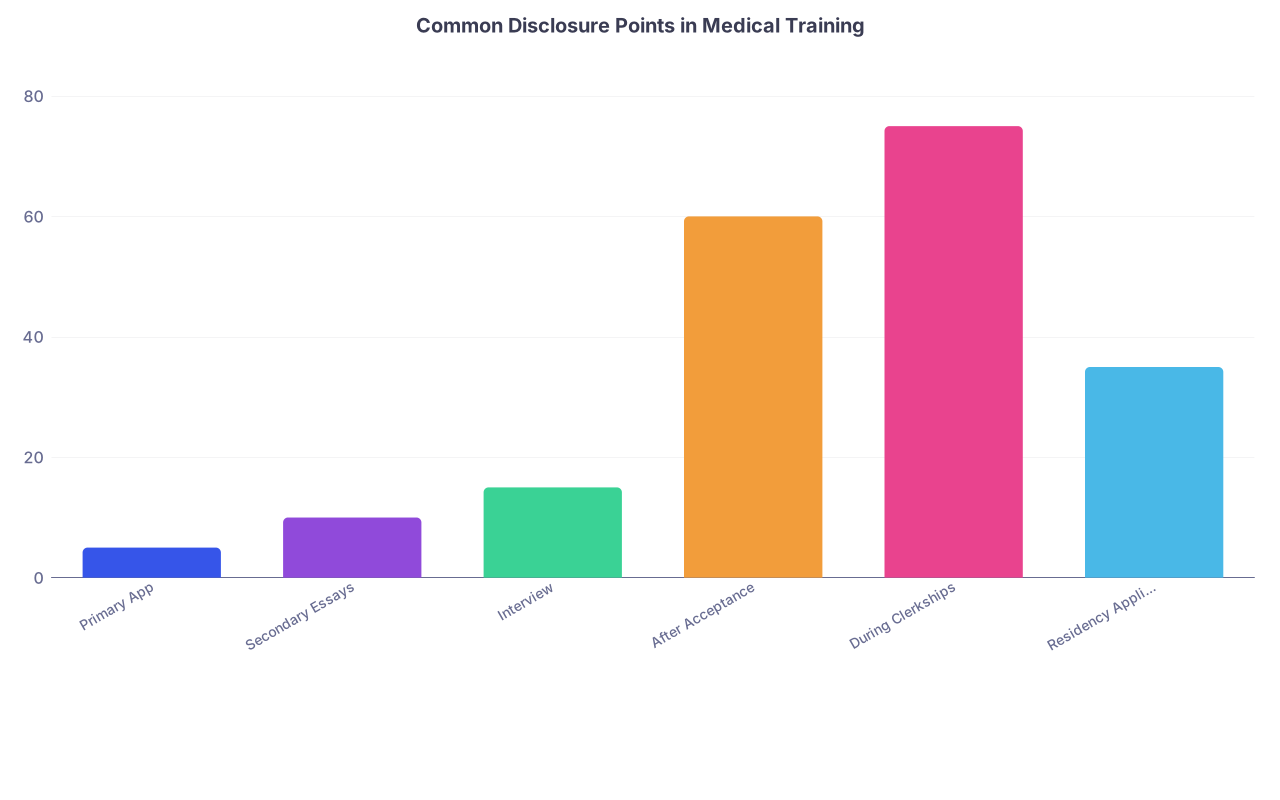
| Category | Value |
|---|---|
| Primary App | 5 |
| Secondary Essays | 10 |
| Interview | 15 |
| After Acceptance | 60 |
| During Clerkships | 75 |
| Residency Applications | 35 |
That chart is the reality I see: most people don’t disclose up front. They disclose later, quietly, once they know they’re in.
Before Admission: On the Application
Do you have to disclose on AMCAS/AACOMAS/TMDSAS?
No.
There is no box that forces you to say “I have ADHD” or “I have bipolar disorder” or “I’m deaf.” Any mention is voluntary.
Reasons to not disclose at this stage:
- You don’t need accommodations yet.
- You don’t want to risk subtle bias.
- Your disability history doesn’t impact your academic record in a way that needs explanation.
Reasons you might choose to disclose anyway:
- Your disability is central to your story and motivation for medicine.
- It explains real performance issues (low semester, leaves, failures) that otherwise look like lack of ability or grit.
- You’ve already had significant accommodations (e.g., reduced courseload, exam time) and your transcript hints at it.
My rule of thumb:
If sharing clarifies your record or strengthens your narrative, consider it. If it only adds risk and no clarity, skip it.
Interview Stage: Do You Tell Them?
Again, you don’t have to.
Some students mention a disability casually as part of their story:
“I struggled in undergrad until I was diagnosed with ADHD and learned how to structure my studying.”
That’s different from a formal disclosure requesting accommodations.
You should consider disclosing pre-interview if:
- You need accommodations for the interview itself (e.g., extra time for a written station, access needs for mobility, ASL interpreter, etc.)
In that case, you disclose to admissions staff, not the interviewer. You keep it functional: what you need, not your entire diagnosis history.
After Acceptance: Getting Accommodations in Med School
Here’s where disclosure becomes functionally necessary if you want support.
You’ll typically need to:
- Register with the school’s disability or accessibility office.
- Provide documentation (diagnosis, functional limitations, testing if needed).
- Work out an accommodation letter that instructors/clerkships receive.
Who sees your diagnosis?
Usually:
- Disability office: knows your diagnosis and documentation.
- Course directors / clerkship directors: see your approved accommodations, not your diagnosis.
Program directors (PDs) do not automatically get a line in your file that says “disabled.” If they act like they do, that’s a red flag.

Clerkships and Clinical Years
You don’t have to walk into every rotation saying, “Hi, I have [X].”
Instead, you usually:
- Have an accommodation letter or system:
- Example: permission to sit in clinic, adjusted call frequency, no overnight driving after 24s, or extra time on written assessments.
- Decide how much to tell your attending, if anything, beyond “I have an accommodation approved through the school.”
You may choose light disclosure if it smooths things:
- “I have a medical condition that affects my stamina, so I do need to use a stool when possible—this is already cleared through the school.”
That’s very different from handing them your entire psych history.
3. Residency: ERAS, PDs, and the Match
Residency adds higher stakes. So the fear gets louder: “If I tell them, will they rank me lower? If I don’t, am I unsafe?”
Let’s break this into three timepoints.
On ERAS: Do I Disclose in the Application?
Legally, you are not required to disclose a disability on ERAS.
Your options:
- Don’t mention it at all.
- Briefly reference it in your personal statement or experiences.
- Describe functional impact without naming the diagnosis (e.g., “chronic health condition”).
- Fully name the disability and its role in your path.
When disclosure can help:
- You have red flags—multiple attempts on Step, repeated preclinical failures, LOAs—that directly tie to your disability.
- The disability is core to your interest in a specific field (e.g., blind physician in rehab medicine; autistic physician focused on neurodevelopment).
When it usually hurts more than helps:
- You toss it in as “adversity story” without tying it tightly to growth, resilience, or competence.
- You talk more about your struggle than about how you successfully function now.
- You raise questions about reliability or safety and do not answer them.
Be brutally honest with yourself: are you giving them a reason to trust your performance in residency, or just asking for sympathy?
4. Residency Interviews and Ranking: What PDs Actually Need to Know
Here’s the practical reality:
Program directors care about three things:
- Can you do the job safely?
- Will you show up and not implode?
- Will you pass boards and finish the program?
They are not entitled to your diagnosis. But they need enough information to know whether they can reasonably train you within the essential functions of the specialty.
Interview Stage
Same rule as med school: disclosure is optional.
You should consider disclosing something pre-interview only if:
- You need specific interview accommodations (extra time, remote format, captioning, interpreters, accessible locations).
You do that through the coordinator, not by trauma-dumping in your first 10 minutes with the PD.
During the interview, if you choose to bring it up:
- Keep it short, functional, and future-looking.
Example of decent framing: “I had a health condition that caused me to repeat my second year. Since diagnosis and treatment in 2020, I’ve had consistent performance, no further delays, and have taken steps that are sustainable for residency—time management routines, established outpatient follow-up, and I’ve successfully completed all sub-I rotations without any issues.”
That answers the PD’s real question: “Is this going to be my problem next July?”
After You Match: Disclosing to Your PD
Once you’ve matched, the power dynamics shift slightly. You’re “in.”
You still don’t owe them your full health record. But if you foresee needing structural accommodations, you’re better off disclosing early to the GME office / HR / institutional disability office, not just informally to your PD.
Typical flow:
- You contact GME or Employee/Occupational Health.
- You provide documentation to them—not to your PD.
- They define reasonable accommodations.
- PD is told the “what,” not necessarily the “why.”

| Step | Description |
|---|---|
| Step 1 | Resident identifies need |
| Step 2 | Contact GME or Disability Office |
| Step 3 | Provide documentation |
| Step 4 | Determine accommodations |
| Step 5 | Communicate to PD |
| Step 6 | Implement on rotations |
You might choose a short explanation for relationship reasons: “I have a chronic medical condition. I’ve registered with GME and have an accommodation for no more than X consecutive nights. The paperwork is already done.”
That’s usually enough.
5. How Much Do You Have to Reveal? (Legally and Practically)
This is where people over-share out of anxiety.
You generally do not have to:
- Name the specific diagnosis to your PD.
- Provide your full psych or neuropsych report to the program.
- Justify every past failure or life event in detail.
- Disclose medications, therapy, or past hospitalizations unless there’s a current safety or performance concern that directly impacts your duties.
You generally do need to:
- Provide adequate documentation to the disability office / HR / exam board to justify accommodations.
- Be honest about functional limitations that materially affect patient care, scheduling, or safety.
- Avoid misrepresentation that could be considered fraud (e.g., hiding a condition that makes you consistently unsafe in a core requirement of the specialty).
Think in terms of functions, not labels:
- “I cannot safely perform night driving after 24 hours of wakefulness.”
- “I require captioning or transcription support for didactic sessions.”
- “I need 50% extended time for standardized exams.”
That’s what matters operationally.
6. Strategic Framework: How to Decide Whether to Disclose
Here’s a simple decision framework you can actually use.
| Situation | Recommended Approach |
|---|---|
| No impact on grades or performance | Usually do not disclose |
| Need test/rotation accommodations | Disclose to disability office only |
| Major gaps/LOAs tied to disability | Consider limited disclosure to explain |
| Safety concern without modifications | Must discuss functional limits |
| Applying to disability-positive program | Consider honest, framed disclosure |
Ask yourself:
Do I need a legal accommodation to function?
- Yes → You must disclose to the appropriate office. Not necessarily to PDs in detail.
- No → Disclosure is mostly about narrative, not necessity.
Is there something in my record that looks bad without context?
- If yes, consider a tightly framed explanation that:
- Shows diagnosis or change point
- Demonstrates stable performance since
- Emphasizes systems and strategies that will carry into residency
- If yes, consider a tightly framed explanation that:
Will non-disclosure create a safety or competence problem later?
- If your condition could cause sudden loss of consciousness, impaired judgment, or inability to meet essential functions without accommodations, hiding it completely is dangerous—for you and patients.
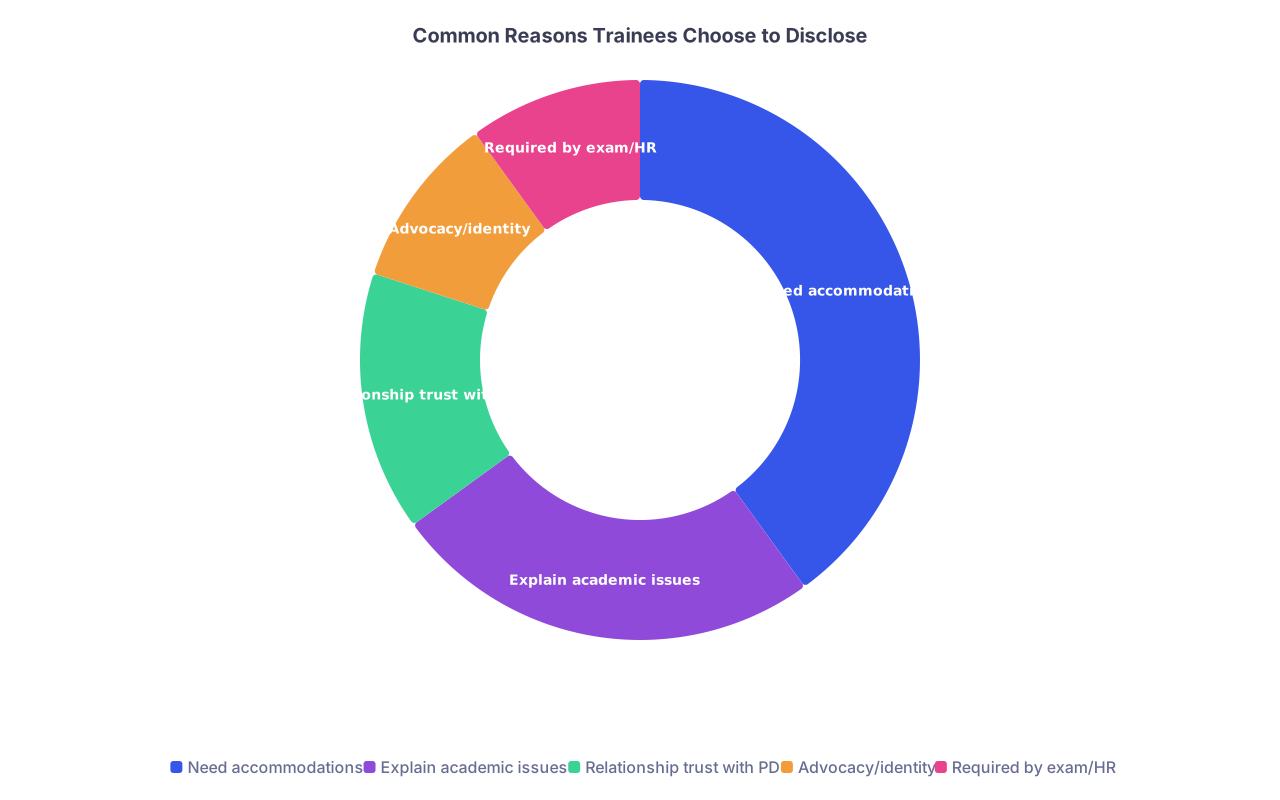
| Category | Value |
|---|---|
| Need accommodations | 40 |
| Explain academic issues | 25 |
| Relationship trust with PD | 15 |
| Advocacy/identity | 10 |
| Required by exam/HR | 10 |
7. Common Mistakes and Better Alternatives
Here’s what I see people do that backfires.
Mistake 1: Oversharing the worst parts
- Long paragraphs detailing hospitalizations, suicidal ideation, psychotic episodes, etc., without a clear stabilization window or plan.
Better:
- “I experienced a significant mental health crisis in 2019 requiring treatment and time away from school. Since then, I’ve had ongoing care, no further interruptions, and strong academic and clinical performance as reflected in [X, Y, Z].”
Mistake 2: Vague hints that raise more questions
- “I’ve had health challenges” with no reassurance about stability or management.
Better:
- One or two sentences linking:
- Past issue → concrete treatment/diagnosis → stable performance evidence.
Mistake 3: Asking for accommodations informally
- Telling a PD, “I have ADHD, so I’ll probably need lighter call,” without going through the proper disability or HR channels.
Better:
- Going through the official system so your accommodations are documented and protected, and PD is given a clear, approved plan.
FAQ (Exactly 6 Questions)
1. Can a medical school or residency program force me to disclose my disability diagnosis?
No. They can require documentation to justify accommodations, but that usually goes to a disability office, GME, or HR. They can ask about your ability to meet essential job functions, not demand your specific diagnosis in most situations.
2. Will hiding my disability get me into trouble later?
It depends. If you never need accommodations and it doesn’t affect safety or competence, no. If your undisclosed condition leads to repeated absences, unsafe behavior, or failure to meet essential requirements, then yes—because of performance, not because you “hid” a label.
3. Should I disclose my disability in my personal statement?
Only if it clearly strengthens your application. That means it either:
- Explains real academic/clinical irregularities in a reassuring way, or
- Is central to your motivation, perspective, and long-term goals in a way that highlights strengths, not just hardship.
4. Can program directors see that I got accommodations on board exams?
No, in the U.S. score reports for USMLE/COMLEX do not indicate that accommodations were granted. PDs usually have no idea unless you tell them or unless your schedule/behavior makes it obvious you’re operating under a formal plan.
5. What if I need accommodations on call or night shifts during residency?
You’ll usually handle this through GME or a disability/HR process, not by negotiating solo with your PD. If your limitation affects essential functions (like ICU nights in critical care), you may need to discuss how the program can reasonably restructure duties. Some specialties will be more flexible than others.
6. Is it “lying” if I don’t mention my disability in my interview or application?
No. You are not obligated to disclose a disability unless a direct question is asked about your ability to perform essential functions and your condition directly affects that. Omitting your diagnosis is not lying. Misrepresenting your functional capacity or falsifying documentation is.
Key points:
You almost never have to disclose your disability to a med school or residency PD by name or detail.
You do need to disclose functional limitations and work with the proper institutional offices if you want formal, protected accommodations.
Disclose strategically—only when it clarifies concerns, secures support you truly need, and shows you’re stable, safe, and ready to do the job.