Can I Switch Specialties Because of New Disability Limits—And How?
What are you supposed to do when your body changes, new regulations land, and suddenly the specialty you trained for is no longer realistically possible?
Let’s answer the blunt version:
Yes, you can often switch specialties because of new disability limits. But it’s not automatic, and if you do this blindly, you can wreck your career, your finances, and your sanity.
Here’s the clear framework you actually need.
Step 1: Separate Three Different Questions
People mix these up and get stuck. Don’t.
- Can I get accommodations and stay in my current specialty?
- If not, can I officially change my career path (residency/fellowship/role) because of disability?
- If yes, how do I make that change without burning everything down—contracts, licensing, reputation?
You work through them in that order. Not the other way around.
Step 2: Understand the Real Limits: ADA vs. “Essential Functions”
You’re probably hearing phrases like “essential functions,” “technical standards,” or “undue hardship.” That’s not just bureaucratic noise. That’s the battlefield.
Quick breakdown:
ADA (Americans with Disabilities Act) and similar laws in other countries:
- You’re entitled to reasonable accommodations if you’re otherwise qualified.
- Employers can’t just say “we don’t want disabled doctors.”
- They can say: “You can’t perform the essential functions of this specific job even with accommodation.”
Essential functions = the core tasks of the job that can’t be removed without breaking the job itself.
Example:- Emergency medicine: rapid response to codes, nights, continuous high-acuity care.
- Ortho surgery: sterile procedures, standing for long periods, fine motor surgical work.
- Anesthesia: constant vigilance, rapid crisis response, frequent OR presence.
If your new disability or new institutional limits mean you truly can’t perform those essential functions—even with reasonable accommodations—then either:
- the job has to change, or
- you move to a different job/specialty that matches what you can reasonably do.
That’s the legal backbone of your situation.
Step 3: Map Out Where You Actually Are in Training or Practice
Your options depend heavily on your phase and credentials.
| Stage | Main Paths to Switch |
|---|---|
| Med Student | Change specialty plans, adjust electives, re-aim apps |
| Pre-Residency Match | Re-rank, take gap year, reapply |
| Resident (PGY1–3) | In-program switch, new program, transfer credit |
| Fellow | Pivot to another fellowship/field, academic/nonclinical |
| Attending | Boarded? Retrain, additional residency, nonclinical |
If you’re a med student
You’re in the best position, frankly.
- Update your specialty plans now.
- Get formal disability documentation on file with your school.
- Pick specialties where the essential functions match your new limits and where accommodations are realistic: psych, path, radiology, PM&R, outpatient IM, etc.
You don’t need to “switch specialties” as much as “change target.” Much easier.
If you’re a resident
This is where it gets messy—and where most of you are when you ask this question.
Common scenarios I see:
- Ortho resident develops a chronic back condition and can’t stand for long cases.
- EM resident with new seizure disorder; night shifts and sleep deprivation are dangerous.
- OB/GYN resident with progressive vision issues; surgical field safety becomes questionable.
Here’s the good news:
ACGME programs can and do allow residents to switch specialties, especially when health/disability makes the current one unsafe or unrealistic.
But it’s a process, not a “click and move.”
Step 4: Confirm You’ve Actually Hit a Wall in Your Current Specialty
Don’t skip this.
Before you decide, “I have to switch specialties,” you need real answers to these:
- What exactly are the tasks you can’t safely or reliably do now?
- Have you had a formal accommodations review?
- Has your program or institution clearly said either:
- “Yes, we’ll accommodate,” or
- “No, that would remove essential functions or cause undue hardship”?
You need that on record.
This is where you:
- Loop in Occupational Health or the equivalent.
- Make sure your disability is medically documented.
- Involve GME (Graduate Medical Education), not just your PD in hallway conversations.
- If needed, talk to HR or disability services and, ideally, a disability lawyer who actually knows medical training (not your neighbor who does real estate closings).

If accommodations could make your current specialty feasible (e.g., modified call schedules, assistive tech, different rotation structure) and you’d still meet competency and essential functions, that’s usually the smoother path.
If everyone agrees: “No, this specialty isn’t safe or realistic even with accommodations,” then you’re in legit specialty-switch territory. And you’ll want that conclusion documented.
Step 5: Decide Your Direction: To Which Specialty, And Why?
You don’t just “switch away” from a specialty. You switch to a new one.
Ask yourself:
- What physical/cognitive limits are permanent vs. temporary vs. uncertain?
- What kind of work environment is now realistic?
- Inpatient vs. outpatient
- Procedure-heavy vs. mostly cognitive
- Shift work vs. more predictable hours
- How much additional training are you actually willing/able to do? Another 3 years? More?
Common “landing specialties” after disability-related limits:
- Psychiatry
- Pathology
- Radiology
- PM&R
- Outpatient internal medicine, outpatient pediatrics
- Non-procedural neurology
- Occupational medicine
- Family med with heavy outpatient focus
But don’t just chase “lighter” or “easier.” You still need:
- Interest
- Alignment with your abilities
- A realistic path to board certification
This is where talking to residents or attendings in that target field—who actually live that life—is non-negotiable.
Step 6: The Actual Mechanics of Switching Specialties
Here’s the “how” you came for. It’s not one-size-fits-all, but the pattern’s similar.
1. Have a structured conversation with your current program
Not a vague “I’m thinking of leaving.” A concrete, calm meeting.
You want to cover:
- Your medical situation (at the level you’re comfortable sharing—enough to justify the switch).
- The documented conclusion on why current specialty isn’t feasible even with accommodations.
- Your target specialty (or short list) and your plan.
- Ask: “Is there a path within this institution to move to [X specialty]?”
Sometimes:
- IM takes you from EM.
- Psych or FM takes you from surgery or OB.
- Pathology or radiology takes people who can’t safely be in procedural or acute care environments anymore.

| Step | Description |
|---|---|
| Step 1 | New disability or limit |
| Step 2 | Request accommodations review |
| Step 3 | Stay in current specialty with accommodations |
| Step 4 | Discuss with PD and GME |
| Step 5 | Explore switch to another specialty at same institution |
| Step 6 | Apply to programs in new specialty |
| Step 7 | Confirm credit transfer and training plan |
| Step 8 | Update career plan and documentation |
| Step 9 | Can essential functions be met with accommodation? |
| Step 10 | Is internal transfer possible? |
2. Explore an internal transfer first
Why? Because:
- It avoids the chaos of re-entering the Match.
- You may be able to transfer some credit (e.g., a surgical intern year partly counting for anesthesia, radiology, or PM&R; a prelim medicine year counting toward categorical IM).
- Institutions often want to “keep” invested trainees if they can.
The GME office is key here. They’ll:
- Coordinate discussions between PDs.
- Talk to the new specialty’s program about available slots.
- Clarify what training time can transfer under ACGME and board rules.

3. If internal transfer isn’t possible: external switch
Then you’re looking at:
- Off-cycle PGY-2 or PGY-3 spots in another specialty.
- Or re-entering the Match, possibly after a formal leave or gap.
This is harder, but people do successfully do it.
You’ll need:
- Updated CV and personal statement clearly—but concisely—addressing:
- Your disability or health change (at a high level).
- Why your prior specialty is no longer safe/feasible.
- Why you’re choosing the new specialty (not just “I need somewhere to land”).
- Strong letters from:
- Your current PD (critical).
- Other faculty who can speak to your clinical ability and professionalism.
Programs don’t want drama. They want:
- A clear story.
- Evidence you performed well before the change.
- Assurance you can fully meet their specialty’s essential functions, with or without accommodations.
Step 7: Licensing, Boards, and Credentialing Gotchas
This is where people get blindsided.
You need to track three things:
- Board eligibility
Each specialty’s board (ABIM, ABPN, ABP, etc.) has rules on:- What prior years can count.
- Whether partial years can count.
- Time limits for completing training.
Check their website, then confirm with:
- Your new PD
- Your institution’s GME office
- State medical boards
Some boards want explanations for:
- Leaves of absence
- Program transfers
- Health issues impacting your training
That doesn’t mean “no license.” It means: have clean documentation and clear, consistent explanations.
- Future hospital credentialing and malpractice
Again—clean documentation helps:
- That your change was medically driven, not due to unprofessional conduct or incompetence.
- That you successfully completed training and are fully able to function in the new field.
Step 8: Mental, Financial, and Real-Life Impact
Let’s not sugarcoat it: switching specialties due to disability hits hard.
Common hits:
- Financial: extra years of training, moving, delayed attending salary.
- Emotional: grief over the identity you’d built (“I was going to be a trauma surgeon”).
- Social: explaining to co-residents, faculty, family.
You’re allowed to mourn what you lost and still build a damn good career from here.
Serious recommendation:
- Get a therapist outside your institution if possible. Someone who understands medical training or disability adjustment is ideal.
- Talk to others who’ve done it—residents or attendings who had to pivot due to MS, cancer, injury, mental health conditions, etc. They exist, and their perspective is gold.
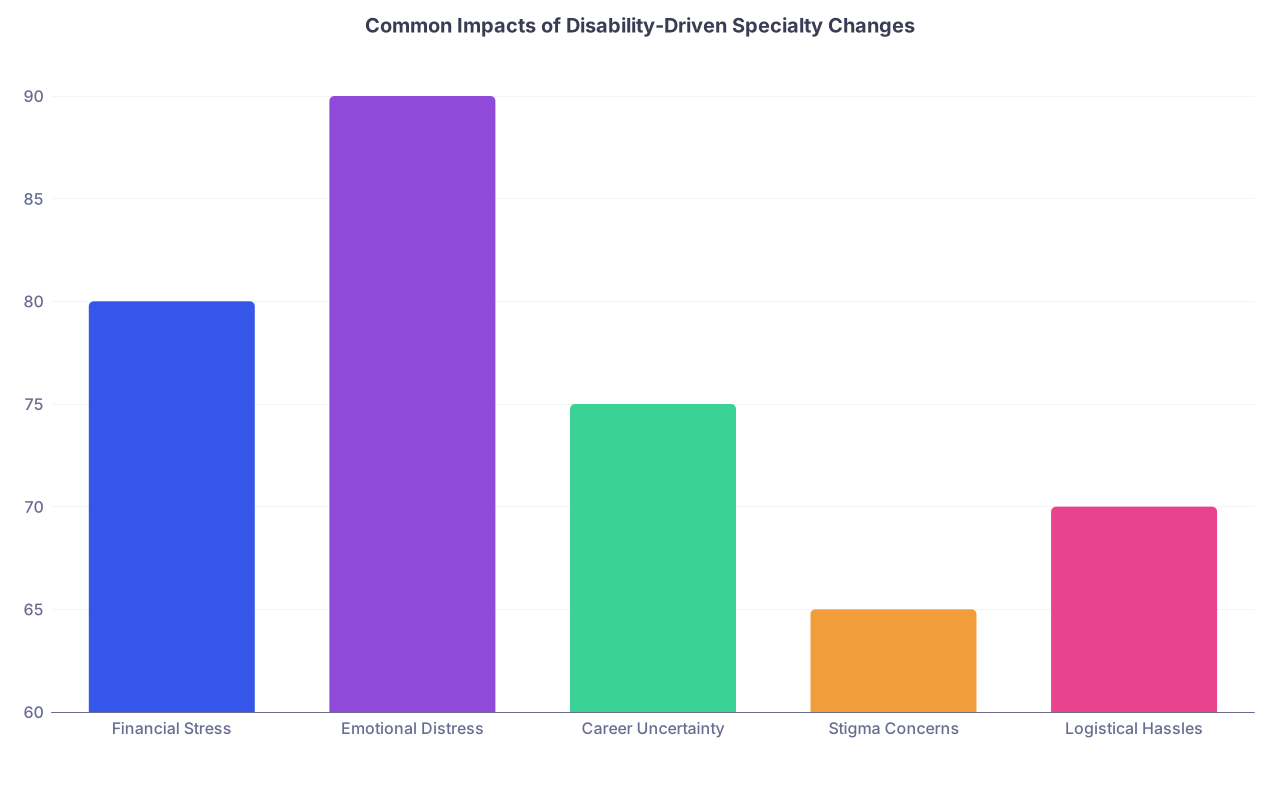
| Category | Value |
|---|---|
| Financial Stress | 80 |
| Emotional Distress | 90 |
| Career Uncertainty | 75 |
| Stigma Concerns | 65 |
| Logistical Hassles | 70 |
Numbers are approximate, but the pattern is real: this is heavy. Pretending it’s not just makes it worse.
Step 9: Protect Yourself Legally and Professionally
You don’t need to be adversarial. But you do need to be strategic.
Minimum protections:
- Keep written records of:
- Accommodation requests
- Occupational health conclusions
- Institutional responses
- GME decisions about your transfer or non-renewal
- If you sense you’re being quietly pushed out because of disability, not for legitimate performance reasons:
- Talk to a disability-rights or employment lawyer with healthcare experience early, not after you’ve signed away options.
- Get advice before resigning or agreeing to anything that looks like “voluntary withdrawal” if you feel cornered.
Sometimes the best outcome is a negotiated path:
- Finish the year, then transfer.
- Keep your record clean.
- Move forward instead of getting stuck in a long, ugly battle.
But you can’t make those decisions intelligently if you don’t know your rights.
Step 10: If You’re Already an Attending
Different ballgame, same rules.
Questions to answer:
- Can your current role be modified?
- Fewer calls, no nights, fewer or different procedures, more clinic/consult roles.
- Can you pivot within your specialty?
- Example: from trauma to elective, from OR-heavy to clinic-heavy, from inpatient-heavy to outpatient.
- Do you actually want or need to retrain in another specialty, or can you move into:
- Hospital admin
- Quality, safety, informatics
- Medical education
- Industry roles (pharma, med tech, consulting)
- Telemedicine-heavy practice
If retraining is on the table:
- Some boards give credit for prior specialty time.
- You may enter a shortened pathway (less common, but it exists in some fields).
- Talk directly with the receiving specialty’s PDs and boards.

Key Takeaways
- Yes, you can often switch specialties because of disability or new limits—but it needs structure, documentation, and strategy.
- You start with: “Can I be reasonably accommodated and still do the essential functions of my current specialty?”
- If the answer is no, your next step is a planned, documented pivot:
- Internal transfer if possible
- External transfer or re-Match if not
- Board rules, licensing, and GME policies matter. Don’t guess; confirm.
- Protect your legal and mental health as fiercely as you protect your career.
FAQ (Exactly 5 Questions)
1. Can my program force me out of my specialty because of a new disability?
They can’t legally remove you just for having a disability. They can decide you can’t meet the essential functions of that specialty even with reasonable accommodations. If that happens, they may:
- Offer alternate roles or help you explore transfer, or
- Non-renew your contract.
If you suspect they’re skipping the accommodation step or using disability as a cover for discrimination, talk to a disability/employment lawyer before you resign or sign anything.
2. Will switching specialties because of disability ruin my career?
No, but it will change it. I’ve seen:
- Surgery residents become happy, respected psychiatrists.
- EM residents become stellar outpatient internists.
- Proceduralists move into radiology, path, PM&R, or admin.
What ruins careers isn’t the switch itself—it’s unmanaged burnout, denial, and staying in a specialty that’s no longer safe or sustainable.
3. Do I have to disclose my disability when applying to a new specialty?
Legally, you’re not required to disclose diagnoses. Practically, you’ll usually need to explain:
- That you had to leave or change your previous residency.
- That you can perform all essential functions of the new specialty, with or without reasonable accommodations.
Most people give a concise explanation: “I developed a health condition that made [prior specialty] unsafe or unsustainable long term. I am fully able to meet the demands of [new specialty], and here’s what I’ve learned and why I’m committed to it.”
4. Can any of my previous residency time count toward the new specialty?
Sometimes, yes. Depends on:
- The two specialties involved
- ACGME rules
- The new specialty board’s policies
- Your specific rotations and competency documentation
For example, a completed prelim medicine year may count toward IM, anesthesia, radiology, or neurology. You need the new PD and GME to formally review and request credit from the board.
5. What’s the very first step I should take if I think I might need to switch specialties?
Don’t start with the Match website. Start with clarity.
Today, do this: email or message your program to request a formal meeting with your PD and GME, and tell them you’d like:
- A formal occupational health/disability accommodation review, and
- A conversation about long-term fit and options if your current specialty isn’t sustainable.
Then gather your medical documentation. That one action—requesting a structured review—moves you from panic to process.
Open a blank document right now and write down three things: what you can’t safely do anymore, what you can do reliably, and which specialties that realistically matches. That’s the foundation of your next move.