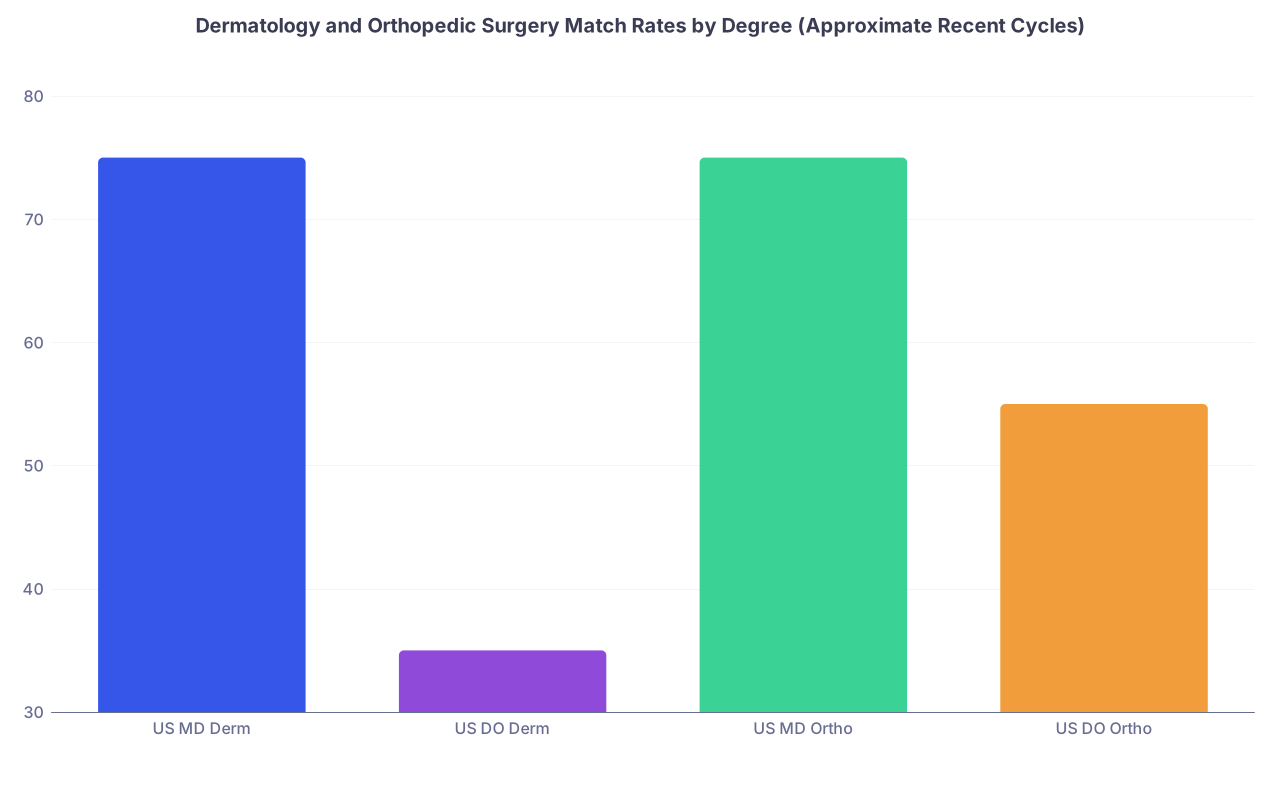
The Scenario: Two Applicants, Two Paths
Lieutenant Daniels, DO, scored a 245 on Step 2 CK. She rotated through a Navy emergency department during a third-year elective and walked away with a letter from the department head. Captain Reyes, MD, holds a 250 Step 2 and a year of bench research at the Uniformed Services University. Both want one of the two emergency medicine slots at a major military medical center. Only one gets it.
The match outcome won't hinge on test scores alone. It won't be decided by a whimsical bias against osteopathic medicine. The difference is structural, and it sits inside how military graduate medical education (GME) is funded, how board certification is handed out, and how program directors evaluate two separate sets of credentials that aren't quite parallel.
This is the reality. I've watched brilliant DO applicants scramble because they assumed their COMLEX scores would speak for themselves. I've seen MD applicants floored when a military program ranked a DO student higher because that student had the military bearing and deployment-ready mentality the service needs. Both sides misunderstand the machine. This article breaks down the actual mechanism, no sugarcoating, and gives you the strategy to tilt it in your favor.
Military Medicine 101: How GME Funding Changes Everything
Military medicine isn't a quirky add-on to the civilian match. It's a fully parallel system with its own funding streams and its own calculus. The Health Professions Scholarship Program (HPSP) sends students to civilian medical schools and pays full tuition plus a stipend. Those graduates enter active duty owing a service commitment, and they compete for military residency slots through the military match. The Uniformed Services University (USUHS) educates medical students who are already commissioned officers; their entire education, from anatomy lab to clinical clerkships, occurs inside the military ecosystem. Then there's civilian deferred residency: a smaller number of applicants train at civilian programs with military funding, often to fill gaps in specific specialties the military can't fully train internally.
Why does this matter for the DO vs MD question? Because the military GME system runs on a fixed budget. Each residency slot is a line item. Program directors aren't just selecting a trainee; they're justifying an expense to the Defense Health Agency. When two candidates with different credentialing systems appear, the director naturally gravitates toward the credential they know best. The American Board of Medical Specialties (ABMS) pathway, the MD route, has been the default in military hospitals for decades. The AOA pathway, while now largely ACGME-accredited, still carries a validation lag. It's not prejudice. It's institutional friction.
The military match also operates on a modified rolling timeline that doesn't mirror the NRMP calendar. Applications open earlier, interview slots are fewer, and the review process starts with a triage you won't find in civilian programs. That triage often leans on USMLE scores as a common denominator. If a DO applicant has only COMLEX scores, the committee must convert or contextualize them. That conversion step alone can bounce an application out of the "invite" pile before a human spends more than 90 seconds on it.
The Real Reasons DO and MD Applicants Are Treated Differently
The divide starts with history. Until 2020, the AOA ran its own accreditation system for osteopathic residencies. MDs took the USMLE; DOs took COMLEX. Military programs fell under the Accreditation Council for Graduate Medical Education (ACGME) umbrella, which meant they answered to ABMS specialty boards. For decades, a DO graduate entering a military training program had to navigate a separate board-certification track, often requiring an extra application to the American Osteopathic Association. The bureaucracy added paperwork and uncertainty. Even though all residencies now sit under a single ACGME accreditation, the memory of that administrative split persists inside program directors' heads.
Board certification still isn't fully unified. The NBME and NBOME issue different exams that measure slightly different things. COMLEX emphasizes osteopathic principles and manipulative medicine; USMLE emphasizes a pathophysiology model that military teaching hospitals have used for 40 years. A program director who trained on the MD side can read a USMLE score report in their sleep. A COMLEX score in the 500s doesn't translate at a glance. I've watched screening committees ask, "What's a 550 in COMLEX Level 2?" and then move to the next file. That's not malice. That's a system that hasn't been forced to learn the conversion.
Military credentialing adds another layer. Before a physician can deploy independently, they must hold board certification or board eligibility from a recognized board. The military's medical credentialing office defaults to ABMS boards. A DO who pursues AOA board certification, still an option in some specialties, will face additional hoops when applying for privileges at a military treatment facility. I've seen credentialing delays that push a freshly-trained attending into a six-month limbo, unable to practice at full scope. No program director wants to risk that hassle. So they default, again, to the familiar.
Then there's the lingering perception gap. In civilian academic centers, the DO stigma has narrowed dramatically. In the military, it's narrower still but not gone, and it's entangled with cultural fit. Military medicine wants officers who can lead in a field hospital under fire, not just ace a board exam. But when a DO applicant shows up and the interviewer's mental model of "doctor" is an MD from USUHS, the applicant starts at a subtle deficit. They have to prove they belong in the uniformed culture, not just in the hospital.
What Actually Happens in the Military Match Process
The timeline hits differently. For the military match, applications typically open in June, with interviews in July and August. That's months before civilian ERAS even starts transmitting. If you haven't built relationships by April of your third year, you're already behind. DO applicants who haven't taken USMLE Step 2 CK by early summer are gambling with their entire season.
Score thresholds are real and often unspoken. Each specialty sets its own filter, and I've seen program coordinators quietly apply a Step 2 CK cutoff of 230 for family medicine and 240 for surgical fields at Navy and Air Force programs. Those numbers aren't published. But if your COMLEX equivalent falls below a rough conversion, your application slams into the same filter. The military loves data. It doesn't love ambiguity.
Interview invitation logic disproportionately rewards a clean USMLE transcript. Many military program directors told me directly: if a DO applicant has a USMLE Step 2 CK above 240, they'll treat that person on par with an MD applicant. But when the DO only submits COMLEX, the director's mental math tends to discount the score by 10 to 15 percentile points. I'm not saying that's fair. I'm telling you what happens.
Program director perspectives vary, but a pattern emerges. Surgical programs are the most hesitant; primary care and emergency medicine are more open. I've heard the phrase, "We've trained great DOs, but they came with USMLE scores," from a PD at a major Army medical center. That sentence should burn into your memory. The way you present your credentials determines whether the skepticism ever gets triggered.
Strategic Playbook for DO Applicants
If you're a DO student aiming for a military residency, you aren't fighting bias; you're navigating a credentialing mismatch. Fix it at the source.
Take USMLE Step 2 CK early. Not Step 1. Not Step 3. Step 2 CK is the military's currency. Schedule it before August of your fourth year, preferably earlier. A score of 240 or above opens the same doors an MD walks through. A 250 erases the degree difference in most specialties. Relying on COMLEX alone is a strategic mistake. I've seen too many qualified DO students miss interviews because they made this one choice.
Research DO-friendly programs. The Army's Darnall Medical Center (FM), Navy's Camp Lejeune (FM), and Air Force's Scott Medical Center (IM) have historically accepted and supported DO residents. Larger tertiary centers can be more rigid. Don't waste application slots hoping a surgical program with zero DO graduates will suddenly reverse course.
Build your narrative around military readiness, not osteopathic identity. Emphasize leadership, deployment interest, and operational medicine. If you mention OMT, tie it to field medicine, how it might reduce musculoskeletal injuries in a deployed setting. That's an asset. Treating it as a philosophical alternative to allopathic medicine is a liability in a military culture that prizes uniformity.
Get a rotation at a military hospital. HPSP students have access to Active Duty Training (ADT) rotations; use them aggressively. A letter from a military attending who says, "I'd trust this doc with my soldiers," outweighs any COMLEX score. I watched a student with a 215 Step 2 CK match into a competitive Navy IM slot because she'd worked a summer rotation and the program director already considered her part of the team.
In personal statements and interviews, address the elephant. Acknowledge that you're a DO and that you chose to take USMLE to be fully comparable. Show you understand the military credentialing pathway, not just the medical one. That proactive confidence disarms skepticism.
Strategic Playbook for MD Applicants: Don't Get Comfortable
An MD behind your name is not armor against military match failure. I've seen MD applicants, stellar on paper, fail to match because they never set foot on a military base. They assumed the degree would carry them. It doesn't.
Civilian-trained MDs entering via HPSP or USUHS have an advantage in board eligibility, but they often lack the military cultural fluency that program directors weigh heavily. A 250 Step 2 CK with no operational experience reads as a liability. The program wants someone who comprehends what it means to be a medical officer, not just a doctor in uniform.
Build military-specific experience: attend a field training exercise, shadow a battalion surgeon, complete the Officer Development School early. Don't list it as a resume checkbox; let it inform your interview answers. I've seen a PD rank a lower-scoring applicant higher because that applicant described a mass casualty drill with genuine insight into triage under austere conditions.
Don't let civilian research overshadow military relevance. Basic science papers impress academic centers; the military PD wants to know if you've thought about prolonged field care or aeromedical evacuation. Tilt your narrative accordingly. And never assume your civilian connections will substitute. A glowing letter from a renowned academic attending means little if the military committee doesn't know the name. Get at least one letter from a military physician.
Finally, understand the oath and commitment beyond the medical. Military medicine is a dual profession. When the board asks about your motivation, they're probing your willingness to lead in chaos. An MD applicant who can't articulate that willingness, who talks only about the quality of the residency training, will lose to a DO applicant who radiates service.
Your Action Steps: Navigate the Difference, Own Your Path
Right now, put your degree aside and audit your application as if you were a military program director. If a credential requires translation, fix it. If your story doesn't speak to service, rewrite it. The military match punishes ambiguity; it rewards deliberate preparation.
For DO applicants: schedule USMLE Step 2 CK within the next two months if your test date isn't already set. Identify three DO-friendly programs and contact their program coordinators, not to lobby, but to ask intelligent questions about their process. That inquiry alone puts you on a radar.
For MD applicants: book a military rotation. Today. If your school doesn't have an affiliation, contact the HPSP office or the graduate medical education department at the nearest military hospital. The friction of making that call is the price of admission.
Long-term, build a career strategy, not just a match strategy. The military system values certification portability. Board certification from an ABMS board remains the cleanest path for both DO and MD graduates. Choose residency programs that guarantee that eligibility.
Key resources: the AMEDD recruiter for your branch, the GME office at USUHS, the Council on Graduate Medical Education (COGME) reports on military GME, and the individual program websites that list their current residents, look at the mix of DO and MD. That data tells you the truth that brochures won't.
The difference isn't going away soon. But the gap is entirely navigable if you respect the machine's logic and feed it what it needs. Your instruction sheet is clear. Read it. Then move.