It is 11:47 p.m. You have fifteen browser tabs open: SDN threads, Reddit arguments, school websites, NRMP data, YouTube videos from residents who definitely have time to vlog but not answer your exact question. DO vs. MD. You keep circling the same points: residency chances, prestige, OMM, Step vs COMLEX, “closing doors.” You are not actually deciding. You are just doom-scrolling.
Let us fix that.
You do not need more opinions. You need a structured way to decide that fits your goals, not whatever some anonymous PGY-2 thinks is important. That is what we will build: a clear, weighted decision matrix you can fill out today and use to get to an answer you can stand behind.
Step 1: Get Rid of the Noise – What Actually Matters
First, strip this down to the variables that actually move the needle. Everything else is background radiation.
The big domains that truly matter when choosing between DO and MD:
- Residency and specialty goals
- Geography and regional bias
- Your competitiveness and timeline
- Philosophy of training (OMM, holistic focus)
- Long-term career signaling (prestige, academia, ultra-competitive subspecialties)
- Cost, debt, and logistics
Most arguments online are just these six things in disguise.
Here is what people think matters but is usually overblown:
- “Patients will not respect DOs” – in most of the U.S., this is simply false in 2026. Some hospitals and older physicians still have bias, but patient-level impact is minimal if you are competent.
- “DOs cannot match competitive specialties” – wrong. They can, but it is harder in certain fields and programs. That is different from “cannot.”
- “DO = holistic, MD = not holistic” – marketing over reality. Holistic care is more about you and your training environment than the letters.
You are going to build a matrix around the actual six drivers, not the noise.
Step 2: Understand the Real Differences (No Sugarcoating)
You cannot build a decision tool if you do not understand the baseline.
1. Residency and Specialty Outcomes
Here is the blunt version:
- For primary care (FM, IM, peds), both MD and DO can get you there reliably if you pass your boards and perform reasonably.
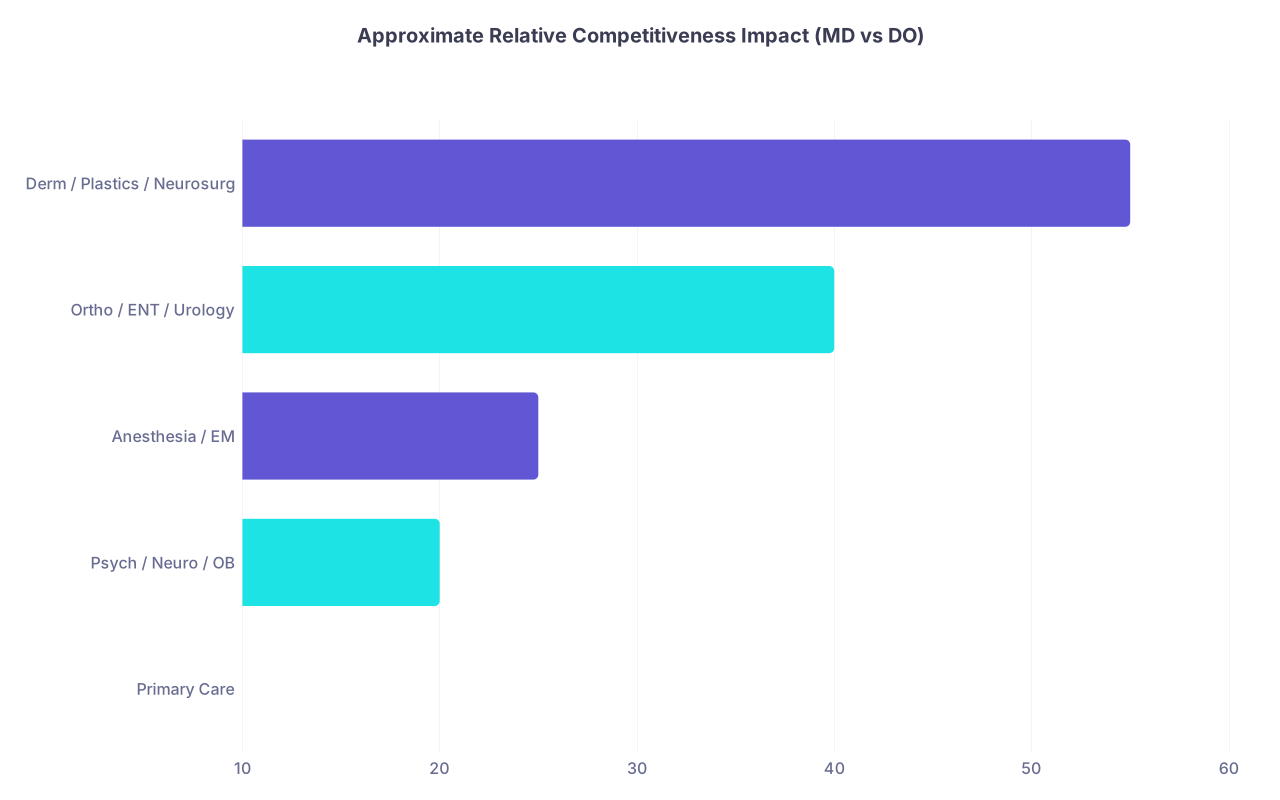
- For mid-competitive specialties (EM, anesthesia, OB/GYN, psych, neurology) – MD has an easier time at the top academic places, DO slightly more friction but still very possible.
- For very competitive specialties (neurosurgery, plastics, derm, ENT, ortho, some road subspecialties) – MD has a clear structural advantage, especially from strong academic MD schools.
The merger of AOA and ACGME residencies helped, but it did not magically erase program bias.
| Category | Value |
|---|---|
| Primary Care | 10 |
| Psych / Neuro / OB | 20 |
| Anesthesia / EM | 25 |
| Ortho / ENT / Urology | 40 |
| Derm / Plastics / Neurosurg | 55 |
Interpretation: higher number = stronger MD advantage. This is not exact data, but it matches what you will see talking to PDs, not Reddit.
2. Board Exams
MD:
- Traditionally USMLE Step 1, Step 2 CK (Step 1 now Pass/Fail).
- Allopathic schools geared heavily towards USMLE.
DO:
- Must take COMLEX.
- Most competitive residencies still strongly prefer or flat-out require USMLE scores on top of COMLEX.
Reality: Many DO students end up prepping for two exams. That is extra time, extra mental load. If you go DO and you want a competitive specialty, assume you are taking USMLE.
3. Curriculum and OMM
MD:
- Standard curriculum, maybe a little integrative medicine sprinkled in.
DO:
- Same basic medical content plus OMM/OMT (osteopathic manipulative medicine/therapy).
- That is extra hours and practical exams. Some people like it, some just tolerate it.
If the idea of doing hands-on manual medicine bores or annoys you, be honest about that. It is not a reason to avoid DO if it is your best shot, but it affects your day-to-day life in school.
4. Prestige and Signaling
Is MD more “prestigious” in most circles? Yes.
Does that matter for everyone? No.
Who actually cares:
- Competitive academic programs.
- Ultra-competitive subspecialties.
- Some older physicians and certain regions (especially where DO presence is historically low).
Who does not care much:
- Most patients.
- A lot of community programs.
- Many hospital systems that have DOs in leadership positions (which is increasingly common).
Step 3: Build Your Personal Decision Matrix
Now we structure this so you can actually score DO vs. MD.
We will use a simple weighted decision matrix:
- List criteria (rows).
- Assign each criterion a weight from 1–10 based on how important it is to you.
- Score DO and MD separately from 1–5 for each criterion.
- Multiply weight × score for each, then sum.
Core Criteria List
Use this baseline list and adjust as needed:
- Match potential for your likely specialty interest
- Ability to match in your preferred region
- School reputation / prestige for your goals
- Comfort with OMM and osteopathic philosophy
- Likelihood of needing to take both COMLEX and USMLE
- Cost and debt load
- Support for research and academic opportunities
- Your current competitiveness (and what doors each option opens)
- Flexibility if you change your mind on specialty
- Cultural “fit” and teaching style
You do not need all ten. But most people benefit from at least 6–8 of these.
How to Score
- Weight (importance): 1 (do not care) to 10 (dealbreaker).
- Score: 1 (terrible) to 5 (excellent) for that pathway (DO or MD).
Let me give you a concrete example.
Step 4: Walk Through a Realistic Example (Fill-in Template)
Imagine this scenario:
- You are a junior.
- cGPA 3.4, sGPA 3.3, MCAT 507.
- You are interested in EM or IM, not dead set on derm or neurosurg.
- You are open to DO but a bit wary about extra exams.
- You care strongly about matching in the Northeast.
We will build a simple matrix.
Example Decision Matrix (You Can Copy This)
Let’s pick 8 criteria.
| # | Criterion | Weight (1–10) | MD Score (1–5) | DO Score (1–5) |
|---|---|---|---|---|
| 1 | Match chances in EM/IM | 9 | 4 | 3 |
| 2 | Northeast residency placement | 8 | 4 | 3 |
| 3 | Prestige / reputation for future flexibility | 7 | 4 | 3 |
| 4 | Comfort with OMM / extra curricular content | 4 | 5 | 3 |
| 5 | Boards burden (USMLE + COMLEX vs just USMLE) | 6 | 4 | 2 |
| 6 | Cost / debt (based on your acceptances) | 10 | 3 | 5 |
| 7 | Research and academic opportunities | 6 | 4 | 2 |
| 8 | Admission likelihood with current stats | 10 | 2 | 4 |
Now multiply weight × score:
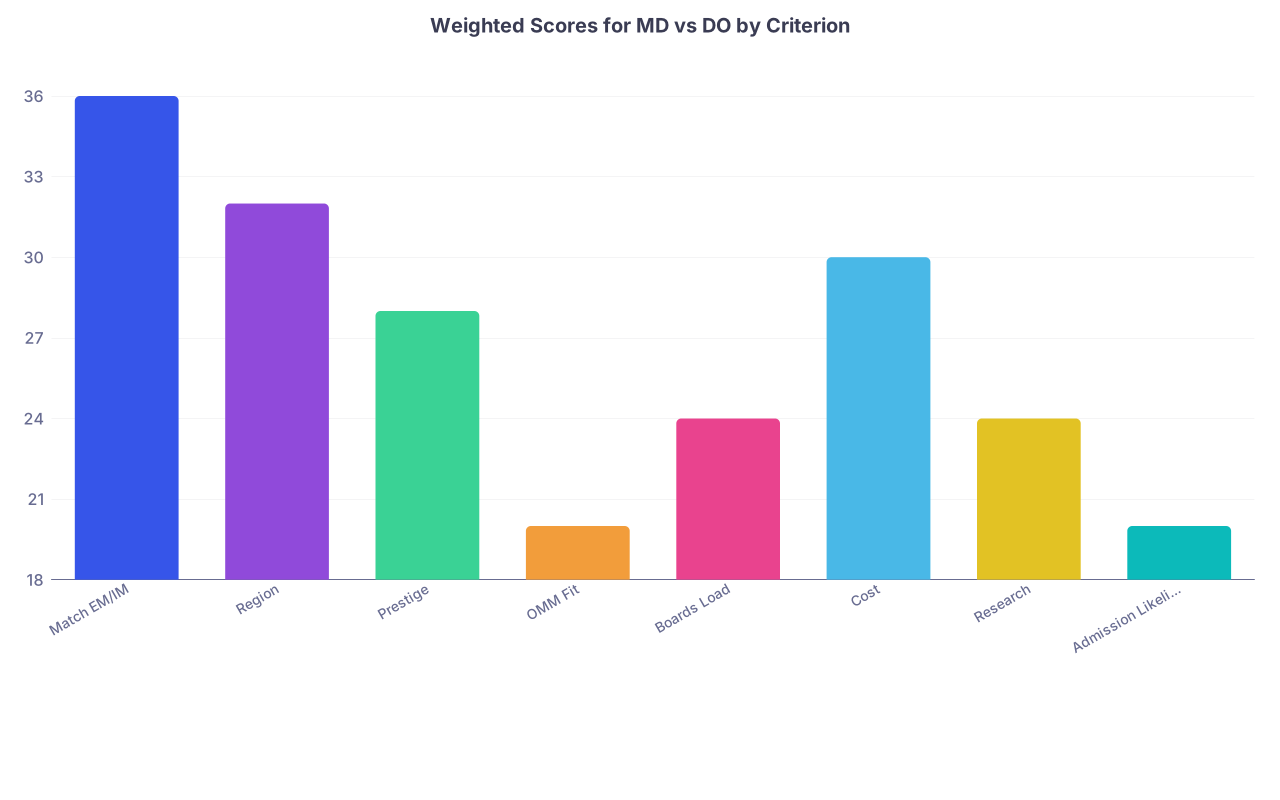
Match EM/IM:
- MD: 9 × 4 = 36
- DO: 9 × 3 = 27
Northeast region:
- MD: 8 × 4 = 32
- DO: 8 × 3 = 24
Prestige:
- MD: 7 × 4 = 28
- DO: 7 × 3 = 21
OMM comfort:
- MD: 4 × 5 = 20
- DO: 4 × 3 = 12
Boards load:
- MD: 6 × 4 = 24
- DO: 6 × 2 = 12
Cost / debt:
- MD: 10 × 3 = 30
- DO: 10 × 5 = 50
Research:
- MD: 6 × 4 = 24
- DO: 6 × 2 = 12
Admission likelihood:
- MD: 10 × 2 = 20
- DO: 10 × 4 = 40
Now add totals:
- MD total = 36 + 32 + 28 + 20 + 24 + 30 + 24 + 20 = 214
- DO total = 27 + 24 + 21 + 12 + 12 + 50 + 12 + 40 = 198
So this student’s matrix leans MD… but notice something: the DO route has a much higher score on cost and admission likelihood. That is the real-world tension.
Here is how that type of tension usually resolves:
- If this student has no MD acceptances, the DO route still comes out clearly better than “reapplying forever.”
- If they have a lower-ranked MD with weak match outcomes vs a strong DO with solid match history, those scores might flip.
You can visualize how weight and scoring interact:
| Category | Value |
|---|---|
| Match EM/IM | 36 |
| Region | 32 |
| Prestige | 28 |
| OMM Fit | 20 |
| Boards Load | 24 |
| Cost | 30 |
| Research | 24 |
| Admission Likelihood | 20 |
(That chart is MD’s side; you can sketch DO’s beside it on paper.)
Step 5: Calibrate Your Weights Honestly
Most people screw up the matrix at the weighting step. They put what they think they are supposed to care about, not what they actually do.
Some reality checks:
- If you have been saying “I might want derm or ortho, not sure” for two years, then competitive specialty access should be high weight (8–10), even if you are “not sure.”
- If you are already 29 with a family and a mortgage, then time, cost, and admission likelihood should get big weights.
- If you have zero interest in research and only care about being a solid community physician, then prestige and academic opportunities should be low weight (1–3), regardless of what prestige-obsessed forums think.
Use this quick calibration:
- Any criterion that would make you say “I would not attend that school if it failed on this” = weight 9–10.
- Any criterion that would make you say “I would be annoyed but still go” = weight 5–8.
- Any criterion you could shrug off = weight 1–4.
Write that down. Do not keep it in your head.
Step 6: Plug in Real Schools, Not Just “DO vs MD” as Abstractions
Next level: stop thinking DO vs MD in the abstract. You do not attend “MD.” You attend a specific MD school. Same with DO.
You should run the matrix for pairs of actual options you have or will likely have:
- “Mid-tier in-state MD vs new DO school”
- “Established DO with strong match vs offshore MD”
- “Top-30 MD vs strong DO where you got a major scholarship”
You can do a quick two-school comparison like this:

| Step | Description |
|---|---|
| Step 1 | List actual acceptances |
| Step 2 | Compare best MD vs best DO using matrix |
| Step 3 | Compare DO vs reapply option |
| Step 4 | Strongly reconsider offshore / reapply |
| Step 5 | Choose higher scoring path |
| Step 6 | Any U.S. MD offers? |
| Step 7 | Any U.S. DO offers? |
Do not compare your fantasy MD to your worst DO acceptance. Compare actual choices.
Step 7: Factor in Your Current Competitiveness and Risk Tolerance
This is the part nobody is honest about.
If you are a strong applicant (e.g., 3.8+ GPA, 515+ MCAT)
- You will almost certainly have at least some MD options.
- DO can still make sense if:
- Massive scholarship.
- Specific program you love with great match outcomes.
- You genuinely like the osteopathic model and OMM.
But if you are aiming at derm/ortho/neurosurg and have strong MD options, intentionally choosing DO while claiming you want those fields is like saying you want to climb Everest and starting halfway down the wrong side of the mountain. Not impossible. Just obviously harder.
If you are a borderline MD applicant (e.g., 3.3–3.5, 502–508)
You are the person this decision matrix matters most for.
You likely face:
- Real chance of no MD acceptances even with a solid application cycle.
- Better odds at multiple DO schools.
- The question is not “DO vs MD?” in isolation.
- The question is “DO now vs multi-year reapplication gamble for MD”.
You should explicitly treat “reapply” as another option in your matrix:
- Add a column for “Reapply MD-only.”
- Score it on:
- Delay (lost income years).
- Odds of actually improving stats (are you realistically retaking the MCAT from 504 to 516?).
- Mental burnout.
- Lost momentum.
| Category | Value |
|---|---|
| Year 1 | 0 |
| Year 2 | 1 |
| Year 3 | 2 |
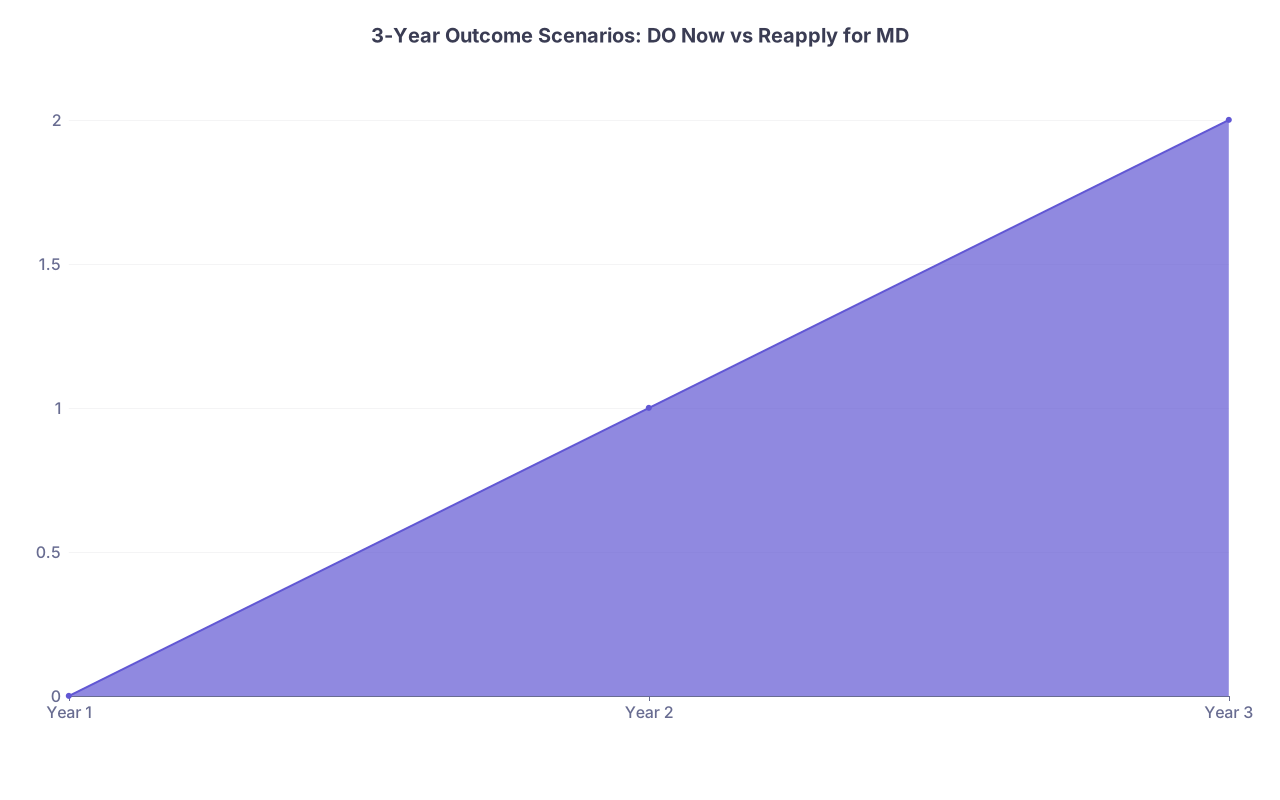
Think of “DO now” as starting medical school at Year 1 while “reapply” might mean you are still in limbo in Year 2.
If your reapplication plan is basically “hope and vibes,” the matrix will expose that quickly.
Step 8: Regional and Program-Level Bias – Be Specific
Not all regions treat DOs the same.
Blunt pattern I have seen repeatedly:
- Midwest, parts of the South, rural regions: DOs are embedded, often in leadership. Plenty of DO-friendly residencies. A solid DO grad with good scores can do very well here.
- Certain coastal academic hubs (think some Boston, NYC, West Coast academic flagships): more MD-heavy, some programs with soft or hard bias against DOs, especially for highly competitive fields.
So add this reality:
- Look at match lists from specific DO schools you are considering.
- Look at where their grads are matching:
- Are they landing in the region you want?
- Are they placing into your target specialty at all?
If a DO school’s last 3 years of match lists show zero students going into your dream specialty, that is not a small detail. That is data.
Step 9: Decide What You Will Trade… and What You Will Not
At some point, the matrix will force an uncomfortable admission:
You cannot have everything.
You might need to pick between:
- Better prestige and fewer financial aid dollars vs cheaper tuition and slightly more friction in residency applications.
- Faster start (DO acceptance now) vs uncertain delay (hoping to land MD next year).
Write down your non-negotiables clearly:
- “I will not attend an offshore school.”
- “I will not delay more than 1 year to get into medical school.”
- “I will not choose a route that makes derm realistically unattainable given my work ethic.”
Then see which pathway fails those non-negotiables. Cross it out.
Step 10: Use the Matrix to Make a Call, Not to Procrastinate Better
Mistake I see constantly: people treat tools like this as a way to “process” indefinitely while avoiding an actual decision.
Do this instead:
- Draft your criteria.
- Assign weights in one sitting (20–30 minutes).
- Score MD vs DO (and possibly “reapply”) in one sitting.
- Look at the totals.
- Highlight the two or three criteria that swung the result most.
- Ask yourself: “Do I accept that these are the real reasons I am choosing this path?”
If yes: you have a decision.
If no: adjust weights to reflect your actual priorities, not what you think sounds good. Recalculate once. Then stop.
Print the finished matrix. That becomes your anchor when you start second-guessing yourself mid-M2 because someone on TikTok said DOs can never match ortho (again, false).
FAQ (Exactly 4 Questions)
1. If I am not 100 percent sure about my specialty, should I avoid DO?
Not automatically. If your realistic range of interests is mostly primary care, EM, IM, psych, peds, anesthesia, or OB/GYN, DO is a perfectly viable path. You should be more cautious choosing DO over strong MD options if you are even seriously considering derm, plastics, neurosurg, or ENT. In that case, your decision matrix should assign high weight to “access to top-tier and ultra-competitive residencies,” which will push you toward MD if the rest of your profile supports it.
2. Do I really need to take USMLE if I go DO?
If you want competitive specialties or competitive academic programs, yes, you should plan on taking USMLE Step 2 at minimum. Some DO students still sit for Step 1 even though it is Pass/Fail, because program directors are familiar with USMLE score reports and there is still quiet skepticism in some places about COMLEX-only applicants. If you are happy with primary care or community programs that are historically DO-friendly, COMLEX alone may be enough. But from a risk-management standpoint, assuming you will take USMLE is safer.
3. How bad is the “prestige gap” in actual day-to-day life?
For most practicing physicians, once you are out and board-certified, the MD vs DO debate fades fast. Patients care more about bedside manner and word-of-mouth reputation. The prestige gap bites earlier: during residency applications, particularly for competitive specialties and elite academic centers. It also matters somewhat for research-heavy careers or leadership tracks at universities that are still very MD-dominated. If your long-term plan is community practice, the prestige gap should be a relatively low-weight criterion in your matrix.
4. Is it better to go DO in the U.S. or attend a Caribbean/offshore MD for the “MD” letters?
In almost every scenario, a solid U.S. DO school beats a Caribbean MD program. Offshore schools have far lower match rates, more variable clinical experiences, and a reputation problem with residency directors that is significantly worse than anything DOs face. If your realistic choices are “accredited U.S. DO” vs “Caribbean MD,” your matrix should hammer the “residency match probability” and “training quality” criteria with very high weights, and those heavily favor DO. The only time offshore MD even enters the conversation is when applicants refuse to consider DO for emotional reasons, which is not a serious way to build a medical career.
Key takeaways:
- Do not decide DO vs MD based on vibes or anonymous forum posts; build a weighted decision matrix and score your real options.
- Be brutally honest about your priorities: specialty competitiveness, cost, regional goals, and your actual competitiveness today.
- Use the tool to commit to a decision once—and then get back to doing the harder work that matters far more than the two letters on your white coat.