The dirty secret no one tells you before you sign that DO enrollment form: a lot of students hate OMM. Not mildly dislike. Hate. Feel-trapped, what-did-I-just-sign-up-for levels of resentment.
If that’s you, you’re not broken and you’re not alone. But you do have to decide what to do about it, because just “powering through and pretending it’s fine” is how people end up miserable for four years and bitter in residency.
Let’s go straight at this.
First, Get Clear: What Exactly Do You Hate?
Before you start fantasizing about switching to MD or dropping out, you need a diagnosis. “I hate OMM” is too vague to act on.
Ask yourself, very concretely, which of these resonates:
You hate the pseudoscience vibe
You sit in lecture and think, “Show me the RCTs or stop talking.” You’re allergic to words like “energy” and “cranial rhythm” and you feel like your school is gaslighting you about evidence.You hate the time sink
You don’t mind manipulation conceptually, but you’re furious that 6 hours a week of lab plus studying for OSCEs is cutting into time you need for Step/Level, research, or just surviving.You hate touching people / being touched
You underestimated how intimate OMM lab is. Shirt off, bra strap moved, everyone palpating each other’s pelvis. You feel uncomfortable every single session and it’s not getting better.You hate being bad at it
You can’t “feel” anything. Strain, ease, motion, “the barrier” — all of it is just mush under your hands. You’re anxious every lab that your partner will figure out you’re faking your findings.You hate what you think it says about your career
You’re terrified that being a DO + OMM on your transcript will limit you: competitive specialties, academic centers, certain fellowships. You don’t want to be known as “the manipulative back doctor.”
Different problem, different solution. So be specific.
Write one sentence:
“I’m in a DO program and I hate OMM mainly because __________.”
If you can’t fill that blank clearly yet, you’re not ready to make big moves. Figure that out first.
Reality Check: What You Actually Signed Up For
Let me be blunt: if you’re already enrolled at a DO school, you’re not getting out of OMM without consequences. You can adapt your mindset and strategy, but you’re not going to “opt out” like a gym membership.
Here’s the cold, structural reality:
- OMM is required at every DO school.
- You have to pass OMM courses and practicals to progress.
- COMLEX Level 1 and 2 will test osteopathic principles and practice (OPP).
- Some schools will remediate or even dismiss students who repeatedly fail OMM.
You can either:
- Treat OMM like a professional hoop to jump through efficiently.
- Turn it into an existential crisis about your career and identity.
Option 1 is survivable. Option 2 burns months of your life you could spend positioning yourself for the specialty and career you actually want.
So your decision tree looks more like this:

| Step | Description |
|---|---|
| Step 1 | Hate OMM in DO School |
| Step 2 | Evidence/Philosophy Concerns |
| Step 3 | Time & Stress Burden |
| Step 4 | Physical Discomfort with Touch |
| Step 5 | Career Identity / Specialty Fears |
| Step 6 | Reframe as content to pass |
| Step 7 | Efficiency & Boundaries Plan |
| Step 8 | Accommodations & Gradual Exposure |
| Step 9 | Career Strategy as DO |
| Step 10 | Stay in DO Program |
| Step 11 | Explore MD Transfer/Restart |
| Step 12 | Commit to DO Path |
| Step 13 | Main issue? |
| Step 14 | Still considering switching? |
We’ll go branch by branch.
If Your Issue Is “This Feels Like Pseudoscience”
You’re not crazy. Some OMM teaching does sound like pseudoscience, and some of it actually is very weakly supported. There’s a wide spectrum:
- Reasonable: rib raising for autonomics, soft tissue for muscle tension, HVLA for selected somatic dysfunction, basic biomechanics.
- Murky: lymphatic “pumps” solving systemic illness, magical-sounding cranial techniques, sweeping promises about treating internal diseases manually.
If this is your main hangup, your move is not to crusade. It’s to compartmentalize.
Here’s how to adapt:
Separate identity from curriculum.
You’re not swearing a blood oath to cranial every time you do a sacral rock on your roommate. You’re learning what’s required to pass, just like you memorized the Krebs cycle even though you’ll never draw it out in clinic.Adopt the “toolbox, not religion” mindset.
Think of OMM as tools that you’re required to learn. You might use 2 of 50 tools later. Fine. Most of med school is like that anyway.Anchor yourself in evidence where it exists.
When you can, skim the literature:- OMM for low back pain? Some data.
- Manipulation vs PT vs usual care? Mixed but at least it’s real science.
Focus on what passes your personal “this isn’t nonsense” filter and let the rest be “exam content.”
Keep your skepticism, but mute it strategically.
I’ve watched students argue with OMM faculty mid-lab about evidence. That never ends well. You don’t have to drink the Kool-Aid. You also don’t have to throw it in the instructor’s face.
In practice, your internal monologue changes from “this is garbage” to “this is board content and I’m going to learn it well enough to never see it again.”
If Your Issue Is “OMM Is Wasting My Time”
This one is rational. OMM lab + studying + COMLEX OPP section = many hours you could spend on Step-style questions or sleeping like a human.
Here’s the move: stop fighting the existence of OMM and attack the efficiency problem.
Concrete tactics:
Set a hard mental budget for OMM.
For pre-clinical:- Labs: show up, fully present. That’s non-negotiable hours.
- Outside lab: 1–2 focused sessions per week for technique review + written content.
Don’t let OMM sprawl into 6 half-distracted sessions. Contain it.
Use OMM as your “lighter” study block.
You’re exhausted at 8–9 pm and not absorbing UWorld? That’s when you:- Watch OMM review videos
- Practice motions in the air or on a pillow
- Run through flashcards for OPP concepts
Front-load for practicals.
Most anxiety comes from OMM practicals creeping up. Two weeks before:- Schedule 3–4 short partner practice sessions
- Make a checklist of each tested technique and run it like choreography
Integrate OPP into board prep, not separate.
Use a resource that hits COMLEX OPP systematically (e.g., Savarese “Green Book”, TrueLearn OPP questions) alongside your regular board prep. Otherwise you’ll panic-cram the week before COMLEX and waste more time.Know your passing threshold.
If your school requires 70% to pass OMM and honors aren’t going to matter for your specialty, act accordingly. Doing 40% more work to move from 85% to 95% in OMM is a bad trade if you want derm or ortho.
This is the unglamorous truth: you treat OMM like a required but non-core course. Respect it enough to pass cleanly. No more.
If Your Issue Is “I Hate the Physical, Intimate Nature of OMM”
This is the one people are embarrassed to say out loud, so it festers.
If the thought of upper-body undressing, classmates palpating your pelvis, or you putting hands on classmates is triggering panic or dread, you don’t just “push through.” That’s how people end up dissociating in lab.
Here’s how to handle it like an adult:
Acknowledge the difference between discomfort and a boundary.
- Normal discomfort: “This is awkward, I feel weird, but I can breathe through it.”
- Boundary/trauma: “I’m shutting down, freezing, or mentally leaving the room.”
**If it’s in the trauma/boundary range, talk to someone officially.
Reach out to:- Student affairs / dean of students
- Counseling services (most DO schools have on-site or partner therapists)
Say something like:
“I’m struggling in OMM lab because of past experiences and the physical contact. I want to meet requirements but I need help figuring out accommodations.”Ask about specific accommodations.
I’ve seen schools allow:- Same-gender partners only
- Limited roles as “treating student” rather than “patient” for specific regions
- Privacy screens or back-of-room positions
- Modified clothing rules in non-exam settings (e.g., tighter tank tops)
Don’t assume they’ll say no. They’ve seen this before.
For general awkwardness (without trauma), use graded exposure.
This sounds psych-y but it works:- First few labs: volunteer less, observe more, get used to the space.
- Pair with 1–2 consistent lab partners you trust.
- Start with distal techniques (ankle, wrist, ribs) before sacrum/pelvis stuff in practice.
Over time, most students move from “this is awful” to “this is just another weird med school thing.”
Protect yourself during practicals.
If you’re terrified of being randomly assigned, talk to the course director early about whether they can:- Avoid triggering regions for you as the demonstration patient.
- Be thoughtful with pairings for practicals.
You’re not weak for needing boundaries. You’re also not exempt from learning hands-on skills. Your goal is to find a way to meet graduation requirements without destroying your mental health.
If Your Issue Is “I’m Worried This DO + OMM Thing Will Ruin My Career”
This is where a lot of resentment toward OMM hides: not in the techniques themselves, but in what they symbolize.
The fear script usually sounds like:
“I chose DO and now I’m stuck being ‘the OMM person’ and doors are closed.”
Reality is more nuanced. Let’s strip out the drama and look at actual career outcomes.
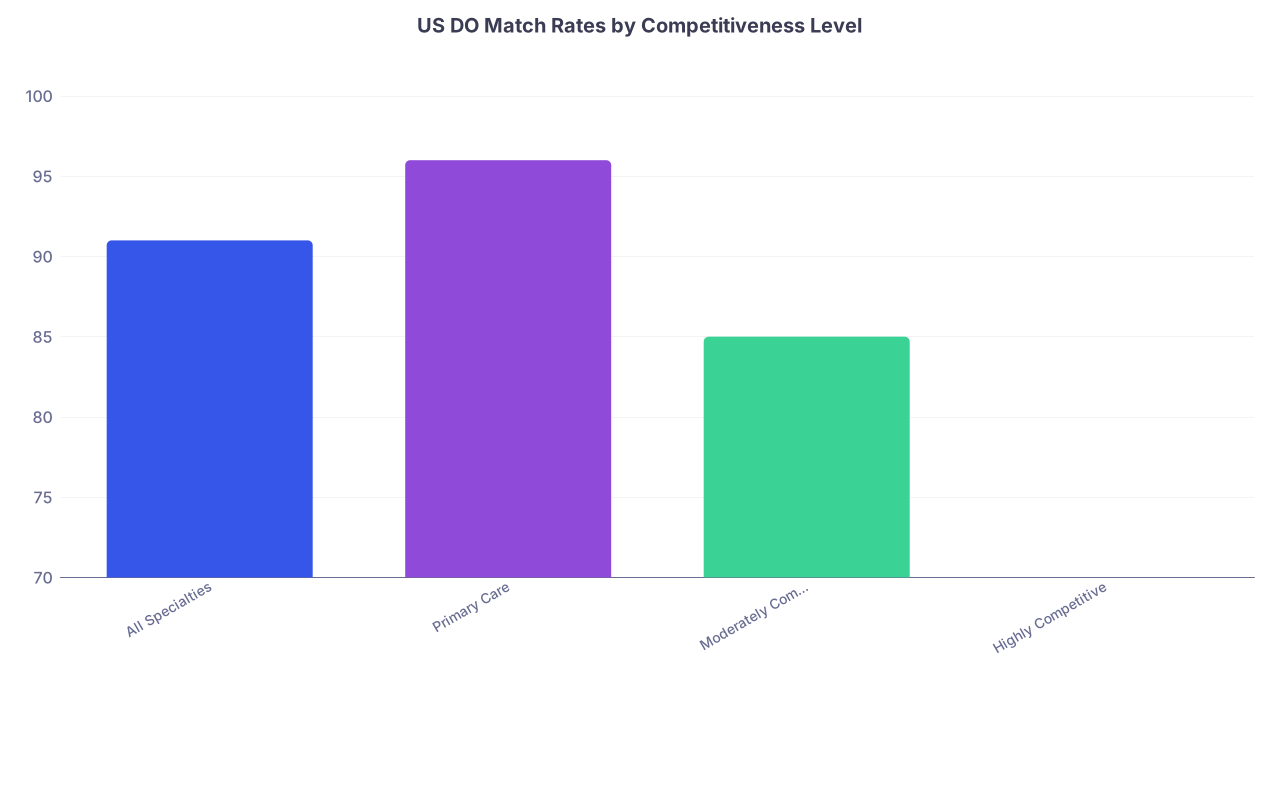
| Category | Value |
|---|---|
| All Specialties | 91 |
| Primary Care | 96 |
| Moderately Competitive | 85 |
| Highly Competitive | 70 |
Rough pattern (ballpark numbers vary by year, but trend holds):
- DOs match very well into primary care and less competitive specialties.
- DOs can and do match into EM, anesthesia, psych, PM&R, neuro with solid scores and apps.
- DOs match into ortho, derm, ENT, neurosurg, plastics but at lower rates and usually with stronger-than-average metrics (Step scores, research, networking).
OMM is not what’s closing doors. The DO letters and school “tier” factor more than whether you personally like cranial.
If you’re aiming competitive:
Prioritize what programs actually care about.
- Step 2 / Level 2 score (yes, even with Step 1 P/F)
- Class rank
- Research and letters
- Rotations at target institutions
Your OMM grade matters only in the sense that failing it derails everything.
Be strategic about how “osteopathic” you present.
You don’t have to brand yourself as an OMM evangelist. You can:- Mention OPP/OMM briefly as extra MSK training.
- Emphasize your broader skill set, not your comfort doing muscle energy on a C2.
Use OMM where it helps, ignore where it doesn’t.
On rotations:- MSK complaints? Maybe a quick rib or lumbar technique earns you patient gratitude and attending approval.
- Complex ICU patient? Probably not the moment for CV4.
You’re allowed to be selective.
Stop catastrophizing OMM into a permanent identity.
The vast majority of DO attendings I see in hospitals:- Use little to no OMM in daily practice.
- Are seen simply as “doctors,” not as alternative practitioners.
OMM becomes a footnote, not the headline.
So no, hating OMM doesn’t doom your career. Failing OMM or letting it wreck your board prep? That can.
The Nuclear Question: Should You Try to Switch to MD?
You might be thinking, “I don’t just hate OMM. I hate that I chose DO at all.”
Let’s separate two groups:
- Group A: You like medicine, you’re okay being a DO, you just hate OMM.
- Group B: You’re fundamentally unhappy with being in a DO program at all.
If you’re Group A, switching to MD solely to avoid OMM is almost never rational. You’d be:
- Losing years
- Losing money
- Reapplying with a “why are you leaving med school?” question hanging over you
All so you can skip a lab you’re going to barely use later anyway.
If you’re Group B (truly misaligned with DO, OMM is just one symptom), you at least owe yourself an honest look at the options:
Intra-medical-school transfer (DO → MD) is functionally nonexistent.
MD schools very rarely take transfers, and when they do, it’s typically from other MD schools, and almost always for advanced standing with USMLE + clinical performance, not pre-clinical dissatisfaction.Dropping out and reapplying MD is possible but brutal.
Risks:- Schools may see you as a flight risk or a quit.
- You explain a gap and a withdrawal.
- You spend 1–3 extra years and six figures more.
Sometimes it’s right (true misfit, mental health crisis, or deep ethical conflict). But “I don’t like OMM class” almost never rises to that threshold.
Think in probabilities, not fantasies.
Ask:- Realistically, how likely is it I get an MD acceptance if I reapply with a withdrawal from DO?
- How much more debt and time am I taking on?
- What’s my Plan B if I don’t get in?
Talk to someone who isn’t emotionally invested.
Not your equally-frustrated classmate. A:- Dean of students
- Physician mentor (MD or DO) who knows match realities
- Licensed therapist who can help separate “I hate today” from “this is wrong for me long-term”
If after all that, you still feel in your gut that continuing in DO would be a bigger life mistake than walking away, you make a clean decision and own it.
But most students, once they calm down, land here:
“I don’t love OMM. I can tolerate it. My real job is to become an excellent physician in my chosen specialty.”
That’s a workable place.
How to Survive OMM Practicals Without Losing Your Mind
OMM practicals are where the resentment crystallizes. You’re half-dressed, stressed, being judged on skills you’re not planning to use.
You don’t need to be great. You need to be competent enough to pass reliably.
Here’s a bare-bones survival framework:
Know the exam rubric.
Print or screenshot it. Most OMM practicals grade:- Setup: patient position, doctor position, contact points
- Diagnosis: stating proper somatic dysfunction
- Technique performance: hand placement, movement, sequence
- Safety: no neck-cranking, no obvious harm
- Communication: explaining what you’re doing
You win by doing the rubric, not by being a genius palpator.
Script your words.
Have canned phrases ready:- “I’m placing my hands on your ___ to assess motion and tissue texture.”
- “I’m going to treat this restriction using a muscle energy technique. I’ll have you gently push against my hand.”
Saying the right thing cleanly sometimes rescues shaky hands.
Practice like choreography, not like art.
For each tested technique:- Step 1: where do my feet go?
- Step 2: where do my hands go?
- Step 3: what direction do I move this structure?
Run that sequence 10–15 times with a partner. You’re building muscle memory, not insight.
Accept “good enough” on diagnosis.
Tons of students can’t perfectly feel the difference between, say, L3 flexed, rotated right vs. L4 extended, rotated left. Faculty know this.
Often you can earn majority of points by having:- A plausible diagnosis
- Correct technique for that diagnosis
- Safe, confident execution
Aim to be boring, not brilliant.
Examiners remember people who are unsafe or wildly off-script. You want to be the student they barely remember: showed up, did the thing, moved on.
Using OMM to Your Advantage (Without Becoming “The OMM Person”)
Here’s the twist: even if you hate OMM, there are ways to turn it into a quiet asset.
You don’t have to become the OMM club president. Minimalist version:
On rotations, when someone has a straightforward MSK complaint and there’s downtime, you can offer:
“If you’re open to it, I’m trained in some manual techniques that might reduce your muscle tension a bit.”
If it helps and your attending is reasonable, you just became memorable in a good way.In interviews, if asked about DO vs MD, you can say:
“The additional musculoskeletal and hands-on training has given me a more precise feel for physical exam, even when I’m not formally doing OMM.”
Short, neutral, professional.For boards, your OPP knowledge helps pad your COMLEX score. A high Level 1/2 can offset some bias against DO for certain programs.
You’re using the system, not being used by it.
Bottom Line: How to Decide Your Next Move
You’re in a DO program, you hate OMM, and you’re trying to figure out whether to adapt or bail.
Strip it down:
- Be specific about what you actually hate: philosophy, time, touch, or what DO/OMM symbolize for your career.
- Treat OMM as a professional requirement you handle efficiently, not a personal ideology you have to embrace.
- Only entertain leaving the DO path if your misalignment is global and deep, not just “I don’t like this one part of the curriculum.”
You don’t have to love OMM. You just have to decide whether it’s a tolerable tax on your way to being the physician you want to be, or a sign you’re fundamentally in the wrong place.
Most of the time? It’s a tax. Pay it strategically. Then move on.