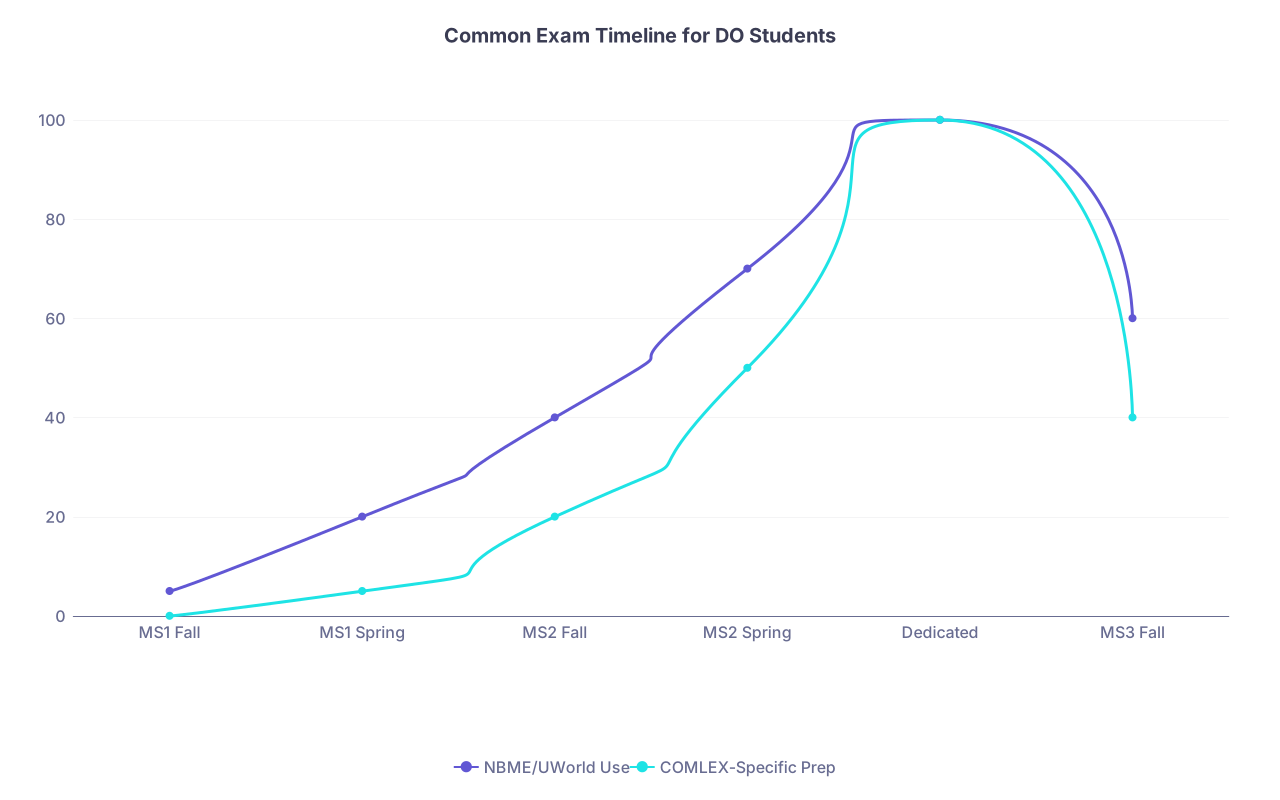
| Category | NBME/UWorld Use | COMLEX-Specific Prep |
|---|---|---|
| MS1 Fall | 5 | 0 |
| MS1 Spring | 20 | 5 |
| MS2 Fall | 40 | 20 |
| MS2 Spring | 70 | 50 |
| Dedicated | 100 | 100 |
| MS3 Fall | 60 | 40 |
Most DO students mess up their exam strategy not because they are lazy or incapable, but because their timeline is wrong. They treat COMLEX and USMLE like two separate mountains instead of one coordinated climb.
You are not just “taking some tests.” You are designing a 2–3 year exam campaign that will affect your specialty options, where you match, and how miserable (or sane) your clinical years feel.
Let’s fix that.
Step 1: Decide If You Should Take USMLE at All
Let me be blunt: the worst exam plan is a vague one.
“I’ll see how school goes and decide later” is how students end up cramming USMLE in 3 weeks during MS3, half burned out, half on call. I have watched that movie. It usually does not end well.
You need a provisional decision by early MS1 and a firm decision by mid MS2.
Who should strongly consider USMLE?
If any of these are true, you should almost certainly plan to take the USMLE Step 1 (and usually Step 2):
- You are even mildly interested in a competitive specialty:
- Dermatology, orthopedics, otolaryngology, neurosurgery, plastics, urology
- Highly competitive IM programs (think academic powerhouses: Mayo, MGH, Hopkins, UCSF, etc.)
- You want maximum geographic flexibility, especially in:
- California, Northeast academic centers, or big-name university programs
- You already know you test well on standardized exams and scored high on:
- SAT/ACT, MCAT, or practice board-style questions
- Your school’s graduates match better when they have both exams (ask the dean or look at match lists).
Who might reasonably skip USMLE?
You might skip USMLE Step 1 if:
- You are very confident you want:
- Family medicine, internal medicine (community), pediatrics, psychiatry, PM&R, pathology at mid-tier or community programs
- Your school has strong relationships and match history in those fields using COMLEX alone.
- You struggle significantly with standardized tests and adding another exam may lower both your performance and your sanity.
Even then, I consider taking USMLE Step 2 only a strong option. It is scored, programs care about it, and it is more clinically grounded than Step 1.
Timeline decision rule
Here is the rule I push on students:
- By the end of MS1 fall: Assume you are taking USMLE Step 1.
- By the middle of MS2 fall: Reassess. If your COMSAE/NBME practice scores are chronically low and you are not considering competitive specialties, you can pivot and drop USMLE strategically.
But you cannot build a serious exam plan by “waiting to see” until dedicated. That is how you end up underprepared on both exams.
Step 2: Understand the Exams and How They Overlap
You are not studying for two completely different universes.
USMLE and COMLEX share 70–80% core content. The divergence is in:
- Style of questions
- Level of detail
- OMM / osteopathic principles
- Ambiguous wording and “two right answers” feel on COMLEX
Key differences (that matter for planning)
USMLE Step 1
- Pass/Fail
- Heavy on mechanisms, pathophysiology, “why”
- Cleaner, more logical questions
- Strong alignment with:
- UWorld
- NBME practice exams
- Sketchy/Boards & Beyond/Pathoma style resources
COMLEX Level 1
- Still scored (0–800; 400–450 is common pass zone, 550+ competitive)
- More clinically vague vignette style, often less precise
- Includes:
- OMM
- Osteopathic philosophy
- Some weirder question-writing patterns
- Better aligned with:
- COMBANK, COMQUEST, TrueLearn
- Savarese OMT Review
So you do not need two separate study programs. You need:
- A USMLE-centered core that builds a strong foundation.
- A COMLEX-specific layer added strategically at the right times.
Step 3: Big-Picture Timeline – MS1 through MS3
Here is the general structure that works for most DO students planning for both exams.
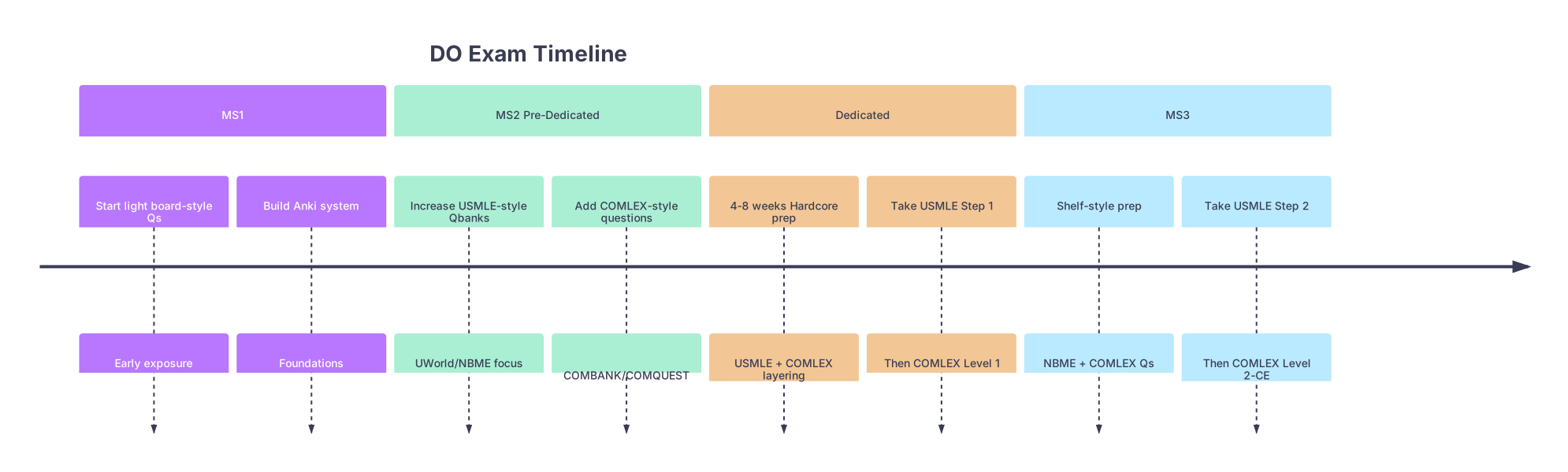
| Period | Event |
|---|---|
| MS1 - Start light board-style Qs | Early exposure |
| MS1 - Build Anki system | Foundations |
| MS2 Pre-Dedicated - Increase USMLE-style Qbanks | UWorld/NBME focus |
| MS2 Pre-Dedicated - Add COMLEX-style questions | COMBANK/COMQUEST |
| Dedicated - 4-8 weeks Hardcore prep | USMLE + COMLEX layering |
| Dedicated - Take USMLE Step 1 | Then COMLEX Level 1 |
| MS3 - Shelf-style prep | NBME + COMLEX Qs |
| MS3 - Take USMLE Step 2 | Then COMLEX Level 2-CE |
That is the skeleton. Now let’s build the muscle.
Step 4: MS1 – Quietly Building a Test-Taking Machine
MS1 is not about hitting massive question counts. It is about habits and infrastructure.
Your goals in MS1
- Learn systems-based content solidly.
- Start learning in a board-relevant format.
- Build a spaced repetition system that will carry you through MS2.
MS1 practical plan
During each block:
- Use Anki (or equivalent) tied to:
- Your school’s lectures
- A consistent board resource (e.g., Boards & Beyond or equivalent)
- Add 10–15 board-style questions per week starting mid–MS1:
- Early on: Any question bank your school provides (Kaplan, AMBOSS, etc.)
- Goal is pattern recognition and comfort with stems, not high scores.
End of MS1 spring:
- Do a small block of USMLE-style questions (100–200 total):
- Purpose:
- Benchmark where you are
- Identify weak systems early
- Purpose:
- Start a light OMM habit:
- 1–2 hours/week with Savarese or school OMM question sets
- This is insurance so you are not cramming OMM from scratch during dedicated
Do not obsess over scores in MS1. You are building a framework, not performing yet.
Step 5: MS2 – The Real Exam Engine
MS2 is where your decisions start to matter.
Here you decide:
- How seriously you are taking USMLE
- How early you bring in COMLEX-specific prep
- How you will align school exams with your board timeline
Core MS2 study structure
Your four pillars:
- Primary video/text resource (Boards & Beyond, Sketchy, etc.)
- Anki or similar spaced repetition
- USMLE-style Qbank (UWorld, AMBOSS)
- COMLEX-specific Qbank later in MS2 (COMBANK, COMQUEST, TrueLearn)
Early MS2 (first 3–4 months)
Your focus is USMLE foundation.
Weekly plan example:
- 5–6 days/week:
- 2–3 hours: Systems content (video/text + notes tied to your curriculum)
- 30–60 minutes: Anki reviews
- 3–4 days/week:
- 10–20 USMLE-style questions (UWorld or AMBOSS), tutor mode, heavy review
At this stage, USMLE-style questions train how to think. COMLEX will come later.
Mid MS2 (4–6 months before exams)
You now pivot to a heavier question-based schedule.
- USMLE Qbank:
- 20–40 questions/day, 5–6 days/week
- Mixed or system-based depending on school blocks
- COMLEX Qbank (start here):
- 10–15 questions/day, 3–4 days/week
- Focus:
- Getting used to COMLEX question style
- OMM / osteopathic principles
- Risky-sounding answer choices that USMLE would never use, but COMLEX might
Milestone by mid MS2:
- You have touched most major organ systems in:
- Content (videos/notes)
- USMLE-style questions
- You have started to see COMLEX vignettes often enough that they are no longer shocking.
Step 6: Dedicated Period – Sequencing USMLE and COMLEX
This is where many DO students torpedo themselves. Wrong order. Wrong spacing. Wrong focus.
Correct order for most DO students
For almost everyone taking both:
- Take USMLE Step 1 first.
- Take COMLEX Level 1 second, usually 7–14 days later.
Why?
- USMLE content prep is more structured and higher fidelity.
- COMLEX builds on the same core knowledge but tests it less cleanly.
- It is easier to add OMM + COMLEX question style on top of a strong USMLE core than the other way around.
How long should dedicated be?
This depends on how hard you worked in MS2.
- Aggressive, well-prepared student:
- 4–6 weeks of dedicated can be enough.
- Average student with uneven prep:
- 6–8 weeks of serious, focused dedicated is safer.
- Struggling or heavily behind:
- 8–10 weeks if your school allows it and you use it properly (not endless passive rereading).
Dedicated structure: 6–8 week example
Weeks 1–4: USMLE-centric
Daily (6 days/week):
- 2–3 UWorld blocks (40 questions each) timed + full review
- 1–2 hours of targeted content review based on missed questions
- OMM:
- 30–45 minutes every other day:
- Savarese
- OMM flashcards
- COMLEX Qbank OMM questions in small sets
- 30–45 minutes every other day:
Weekly:
- 1 NBME or equivalent assessment every 1–2 weeks
- Track progress. Adjust weak areas aggressively.
Final 1–2 weeks before USMLE:
- Focus on:
- High-yield systems
- Rapid review materials (First Aid-type resources, summary charts)
- Only light COMLEX exposure so you do not pollute your USMLE test-taking instincts.
Between USMLE and COMLEX (7–14 days):
Now you flip the ratio.
- COMLEX Qbank: 60–80 questions/day
- OMM:
- 1–2 hours/day
- Drill viscerosomatic levels, Chapman points, counterstrain positions, autonomics
- Practice full-length COMSAE or COMSAE-style exams:
- At least 1–2 before exam day
You are not relearning content here. You are:
- Translating USMLE thinking to COMLEX style
- Adapting to length, pacing, and weird question tone
- Getting your OMM sharp enough to pick up easy points
Step 7: Positioning COMLEX vs USMLE Scores Strategically
You have another layer to consider: how programs see your scores.
If your USMLE practice scores are consistently stronger
- Still sit for COMLEX (obviously required).
- Make sure COMLEX is scheduled close enough to USMLE that knowledge carries over.
- Accept that COMLEX may be slightly lower percentile; that is fine if USMLE is strong.
If your COMLEX practice scores are better than USMLE
This is actually common for DO students who lean heavily into COMLEX-style qbanks and OMM.
You have options:
- Focus dedicated more on COMLEX and tolerate a modest USMLE performance if:
- You are not chasing hyper-competitive specialties.
- Your goal is solid mid-tier or community programs that accept COMLEX.
- Or defer USMLE if:
- You truly cannot raise your practice scores despite smart work.
- You are committed to a less competitive field.
But you cannot make this call intelligently without real practice data:
- COMSAE practice exams
- NBME practice exams
- Qbank percentages after thousands of questions, not hundreds
Step 8: Step 2 / Level 2 – Do Not Repeat Your Mistakes
Too many DO students treat Level 2/Step 2 as an afterthought. Then they realize too late that for many programs:
- Step 2 (or Level 2) is now the main scored exam they care about.
You fix that by planning early.
General sequencing for clinical year exams
For most DO students taking both:
- Take USMLE Step 2 first.
- Follow with COMLEX Level 2-CE 1–4 weeks later.
This parallels what you did for Step 1/Level 1.
When in MS3 should you take them?
Common, functional timeline:
- Finish your core rotations in:
- Internal medicine
- Surgery
- Pediatrics
- OB/GYN
- Psychiatry
- Start serious board-style prep around:
- 4–5 months before your desired test date.
Some students:
- Tuck Step 2 between rotations with a 2–4 week lighter or elective block.
- Or use a late spring / early summer window before ERAS applications are due.
MS3 prep approach
During each rotation:
- Use NBME-style questions (e.g., UWorld Step 2, AMBOSS) tied to the shelf exam.
- For COMLEX:
- Use a COMLEX-specific clinical qbank later in MS3.
- Especially before Level 2-CE.
Dedicated for Step 2 / Level 2:
- 4–6 weeks of focused review is usually enough if:
- You studied during rotations
- You did consistent shelf-style questions
Priority:
- Step 2:
- 60–80 USMLE-style questions per day
- Frequent practice exams
- Level 2:
- 40–60 COMLEX-style questions per day for 1–3 weeks after Step 2
- Short, frequent OMM refreshers
Step 9: Concrete Timelines – Three Sample Scenarios
Let’s make this painfully clear with real timelines.
Scenario A: DO Student, Wants IM or FM, Taking Both Exams
- MS1:
- Light questions, Anki, occasional OMM.
- MS2:
- Heavy UWorld during spring.
- Start COMLEX qbank 4–6 months before exams.
- Dedicated (June–July after MS2):
- June 10: Start dedicated
- July 10: USMLE Step 1
- July 20: COMLEX Level 1
- MS3:
- Solid shelf prep.
- May MS3: Start dedicated Step 2 prep
- June 20: USMLE Step 2
- July 10: COMLEX Level 2
Scenario B: DO Student, Strong Candidate, Interested in Ortho
- MS1:
- Same as above, but more disciplined with Anki and early qbanks.
- MS2:
- Aggressive UWorld schedule.
- Multiple NBME practice tests.
- Dedicated:
- 8 weeks:
- USMLE Step 1 around week 6
- COMLEX Level 1 7–10 days later
- 8 weeks:
- MS3:
- Early Step 2:
- Strong analytic prep
- Aim for high Step 2 score to offset pass/fail Step 1
- COMLEX Level 2 shortly after Step 2
- Early Step 2:
Scenario C: DO Student, Initially Planned USMLE, Decides to Drop It
- MS1:
- Assumes USMLE, but no big commitment yet.
- MS2 mid-fall:
- NBME practice and Qbank performance show chronic weakness.
- Student has no interest in competitive specialties.
- Pivot:
- Drop USMLE plan officially.
- Shift resources:
- Less time in UWorld
- More time in COMLEX qbank and OMM
- Dedicated focused purely on:
- Level 1
- OMM
- COMLEX-style vignettes
This is not failure. It is strategic. What is failure? Pretending you are going to crush both exams when all your data says otherwise, then underperforming on both.
Step 10: Guardrails – How to Know If Your Timeline Is Broken
Here are signs your plan needs fixing:
- You do not know your practice exam baseline for either USMLE or COMLEX.
- You have done fewer than 1,000 USMLE-style questions by the start of dedicated.
- You have done almost no COMLEX-specific questions before scheduling Level 1 or 2.
- Your OMM studying is:
- “I’ll just wing it from school lectures.”
If any of those are true, your current trajectory is off.
Here is how to fix it quickly:
- Schedule a practice NBME and a COMSAE within the next 4 weeks.
- Count how many total board-style questions you have completed so far.
- Build a 12-week calendar that:
- Hits 3,000–4,000 USMLE-style questions before USMLE.
- Hits 1,500–2,500 COMLEX-style questions before Level 1/2.
- Decide now, not later, what order you will take the exams in and how many days apart.
Step 11: Tools You Actually Need (and What to Ignore)
You do not need 14 resources. You need a clean spine and a few focused add-ons.
Baseline spine
- One main video/outline resource for MS1–2 content.
- One main USMLE qbank (usually UWorld).
- Space repetition (Anki, Firecracker, or school cards).
Osteopathic / COMLEX layer
- Savarese OMT Review (or equivalent compact OMM text).
- One main COMLEX-level qbank (COMBANK, COMQUEST, or TrueLearn).
Practice exams
- Multiple NBMEs for USMLE.
- COMSAEs for COMLEX (at least 1–2 before each COMLEX exam).
What to ignore:
- Constantly jumping between qbanks.
- Starting Step 2 qbanks in MS1.
- Hoarding resources “just in case.”
You are not building a museum. You are building a machine.
The Move You Should Make Today
Do this right now:
- Open a calendar and mark:
- A provisional USMLE Step 1 date
- A COMLEX Level 1 date 7–14 days later
- Then work backward:
- When does dedicated start?
- When do you need to finish your first full pass of UWorld?
- When will you take your first NBME and COMSAE?
If those dates are just vague ideas in your head, you do not have a plan. You have a wish. Turn it into a timeline you could hand to someone else and they would know exactly what you are doing in March, June, and August.
That is how you stop letting the exams control you and start running your own training campaign.