The residency conversation about DO vs. MD is not fair, not clean, and not what schools tell you. But it’s also not as hopeless or binary as Reddit makes it sound.
I’ve sat in those committee rooms. I’ve watched PDs flip through applicant lists, seen who gets dismissed in 10 seconds and who gets fought over. DO vs. MD absolutely comes up. Not in the way premed forums imagine, but it’s there, baked into people’s shortcuts and biases.
Let me walk you through what actually happens behind the closed door.
The First Dirty Truth: It’s Not DO vs. MD. It’s “Known Quantity” vs. “Unknown Quantity.”
Most students think program directors sit there thinking, “MDs are better,” or “DOs are worse.” That’s too simplistic. What they’re really thinking is:
Can I predict what I’m getting with this applicant?
MD from a well-known allopathic school? That’s a known quantity. The PD has worked with their grads for years. They roughly know what a “mid-tier” student from that school looks like on the wards.
DO from a smaller or newer osteopathic school? That might be an unknown quantity. Not because you’re less capable, but because the PD has fewer data points.
So on a practical level, here’s what happens when a list of 800 applicants shows up:
- MD from state school they know well + solid board scores + decent letters → low friction. Easy to interview.
- DO from a school they’ve had one or two great residents from → positive bias if those people did well. “We’ve had good luck with XXXXCOM.”
- DO from a school they’ve never heard of + no home rotation at their site + average scores → more hesitation. Not “no,” but higher bar to stand out.
I’ve literally heard the line:
“Anyone know this DO school? Have we had people from here before?”
If the answer is yes and they were strong, doors open. If the answer is no, you’re going to be judged harder on everything else.
This is why the same DO applicant looks “dead in the water” at one program and “excellent candidate” at another. It’s not abstract prejudice. It’s familiarity and risk tolerance.
How DO vs. MD Really Shows Up at Different Tiers of Programs
Let’s get specific, because vague advice is useless.
At high-prestige, research-heavy university programs (think big-name IM or surgical departments), the order of sorting often looks like this:
- Filter by USMLE Step 2 score or similar standardized metric. Even now, with Step 1 Pass/Fail, they still lean on objective numbers.
- Filter by school pedigree. Ivy, top-20, big allopathic state schools rise to the top of the stack.
- Then they look at research, letters from “name” faculty, and away rotations.
Where do DOs fall in that world?
- If you’re a DO with a high Step 2 (think 245+ for competitive fields, 230+ for solid IM), strong letters from university attendings, and you rotated at that same program → you absolutely can get interviews. I’ve seen it many times.
- If you’re a DO with average scores, no large academic exposure, and no meaningful research → you’re invisible at those top programs. MDs with the same stats are also often invisible, by the way.
So at the top-tier level, DO vs. MD is a disadvantage, yes, but less if you’ve aggressively built a profile that screams “outlier.” High scores, real research, and direct contact with their faculty are how DOs crack those doors.
At mid-tier university and strong community programs, things are much more mixed. Some are very DO-friendly; others just “never really get DO applicants” (translation: they don’t look for them, but they’ll take a strong one).
Then there are osteopathic-heavy programs or community programs that have historically loved DOs. There, being a DO might actually be a small plus; you’re in their comfort zone.
The stupid myth that “DOs can’t match good residencies” is false. The more accurate statement:
DOs have a narrower margin for mediocrity at competitive and academic programs.
A mid MD gets the benefit of the doubt more often than a mid DO. That’s the ugly truth.
What Committees Actually Say Out Loud About DO Applicants
I’ll give you real quotes I’ve heard in ranking meetings and selection conversations. Not from 20 years ago. Recently.
From a university IM program director reviewing a DO applicant with 245 Step 2 and strong letters:
“He’s a DO but his numbers are great and look, Dr. X from our own hospital wrote him a fantastic letter. He’ll do fine here.”
Translation: the DO label raised a question, the rest of the file immediately erased the doubt. That “but” is exactly the uphill battle.
From a surgery associate PD flipping through files rapidly:
“We don’t really take DOs unless we’ve worked with them directly. Any DOs do a sub-I with us this year?”
That’s the key move: “worked with them directly.” For some programs, DOs without a home or away rotation at that site are almost never considered. They aren’t going to say that on their website, but that’s the house rule.
From a community FM program director, very DO-friendly:
“We love DOs. They come in ready to work. I don’t care what letters are after the name if they’re solid on wards.”
And that’s absolutely real too. Many community PDs genuinely do not care about DO vs. MD. They care about: Will this person show up, treat patients decently, and not create disasters for me?
So you end up with this three-bucket reality:
- “We’re skeptical of DOs unless they’ve proven themselves directly with us.” (Some competitive or conservative programs)
- “We’re neutral but we prioritize what we already know – which usually means MDs from familiar schools.” (A lot of mid-range programs)
- “We like DOs, we’ve had good experiences, and this is not a big factor.” (Many primary care and DO-heavy programs)
None of that nuance shows up on program websites.
The Board Exam Issue After Step 1 Went Pass/Fail
Here’s a behind-the-scenes shift: when Step 1 went Pass/Fail, a lot of PDs panicked quietly. They lost the clean number they’d been using as a blunt sorting weapon.
For DOs, that made Step 2 even more of a battlefield.
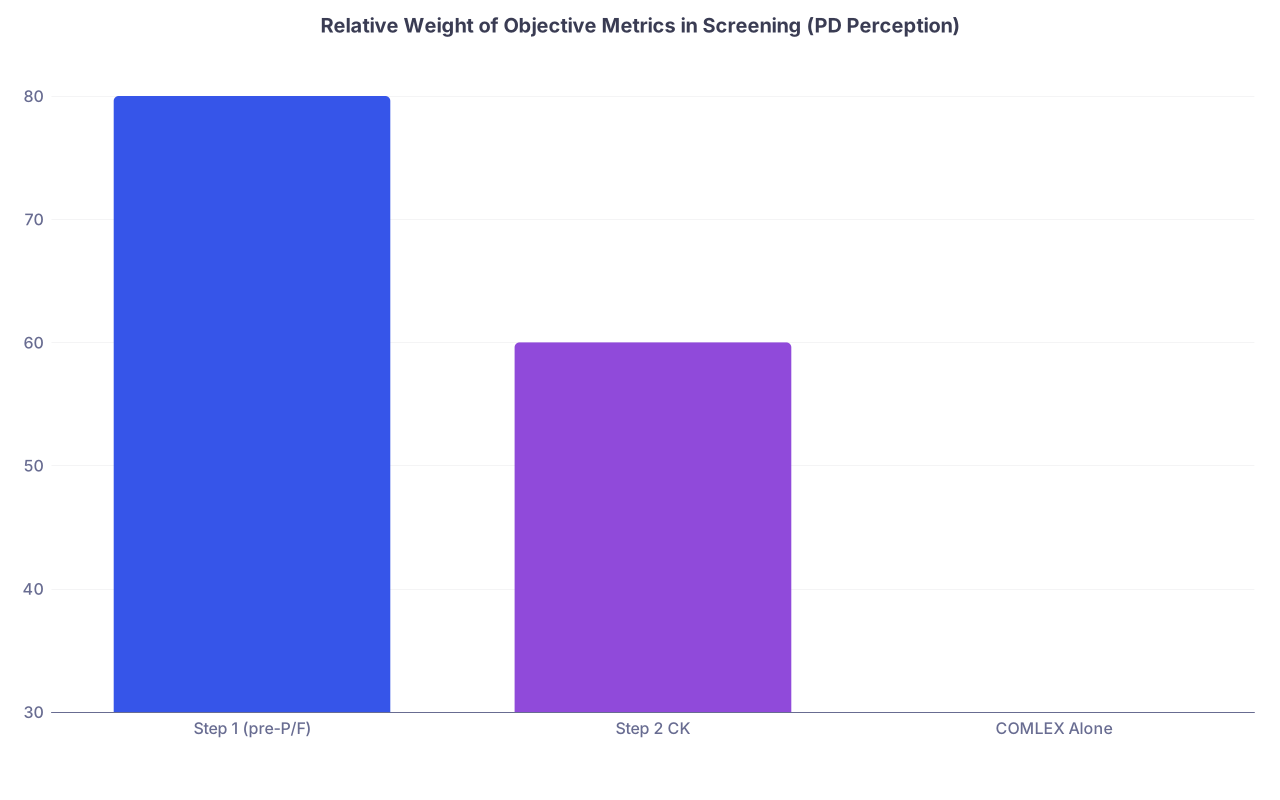
| Category | Value |
|---|---|
| Step 1 (pre-P/F) | 80 |
| Step 2 CK | 60 |
| COMLEX Alone | 30 |
These aren’t official percentages, but they reflect how PDs talk. Step 1 used to be the monster. Now Step 2 is the workhorse.
Here’s the part most DO students don’t want to hear:
Programs are still more comfortable interpreting USMLE than COMLEX.
I’ve seen this exchange more times than I can count:
Resident: “This DO has a 650 on Level 2, that’s pretty strong, right?”
Faculty: “Yeah, I think that’s good… do we have a USMLE score?”
If you want to be maximally competitive for non-primary-care or academic programs as a DO, taking USMLE Step 2 (in addition to COMLEX) is still, in most places, a net positive. Some PDs will say “COMLEX only is fine.” Then in private, they still sort their list mentally by USMLE.
Are there some specialties and programs starting to adapt COMLEX conversion charts and be more intentional? Yes. But we’re not there yet universally. And you’re gambling your entire career on the assumption that every screener will be enlightened and updated.
That’s not a bet I recommend for someone aiming at derm, ortho, rads, gas, or competitive IM.
Where DO vs. MD Still Matters a Lot (and Where It Barely Matters)
Let’s categorize it by specialty and setting, because that’s how PDs actually think.
High-stakes specialties: DO vs. MD is a big deal unless you’re exceptional
Dermatology, plastic surgery, orthopedics, ENT, neurosurgery, some competitive radiology and anesthesia programs.
In these worlds:
- MDs from top schools with 250+ Step 2, research, and home program connections are the default.
- DOs with similar scores and research exist, but they’re much rarer, and committees are more risk-averse.
I’ve watched ranking meetings where DO applicants are described like this:
“This DO is really impressive for a DO. Great scores, good letters, they rotated with us.”
That “for a DO” may sound condescending, but it’s revealing. They’re benchmarking you against a different reference group. You can absolutely break in, but the bar is higher and the margin of error is smaller.
Competitive-but-broad specialties: DO vs. MD is a factor, but not absolute
Internal Medicine at university programs, EM at solid institutions, pediatrics at big children’s hospitals, OB/GYN at academic centers.
Here, DOs with strong Step 2, solid clinical evals, and especially away rotations at that program are absolutely in play. The DO label might shift you from “auto-interview” to “needs a second look,” but it doesn’t kill you.
Where you get crushed is being average.
Average DO vs average MD? The MD gets the interview more often. Committees will deny that out loud. Their rank lists say otherwise.
Primary care and community-focused specialties: DO vs. MD matters the least
Family Medicine, community IM, community peds, many psych programs.
At many of these places, DOs are half or more of the resident class. Some PDs are DOs themselves. They know exactly what DO schools produce.
I’ve seen DO applicants with modest scores walk into strong community FM or IM programs because their letters screamed “hard worker, great with patients, no drama.” No one in that room cared about two letters on the diploma.
If your career goal is solid training and practice in a non-competitive field, DO vs. MD is more about your ego than your ceiling.
The Bias No One Admits: DOs Are Expected to “Over-Prove” Themselves
Even at programs that are “DO-friendly,” there’s often an unspoken expectation:
If you’re DO, you need to show a little more to be seen as equal.
More concrete examples:
- On away rotations, DO students tell me they feel like they can’t have an off day. They’re not wrong. MD students get more slack; DO students are watched as a “test case.”
- Letters for DOs that sound generic (“hard-working, pleasant, will be a good resident”) are read more harshly. Committees are looking for a reason to believe you’re above whatever stereotype they’re carrying.
- A DO with a 230 Step 2 is read as “pretty solid.” An MD with a 230 from a known school is read as “we know that’s fine; we’ve matched people like this before.”
The playing field isn’t level.
Is it fair? No. Is it changing? Slowly, yes. I’ve seen younger PDs especially care less about the degree and more about objective metrics and performance they’ve seen in person.
But if you walk into this process pretending DO vs. MD doesn’t matter at all, you’re setting yourself up for unpleasant surprises.
What You Can Actually Control as a DO Applicant
You can’t rip “DO” off your diploma. But there are specific levers that move you from “risky unknown” to “clearly strong” in PD eyes.
Here’s how DO students I’ve seen succeed actually did it:
They treated rotations as live auditions, not just required experiences.
They were strategic about USMLE.
They hunted for letters from people PDs actually recognize.
They didn’t apply blindly to programs that quietly never take DOs.
Let’s break that down.
Away rotations: the DO’s equalizer
If you’re DO and trying for anything more competitive than low-key community programs, away rotations are not optional. They’re your proof-of-concept.
On the inside, here’s how it works:
- Programs remember rotating students much more than paper applications.
- If you impressed them, your name shows up with: “This one rotated with us – really good.” That single comment can override your school name and degree.
- I’ve watched weaker-paper MDs get passed over for DOs who crushed a sub-I and had a champion on faculty.
If you’re DO and never step foot in the kind of program you want (academic IM, EM, OB, etc.), you’re relying entirely on your PDF to speak for you. That’s a losing move in borderline cases.
USMLE vs COMLEX: what PDs won’t tell you openly
If you want maximum flexibility, especially for non-primary-care specialties, take USMLE Step 2. COMLEX alone is still a handicap at many programs. They might like you, but they don’t know where to rank you.
I’ve heard some PDs say: “If a DO didn’t take USMLE, I assume they either didn’t prepare enough or they’re aiming only for DO-heavy programs.” Brutal, but that’s how some interpret it.
You can fight that perception or use it strategically. Your choice. But be conscious of the reality.
The Hard Conversation: If You’re Still Choosing Between DO and MD
This is the premed and early med school section you probably came for.
If you’re choosing between:
- A mid/low-tier MD school, and
- A DO school
and you have any thought — even a faint one — of going into a competitive specialty or a top academic program, pick the MD. Every time.
That MD gives you a slightly wider docking bay at competitive residencies. Your school name shows up in their mental database as “we know their grads.”
If your options are:
- No MD acceptance anywhere, and
- One or more DO acceptances
Then it’s simple. If you want to be a physician, take the DO and go become a star. You can absolutely build a strong career, and most of the DOs I know who matched well did it by playing the long game: board scores, early specialty exploration, strong clinical performance, and networking hard during fourth year.
The worst position is denial. Going DO while believing “it’s the same now, everything is merged, residencies don’t care anymore.” That’s how you end up bitter in fourth year, realizing too late that the bar was higher for you and you didn’t train for it.
Know the game you’re entering. Then decide if you want to play it.
How Committees Really Justify Their Choices to Themselves
Here’s the final thing almost nobody talks about: PDs and committees do not sit there thinking, “We prefer MDs because we’re elitist.” They tell themselves a different story.
They tell themselves:
- “We’re just going with the safest bets. We’ve had good experience with X school.”
- “We’re not biased against DOs, we just want objective metrics we trust.”
- “We would totally rank DOs higher if we saw more who rotated with us/had research/had higher scores.”
In other words, they frame it as risk management, not discrimination.
From the outside, as a DO applicant, it feels like a wall. From the inside, it feels like “we’re using the tools we have to minimize bad matches.” Both can be true at the same time.
Your job is to make yourself feel like a low-risk, easy yes.
That means:
- You give them the metrics they understand.
- You put yourself physically in their hospitals when possible.
- You collect advocates who will actually speak up for you in those closed rooms.
Because at 10 PM on rank night, when a tired PD is staring at a giant list, they’re not thinking about DO vs. MD in big philosophical terms. They’re thinking:
“Whose name do I remember from wards?”
“Who has a letter I trust?”
“Who feels like a safe choice not to blow up in July?”
You want to be the person that triggers recognition, not doubt.
The Bottom Line
Three things to walk away with:
- DO vs. MD still matters to residency committees, especially at competitive and academic programs, but not as an absolute barrier — more as a higher bar and lower forgiveness for mediocrity.
- As a DO, you can absolutely match strong programs, but you must over-prove: strong Step 2 (often USMLE), strategic away rotations, real letters from recognizable faculty, and smart targeting of programs that actually take DOs.
- If you’re still choosing your path and care about competitive specialties or elite academics, a mid-tier MD generally gives you a smoother road; if DO is your route, go in clear-eyed and prepared to outwork the assumptions baked into the system.