
You’re a premed scrolling Reddit at 1:30 a.m., staring at a thread titled “DO without USMLE—am I screwed?” Or you’re a first-year DO student hearing second-years argue in the lounge: “You have to take Step 2 at least,” “No, my faculty said COMLEX is fine now,” “That’s old info, bro.”
Meanwhile, on the other side of this mess, a program director is sitting in a windowless office, clicking through ERAS with a cold coffee and 400 applications in their queue. Half the time, they’re making decisions in under 15 seconds per file.
Let me tell you what actually happens when a PD sees a COMLEX‑only DO file versus an MD application with USMLE scores. Not the brochure version. The real version.
The First 10 Seconds: How Your File Is Really Screened
Here’s the unromantic truth: your fate at a lot of programs is decided before anyone reads your personal statement, research section, or “I learned empathy from my grandma” essay.
Program directors (and more often, their coordinators or chief residents) usually do this first:
- Pull all applicants into a spreadsheet or dashboard.
- Sort or filter by test score: USMLE first, or combined, depending on the software.
- Apply an auto-cutoff.
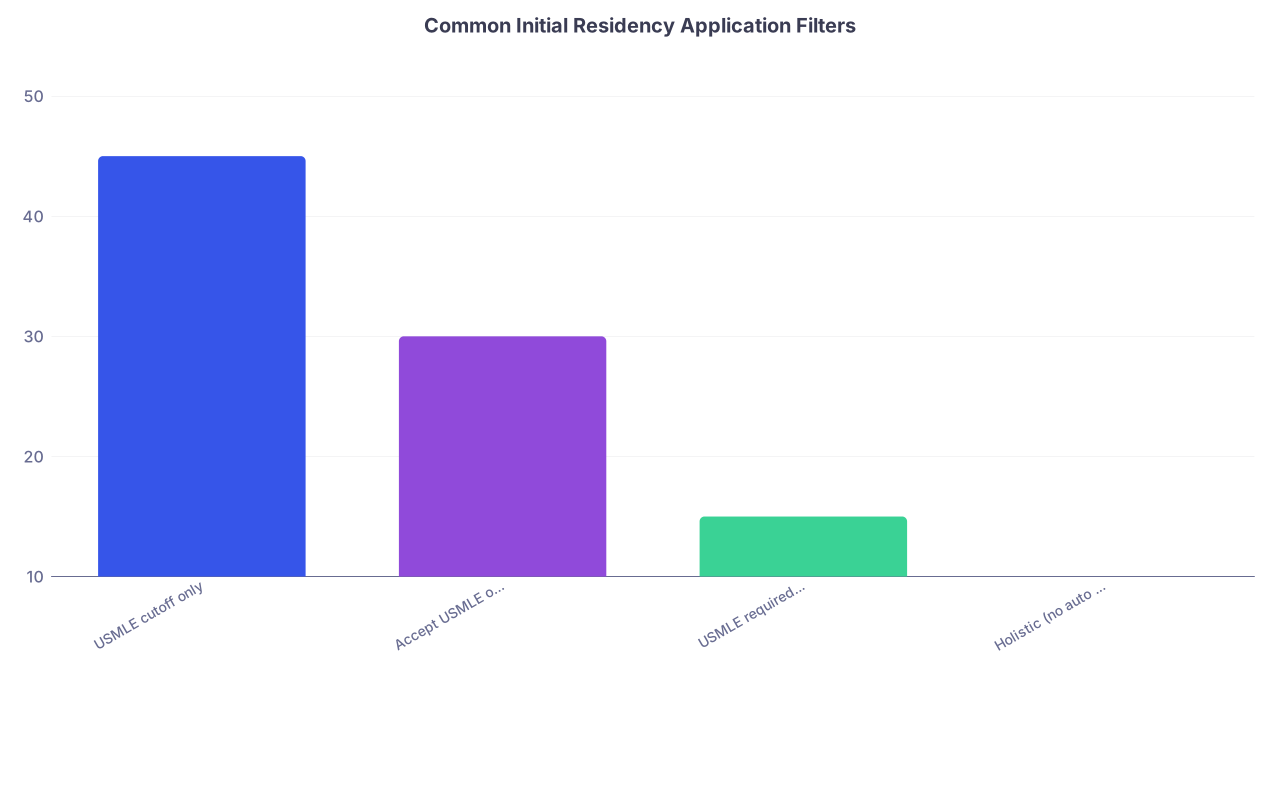
| Category | Value |
|---|---|
| USMLE cutoff only | 45 |
| Accept USMLE or COMLEX | 30 |
| USMLE required for DOs | 15 |
| Holistic (no auto cutoff) | 10 |
Those numbers are approximate, but they’re in the right ballpark from conversations I’ve had with PDs and coordinators. The key is the behavior: a huge chunk of programs still sort by USMLE score as their main numeric screen.
So what happens when your file shows up as:
- MD, Step 1: Pass, Step 2 CK: 247
versus - DO, COMLEX 1: 561, COMLEX 2: 596, no USMLE
Here’s the part nobody tells you clearly: the default mental model for most PDs is built around USMLE, not COMLEX. They live in a USMLE world. They talk in USMLE numbers. They swap “we’re around 235–240 this year” with other PDs, not “we’re around 580 COMLEX”.
So when your file has only COMLEX, two very different patterns emerge depending on the type of program.
Where COMLEX-Only is Genuinely Fine (and Where It’s Not)
I’ll be blunt: “COMLEX only is fine everywhere now” is a lie people tell themselves so they can sleep better. It’s not malicious, it’s just about 5–10 years behind.
There are three rough buckets of programs:
- DO-heavy or historically AOA programs
- Middle-of-the-road MD programs
- Brand-conscious, university, or competitive specialty programs
Each group treats COMLEX very differently.
1. DO-Heavy / Historically AOA Programs
These are places where half (or more) of the resident class is DO. Think community IM programs with a long DO presence, some EM, FM, psych, and certain regional systems.
Behind the scenes, I’ve heard this exact sentence more times than I can count from these PDs:
“If they’re DO and have solid COMLEX, I don’t care about USMLE.”
And they mean it.
At these programs:
- They understand COMLEX ranges. They know 500 is average-ish, 550+ is solid, 600+ is strong.
- Their current chief who’s killing it clinically scored a 540 COMLEX and never touched USMLE.
- They often do not have any extra hoops for DOs. You’re evaluated in your own exam ecosystem.
If you want to stay in the COMLEX-only lane and never take USMLE, you should be strategically aiming for these kinds of programs and specialties: primary care, a decent slice of IM, some psych, some EM (though EM has gotten more complicated after the merger), PM&R, peds in certain regions.
Can you match without USMLE here? Yes. Every year. Many do.
The catch? Your geographic and prestige flexibility shrinks. And that matters more than people admit.
2. Middle-of-the-Road MD Programs
This is where things get fuzzy and where most DO students get blindsided.
These PDs say nice words on their websites:
- “We accept COMLEX or USMLE.”
- “We value osteopathic applicants.”
But internally, the conversation in the selection committee looks more like this:
“What’s their Step 2?”
“They don’t have one, just COMLEX.”
“Okay… what is that, like a 560? What does that even map to?”
“I think there’s some chart… hang on.”
“…let’s just put them on the ‘maybe’ pile and see how many we get with Step scores.”
Not overtly hostile. Just… not fluent in your language.
These programs:
- Usually sort by USMLE because the majority of their pool is MD.
- May technically accept COMLEX-only, but practically, when they set a cutoff like “Step 2 ≥ 220”, they don’t always have a clean, consistent convertor they trust.
- Often assume: “A DO who didn’t take USMLE might be weaker, or is avoiding it.” They don’t always say that out loud, but I’ve heard it behind closed doors.
Do some PDs here make a good-faith effort to understand COMLEX? Yes. Usually the younger ones, or those who’ve trained DO residents before. But many older, more traditional academic folks just never fully adopt it in their mental framework.
3. Brand-Conscious / Academic / Competitive Specialty Programs
This is where COMLEX-only is, frankly, a problem.
I’ve sat in on these meetings. I’ve heard the unfiltered version:
“If they want to be here and they’re serious, they take USMLE.”
“We need apples to apples with our MD pool.”
“If they didn’t take Step 2, I don’t know what that means for boards.”
These programs often include:
- University IM programs trying to send residents to cards/GI/fellowships.
- Surgery, ortho, ENT, derm, rad onc, urology, neurosurgery (when they take DOs at all).
- Big-name EM programs in saturated markets.
- Gas, rads, and some higher-prestige psych/PM&R spots.
Many of these will never put this in writing, but the internal rule is effectively:
“DOs must have USMLE Step 2 to be ranked.”
Some are open about it on FREIDA or their website. Many are not. But the rank list behavior gives them away: look at their current residents. If they have a DO, that DO almost always has strong USMLE scores.
How PDs Actually Translate COMLEX to USMLE in Their Heads
You’ve probably seen those conversion calculators floating around. PDs have too. And most of them don’t trust them.
I’ve heard:
- “That COMLEX 600 is ‘supposed’ to be like a 240, but my DO last year had a 575 and got a 252 on Step 2, so who knows.”
- “These tools always inflate the equivalence. I don’t buy that a 550 is a 235. I just don’t.”
So what do they do in practice?
- Some just say: “600+ COMLEX = strong. 550–600 = okay. Below 500 = I’m worried.”
- Others mentally deflate the converter by 5–10 USMLE points because they’ve been burned before.
- Many simply avoid making a precise translation and instead look at patterns: strong grades, strong letters, solid rotations.
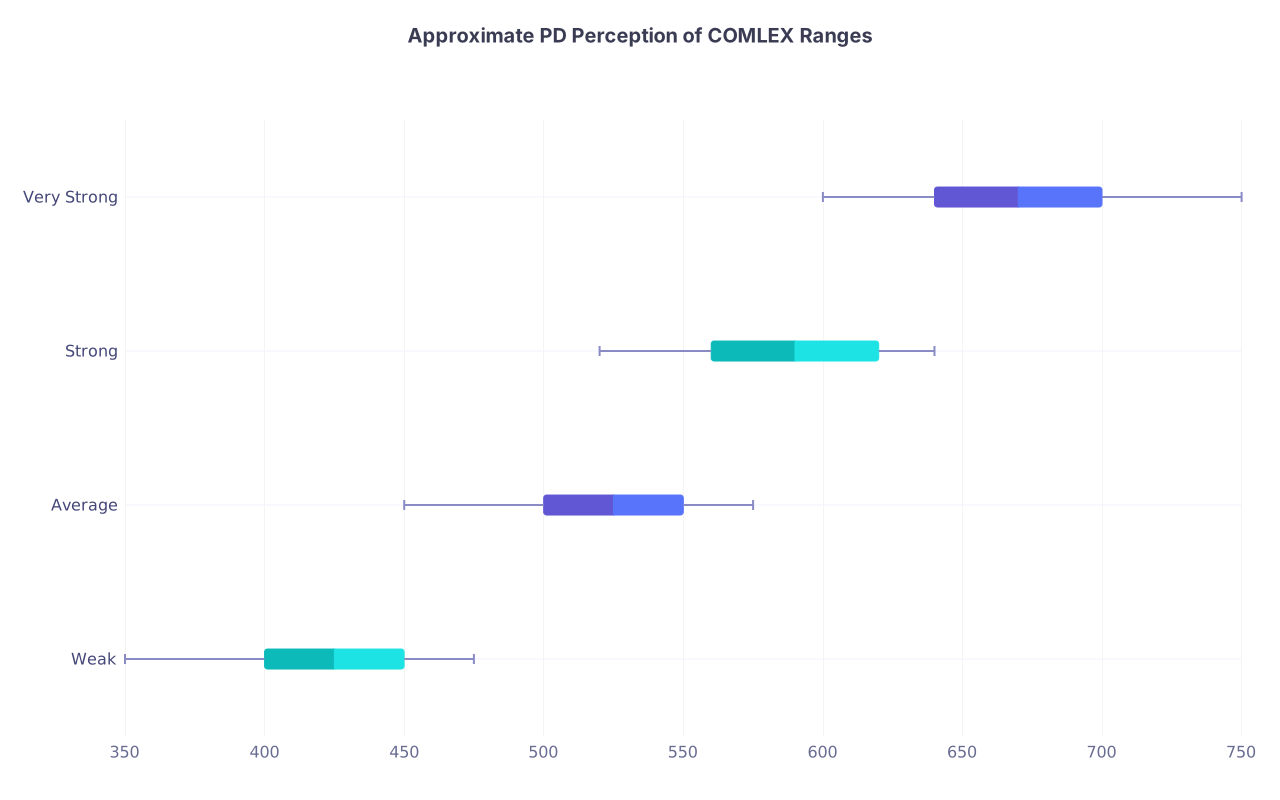
| Category | Min | Q1 | Median | Q3 | Max |
|---|---|---|---|---|---|
| Weak | 350 | 400 | 425 | 450 | 475 |
| Average | 450 | 500 | 525 | 550 | 575 |
| Strong | 520 | 560 | 590 | 620 | 640 |
| Very Strong | 600 | 640 | 670 | 700 | 750 |
Again, not exact numbers. But it captures the vibe: below ~500 makes them nervous, 550–600 feels acceptable, 600+ gets attention.
The MD applicant with a Step 2 of 247? They know exactly where that lands. They’ve seen years of internal data, in-training exam correlations, and board pass rates based on USMLE.
With COMLEX, most PDs are operating off anecdotes and vibes.
And when they’re unsure, they default to what they know: USMLE.
The Unspoken Bias: “If You Really Wanted This, You’d Take Step”
This part is uncomfortable, but it’s real.
Among many PDs—especially in competitive specialties or university programs—there’s a quiet narrative:
“If a DO applicant didn’t take USMLE, it’s either because they were scared to, didn’t think they’d do well, or aren’t serious about more competitive training environments.”
Is that fair? Not really. But it exists.
I’ve heard DO students say:
- “My school told me not to bother with Step.”
- “I’m just going into FM, I don’t need it.”
- “They said program directors now fully respect COMLEX.”
Meanwhile, a PD at a mid-tier academic IM program literally told me:
“If a DO doesn’t have Step 2, I assume they’re either poorly advised or not as ambitious. That’s not always true, but that’s my reflex.”
That’s what you’re up against.
For MDs, USMLE is simply the default. Step 1 pass/fail changed the game a little, but Step 2 CK is now the main hard metric. MD applicants must swim in that pool. There’s no perceived “choice.”
For DOs, PDs see taking USMLE as a signal:
- Signal that you can handle their metric system.
- Signal that you’re willing to compete head‑to‑head with MDs.
- Signal that you’re planning ahead for harder fellowships, if needed.
Do you need that signal for every program? No. For some, your COMLEX alone is enough. But for many places that attract large, competitive MD pools, going COMLEX‑only is like showing up to a chess tournament with checkers pieces. They might let you in, but you’re already at a disadvantage.
Specialty By Specialty: How Harsh Is the Difference?
Let me cut through the noise and give you the real pattern I’ve seen.
Primary Care (FM, Many IM, Peds, Community Psych)
COMLEX-only is:
- Very acceptable at DO-heavy or community programs.
- Reasonably accepted at many mid-tier MD programs, especially in regions with lots of DO schools (Midwest, South, parts of Northeast).
- A weaker position at big-name university programs, especially IM and peds.
If you want broad geographic reach and a shot at stronger IM or peds programs, USMLE Step 2 is a very smart insurance policy.
EM, PM&R, Anesthesia, Radiology, Psych (Academic Lean)
These are “in-between” specialties.
For DOs:
- EM used to be DO-friendly everywhere; that’s fading at some university departments after the merger. Large EM programs increasingly prefer or quietly require USMLE.
- PM&R, gas, rads, psych: many will list “COMLEX accepted,” but their ranked DOs almost all have USMLE. That’s not a coincidence.
I’ve seen very strong COMLEX-only DOs get filtered out or never interviewed at places where a slightly weaker MD with a known Step 2 score gets a look.
Surgery and the Competitive Stuff (Ortho, ENT, Derm, Uro, NSG, Rad Onc)
Here, the rule is brutal:
If you’re a DO without USMLE, many programs will never consider you a serious contender.
Look at their current DO residents (if any). Nearly every DO in those programs has at least Step 2, often with excellent scores. That’s your real data set. Not the comforting one-line statement on their website.
Can a COMLEX-only DO match ortho? Once in a blue moon, usually at a historically DO-heavy or niche program where they really know COMLEX and value osteopathic grads. But you’d be betting your entire career on being the exception in a numbers game that’s already ugly.
What This Means for You as a Premed or Early Med Student
You’re premed or early MS1/MS2. You’re not deciding Step 2 tomorrow, but you are deciding your trajectory.
Here’s the part everyone glosses over: your decision to go DO vs MD is indirectly a decision about USMLE flexibility.
For MD students:
You’re automatically locked into USMLE. No question, no angst. PDs know exactly what to do with your scores. All the mental calibration they’ve built over decades works for you.
For DO students:
You live in dual‑exam limbo. You must decide:
- Do I go all-in on COMLEX and accept a narrower set of programs?
- Or do I take USMLE (at least Step 2) and keep more doors open?

| Step | Description |
|---|---|
| Step 1 | Start DO School |
| Step 2 | Plan for USMLE Step 2 |
| Step 3 | COMLEX-only may be reasonable |
| Step 4 | Align coursework with USMLE style |
| Step 5 | Take Step 2 CK |
| Step 6 | Focus on DO-friendly programs |
| Step 7 | Interested in competitive specialties or academic programs? |
| Step 8 | Want geographic & program flexibility? |
The “we accept COMLEX” era is only half-true. The more honest statement is:
“We accept COMLEX in theory. In practice, our system, habits, and biases are built around USMLE.”
You can pretend that doesn’t matter. PDs don’t.
What PDs Tell Me Privately About DOs and Exams
Let me lay out the most honest lines I’ve heard, word for word, from PDs in the last few years:
- IM university PD: “If a DO doesn’t take Step 2, we can’t easily compare them to the rest of our pool. I’m not going to gamble when I have 600 applications.”
- Community FM PD: “I don’t care about USMLE for DOs. Strong COMLEX, good letters, we’re fine.”
- Ortho academic PD: “We don’t say it online, but we don’t rank DOs who haven’t taken USMLE. It’s too risky for us with our board pass pressure.”
- EM PD: “Officially we say COMLEX is fine. Realistically, every DO we’ve ranked in the last 3 years has had Step 2 with a solid score.”
- Psych PD: “I wish I understood COMLEX better. I’m getting there. But my faculty still speak USMLE, and they’ll ask ‘what’s their Step’ on every file review day.”
That last one is more common than you think. Faculty reviewers—who influence rank lists heavily—ask “what’s their Step?” even when the PD is trying to modernize.
When it comes down to a stack of 40 decent applicants for 10 interview spots, they’re choosing the ones they understand fastest. That’s the ugly, practical layer of all of this.
So, Should a DO Take USMLE or Not?
There’s no one-size answer, but I’ll be very clear with my own rule:
- If you’re DO and even thinking about a competitive specialty, academic program, or keeping fellowships wide open: plan for USMLE Step 2 CK.
- If you’re committed to primary care and genuinely don’t care about big‑name places or specific hot markets, and your school is strongly supportive of COMLEX-only: you can skip it, but you’re trading optionality for comfort.
The premed mistake is assuming “by the time I get there, this will all be fixed and everyone will respect COMLEX the same.” No. Culture moves slower than policy.
The PDs making rank lists right now trained in a USMLE world. Many don’t fully understand COMLEX. Some never will before they retire.
You’re not just dealing with a test. You’re dealing with a generation’s habits.
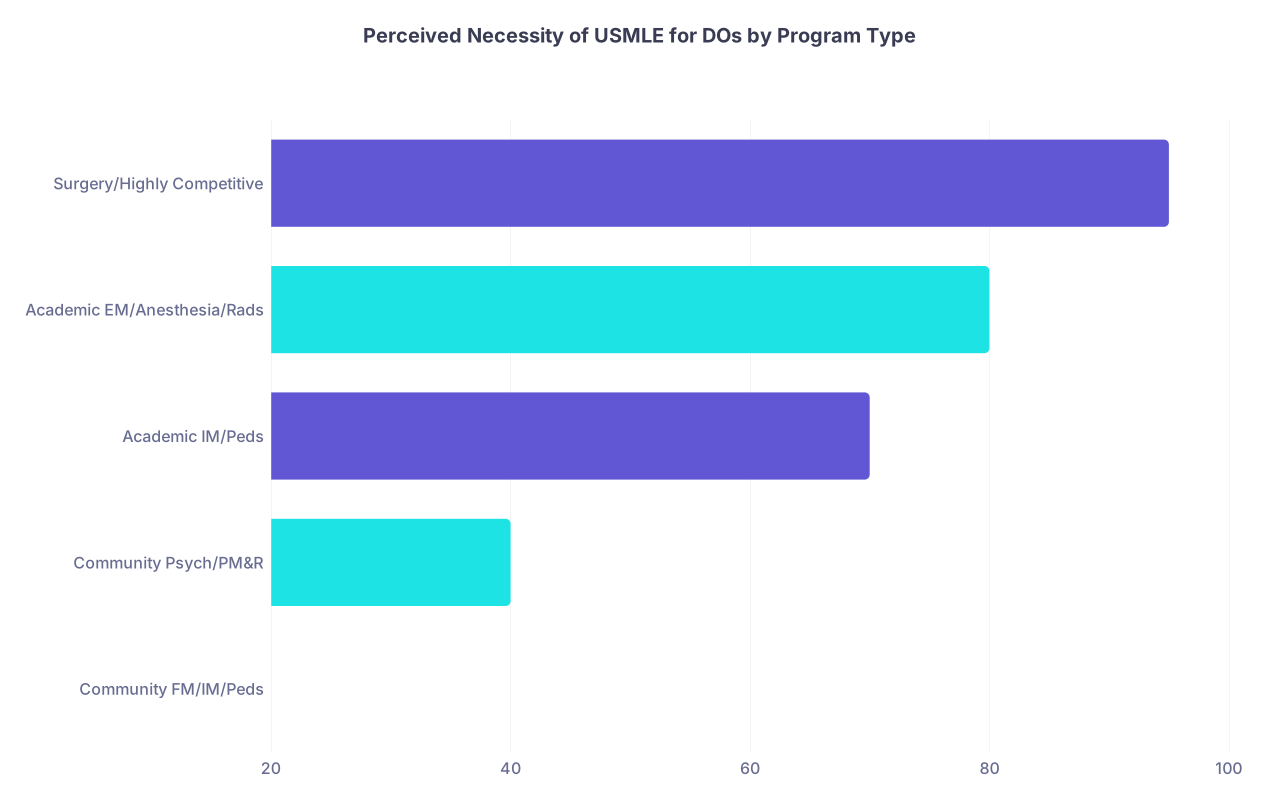
| Category | Value |
|---|---|
| Community FM/IM/Peds | 20 |
| Community Psych/PM&R | 40 |
| Academic IM/Peds | 70 |
| Academic EM/Anesthesia/Rads | 80 |
| Surgery/Highly Competitive | 95 |
Those are perception numbers: percentage of programs where PDs informally treat USMLE as strongly preferred or essentially required for DOs. The exact numbers aren’t the point. The gradient is.
The MD Side: Why Their Files Hit Differently
Let me flip the lens for a second.
When an MD file lands on a PD’s screen with:
Step 1: Pass
Step 2: 244
that PD’s brain instantly connects that number to:Years of internal data: “Our 244s usually pass boards, perform fine on wards, might land mid‑tier fellowships.”
Direct comparisons: “He’s right in line with our current PGY-2s.”
It’s a stable currency.
When they see:
- COMLEX 1: 575
- COMLEX 2: 610
they might intellectually know that’s good. But it doesn’t anchor to the same deep pattern recognition. They’re guessing more.
And in a risk-averse environment (board pass rates, ACGME reviews, reputation, fellowship match brag slides for med students), PDs avoid guessing.
So MDs get the benefit of the doubt. DOs, without USMLE, don’t.
Again, not always. But often enough to affect your odds.
How to Use This Information Without Losing Your Mind
If you’re still premed:
- When you choose DO vs MD, don’t just look at “MD is harder to get into, DO is more flexible.” You’re also choosing how much extra exam strategy and program filtering you’ll face later.
- If you go DO, go in eyes open: you’ll need to make a conscious call about USMLE later. Not a panicked one in third year after hearing some horror story.
If you’re already in DO school:
- Start quietly asking your upperclassmen where they matched and whether they had USMLE. Ignore the brochure talk. Look at actual outcomes.
- Talk to your school’s PDs and advisors, then cross‑check with residents who matched where you want to go. Confirm the discrepancy; there almost always is one.
And if you’re stubbornly thinking, “I’ll be the exception, I’ll crush COMLEX and everyone will love me”—you might. There are always exceptions.
But I’ve sat in on enough selection meetings to tell you this: the system is not designed with COMLEX as the primary language. If you choose to only speak COMLEX, some programs simply won’t listen, no matter how loudly you shout.