You are here
You are a premed or early medical student. You keep hearing the same low-level noise:
“MDs get better residencies.”
“Some programs do not really respect DOs.”
“If you go DO, doors will close.”
And you are trying to be rational about it. You know DOs match derm, ortho, anesthesia, GI. You have seen it. But you also know there are perception gaps. Subtle ones. You hear comments on Reddit, from older attendings, even from classmates.
That is the problem you are trying to solve:
If you choose (or already chose) a DO route, how do you build a clinical profile so strong that those MD vs. DO perception gaps shrink to the point of irrelevance?
You will not fix systemic bias alone. But you can make yourself the kind of trainee where people stop caring about the letters and start noticing the work.
This is exactly how to do it.
Step 1: Accept the bias, then decide to outgrow it
You cannot fix what you will not name.
There are three realities you are up against:
- Some older physicians and some competitive programs still reflexively view MD as “default” and DO as “other.”
- A minority of DO schools have weaker clinical sites or less structured advising. That inconsistency spills over onto all DO students in the eyes of lazy evaluators.
- Program directors are risk-averse. When they do not know a school well, they lean on crude signals: school name, board scores, letters from known faculty.
So no, “DO=MD” in perception is not fully true yet. Pretending otherwise is delusional.
Your response is not to argue on Twitter. Your response is to build such a clean, high-signal clinical profile that you become a low-risk, high-upside pick for any reasonable program.
This means three priorities:
- Demonstrate you can perform at or above the level of strong MD peers in real clinical environments.
- Get your performance documented by people programs know and trust.
- Translate that performance into standardized signals program directors actually use.
Everything below is aimed at those three.
Step 2: Premed choices that shrink the future gap
If you are still premed, you can reduce the DO vs. MD perception problem before you ever matriculate.
2.1. Choose the strongest DO schools you can realistically reach
Not all DO schools are equal in the eyes of residencies. I am not going to pretend otherwise.
Pattern I see repeatedly:
DO schools with:
- Longstanding affiliations with large academic centers
- Older, established GME networks
- Strong in-house residency programs
→ Graduates face less skepticism.
Newer, stand-alone schools with:
- Many distant community rotations
- Thin research infrastructure
- Scattered clinical experiences
→ Graduates often have to work much harder to prove themselves.
When you evaluate DO schools, focus on:
- Where do 3rd- and 4th-year rotations happen?
- University hospital vs. random clinic 2 hours away.
- What residencies are attached?
- If the school’s main hospital has IM, EM, surgery, psych, OB/GYN residencies, that is a real asset.
- Match lists:
- Look specifically at ACGME university programs and competitive specialties.
If you are borderline MD/DO, a mid-tier MD with decent clinical infrastructure beats a new DO with no real hospital anchor. If you are likely DO-only, pick the DO that gives you the best clinical ecosystem, not the one with the newest building.
2.2. Use premed years to build “high-signal” clinical proof
You can start shrinking perception gaps before school.
Do real clinical work that puts you in the same rooms as MDs and DOs:
- EMT, ED tech, scribe in academic hospitals
- MA in subspecialty clinics (cards, ortho, GI)
- Long-term volunteer roles that actually involve patient contact, not just folding blankets
Your goals:
- Learn how hospitals really function.
- Get comfortable around attendings and residents.
- Collect early advocates who can eventually say, “This student was excellent even before school.”
You are not just “checking the box.” You are building the muscle memory and confidence that later makes you look indistinguishable from MD peers on day one of rotations.
Step 3: Academic and licensing decisions that neutralize doubt
You cannot talk your way out of a bad score report. This is where many DO students lose ground.
3.1. Treat Step 2/Level 2 as your single biggest equalizer
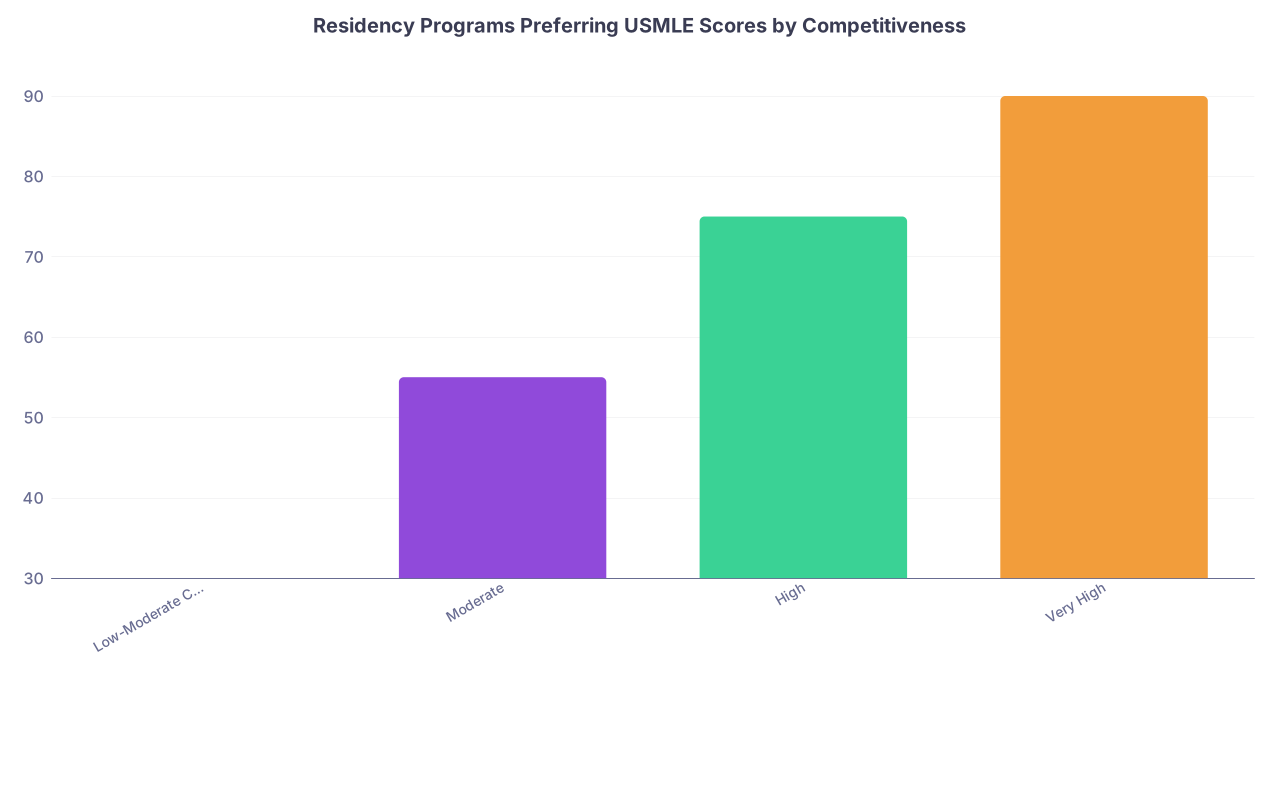
Step 1 is pass/fail. COMLEX still gives three-digit scores. Here is the uncomfortable truth:
- A strong Step 2 CK score will do more to erase MD vs. DO doubt than any speech about holistic review.
- Program directors repeatedly say: Step 2 is now the main standardized metric once Step 1 went P/F.
If you are DO:
Strongly consider taking USMLE Step 2 CK
- Many competitive programs still prefer or require it.
- A good Step 2 score places you in the same numeric pool as MDs.
Avoid the “COMLEX only, my dean says it is fine” trap.
- It might be “fine” for FM, psych at community sites, or less competitive IM.
- It is not fine for the top half of EM, anesthesia, surgery, ortho, derm, rads, etc., where applicant volume is high and risk tolerance is low.
| Category | Value |
|---|---|
| Low-Moderate Competition | 30 |
| Moderate | 55 |
| High | 75 |
| Very High | 90 |
Do not overshoot your capacity. But if you are serious about minimizing perception gaps, you aim to:
- Pass COMLEX comfortably.
- Score solidly on Step 2 CK. For many specialties, “solid” is:
- IM: 235–245+
- EM/Anesthesia: 240–250+
- Surgery: 245–255+
- Highly competitive (ortho/derm/rads): 250+ is safer
Is it harsh? Yes. Is it how real selection often works? Also yes.
3.2. Use preclinicals to set up clinical dominance, not just grades
Your preclinical strategy:
- Learn pathophysiology and common presentations so well that by the start of 3rd year you:
- Recognize patterns instantly.
- Can present succinctly.
- Can write a basic note without sounding lost.
This is not about getting every detail of the Krebs cycle right. It is about:
- Developing:
- Tight illness scripts (classic CHF, COPD exacerbation, DKA, sepsis).
- Clear mental templates for H&P.
The best way to do that:
- During preclinicals:
- Use question banks (UWorld, Amboss) early not just for exams, but to build that clinical pattern recognition.
- For every disease you study, ask: “How would this actually present? What would I tell my attending in 60 seconds?”
You want to hit 3rd year looking like someone who has been in hospitals before, not like a bright but clueless student seeing their first real patient.
Step 4: Clinical rotations – this is where you erase the gap
Rotations are where perceptions about DO vs. MD harden or disappear. You need a plan before day one.
4.1. Fight for the best clinical sites available
Many DO curricula scatter students across:
- Community hospitals
- Private practices
- Sometimes lower-volume, lower-complexity sites
You cannot always control it. But you can often influence it more than you think.
Actions:
Early in MS2, meet with your clinical dean or rotation coordinator:
- Ask, clearly and directly:
- “Which sites have the best teaching and the strongest residents?”
- “Where do previous students get their best evals and letters?”
- Do not be shy. This is not rude. This is your career.
- Ask, clearly and directly:
When ranking or selecting sites:
- Prioritize:
- Sites with residencies, especially in IM, EM, surgery.
- University-affiliated hospitals.
- Places where multiple students say: “The attendings actually teach and write good letters.”
- Prioritize:
If you get stuck at a weak site:
- Identify at least one attending who:
- Enjoys teaching.
- Has some academic connection (publishes, has title, etc.).
- Work closely with them. Ask for extra cases, clinics, or call shifts.
- Identify at least one attending who:
The goal is not just a rotation. The goal is a rotation that produces:
- A strong narrative letter.
- Concrete stories of you outperforming expectations.
4.2. Behaviors that make attendings forget your degree type in 48 hours
On day one of a rotation, you get about 15 minutes of mental bandwidth from a busy attending. They are looking for quick signals:
- Clueless vs. prepared
- Passive vs. proactive
- High-maintenance vs. low-maintenance
You cannot change your letters after your name. You can absolutely change those signals.
Here is the protocol I give students who want to crush rotations:
Before rotation starts:
Read:
- For IM: one short handbook (e.g., Pocket Medicine) plus a few high-yield topics (chest pain, SOB, fever, anemia, AKI).
- For surgery: common post-op issues, fluids, electrolytes, wound care, pain meds.
Email the coordinator 1 week before:
- Confirm start time, location, dress code.
- Ask if there is a recommended handbook or resource.
First 48 hours on service:
- Learn names fast. Residents, nurses, pharmacists. Use them.
- Ask the senior resident one question:
- “What do the best students on this rotation do that others do not?”
- Then actually do that.
- Always have something in your hands:
- Patient list.
- Penlight.
- Notepad.
Daily habits that immediately differentiate you:
Pre-round on your patients and:
- Know overnight events cold.
- Have vitals, labs, and major imaging ready without being asked.
Present:
- Brief, organized, no rambling.
- Assessment and plan with at least a first draft, even if you are wrong.
Volunteer judiciously:
- “I can call radiology and clarify that,”
- “I will track down those outside records,”
- “I can update the family after rounds, and then report back.”
This sounds basic. It is. But most students do not do it consistently. When you do, the question in the team’s head becomes: “Can we keep this student?” not “Is DO ok?”
Step 5: Letters of recommendation that actually move the needle
Letters from unknown community docs with generic praise do not help you close any gap.
You want high-signal letters:
- From people programs know (or know-of).
- That compare you directly – favorably – to MD peers.
5.1. Targeted letter strategy
Your goal: 3–4 letters that meet at least one of these criteria:
- Writer is core faculty at a residency program in the specialty you are applying to.
- Writer trained at or is affiliated with a recognizable academic institution.
- Writer has a reputation for being honest and not “everyone is excellent.”
How to secure those letters:
Identify potential letter writers early in each rotation:
- Someone who:
- Sees you regularly (not 1x/week clinic only).
- Gives you feedback.
- Seems respected by the team.
- Someone who:
About halfway through the rotation:
- Ask for feedback, bluntly:
- “I am aiming for IM/EM/surgery and want to be competitive with strong MD applicants. What would I need to do in the next few weeks to earn a strong letter from you?”
- Ask for feedback, bluntly:
Then do what they say. Relentlessly.
At the end of the rotation, when you ask for the letter:
- Provide:
- CV
- Draft personal statement
- Short bullet list:
- “Patients I followed closely”
- “Specific projects or cases I contributed to”
- “Feedback themes you gave me that I worked on”
- Provide:
Subtle but powerful: you are feeding them narrative material that lets them write,
“This student functioned at or above the level of many MD students I have worked with.”
You are not asking for them to say “better than MDs.” You are giving them the data so they can say it themselves if it is true.
Step 6: Strategic away rotations and networking
This is where DO students can close enormous ground in competitive fields.
6.1. Why aways matter more for DOs
An MD from a well-known school shows up on an application. Many PDs feel like they “know” roughly what that means.
A DO, especially from a lesser-known school? More uncertainty.
An away rotation does three things for you:
- Lets them see you work, directly, next to MDs from strong schools.
- Gives you a shot at a program-specific letter. Gold.
- Proves you are not just good “for a DO school” but good in their environment.
6.2. How to pick aways that actually help
For competitive specialties (EM, anesthesia, surgery, ortho, rads, derm), your targets:
- Programs that:
- Already have DO residents (less friction).
- Or explicitly mention DOs in their website materials.
- Locations:
- Places you are willing to actually rank highly. Aways double as month-long job interviews.
Do not waste aways on:
- Places that have never interviewed or matched a DO.
- Random community programs with no academic visibility, unless:
- You have strong geographic ties and will rank them highly regardless.
6.3. Performance protocol on away rotations
On an away, you have two jobs:
- Be obviously excellent.
- Be obviously normal.
By “normal,” I mean:
- Not the try-hard gunner that residents roll their eyes about at sign-out.
- Not the shadow who never speaks.
Concrete steps:
- Show up early, leave when residents do.
- Ask the senior: “What is the typical student schedule? What can I do to be most useful?”
- Never correct an attending in public. If you see something off, quietly ask a resident later.
- Say “yes” to work. Procedures. Extra consults. Late cases.
At the end of the rotation, you want at least one person on that team to tell the PD:
“If we do not interview this student, we are making a mistake.”
That comment, from a trusted resident or faculty, crushes a lot of DO vs. MD hesitation.
Step 7: Research and scholarly work – where DOs usually drop the ball
Many DO schools have thinner research infrastructure. So students either:
- Do nothing, or
- Do vague “QI projects” that never see daylight.
You are going to do it differently.
7.1. Find research outside your school if you must
Do not wait for your school to spoon-feed you a project.
Options that work:
Cold email faculty at nearby MD schools:
- Subject: “Med student interested in [field] – willing to help with data/chart review”
- Attach a short, clean CV.
- Emphasize you are reliable and not expecting first authorship immediately.
Use away rotations:
- Ask residents/fellows:
- “Is there anything I can help with – chart review, data collection, lit review?”
- Get your foot in the door on a small project.
- Ask residents/fellows:
Look for:
- Case reports where you can push the literature search and drafting.
- Retrospective chart reviews that need grunt work.
You do not need ten first-author original research publications. But you should aim for:
- 1–3 items that show:
- You know how to follow through on a scholarly project.
- You are at least marginally plugged into your chosen specialty’s academic ecosystem.
7.2. Translate research into talking points, not just lines on CV
Interviewers care less about the abstract and more about:
- “Can this person explain their role clearly?”
- “Can they think through the clinical question that led to the project?”
So, for each project, prepare:
- 1–2 sentences: big-picture question.
- 2–3 sentences: what you actually did.
- 1–2 sentences: what you learned that applied to patient care.
When you answer smoothly and confidently, the “DO vs MD” thing fades fast. You sound like everyone else who took their training seriously.
Step 8: How you present yourself in applications and interviews
You can sabotage all of this with sloppy presentation. Or you can use ERAS/interviews to reinforce one clear message:
“My training and performance are indistinguishable from strong MD peers.”
8.1. Application structure that highlights performance over pedigree
On your CV and ERAS:
Front-load:
- Strong board scores (if you have them)
- Honors in core rotations
- High-yield clinical experiences at recognizable institutions
When you describe experiences:
- Emphasize:
- Responsibility
- Autonomy
- Teamwork
- Concrete language:
- “Managed 5–8 patients daily under supervision.”
- “Led chart review for 120-patient cohort.”
- Emphasize:
Avoid:
- Over-explaining why you chose DO.
- Long philosophical tirades about osteopathic principles.
You can mention OMM and holistic care briefly. But do not make it sound like you are training for a different profession. You are applying to the same residencies as MDs. Your application should look like it.
8.2. Interview behavior that closes the loop
When you walk into an interview, most PDs are not sitting there thinking “DO vs. MD” actively. They are thinking:
- “Is this someone I want at 3 a.m. on a bad call night?”
Your job is to show:
- Clinical maturity
- Humility
- Reliability
Very specific tactics:
When they ask about a tough case:
- Describe what you did, not just what the team did.
- Show insight: “At the time, I missed X. Looking back, Y was a red flag.”
If they ask directly about being a DO:
- Do not get defensive.
- Simple answer:
- “I chose a DO school because [brief reason], and I am grateful for the training. On rotations at [well-known sites], I worked alongside MD students and residents and held myself to the same standards. In residency, my focus will be the same: strong clinical work and being a reliable team member.”
Then move on. You do not need to convert anyone to osteopathy. You just need them to trust you.

| Step | Description |
|---|---|
| Step 1 | Premed Choices |
| Step 2 | Strong DO or MD School |
| Step 3 | Preclinical Foundation |
| Step 4 | High-Quality Rotations |
| Step 5 | Strong Letters |
| Step 6 | Away Rotations |
| Step 7 | USMLE/COMLEX Strategy |
| Step 8 | Research & Scholarly Work |
| Step 9 | Compelling Application & Interviews |
| Step 10 | Reduced DO vs MD Perception Gap |
Step 9: Contingency planning if things are not perfect
Maybe your Step 2 is mediocre. Maybe your school is brand-new. Maybe you got stuck with weaker sites. You are not done.
You compensate by tightening every other signal.
9.1. Double down on clinical excellence and letters
If your scores are average:
- You need truly exceptional letters:
- “Top 5% of students I have worked with in the last five years.”
- “I would rank this student at the very top of our list.”
To get there:
- Pick one or two rotations where you go all-in:
- Longer hours.
- Ask for more responsibility.
- Ask explicitly: “What do I need to do to be one of the best students you have had?”
Then actually do it.
9.2. Adjust specialty targets realistically without giving up ambition
If numbers and context are against you for derm, ortho, or plastics at big-name places, be honest with yourself.
You can:
Pivot to:
- IM then subspecialty (cards, GI, pulm/crit) through strong IM programs.
- Anesthesia with a broader geographic list.
- EM or surgery at solid but less flashy programs.
Or do a staged approach:
- Strong transitional year / prelim IM or surgery.
- Then re-apply with stronger letters and performance.
Trying to strong-arm an ultra-competitive path from a position of weakness because you “deserve it” is how people go unmatched. Do not be that story.
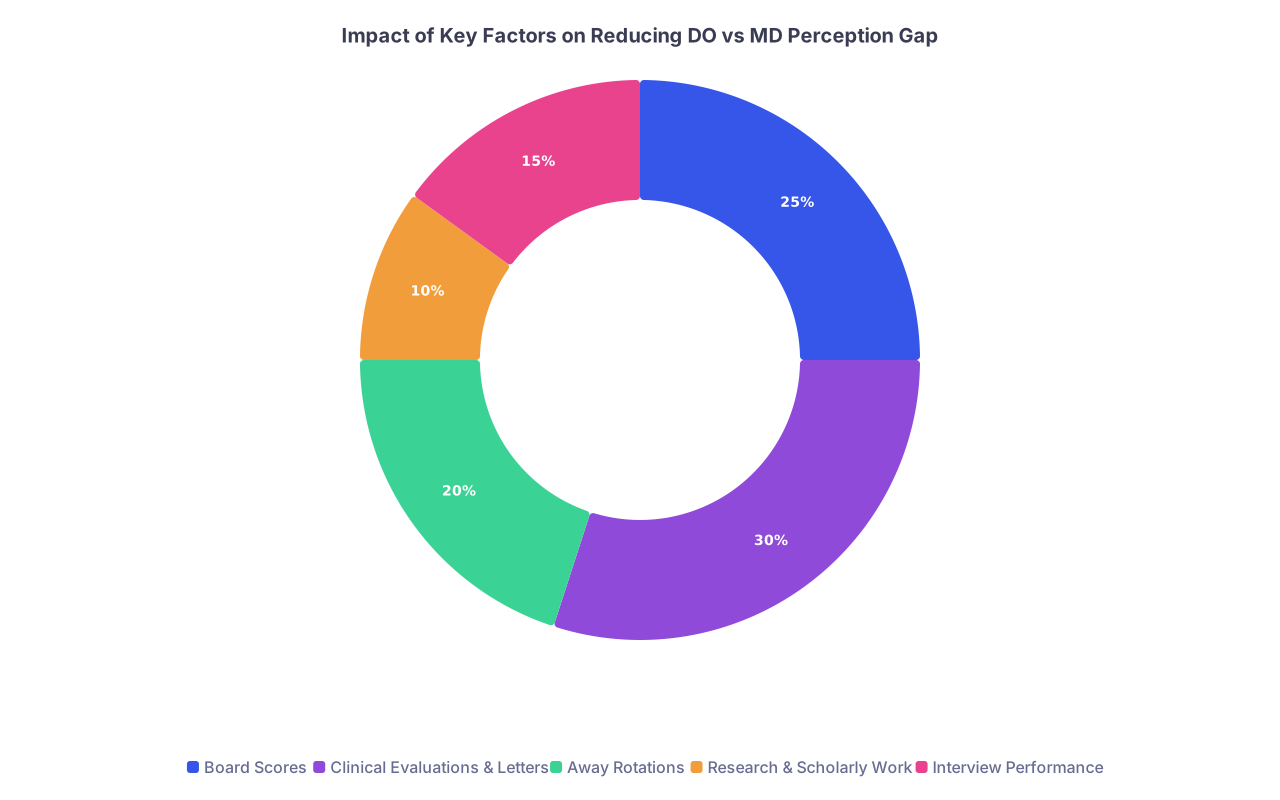
| Category | Value |
|---|---|
| Board Scores | 25 |
| Clinical Evaluations & Letters | 30 |
| Away Rotations | 20 |
| Research & Scholarly Work | 10 |
| Interview Performance | 15 |
Step 10: Mindset that keeps you sane and effective
Last piece. You cannot control every bias. You can control your reaction to it.
Three truths to keep in the back of your mind:
You do not need every program to “get it.”
You need enough of the right ones to see your actual value.A few closed doors do not define your ceiling.
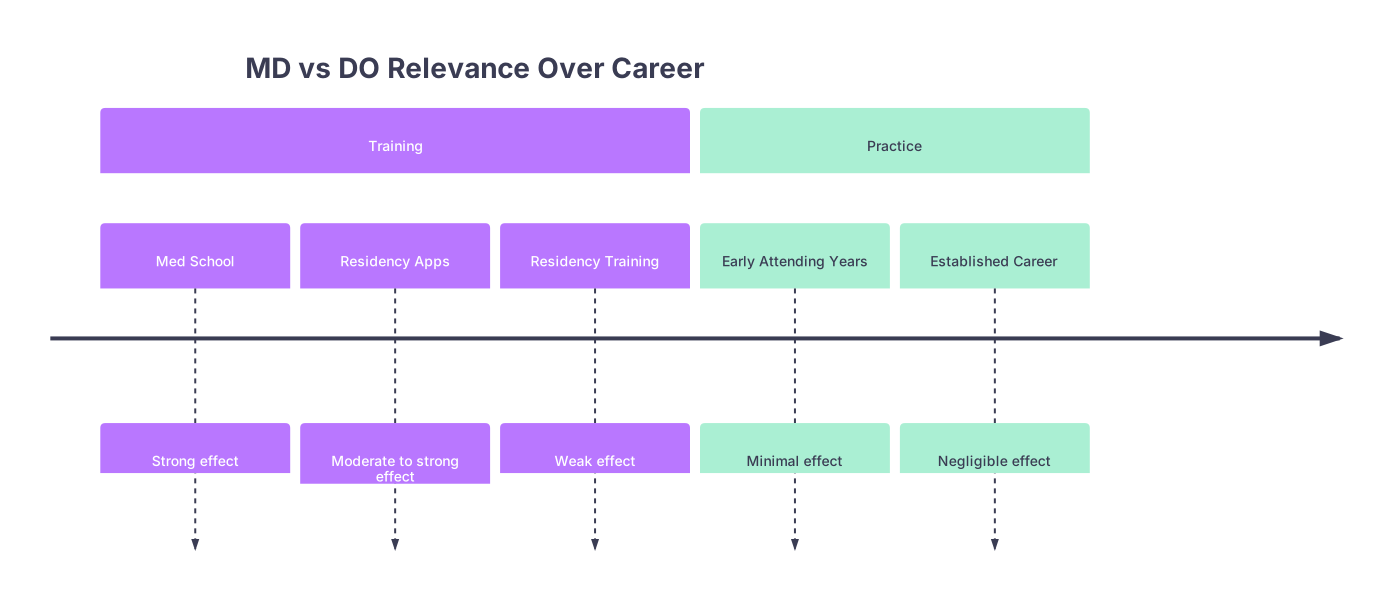
Many DOs end up in academic leadership, subspecialty practice, competitive fellowships. Because they did the work, consistently, over years.The letters after your name matter decreasingly every year after graduation.
Once you are board-certified and your patients and colleagues know you as “the doc who fixes the problem,” the MD vs. DO argument becomes background noise.
| Period | Event |
|---|---|
| Training - Med School | Strong effect |
| Training - Residency Apps | Moderate to strong effect |
| Training - Residency Training | Weak effect |
| Practice - Early Attending Years | Minimal effect |
| Practice - Established Career | Negligible effect |
Key takeaways
- You cannot wish away DO vs. MD perception gaps. You can outgrow them with undeniable clinical performance, strong board strategy, and high-signal letters from respected faculty.
- Your rotations, away choices, and day-to-day behavior on teams matter more than the philosophical debates. Be the student residents fight to keep, and the degree argument fades fast.
- Build a profile that looks like any top MD applicant: solid scores, robust clinical proof, credible research, and mature interviews. Once you do, most rational programs will stop caring about the letters and start focusing on you.