42% of premeds in one national survey believed MDs receive “significantly better” clinical training than DOs—despite almost no data supporting that belief.
Let me be direct: the MD > DO training hierarchy lives loudly in Reddit threads, hallway gossip, and some faculty lounges. It does not live in the actual evidence. When you look at where people train, what they’re taught, how they perform on standardized exams, and what happens in residency, the story is a lot messier—and far less flattering to the stereotype.
You’re a premed or early med student trying to decide whether “going DO” means signing up for second-tier training. You’ve probably heard at least one of these:
- “DO schools are just backup for people who couldn’t get into MD.”
- “MDs get better clinical exposure.”
- “DO residents get treated like interns with training wheels.”
Let’s bust this properly. With data, not vibes.
The Big Picture: Accreditation, Curriculum, and Reality
Here’s the part most people either do not know or pretend not to know: the residency system that actually trains practicing physicians is now fully unified.
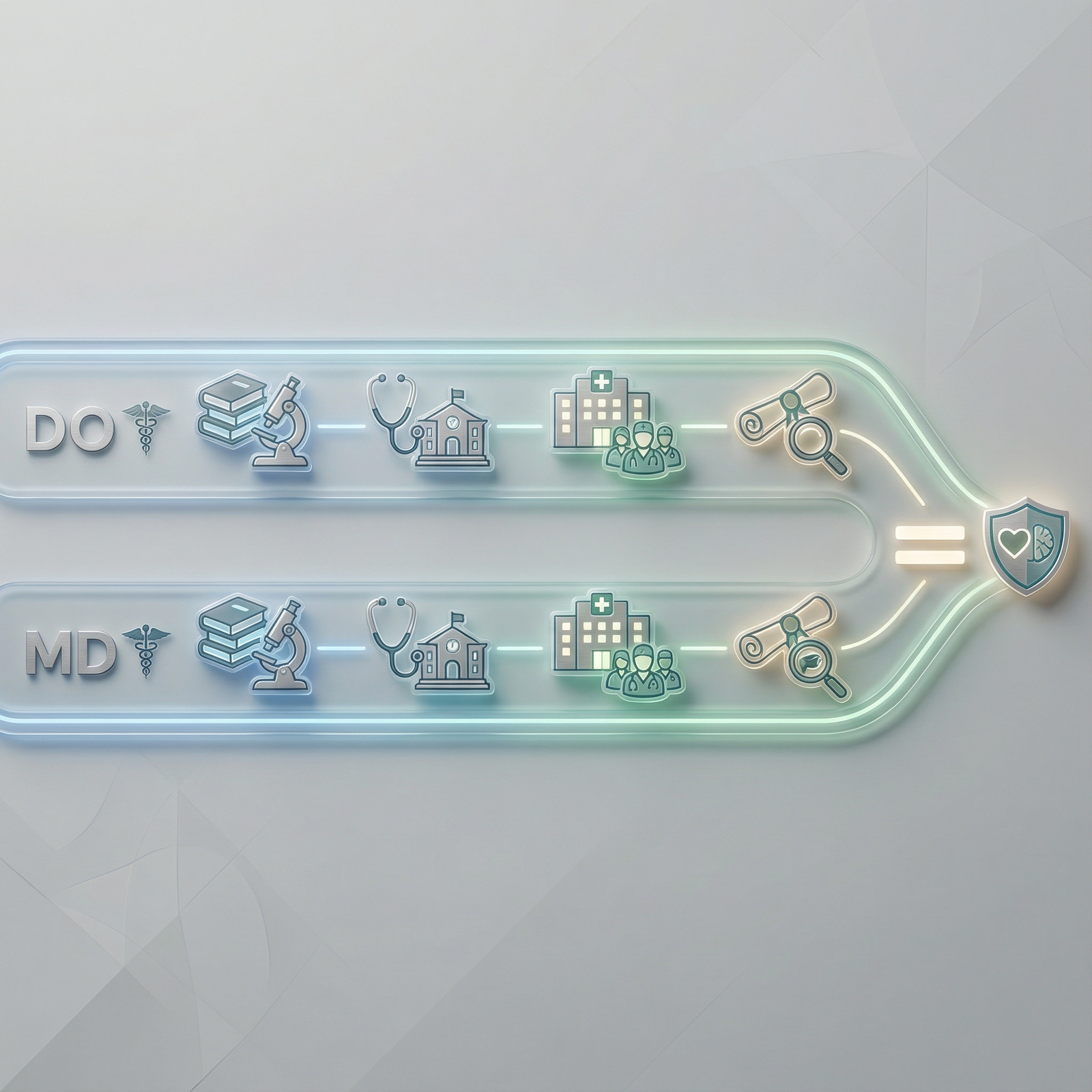
Since 2020, MD and DO grads compete in one ACGME-accredited residency system. Same standards. Same site visits. Same milestones. You don’t get “MD residency curriculum” and “DO residency curriculum.” You get one set of requirements for, say, internal medicine at Massachusetts General or family medicine at UAB, whether you’re MD or DO.
And before residency? Medical school accreditation looks like this:
- MD schools: accredited by LCME
- DO schools: accredited by COCA
Different bodies, yes. But their standards have converged dramatically. Both require:
- A minimum number of clinical weeks in core rotations
- Clinical skills (H&P, communication, professionalism)
- Competency-based outcomes across systems, not just “hours in a seat”
The idea that MDs and DOs are trained on different planets is about 20 years out of date.
Do some DO schools have weaker metrics or newer infrastructures? Yes. Same for a bunch of newer, for-profit, lower-tier MD schools. The split is far more “older, well-established vs newer, fast-growing” than “MD vs DO.”
Curriculum: What Actually Gets Taught (Not What People Assume)
Textbooks do not care about your letters. MD and DO students are studying the same physiology, same microbiology, same path, same pharm.
Here’s what actually differs:
Osteopathic Manipulative Medicine (OMM/OMT)
DO schools add 200–300+ hours of musculoskeletal and manual medicine content on top of what MD schools teach. That is in addition to the standard med school curriculum, not instead of.Is every DO student a master of OMT? Absolutely not. Some love it. Some barely touch it after COMLEX. But the idea that DO schools “replace” real medicine with “bone cracking” is just lazy.
USMLE vs COMLEX
- MD students take USMLE
- DO students must take COMLEX, and many also choose to take USMLE for residency competitiveness
So a DO student aiming at a competitive specialty is often studying for two major exam families that test basically the same underlying science.
Pedagogy differences are school-specific, not degree-specific
PBL-heavy vs lecture-heavy? Small group vs large-group? Early patient exposure vs traditional 2+2 structure? You’ll find all flavors in both MD and DO schools. Saying “DO programs do X” is like saying “all state schools are bad.” It sounds confident and is usually wrong.
The Data Everyone Hints At But Does Not Actually Read
Let’s talk admissions and test scores, because this is where MD superiority narratives love to camp out.
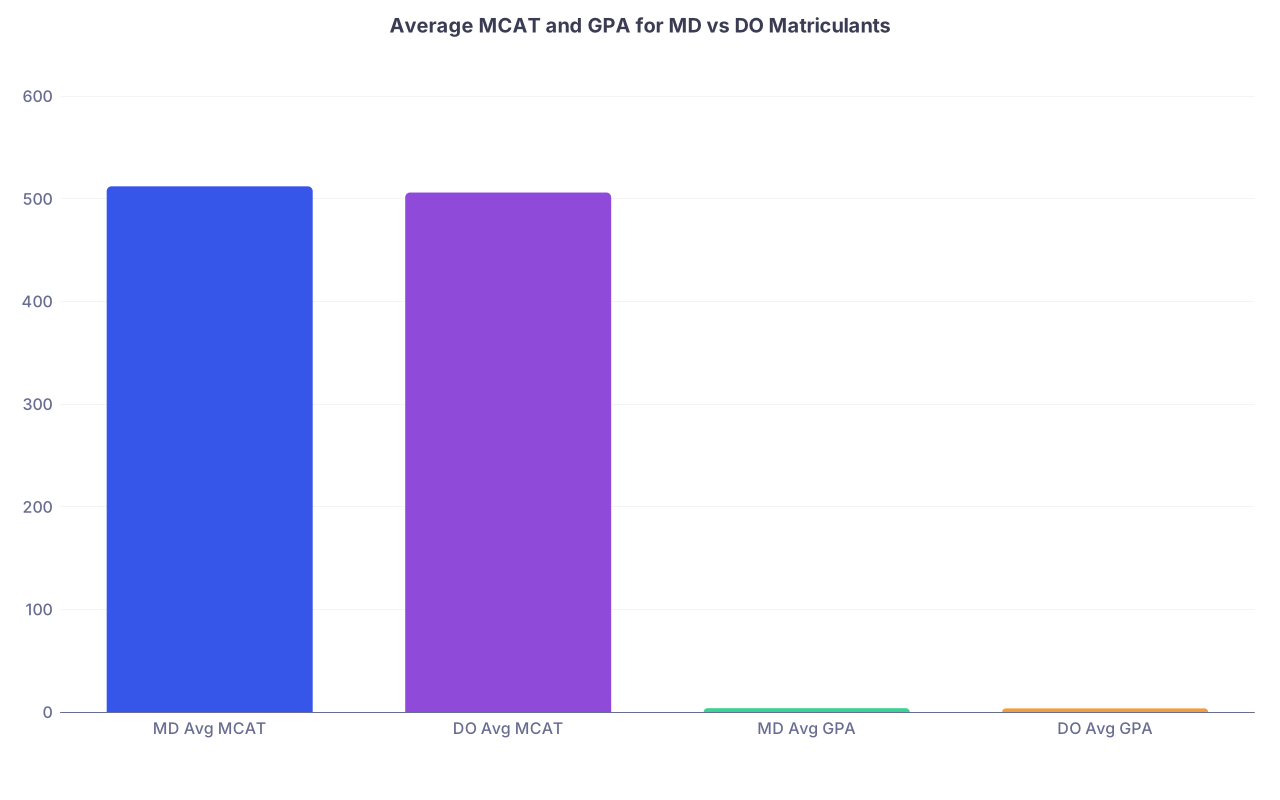
Historically, MD matriculants have higher average MCAT and GPA than DO matriculants. That’s not a myth. But people jump straight from “higher MCAT/GPA” to “better training” like that leap makes any sense.
Here’s what the numbers actually look like (approximate recent ranges):
| Category | Value |
|---|---|
| MD Avg MCAT | 512 |
| DO Avg MCAT | 506 |
| MD Avg GPA | 3.75 |
| DO Avg GPA | 3.55 |
Interpretation:
- MD schools on average attract applicants with more traditional academic metrics.
- DO schools capture more non-traditional students, reinvention stories, later bloomers, and people shut out by the MD numbers game.
- None of that inherently says anything about the quality of what’s taught after matriculation.
The Step/COMLEX story is where things get more real, since that actually reflects both student ability and school preparation.
- Many DO students taking USMLE Step 1/2 score a bit lower on average than MD counterparts.
- But there’s huge overlap in distributions. The top DO students score as high as top MD students.
- The lower-end MD students and lower-end DO students often look surprisingly similar on performance.
On residency evaluations and in-training exams, attendings consistently report that individual work ethic, communication skills, and clinical judgment drive performance—not the degree type. I’ve watched insecure MD interns get quietly outperformed by solid DO co-residents more times than I can count.
Clinical Exposure: “MDs See Sicker Patients” … Really?
This one is thrown around a lot: “MD schools are attached to big-name academic centers, DO schools just rotate in community hospitals, so MDs get better training.”
Portions of that are half-true. The conclusion isn’t.
Many older MD schools do have powerhouse academic hospitals—think Hopkins, UCSF, Columbia. They see cutting-edge stuff, more esoteric pathology, lots of rare disease consults.
But guess what:
- A lot of MD schools also rely heavily on community affiliates for core rotations.
- A lot of DO schools have built strong relationships with busy trauma centers, county hospitals, and large health systems.
And here’s the kicker: most actual doctoring—what you’ll do 95% of your career—looks more like busy community medicine than a tertiary quaternary zebra zoo.
Patients with chest pain. DKA. COPD flare. New cancer diagnosis. Decompensated heart failure. Whether you see them at a “famous” MD hospital or a high-volume community site matters far less than:
- How much responsibility you’re given
- How closely you’re supervised and taught
- Whether people let you actually touch patients and write notes, or just stand in the back
Those variables differ wildly between sites, not between MD vs DO.
I’ve seen DO students rotating at big-name academic centers and MD students at small community programs. The badge ink doesn’t predict who’s getting better exposure.
The Residency Unification Myth: “Programs Secretly Prefer MDs”
This myth has a political cousin: that the unified ACGME system just politely absorbed DO programs but still “respects” MD training more.
Here’s what program directors actually look at, in order of practical importance:
- Board scores (USMLE and/or COMLEX)
- Clinical performance and letters from people they trust
- Fit for their program culture
- Genuine interest in the specialty
- Research / extracurriculars where relevant (especially for competitive fields)
Your degree letters? More like tiebreaker-level, and often not even that.
Are there old-school PDs or faculty who quietly prefer MDs? Yes. Bias exists. I’ve heard the comments behind closed doors.
But then I’ve watched those same people rank a DO applicant higher than several MDs because:
- Their letters described them as relentless, teachable, and clinically strong
- Their sub-I performance blew others away
- They looked like they’d actually do the work
Bias matters at the margins, especially in ultra-competitive specialties and elite institutions. It doesn’t rewrite the rules of training quality after you’re actually in a program.
Once residency starts, it’s one standard. Same call schedule. Same ICU nights. Same procedure quotas. Same angry families at 3 a.m. Nobody is paging “the MD intern” vs “the DO intern.”
Stereotypes About DO Training That Do Not Hold Up
Let’s hit a few head-on.
“DOs don’t learn as much basic science.”
Flat wrong. The accreditation standards demand the same core coverage. You can find bad basic science teaching at both DO and MD schools. The spread is school quality, not degree type.
“DO schools are diploma mills.”
There are new DO schools growing fast and struggling with clinical site logistics. There are also questionable new MD schools with similar issues. If you’re worried about being “used for tuition,” you vet the individual school’s match data, rotations, and teaching reputation—not the letters.
“OMM is pseudoscience; that means DO schools are less rigorous.”
OMM is a mixed bag. There are components with solid evidence (some MSK, pain, certain functional issues). There are parts that are… aspirational. The existence of a controversial extra skillset does not make the rest of the curriculum soft. It just means DO culture still invests in a hands-on, holistic identity that’s partly supported by data and partly historical.
“MD schools are always more competitive environments, so you’re pushed harder.”
I’ve seen cutthroat DO classes and deeply collaborative MD ones. And the reverse. Again: school culture, not degree.
Where MD Does Still Have an Edge (And Why That Is Not “Better Training”)
I’m not going to pretend MD vs DO is identical in outcomes. There are structural advantages to the MD path:
Brand recognition
Outside the US, many people only know “MD.” Inside the US, MD is still the default in public perception. That matters for prestige-driven fields and some international options.Top-tier academic careers are smoother as MD
The path from Harvard Med → MGH residency → NIH-funded PI is still predominantly MD. DOs can and do get there, but the density of mentorship, research infrastructure, and name-brand halo favors MD.Some ultra-competitive specialties
Derm, plastics, ENT, ortho, integrated vascular, neurosurgery: the bar is higher across the board, and the MD bias is still real in parts of these fields. A DO can absolutely match them, but the hill is steeper and the margin for error slimmer.
None of those are about training quality at the med school level. They’re about reputation, historical bias, and pipeline structures that were built before DOs had equal footing in the residency system.
What Actually Determines How “Good” Your Training Is
Here’s the part almost nobody wants to hear because it kills the comforting MD > DO > Caribbean > nothing hierarchy:
The quality of your training is mostly determined by:
- How hard you study and how strategically you practice
- How aggressively you seek feedback, respond to it, and fix your weaknesses
- The quality of your clinical sites and the attendings who bother to teach
- Your ability to impress people who will write brutal, honest letters about what it’s like to work with you
An unmotivated MD student at a mid-tier school will come out weaker than a driven DO student who chased good rotations, crushed exams, and actually learned from patients.
I’ve worked with DO grads who became the unofficial “go-to” residents for difficult procedures, complex ICU cases, or sick floor patients. I’ve also seen MD grads who coasted for four years, survived with okay scores, and showed up to internship undercooked.
Letters after your name give you a starting position. They do not play the game for you.
So, Do MDs Get Better Training Than DOs?
If you want a one-line verdict:
No. MDs do not inherently get “better” training than DOs. They generally have smoother access to prestige, but the quality of medical education and residency training is far more school- and person-dependent than degree-dependent.
If you’re choosing between MD and DO:
- Look at specific schools: match lists, board pass rates, rotation sites, resident/faculty culture.
- Be honest about your own goals: if you’re obsessed with neurosurgery at a top-10 program, MD helps. If you mainly want to be a strong clinician in IM, EM, FM, peds, psych, etc., either path works if you do the work.
- Stop outsourcing your future competence to a label. That’s the mindset that produces mediocre physicians hiding behind fancy diplomas.
Final points to walk away with:
- The MD vs DO training gap is wildly overstated; actual differences are mostly about prestige and history, not educational rigor.
- Real variation in training quality lives within each pathway—between individual schools and residency programs, not between the letters on your white coat.
- Your habits, effort, and clinical environment will shape you far more than whether your degree says MD or DO.