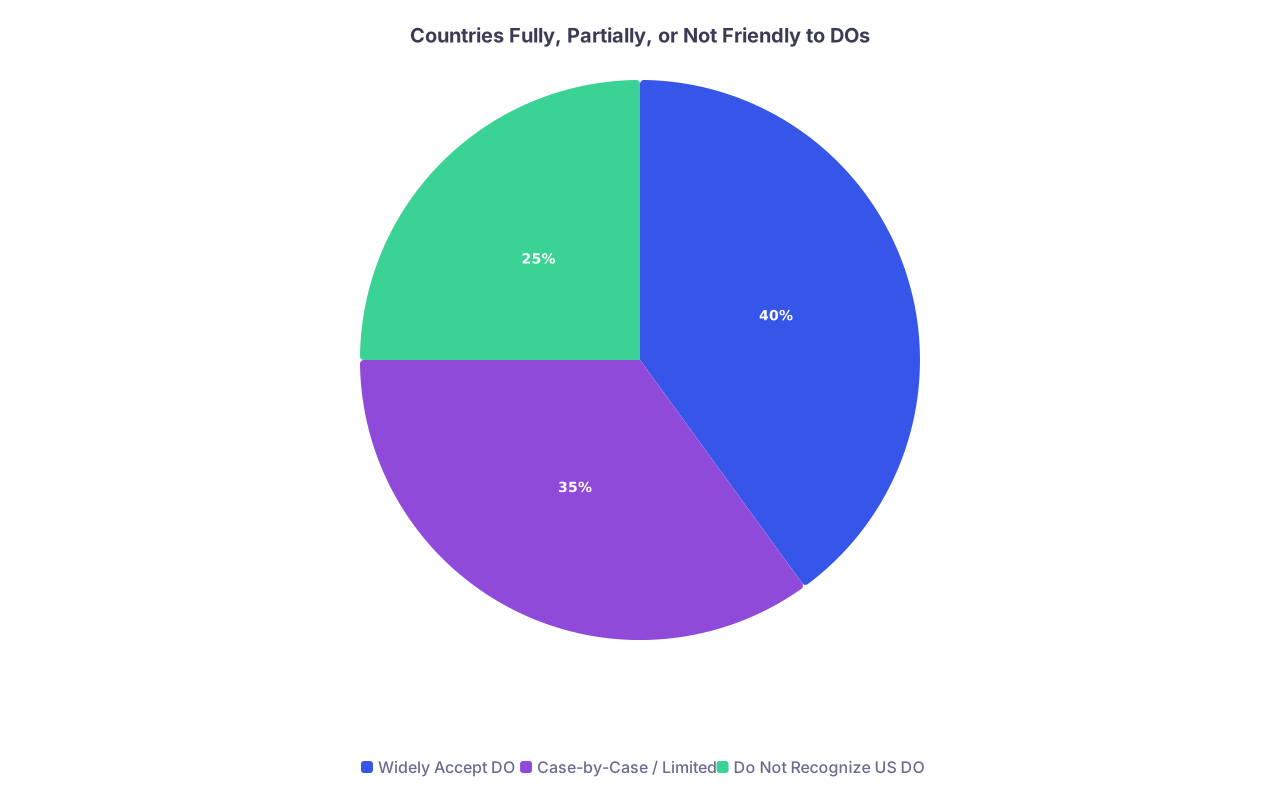
The idea that “MD programs secretly dislike DO students” is lazy thinking. The problem is not that simple—and pretending it is will hurt your planning more than any bias ever will.
There is friction between MD and DO paths. There are doors that are harder to open as a DO. But it’s not some shadowy anti‑DO conspiracy. It’s a messy mix of exam requirements, historical inertia, and applicant behavior. And a lot of the loudest opinions on Reddit or TikTok are from people who never actually had to sit on a rank committee or read 2,000 ERAS applications in October.
Let’s actually look at what the data and real policies show—then translate that into what you should do as a premed or med student.
Myth #1: “MD Programs Just Don’t Want DOs”
This is the clean, emotionally satisfying story. MD = “real doctor.” DO = backup. Doors slam. Fade to black.
Reality: Most MD residency programs do not have a philosophical problem with DOs. They have a risk management problem with incomplete or non-comparable data.
Residency program directors overwhelmingly say the same three things when asked about DO applicants:
- “I need comparable exam scores.”
- “I need evidence you can handle our level of training.”
- “I don’t care what your diploma says if you can do the work.”
The NRMP (National Resident Matching Program) actually surveys these people. In the 2022 NRMP Program Director Survey, a majority of MD programs reported that COMLEX alone was less useful than USMLE for comparing applicants. That isn’t “we hate DOs.” That’s “I’m used to reading USMLE scores and my filters, past experience, and historical benchmarks are all built around USMLE.”
That sounds boring. But that’s the truth: bureaucracy, not bigotry, is doing most of the damage.
You see the same pattern in match outcomes. DO students match into competitive specialties every year: dermatology, orthopedic surgery, anesthesiology, radiology. Is it harder than for MDs with the same stats? Yes. Impossible? No. The data show lower match rates on average for DOs in certain fields—especially the “sexy” ones like derm, ortho, neurosurgery. But when you normalize for Step scores, research, and class rank, the gap shrinks a lot.
Are there individual attendings and program leaders with a chip on their shoulder about DO? Absolutely. I’ve heard the comments:
- “We don’t really take DOs here.”
- “COMLEX just doesn’t mean anything to me.”
- “Our PD trained at [Top 10] and only wants MDs.”
But that’s not the majority. It’s just loud when it happens, and it travels fast through student gossip.
The Exam Problem: COMLEX vs USMLE Is the Real Gatekeeper
If you’re looking for the real “bias,” here it is: the testing ecosystem.
DO students are required to take COMLEX. MD students take USMLE. MD program directors mostly live in a USMLE world, with score filters, historical match data, and institutional habits built around it.
So what happens?
A typical MD program has an initial screen like:
- Did they pass Step 1 on the first try?
- Is Step 2 CK above our soft cutoff?
- Any obvious red flags?
If your application shows only COMLEX scores and the program does not have a clear internal conversion or comfort with COMLEX, you’re starting 10 yards behind. Not because you’re a DO. Because you’re non-standard in their system.
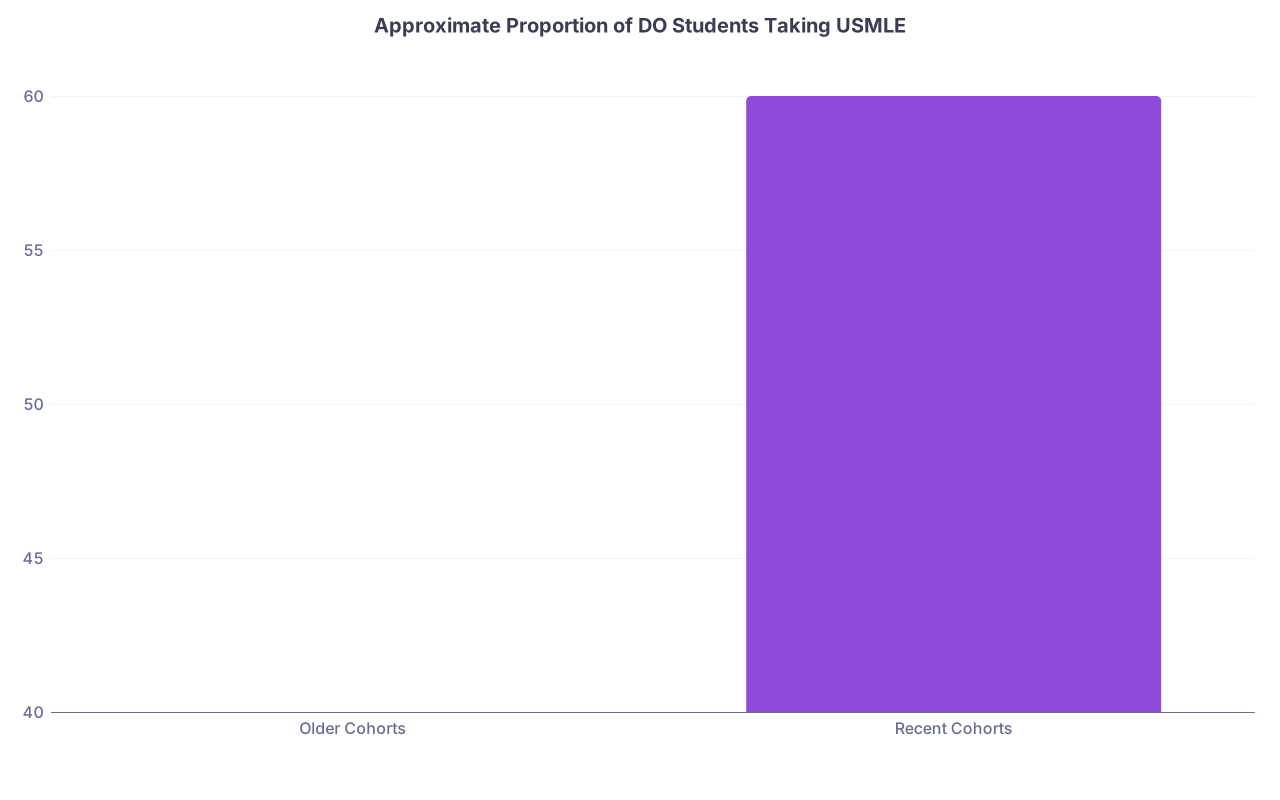
A lot of DO students already know this and act accordingly: they sit for both COMLEX and USMLE. Especially if they’re eyeing competitive MD residencies.
| Category | Value |
|---|---|
| Older Cohorts | 40 |
| Recent Cohorts | 60 |
The exact numbers vary by school and year, but the trend is obvious: more DO students taking USMLE, not fewer. That is not because they love extra exams. It’s because they understand how MD programs screen.
Now layer in the Step 1 pass/fail shift. Some DO students thought, “Great, I can skip USMLE now.” For low- to mid-tier specialties and community programs, sometimes that’s true. For academic MD residencies or competitive fields, skipping USMLE is still a bad bet.
Program directors didn’t suddenly gain deep familiarity with COMLEX because Step 1 became pass/fail. They just shifted pressure onto Step 2 CK—and they still prefer an actual Step 2 CK number they understand.
So you get what looks like “bias against DO.” But follow the money: what they’re actually biased toward is USMLE.
Policy vs Perception: What Programs Actually Say
Instead of listening to thirdhand horror stories, look at what programs literally post.
Go on residency explorer, FREIDA, or individual program websites and read their policies:
- Some say “DOs welcome; COMLEX accepted.”
- Some say “USMLE required for all applicants.”
- Some say “We accept COMLEX; USMLE preferred.”
- A minority quietly filter DOs out without saying it publicly, but those are more the exception.
| Program Type | COMLEX Policy | Practical Reality for DOs |
|---|---|---|
| Community Internal Medicine | COMLEX accepted, USMLE optional | Many DOs matched with COMLEX only |
| Mid-tier University Pediatrics | COMLEX accepted, USMLE preferred | USMLE greatly improves interview chances |
| Academic Anesthesiology | USMLE required | No USMLE = auto screen out |
| Competitive Ortho at University | DOs “considered”; USMLE required | DO with strong USMLE + research can match |
| Hyper-elite Academic IM (Top 10) | DOs “welcome”; USMLE required | DOs rarely matched but not zero |
I’ve seen DO applicants with strong USMLE scores get ranked highly at MD programs that, on paper, looked MD‑only. I’ve also seen DOs with great COMLEX and no USMLE get almost no MD interviews despite being clinically solid. Same person, different exam profile, totally different outcome.
Again: the gate is not your letters. It’s your data.
Are There Still True Anti‑DO Programs? Yes. And You Can Spot Them.
Some places do have a real, baked‑in bias. Usually it looks like this:
- Last DO graduate in the program was 8+ years ago.
- Faculty and leadership mostly from old-school MD-only backgrounds.
- Off-the-record comments like “we just don’t really do DOs here.”
- They either explicitly require USMLE and never interview DOs anyway, or quietly discard DO apps regardless of scores.
Here’s the good news: their behavior shows up in the match lists and past residents.
You don’t need to speculate. You can literally:
- Pull the last 3–5 years of residents off the program website.
- Scan for DO degrees.
- Check if any DOs are in competitive fellowships from that department.
If you find zero DOs anywhere, and you hear whispers that DOs “never get interviews there,” that’s not your hill to die on. Apply if you want, but don’t build your master plan around changing their mind.
The Merger Myth: “After ACGME/ACOEP Merger, DOs Are Equal Now”
Another popular fairy tale: the single accreditation merger “fixed” everything and DOs and MDs are now identical in the eyes of residencies.
No. It killed off the separate AOA residency system and forced everyone under ACGME rules. That’s not the same thing as cultural or institutional equality.
What changed:
- DOs now apply to the same programs as MDs.
- DO schools had to ensure their clinical training meets ACGME standards.
- Many former DO-only residencies became “friendly” MD/DO programs.
What did not magically change:
- PD preferences.
- Exam comfort (USMLE vs COMLEX).
- The tendency of some academic departments to prefer CVs that look like their own.
So the merger helped. It removed a structural barrier. It did not erase all soft bias or fix exam comparability.

| Step | Description |
|---|---|
| Step 1 | Pre-Merger |
| Step 2 | Separate MD & DO Residencies |
| Step 3 | Limited Cross-Application |
| Step 4 | Post-Merger |
| Step 5 | Single ACGME System |
| Step 6 | More Programs Technically Open to DOs |
| Step 7 | Actual Access Depends on Exams & Track Record |
Notice that last node: “depends on exams & track record.” That’s what actually governs your chances.
Specialty Reality Check: Where the Gap Is Big vs Small
You don’t need a PhD in statistics to see the pattern. DO vs MD differences are not uniform across specialties.
Broad strokes:
- Primary care (FM, IM, peds, psych): Gap exists but is modest, especially for community and mid-tier programs. COMLEX-only is often okay, though USMLE can still help.
- Mid-competitive (EM, anesthesia, radiology, PM&R): DOs do fine, if they have USMLE and solid clinical performance. COMLEX-only becomes more of a handicap here.
- Hyper-competitive (derm, ortho, neurosurgery, plastics, ENT, urology): Being DO is another obstacle on top of already brutal competition. Strong USMLE, research, networking, and away rotations become almost mandatory.
| Category | Value |
|---|---|
| Family Med | 1 |
| Internal Med | 2 |
| Psychiatry | 2 |
| Anesthesiology | 3 |
| Radiology | 3 |
| Orthopedics | 5 |
| Dermatology | 5 |
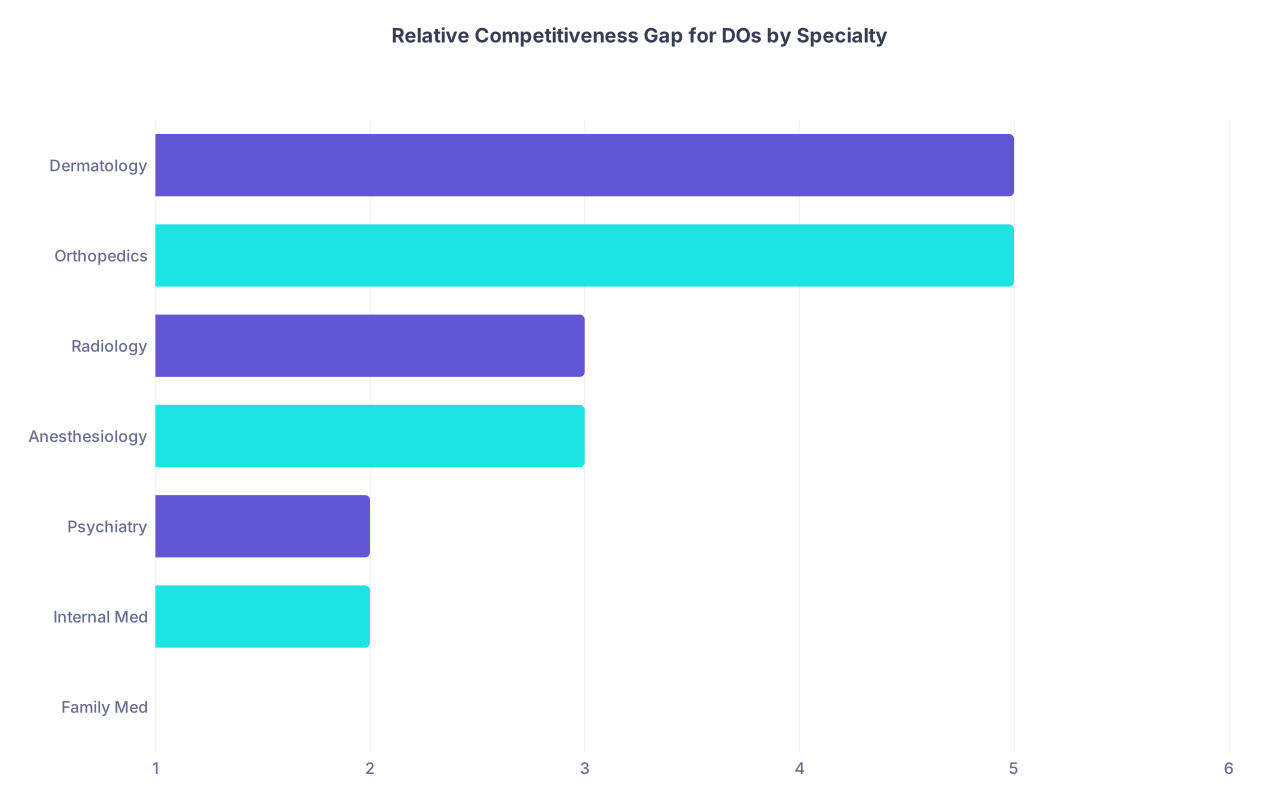
Interpret that as “how much harder relative to MD with similar metrics.” Not perfect science, but directionally true.
Notice something? Where programs are used to DOs (FM, IM, psych), bias melts fast when you perform well. Where programs are used to a flood of high‑scoring MDs with heavy research, you’re asking them to take a chance on a profile they see less often.
You can call that bias. Or you can call it risk aversion and pattern recognition. Either way, yelling about fairness does less for your career than actually adjusting your strategy.
What This Means If You’re a Premed Deciding MD vs DO
If you’re premed, the MD vs DO question is usually framed with terrible nuance:
- “MD good, DO bad.”
- “They’re the same, don’t worry about it.”
- “Do what your heart tells you.”
All wrong.
Here’s the cleaner version:
If you know you want the most competitive specialties (derm, ortho, neurosurg, ENT, plastics) or hyper-elite academic programs, MD gives you a smoother path. Not a guarantee. Just fewer institutional hurdles.
If you’re broadly interested in medicine, okay with a wide range of specialties including primary care, EM, anesthesiology, radiology, psych, PM&R, etc., and your MD options are low-tier or nonexistent, a strong DO school is absolutely a valid route. But you must be willing to:
- Treat USMLE as de facto required if you want competitive MD residencies.
- Be a top performer at your DO school, not average.
- Accept that a few brand‑name MD programs will never really be open to you.

If that trade‑off makes you angry, fine. But don’t pretend it doesn’t exist.
What This Means If You’re Already a DO Student
You’re in a DO program. The ink is dry. The question you should be asking is not “Do MD programs secretly dislike me?” It’s:
“How do I make my application impossible to ignore despite my DO letters?”
Reality-based strategy:
- If you want any realistic shot at MD residencies—especially academic or competitive ones—plan on taking USMLE Step 2 CK at minimum, and usually Step 1 as well if your school still aligns timing. A COMLEX‑only path is mostly for those targeting DO-heavy or community programs.
- Use your third-year clinical rotations like an extended audition. Strong clinical evals and genuine faculty advocates matter more than you think, especially for DOs.
- Do away rotations strategically at MD programs that have a track record of taking DOs in your specialty. That’s how you bypass some of the paper bias.
- Stop relying on rumors. Look up each program’s resident list. If there are DOs there, you’re not walking into a brick wall.
So…Do MD Programs Secretly Dislike DO Students?
No. What they dislike is uncertainty, non-comparable data, and perceived risk.
They prefer:
- Exam scores they understand (USMLE)
- Training pedigrees they’re familiar with (their own feeder MD schools)
- Application profiles that match their historical success stories
Being DO makes you an out-group for some programs. That’s different from universal hatred. It’s more like being the nontraditional candidate: extra work to prove yourself, higher stakes for each misstep, less room for mediocrity.
You can call that unfair. You’d be right. But you’d also still need a plan that works in the system as it is, not as it should be.
| Category | Value |
|---|---|
| USMLE Scores | 35 |
| Clinical Performance | 25 |
| School Reputation | 15 |
| Research | 15 |
| Residual Bias | 10 |
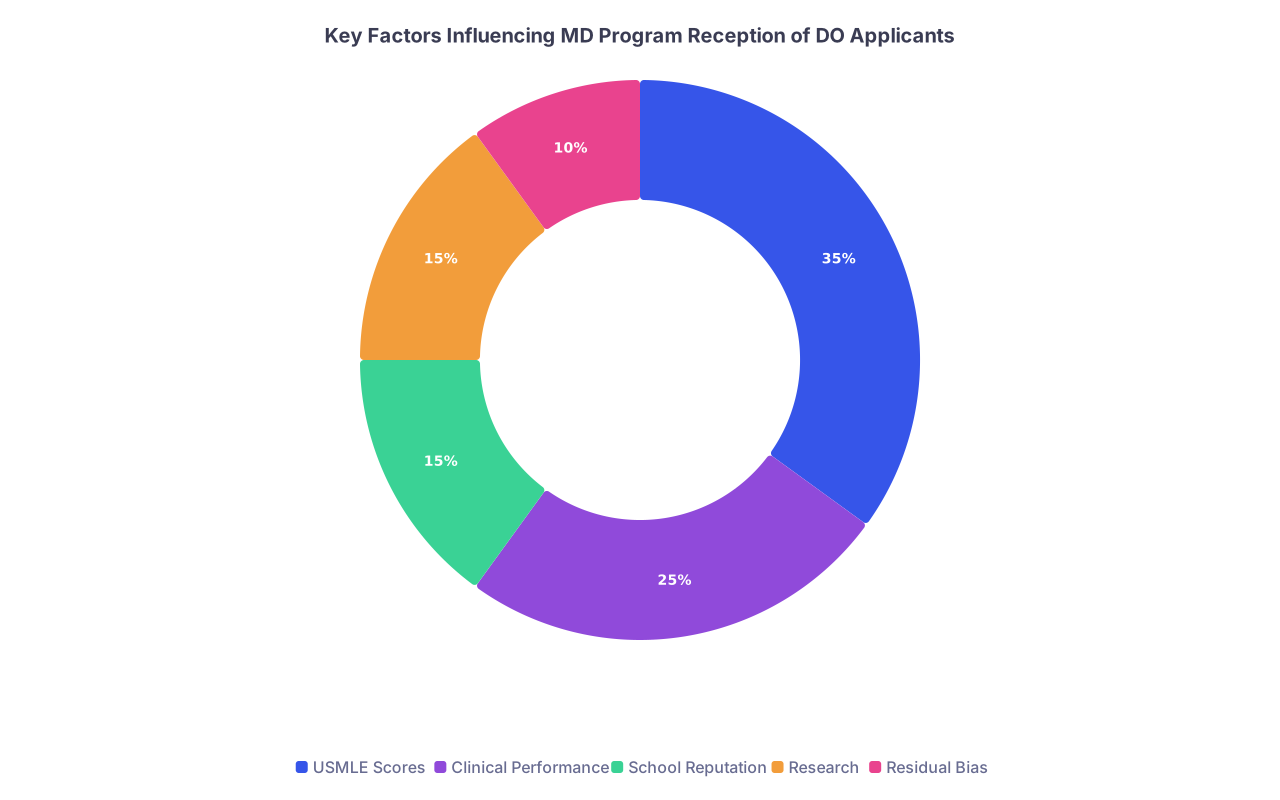
That “Residual Bias” slice? Real. But it’s the smallest piece. The rest are variables you can influence.
Bottom Line
- MD programs are not universally anti‑DO; they’re pro‑USMLE, pro‑familiarity, and risk‑averse. Most of what looks like anti‑DO bias is actually exam and systems bias.
- Your letters (MD vs DO) matter less than your performance, exam choices, and specialty goals. But if you want competitive MD residencies, especially academic ones, as a DO you almost certainly need strong USMLE scores.
- Premeds should stop pretending MD and DO are identical paths. They’re both viable routes to being a physician, but the ceiling and friction differ by specialty and ambition. Pick with clear eyes, not slogans.