You are a college junior, shadowing in a community primary care clinic.
Exam room doors half open, vitals carts beeping softly, overbooked schedule already running behind.
You follow an MD internist in the morning. Straightforward: focused HPI, targeted ROS, guideline-based meds, referrals when needed.
In the afternoon, you switch to a DO family physician… and things feel a bit different. Longer hands-on exam. She palpates the neck and ribs in ways you have not seen before. Talks about “somatic dysfunction.” Mentions maybe doing OMT on the patient’s neck and upper back instead of bumping up a muscle relaxant. The medical care is similar, but the texture is different.
You walk out asking yourself:
If I want to do primary care, does it really matter if I go DO or MD?
And more specifically: what actually changes in clinic?
Let me break this down specifically.
Big Picture: Primary Care Is Similar; The Edges Are Different
In primary care, DOs and MDs do almost all the same things:
- Diagnose hypertension, diabetes, depression, COPD
- Order labs and imaging
- Prescribe medications
- Refer to specialists
- Do routine preventive care and chronic disease management
So no, choosing DO vs MD will not lock you out of “real” primary care. Both are fully licensed physicians.
The differences show up in:
- How you are trained to think about the patient (framework and language).
- How you touch the patient (physical exam and OMT use).
- What you are subtly incentivized to value (whole-person vs organ-system, manual vs tech-heavy).
These are not dramatic, life-or-death differences. But they absolutely change the feel of a clinic visit and your day-to-day practice.
Training Foundations: Where DO vs MD Starts To Diverge
You are in premed / early med school planning territory, so let’s talk about the pipeline you would actually experience.
Curriculum: Overlap Is Huge, But DO Adds a Layer
Both DO and MD schools cover:
- Biochem, anatomy, physiology, path, pharm
- Organ system–based courses (cardio, pulm, GI, etc.)
- Clinical skills, communication, ethics, evidence-based medicine
The added DO layer in most osteopathic schools:
- ~200–400 extra hours of Osteopathic Manipulative Medicine (OMM) / OMT lab
- Regular use of osteopathic structural exam (OSE) in preclinical courses
- Repeated emphasis on “body, mind, spirit,” and structural-functional relationships
This matters in primary care because those OMM hours give you:
- Better palpation skills than the average MD student.
- A practiced habit of putting your hands on patients’ ribs, spine, pelvis, fascia.
- Another therapeutic “lever” besides meds and referrals.
You might not use OMT heavily later. But the training shifts your default approach. You are more likely to ask: “Is there a structural component making this worse?”
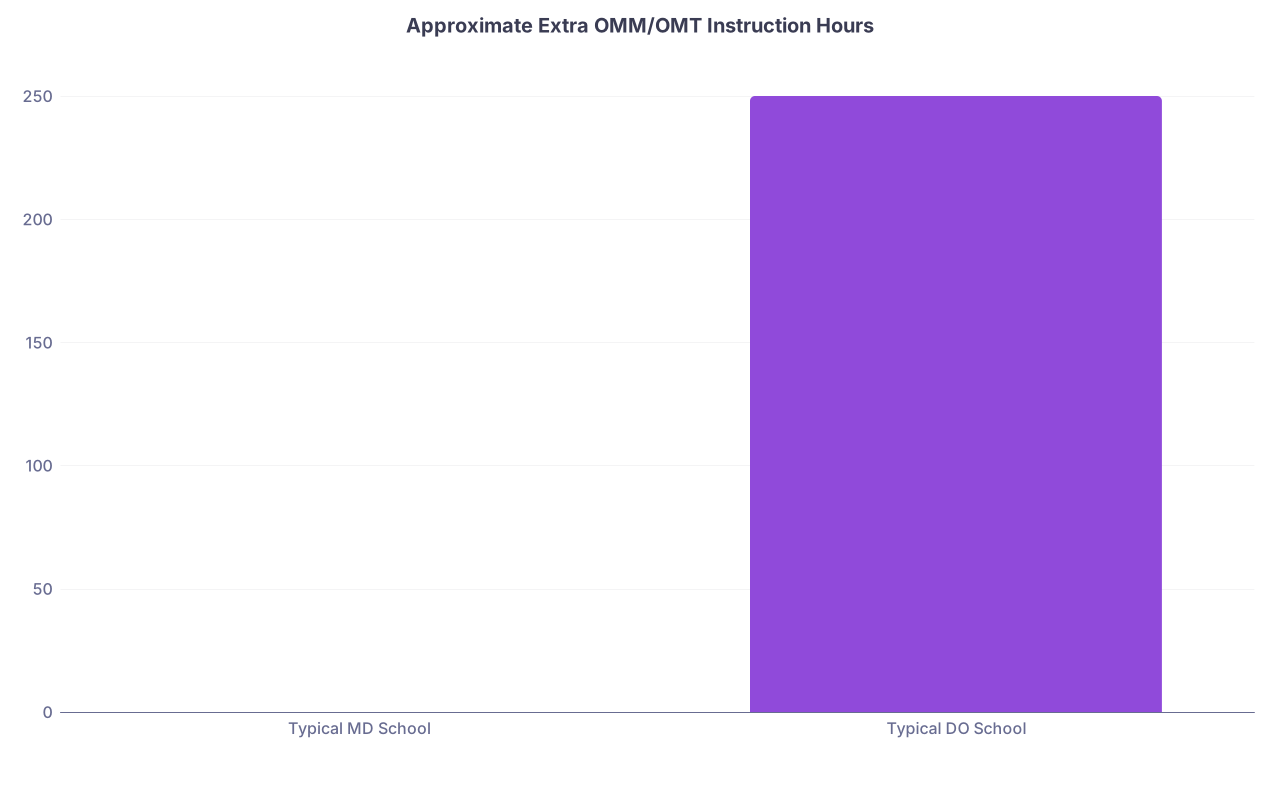
| Category | Value |
|---|---|
| Typical MD School | 0 |
| Typical DO School | 250 |
Licensing Exams: How That Filters Into Primary Care
Old reality:
- MD: USMLE Step 1, 2 CK, 3
- DO: COMLEX Level 1, 2, 3 (and often also USMLE)
New-ish reality post–Step 1 pass/fail and single accreditation system:
- DOs who aim for competitive specialties usually still take both COMLEX and USMLE.
- For core primary care fields (FM, IM, peds), many DOs now match perfectly well with COMLEX alone, but Step 2 CK is increasingly important.
Why this matters for your future clinic:
- DO schools sometimes tilt more graduates toward primary care—both by mission and by the type of students they attract.
- Many DO schools are in regions with primary care shortages, and grads often stay in those communities.
- You will see more DOs in community FM, outpatient IM, and rural clinics; MDs are more unevenly distributed, with more clustering in academic and subspecialty settings.
Do MDs do primary care? Of course. But the concentration of DOs is higher in front-line outpatient medicine. That shapes culture: DO-heavy residency clinics often normalize using OMT and whole-person frameworks more explicitly.
In the Exam Room: Subtle Differences You Actually Notice
Let’s get specific about what you probably care about: what is different sitting across from a patient.
The History: Same Content, Slightly Different Emphasis
Both DO and MD primary care physicians will ask about:
- Chief complaint
- HPI
- PMH, PSH
- Medications, allergies
- Family history
- Social history
The subtle DO tilt, when it is actually practiced:
- More probing into lifestyle, work strain, sleep, stress, emotional context.
- Quicker to connect MSK complaints to posture, occupation, gait, footwear, prior injuries.
- Frequent language like “how is this affecting your day-to-day functioning” and “how is your body handling this stress.”
A decent MD does this too. The difference is that DO students are actually tested and evaluated on “whole-person” and structural-functional integration throughout training. It gets baked into their scripts.
I have watched DO attendings stop a resident mid-presentation with:
“Okay, you told me their A1c, but not who they live with and how they are getting food. That is not an osteopathic HPI.”
That expectation bleeds into daily practice.
The Physical Exam: Where Hands Really Matter
MD primary care exam tends to be:
- Focused physical targeting the complaint and relevant systems.
- Shorter palpation, more “inspection, auscultation, minimal palpation” for many visits.
DO primary care exam, when the doc is actually using their training, often includes:
- Routine structural screening: checking posture, gait, spinal curves, rib motion, pelvic alignment.
- Palpation for somatic dysfunction: tenderness, tissue texture changes, asymmetry, motion restriction.
- Integration of OSE into the normal exam: you are not doing “an OMT visit”; you just add a few palpation maneuvers as part of your usual workflow.
Concrete example.
Patient: 45-year-old office worker with subacute low back pain, no red flags.
MD exam (good one, not lazy):
- Observation of posture and gait
- Lumbar ROM
- Straight leg raise
- Reflexes, motor, sensory
- Maybe SI joint tests
- Decision: conservative therapy (NSAIDs, PT, home exercise), follow-up; maybe imaging if persistent
DO exam:
- All of the above, plus
- Stepwise assessment of lumbar paraspinals, thoracolumbar junction, sacrum, innominates, ribs
- Palpation for segmental dysfunction (e.g., L4 rotated right, sidebent right), sacroiliac rotation, muscular tension patterns
Outcome differences:
- MD may write: “MSK low back pain, no radicular symptoms; plan: NSAID, PT referral.”
- DO may write: “Acute lumbar strain with somatic dysfunction in lumbar, sacral, and pelvic regions; performed OMT; plan: NSAID, OMT, home stretching, follow-up in 1–2 weeks.”
The diagnosis is functionally the same. But the DO has a named, trainable manual skill to alter those somatic findings.

OMT in Real Primary Care: How Often Is It Actually Used?
Here is where premeds get misled. You hear two extremes:
- Myth 1: “Every DO uses OMT daily; it is their main thing.”
- Myth 2: “Nobody uses OMT in real practice; it all disappears after boards.”
Reality is messy. Usage is all over the map and heavily context-dependent.
Rough Categories of DO Primary Care Docs
In clinic, I repeatedly see DO primary care physicians fall into one of these buckets:
High-utilizer OMT primary care
- OMT used on 20–50% of visits, especially for MSK, headaches, rib dysfunction.
- Schedule adjusted to allow time for hands-on work.
- Patients know “this is a doctor who does manipulation.”
- Common in osteopathic-focused residencies, private practices marketing OMT, and some rural clinics.
Targeted-utilizer OMT primary care
- OMT used on maybe 5–15% of visits.
- Mostly when it clearly replaces or reduces need for meds / imaging / referrals.
- Used for acute neck/back pain, tension headaches, chest wall pain, some postpartum pelvic issues.
- The majority of clinic is still standard medical management.
Symbolic / rare-utilizer
- OMT used <5% of visits or essentially never.
- Skills atrophy over time if not intentionally maintained.
- Occasional “showcase” use with residents or for a persistent MSK complaint.
So yes, OMT can be part of your daily toolkit. But only if you deliberately train in a setting that supports it and structure your career that way.
The key premed question:
Do you like the idea of using your hands as a treatment tool, enough to invest extra time in residency and beyond to keep it sharp?
If yes, DO gives you a real head start. An MD could later learn manipulation (through postgrad courses in things like HVLA, mobilization, etc.), but it is not built in.
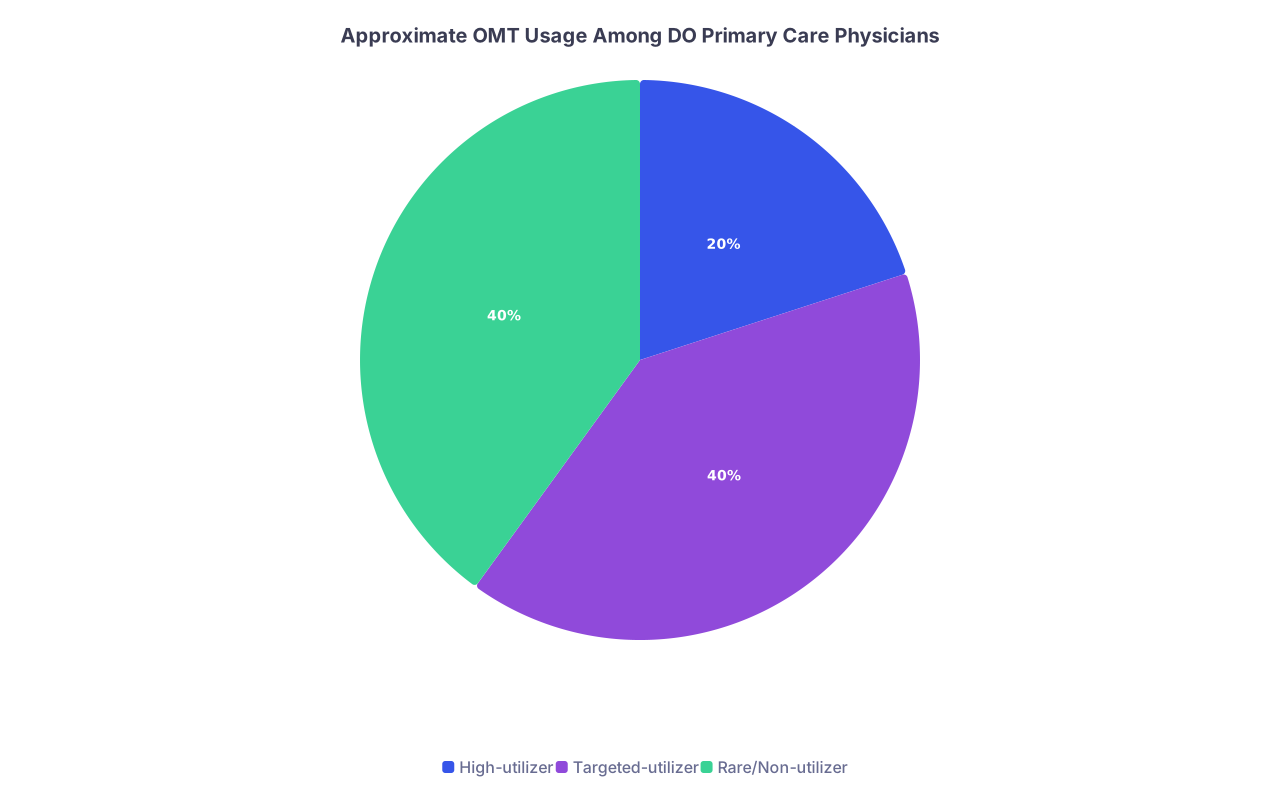
| Category | Value |
|---|---|
| High-utilizer | 20 |
| Targeted-utilizer | 40 |
| Rare/Non-utilizer | 40 |
Clinic Culture: How DO vs MD Shows Up in Real Practices
Now let’s talk clinic environment. Because you are not practicing in a vacuum.
DO-Heavy vs MD-Heavy Primary Care Programs
You will feel a difference between:
- An MD-dominated academic internal medicine clinic at a big university hospital.
- A DO-heavy community family medicine residency clinic in the Midwest or rural South.
MD-heavy academic IM clinic:
- More subspecialty referrals.
- Frequent “let’s check guidelines and evidence” language.
- Complex multi-morbidity, lots of polypharmacy and advanced diagnostics.
- Less time per patient, more RVU pressure, more EMR templates.
- Very strong in guideline-based chronic disease care and complex internal medicine puzzles.
DO-heavy community FM clinic:
- Wider scope: cradle-to-grave, OB in some, joint injections, dermatologic procedures.
- More explicit conversation about social determinants, family dynamics, and functional outcomes.
- More comfort managing MSK issues in-house with OMT instead of immediate ortho referral.
- A culture where “osteopathic exam” is not just a phrase in the mission statement.
I have heard attendings in DO-heavy clinics say to residents:
- “Why are we sending this to ortho when you can treat their thoracic outlet and scalene hypertonicity?”
- “You are missing the somatic dysfunction underlying this recurrent headache pattern.”
In MD-heavy clinics, the critique is more likely:
- “You prescribed the wrong statin intensity for this ASCVD risk.”
- “You need to be more aggressive with ACEi in this diabetic nephropathy.”
Both are correct. Both are valuable. Your DO vs MD path nudges which “blind spots” your mentors focus on.
Patient Perception: DO vs MD On The Door
Patients in many communities do not know the difference between DO and MD. They just see “Doctor.” Some will ask. A few will specifically seek out DOs for OMT or “less pill, more hands-on” care.
What actually shifts patient perception is:
- How much time you spend.
- How much you touch (in a professional, exam-focused way).
- Whether you offer non-pharmacologic options that feel tangible.
A DO who never uses OMT and rushes through visits will not seem any more “holistic” to patients. An MD who listens deeply, understands the patient’s life, and is thoughtful about polypharmacy will absolutely be experienced as “whole-person.”
The degree letters are not magic. The day-to-day choices you make in clinic are.
Career Planning: If You Are Premed Deciding DO vs MD
You are not just picking letters; you are picking:
- Probability of landing in front-line primary care.
- Type of schools and residencies you will be surrounded by.
- Extra toolkit (OMT) you may or may not end up using.
If You Already Know You Want Primary Care
Then DO is absolutely a rational, often excellent choice.
Advantages in this pathway:
- Many DO schools have explicit primary care missions and rural/community ties.
- Higher likelihood of matching family medicine, outpatient IM, and community-based programs that value broad-scope practice.
- Built-in OMT training gives you differentiation in a saturated primary care market. You can market “medical + manual” care.
Caveats:
- You must own your OMT education—seek strong OMM faculty, OMT-heavy rotations, and maybe an osteopathic-focused FM or IM residency if you truly want to use it.
- Some ultra-competitive internal medicine academic fellowships still have subtle bias toward MDs, though this is less relevant if your target is outpatient primary care, not cardiology at MGH.
If You Are Unsure, Or Considering Competitive Specialties
You can still choose DO and keep doors open. Plenty of DOs match into competitive specialties. But:
- Your path may be smoother with MD for certain ultra-competitive specialties (derm, plastics, ENT, ortho at top academic centers), due to entrenched bias and network effects.
- If you are truly undecided and you have strong MD options, MD gives you slightly more flexibility at the high end.
For primary care, though, the DO route often aligns better with:
- Earlier hands-on patient exposure.
- Emphasis on communication and continuity.
- Training environments more similar to where you will actually practice.
Subtle Philosophical Differences That Actually Surface In Clinic
People love to quote osteopathic tenets on slides. Let’s translate a few into how practice looks in real life.
“The body is a unit; person is a unit of body, mind, and spirit.”
In clinic, this means you are:
- More likely to tie physical symptoms to stress, grief, trauma, social isolation.
- More comfortable asking about mental health even when the chief complaint is “back pain.”
- Less satisfied with purely biochemical explanations for chronic pain, fatigue, or functional complaints.
A good MD does this too, especially in family medicine and psych-heavy IM clinics. DO training just pushes this conceptual framework earlier and louder.
“Structure and function are reciprocally interrelated.”
Translation in primary care:
- You consider how posture, ergonomics, surgical scars, fascial restrictions, and joint mechanics contribute to disease.
- For GERD, you might consider the diaphragm’s role, not just proton pump inhibitors.
- For recurrent otitis in a kid, you might think about eustachian tube drainage, cranial mechanics, not only antibiotics and tubes.
Again, you can ignore this as a DO and never touch OMT. But the training constantly reminds you that “how the body is put together” matters, not only “what the labs show.”

| Step | Description |
|---|---|
| Step 1 | Patient with subacute low back pain |
| Step 2 | Imaging, urgent workup |
| Step 3 | Conservative care path |
| Step 4 | MD: Hx, exam, meds, PT, education |
| Step 5 | DO: Hx, exam, OSE, consider OMT |
| Step 6 | Perform OMT if appropriate |
| Step 7 | Follow-up / adjust meds, PT |
| Step 8 | Red flag symptoms? |
How To Decide: Key Questions To Ask Yourself Now
You do not need a spiritual awakening to choose DO. You do need clarity.
Ask yourself:
- Do I actually like using my hands, or do I just like the idea of it?
Watching real OMT visits (not YouTube hype videos) will clarify this. - Am I drawn to front-line, relationship-heavy medicine?
If yes, DO aligns well. MD can too, but DO paths push you there more often. - How much do I care about academic prestige and competitive subspecialties?
If that is a top priority, MD may be a cleaner route. - Am I willing to do the extra work to keep OMT skills sharp after graduation?
If not, you will lose most of that unique DO edge in primary care within a few years.
Last point: “Holistic” is not magically owned by DOs. I have seen MD family docs who are far more patient-centered and whole-person than some DOs churning through 25 visits a day, never using OMT.
Your training shapes you. Your choices define you.
FAQs
1. Will being a DO limit me from getting a good primary care job compared with an MD?
No. For primary care specifically, DOs are in high demand. Many community health centers, FQHCs, and private practices are full of DOs. Employers care far more about your board certification, communication skills, productivity, and whether patients like you than whether your diploma says DO or MD. If anything, having OMT skills can be a bonus if you choose to offer that as a service.
2. Do DO primary care doctors get paid less than MDs in the same job?
In the same job, with the same RVU expectations and schedule, compensation is essentially the same. Salary differences are driven by specialty, region, employer type, and productivity, not the letters after your name. A DO family physician and an MD family physician in the same large group will generally be on the same pay scale. Where you might see variation is if a DO carves out extra OMT visits that are billed differently, but that is more about practice design than degree.
3. How much extra time does OMT add to a typical primary care visit?
It depends how you structure your clinic. Targeted OMT for a simple dysfunction (e.g., one or two lumbar segments, a rib, a few cervical segments) can be done in 5–10 minutes, integrated into a 20–30 minute visit. More comprehensive OMT sessions (multiple regions, complex chronic pain) often require a full 30–40 minute slot. High-utilizer OMT primary care docs often schedule a mix: shorter medical-only visits and longer combined medical+OMT or OMT-only follow-ups.
4. If I go MD, can I still incorporate hands-on/manual treatments in primary care?
Yes, but you will need to pursue that training outside the standard MD curriculum. Some MDs train in manual medicine approaches (e.g., certain spine manipulation or musculoskeletal courses) or partner closely with PT/OT/chiropractic. You will not have the built-in osteopathic structural exam framework or OMT hours that DO school provides, and you will not be able to bill as “OMT” in the traditional sense, but you can absolutely practice very hands-on medicine, especially in family medicine or sports-oriented primary care if you seek the right fellowships and CME.
5. If I want to be a “holistic” primary care physician, should I automatically choose DO?
Not automatically. DO training supports a holistic framework and offers OMT as a concrete tool, which can be a strong fit if that resonates with you. But “holistic” in real clinic life is mostly about how you listen, how you integrate mental health and social context, and how you avoid treating only lab numbers. Plenty of MDs practice this way. The better question is: do you want the osteopathic perspective and manual skills built into your training from day one? If yes, DO is a very logical path for a primary care career.
Key points to keep in your head:
- In primary care, DO and MD practice overlap almost completely; the differences are in mindset, manual skills, and clinic culture.
- DO training gives you OMT as a tangible extra tool, but you must actively choose to maintain and use it.
- Your day-to-day in clinic will be shaped more by the residency and practice environment you pick than by the three letters on your white coat.