You are four tabs deep in school websites. One MD program says “integrated organ systems curriculum,” another DO program says “block structure with OMM longitudinal thread,” and a third throws in “case-based spiral curriculum” like that clarifies anything. You are trying to decide where to apply, but all the terms are starting to blur.
Let me break this down specifically: what “block” vs “systems” actually means, how DO vs MD programs tend to use each, and what it feels like as a student living inside those curricula.
1. First, translate the jargon: block vs. systems
Forget the marketing language. Strip it down to how your calendar and brain will actually function.
What is a block curriculum?
“Block” means you study one major topic at a time, in sequence, usually with one big exam at the end of each segment.
Classic block examples:
- A 6-week “Foundations” block (biochem, molecular bio, basic cell stuff)
- A 4-week “Musculoskeletal” block (anatomy-heavy)
- A 3-week “Microbiology” block
- A 4-week “Neuroscience” block
You are mostly focused on that block’s content, often with:
- One set of lectures / labs dominating your schedule
- One final exam (sometimes plus quizzes)
- Limited cross-talk with other subjects
Block ≠ systems vs. non-systems by itself. Block just describes the time-chunk structure. The blocks might be:
- Discipline-based: anatomy block, physio block, micro block
- System-based: cardio block, renal block, etc.
But when people say “block curriculum” casually, they usually mean discipline-based blocks rather than integrated systems.
What it feels like:
- You cram one discipline intensely, then largely move on.
- High focus, less juggling.
- Integration across disciplines is more on you.
What is a systems (organ-based) curriculum?
“Systems” means the curriculum is organized around organ systems, and multiple disciplines are taught together within each system.
For example, in a “Cardiovascular System” block you might have:
- Anatomy: heart, great vessels, mediastinum
- Physiology: cardiac cycle, hemodynamics, electrophysiology
- Pathology: atherosclerosis, cardiomyopathies, valvular disease
- Pharmacology: antihypertensives, antiarrhythmics, heart failure meds
- Clinical skills: cardiac exam, blood pressure, EKG basics
All centered on one system over 4–8 weeks.
So “systems” is a type of block. Just more integrated.
What it feels like:
- You see basic science, path, pharm, and clinical correlations side by side.
- Easier to see “the whole patient.”
- Exams are usually integrated: questions move across disciplines in a single test.
Most modern MD and DO programs claim some version of systems-based integration. Reality varies a lot.
2. The DO vs MD twist: how each tends to structure pre-clinicals
There is no single DO way and single MD way. But there are patterns I have seen across many schools.
High-level pattern
Older / more traditional MD schools:
More likely to have discipline-based blocks early (anatomy, biochem, physio), then transition to systems second year. Some have fully switched to systems, some are hybrid.Newer MD schools and most “reformed” curriculums:
More integrated, systems-based from early on, sometimes within a shortened preclinical (1.5 years).DO schools:
Frequently use systems-based blocks but with extra longitudinal threads:- OMM / OPP (osteopathic manipulative medicine/principles)
- Osteopathic philosophy and history
- More explicit primary care / community focus at some programs
And DO programs tend to hold onto more structured, exam-heavy block formats rather than extremes of “fully self-directed, no lectures.”
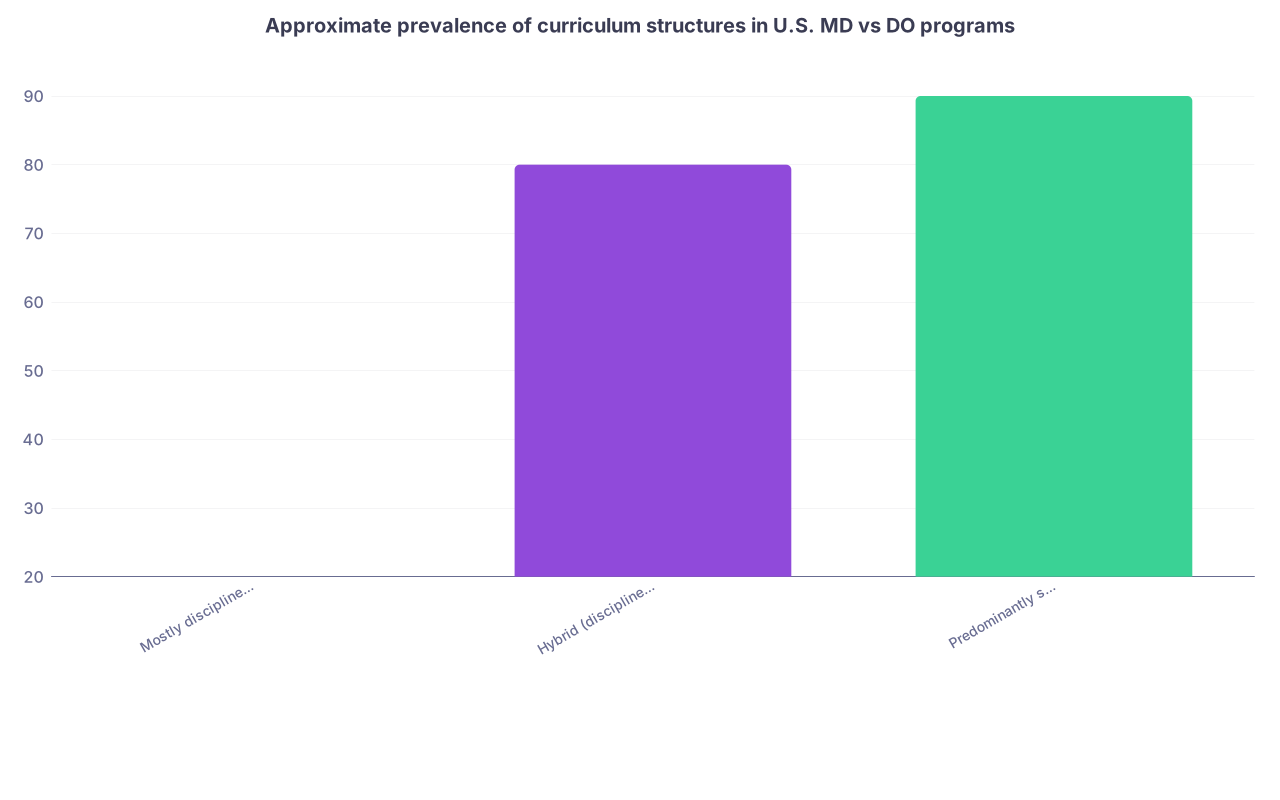
| Category | Value |
|---|---|
| Mostly discipline-based blocks | 20 |
| Hybrid (discipline + systems) | 80 |
| Predominantly systems-based | 90 |
Interpretation: most MD and DO schools have at least some systems-based integration now; what differs is how aggressively they push integration and how they handle longitudinal content.
Concrete examples (approximate models, not exact schedules)
MD example (traditional-leaning school):
- MS1 Fall:
- 8 weeks: Anatomy
- 6 weeks: Biochemistry / Molecular Biology
- 6 weeks: Physiology
- MS1 Spring:
- 4 weeks: Neuroscience
- 6 weeks: Microbiology
- 6 weeks: Immunology / Hematology
- MS2:
- 6–8 week systems: Cardio, Pulm, Renal, GI, Endo/Repro, etc., integrating path+pharm+phys
DO example (typical systems-based):
- Year 1:
- 4 weeks: Foundations / Cellular & Molecular
- 6 weeks: Musculoskeletal (anatomy-heavy, early OMM relevance)
- 6 weeks: Cardiovascular
- 6 weeks: Pulmonary
- Year 2:
- Renal, GI, Endo/Repro, Neuro, Psych, Heme/Onc, multi-system integration
- OMM thread every 1–2 weeks across both years
- Clinical skills thread throughout
Again, both DO and MD schools can do either. But DO programs more consistently have distinct, protected OMM blocks or weekly sessions embedded into the schedule.
3. How this actually changes your day-to-day as a student
Let’s get practical. You are not a curriculum theorist; you care about:
- Your study habits
- Your exam performance
- Your Step/Level readiness
- Your sanity
Discipline-based block experience
You might see this especially in older MD curricula early MS1.
Example: 8-week anatomy block
- Schedule:
- Morning: anatomy lecture
- Several afternoons per week: gross lab
- Minimal other content competing (maybe a sprinkle of ethics, histology)
- Assessment:
- Written exams: multiple choice
- Practical: cadaver spot tests
- Your life:
- You live in the lab.
- You memorize a ton of detail.
- You rarely think about path or pharmacology yet.
- You leave with very strong anatomic recall… that begins to decay if not integrated later.
Downside: you might understand brachial plexus branches in exquisite detail but not how that helps you manage a patient with a stroke until a year later.
Systems-based block experience
Example: 6-week cardiovascular system (MD or DO)
- Schedule:
- Day 1–5: Heart anatomy, basic cardiac physiology
- Week 2: Conduction system, ECG intro, volume/pressure loops
- Week 3–4: Pathology (MI, CHF, arrhythmias) + pharmacology
- Sprinkled weekly: small-group cases, clinical skills, maybe OMM ties (DO)
- Assessment:
- Integrated exam: questions mixing path, phys, pharm in clinical vignettes.
- Your life:
- You think of conditions (e.g., heart failure) along a continuum: physiology → pathology → pharmacology.
- You see how a physical exam finding connects to the underlying physiology in the same block.
Best part: It mirrors how Step 1 / Level 1 questions are structured: system- and vignette-based, not “random physio facts” in isolation.
4. Where DO vs MD programs really differ: threads and emphasis
The core difference is not “DO = block, MD = systems.” That is lazy thinking and usually wrong.
The more consistent differences:
4.1 Osteopathic manipulative medicine (OMM/OPP)
In DO curricula, OMM is not a side elective. It is a core longitudinal course.
How it is usually structured:
- Weekly or biweekly OMM labs during preclinicals
- Didactics on:
- Somatic dysfunction
- Osteopathic principles (TART, facilitated segments, viscerosomatic reflexes)
- Specific techniques: HVLA, muscle energy, counterstrain, myofascial, etc.
- Assessment: practical exams (you perform techniques on standardized patients / classmates), written exams on theory
Impact on your schedule:
- Your “block” calendar will usually have OMM carved out as its own block or standing time slot:
- e.g., Thursdays 1–5 PM OMM lab, regardless of the organ system.
- You must memorize:
- Anatomy at a more palpation-specific level
- Clinical correlations between somatic dysfunction and systemic disease
Does this steal time from systems content? Real answer: yes, a bit. But DO programs know they still have to prepare you for COMLEX and, increasingly, USMLE. So they compress elsewhere.
4.2 Licensing exam alignment (COMLEX vs USMLE)
Curricular design is driven hard by board expectations.
- MD programs:
- Historically: built around USMLE Step 1.
- Now with Step 1 pass/fail: many are shifting emphasis toward:
- Earlier clinical exposure
- More Step 2 CK prep
- Less minute memorization of esoterica in MS1
- DO programs:
- Must prepare you for COMLEX Level 1 and Level 2, and often also support you in taking USMLE.
- COMLEX still tests OMM explicitly + a lot of bread-and-butter physiology/pathology.
- Many DO schools keep a fairly robust, dense systems curriculum with explicit board-review integration (more structured NBME/COMSAE-style exams during preclinicals).
So the same “cardio system” might feel a bit different:
- MD: more early emphasis on clinical reasoning and patient-centered discussions.
- DO: more likely to have explicit “here is exactly how this maps to COMLEX content outline,” plus OMM considerations for, say, post-CABG patients.
5. Specific structures you will see on brochures (decoded)
Let me translate common marketing phrases into something meaningful.
“Traditional block curriculum”
Usually means:
- Discipline-based blocks first
- Heavy lecture and lab
- Integration mostly happens later
- You will be juggling less at once but doing more siloed learning early
You might see this more at older MD schools that have not fully modernized.
“Integrated systems-based curriculum”
Usually means:
- Majority of preclinical time is spent in organ-system blocks:
- Cardiovascular
- Respiratory
- Renal
- GI
- Neuro, etc.
- Each block mixes:
- Anatomy
- Physiology
- Pathology
- Pharmacology
- Clinical skills / case discussions
- Both MD and DO programs increasingly use this language.
“Spiral curriculum”
Translation:
- You revisit core concepts multiple times at increasing complexity.
- Example path:
- MS1: Basic cardio anatomy and phys
- MS2: Cardio path and pharm
- Clerkships: Cardio in internal medicine, ER, surgery
- Fourth year: Advanced electives in cardiology, ICU
This is more of an educational philosophy overlay than a schedule format. DO and MD schools both claim this.
“Longitudinal threads”
Common threads:
- Clinical skills
- Ethics / professionalism
- Interprofessional education
- OMM (DO only or occasionally as an elective concept at some MD schools)
Threads cut across blocks. They are not “cardio-only.” They run in parallel.

| Step | Description |
|---|---|
| Step 1 | Foundations Block |
| Step 2 | MSK Block |
| Step 3 | Cardio Block |
| Step 4 | Pulm Block |
| Step 5 | Renal Block |
| Step 6 | GI Block |
| Step 7 | Neuro Block |
| Step 8 | OMM Labs |
| Step 9 | Clinical Skills |
| Step 10 | Professionalism |
6. How curriculum structure affects board prep (USMLE vs COMLEX)
You care about Step/Level performance, and you should. Structure can help or hurt.
Systems-based blocks: board-friendly by design
USMLE/COMLEX questions:
- Are system-based
- Use clinical vignettes
- Mix phys/path/pharm/biochem/behavioral in one scenario
Systems curriculum:
- Trains you in that frame early.
- Example:
- A question about dyspnea, JVD, peripheral edema.
- You must recall:
- Pathophysiology of right heart failure
- Pharmacology of loop diuretics
- Side effects (e.g., ototoxicity)
- Possibly an OMM aspect (COMLEX): relevant lymphatic drainage, rib raising in COPD, etc.
Students from well-run systems curriculums often feel like boards are “more of the same,” just faster and denser.
Discipline-based blocks: require more integration work from you
If your school front-loads:
- Separate anatomy
- Separate physiology
- Separate pathology
You will:
- Have very deep silos of knowledge.
- Need to spend 2nd year or dedicated board prep time explicitly connecting:
- This pathology with that physiology and that pharmacology.
Not fatal. Many excellent physicians trained under old-school discipline blocks and crushed boards. But you will:
- Need more self-driven integration using resources like:
- Boards & Beyond
- Pathoma
- Sketchy
- UWorld / COMBANK / COMQUEST
DO-specific wrinkle: OMM and COMLEX
COMLEX still expects:
- High familiarity with OMM theory and techniques.
- Osteopathic philosophy integrated into systems.
Good DO curricula:
- Weave OMM into systems:
- E.g., treating rib dysfunction in a patient with pneumonia.
- Facet mechanics in a patient with low back pain + red flags.
Less well-designed DO curricula:
- Keep OMM floating as a semi-detached course that feels unrelated, making it feel like “extra work” rather than integrated reasoning.
You want the former, obviously.
7. Clinical years: does block vs. systems still matter?
By third year, the “block vs systems” argument starts to fade. You live in rotations:
- Internal medicine
- Surgery
- Pediatrics
- OB/GYN
- Psychiatry
- FM, EM, etc.
But early curricular design does echo here.
Students from systems-heavy schools often:
- Are more comfortable:
- Seeing a patient with abdominal pain and quickly sorting:
- GI, GU, vascular, gyn, musculoskeletal.
- Seeing a patient with abdominal pain and quickly sorting:
- Have better pattern recognition:
- Because your early learning was case-based and integrated.
Students from discipline-block schools often:
- Have:
- Slightly stronger independent recall of very detailed anatomy/phys early on.
- Need:
- A bit more time first few months to integrate path+pharm in a clinical way, if they did not do many vignettes preclinically.
By 3–6 months into clerkships, these differences blur. Work ethic and clinical exposure patterns matter more than preclinical structure at that point.
8. What you should actually look for when comparing DO vs MD curricula
Forget whether the brochure says “block” or “systems” on the front page. Go deeper.
Here are concrete features that matter:
How early do they start systems?
- Programs that sit in “random discipline soup” for the entire first year with no clinical integration tend to feel more disconnected.
- A short Foundations → then systems is ideal.
How are exams structured?
- Integrated, vignette-based questions?
- Or siloed “this is only physiology” exams?
- You want tests that look and feel like USMLE/COMLEX.
How is OMM integrated (for DO)?
- Is it:
- Linked to the systems (e.g., cardio OMM in cardio block)?
- Or just “OMM lab” with no clinical tie-in?
- Ask current students. They will tell you quickly if OMM is valuable or a time sink.
- Is it:
Length of preclinical phase: 2 years vs 1.5 vs 1 year
- 2 years:
- More breathing room
- More electives/research time early
- 1.5 years:
- Faster path to clinics
- More intense front-loaded studying
- Both DO and MD schools now experiment with shorter preclinicals.
- 2 years:
-
- USMLE Step 1 / Step 2 CK (for MD; DO if they report)
- COMLEX Level 1 / Level 2 CE (for DO)
- Not just average scores. Look at:
- Pass rates
- Trends over time
| Question | Why it matters |
|---|---|
| When do you start organ systems? | Early systems usually help integration and board alignment. |
| Are exams discipline-specific or integrated clinical vignettes? | Integrated exams better prepare you for USMLE/COMLEX. |
| How many hours per week are mandatory in-person sessions? | Tells you how much flexibility you’ll have to study your way. |
| How is OMM tied into systems? (DO) | Good integration makes OMM clinically meaningful, not just extra work. |
| What proportion of students take USMLE in addition to COMLEX? (DO) | Reflects how well the curriculum supports dual-exam planning. |
9. Strategic implications for you as a premed or accepted student
Let me be blunt.
You should not pick MD vs DO or School A vs School B purely on “block vs systems.” That is like choosing a car only by exterior color.
Better approach:
Decide DO vs MD for the right reasons
- DO:
- You are open to (or interested in) hands-on manual treatment.
- You want both COMLEX and likely USMLE options.
- You accept that OMM will take real time in your schedule.
- MD:
- You want the conventional route without OMM.
- You may prefer schools that already have a strong reputation with competitive specialties.
- DO:
Within DO or MD, rank curricula by:
- Early systems integration
- Quality of longitudinal clinical skills
- Student-reported board prep support
- Flexibility (recorded lectures? attendance policy? exam schedule?)
Then consider your learning style:
- If you like:
- Focused, single-topic immersion: discipline-based blocks can feel satisfying, especially early.
- If you like:
- Seeing the full picture and working with cases: systems-based integration will feel more natural.
- If you like:
And remember: a mediocre systems curriculum with disorganized teaching is worse than a well-run discipline-based block structure with clear objectives and strong review.
Structure helps. Execution wins.
FAQ (5 questions)
1. Is DO school more likely to use block curriculum and MD more likely to use systems?
No. Many DO schools use systems-based blocks, just like MD programs. The reliable difference is that DO programs include longitudinal OMM content; the exact block vs systems pattern varies school by school on both sides.
2. Does a systems-based curriculum guarantee better Step 1 / COMLEX Level 1 scores?
No guarantee. Systems-based curricula align more naturally with board question formats, but outcomes depend heavily on teaching quality, internal exams, and your own use of external resources. I have seen strong and weak board outcomes under both structures.
3. Will OMM in DO programs take away time from studying for USMLE?
It does take time, but that is not automatically a disadvantage. Well-run DO programs compress and integrate content so that OMM reinforces anatomy, neuro, and clinical reasoning. Poorly integrated OMM can feel like extra load. This is why you talk to current students at each DO program.
4. Is a 1.5-year preclinical curriculum better than a 2-year one?
It depends on you. Shorter preclinical means faster to wards and more clinical time before Step 2 / Level 2, but it compresses your early science learning. Some students thrive with intensity and self-directed resources; others benefit from a slower, more faculty-guided pace.
5. When I read “spiral, integrated, learner-centered curriculum” on a website, should I trust it?
Only after verifying. Every school uses buzzwords. Ask for sample block schedules, exam style descriptions, and board performance data. Then talk to MS2s and MS3s. Their lived experience will tell you whether the spiral integration is real or just brochure language.
Two key points to keep in your head:
- “Block vs systems” is not DO vs MD. Both flavors exist in both degrees; what matters is how well they are executed and how aligned they are with boards and real clinical reasoning.
- OMM is the true structural difference for DO programs. Systems integration, exam style, and board support should be your main decision filters once you have decided between DO and MD.