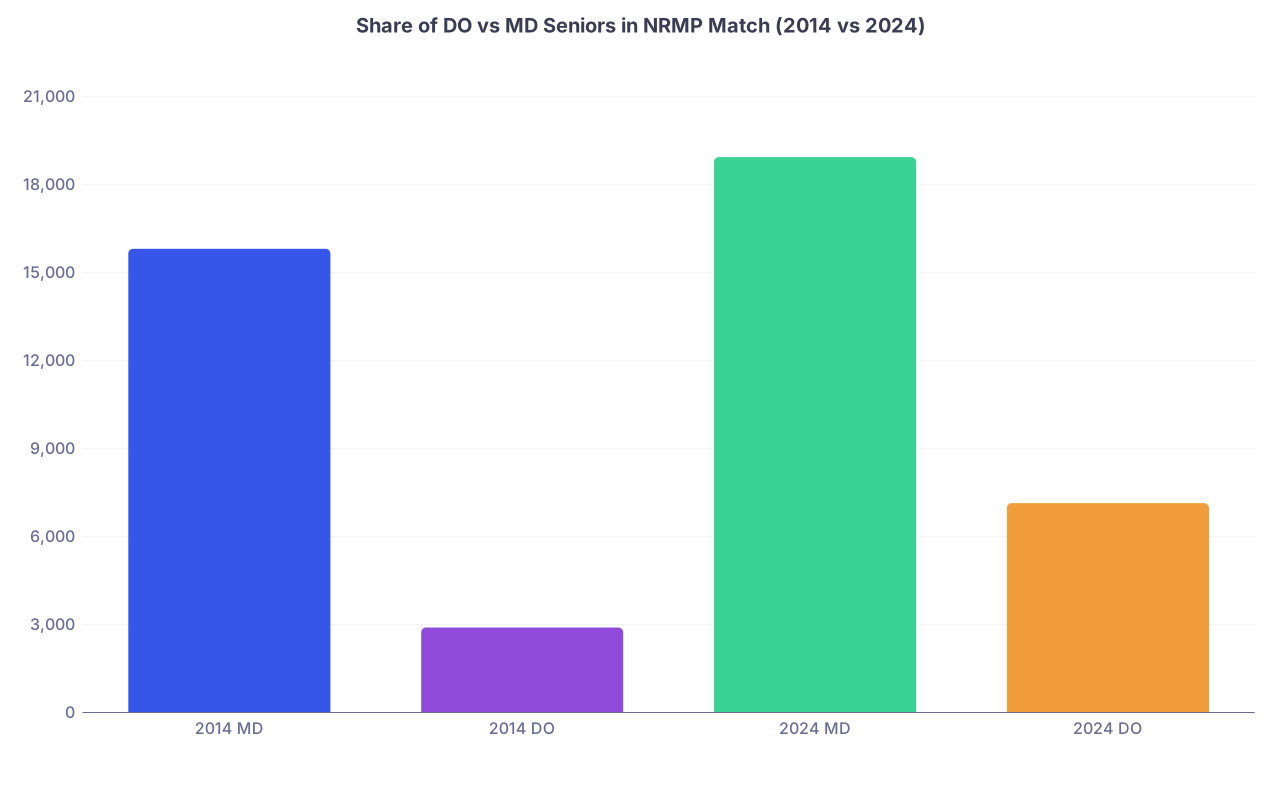
| Category | Value |
|---|---|
| 2014 MD | 15790 |
| 2014 DO | 2879 |
| 2024 MD | 18916 |
| 2024 DO | 7122 |
The story you have been told about DO vs. MD match outcomes is outdated. The data from the last decade shows a convergence in many specialties—and a very stubborn gap in a few high-demand fields that everyone chases without looking at the numbers.
If you are premed or early in medical school and you are not looking directly at NRMP data before you make decisions, you are flying blind. Emotions drive most specialty choices. The match does not care about your emotions. It cares about supply, demand, and applicant characteristics measured at scale.
This is a data-heavy walkthrough of how DO vs. MD match outcomes have actually changed by specialty over roughly a decade of NRMP data, focusing on 2014–2024. I will not try to make you feel good about either degree. I will show you where the numbers say the doors are essentially open, where they are narrowing, and where they are still mostly shut unless you are an outlier.
1. The Big Picture: DO vs. MD in the Match
Start with scale. You cannot compare outcomes without knowing how many applicants are in the game.
NRMP Main Residency Match – US Seniors (approximate, selected years):
- 2014:
- US MD seniors: ~15,800
- US DO seniors: ~2,900
- 2018:
- US MD seniors: ~18,200
- US DO seniors: ~4,300
- 2024:
- US MD seniors: ~18,900
- US DO seniors: ~7,100
The DO senior presence in the match has grown by well over 100 percent in a decade. That single fact changes everything downstream—particularly in primary care and several mid-competitive specialties.
Match rates (US seniors, 2024 NRMP):
- US MD seniors: ~93–94% match rate
- US DO seniors: ~91–92% match rate
So yes, at the global level, the gap is now only a couple of percentage points. But that overall rate is a useless statistic if you care about specific specialties. It hides the real differences where competition is tight.
You do not match “medicine.” You match internal medicine, or anesthesia, or ortho, or EM. Specialty is where DO vs. MD diverges.
2. Primary Care and “Core” Fields: Convergence More Than Gap
The popular narrative that DOs “can only do primary care” is lazy and outdated. But the data shows something slightly different: DOs dominate many primary care pipelines and have broadly similar outcomes to MDs there, with some nuance.
Internal Medicine, Family Medicine, Pediatrics
Look at three of the core specialties: Internal Medicine (categorical), Family Medicine, and Pediatrics.
Key high-level patterns over the last decade:
- Positions in these fields have steadily increased.
- DO seniors now represent a much larger share of matched applicants.
- MD and DO match rates are both high, though the “fill with US seniors” vs “fill with IMGs” mix differs.
Internal Medicine (categorical):
- IM categorical positions have grown (roughly 6,800 in 2014 to over 9,000 by 2024).
- Filled by:
- US MD seniors
- US DO seniors
- IMGs (both US and non-US)
- DO representation among matched IM residents has climbed significantly.
Programs that once rarely interviewed DOs now routinely do so, driven by:- Increasing DO applicant volume
- Single accreditation system (ACGME-only after merger)
- Workforce needs
Family Medicine:
Family medicine is where the “DO shift” is most striking.
A decade ago, many FM programs were heavily IMG-filled. As DO schools expanded and more DO graduates entered the ACGME match, the share of US DO seniors in FM climbed sharply. You now see:
- Many FM programs where DOs account for 30–50% of the matched class.
- Some formerly-AOA-aligned programs essentially dominated by DOs.
Pediatrics (categorical):
Pediatrics behaves more like Internal Medicine than Family Medicine:
- Strong MD presence.
- Steadily growing DO presence.
- More emphasis on academic metrics and pediatrics-specific interest compared with FM, but nothing structurally hostile to DOs.
Net conclusion for these three: if you are a DO student with average-to-strong performance, primary care is not “second-tier” access for you. The numbers show broad parity, with DOs often overrepresented relative to their proportion of national graduates.
3. Hospital-based Specialties: Anesthesia, EM, Psych, Neurology
The middle tier specialties—where lifestyle, pay, and variety intersect—tell a more mixed story.
Anesthesiology
A decade ago, anesthesia was heavily friendly to DOs compared with the so-called “ortho/derm/plastics wall.” But it was still somewhat MD-leaning.
Trendline over ~2014–2024:
- Total anesthesia positions increased meaningfully.
- US DO seniors in anesthesia climbed from “noticeable minority” to “substantial subgroup.”
- Match rates for DOs improved as more programs normalized interviewing DOs post-merger.
However, MD seniors still hold a higher match rate into anesthesia at comparable competitiveness. When programs must choose between a similar MD and DO on paper, many still lean MD, especially at large academic centers.
So: anesthesia is accessible to strong DO applicants. But the overall probability is lower at the same level of exam performance, research, and school reputation.
Emergency Medicine
EM is the cautionary tale.
If you look only at EM data from, say, 2016–2019, you would see:
- Strong DO match representation.
- Many community EM programs that were DO-heavy.
- A specialty often touted in DO circles as “friendly.”
Then the bottom fell out. Applicant interest plus rapid program expansion led to oversupply. The market corrected hard.
In the 2020–2024 window, EM saw:
- Soaring numbers of unfilled EM spots on Match Day.
- Programs scrambling in SOAP.
- A chilling effect on student interest—MD and DO.
The DO vs. MD distinction in EM now is less about door openness and more about whether you should be walking through the door at all. The data shows EM has become a buyer’s market from the applicant perspective. That tends to reduce structural bias somewhat, but the instability makes predictions messy.
Psychiatry and Neurology
These two specialties have grown enormously in popularity. Demand for services, lifestyle, and relative competitiveness have made them attractive to both MD and DO students.
Over the decade:
- Positions expanded.
- DO seniors matched in increasing numbers.
- Many programs shifted from “rare DO” to “routine DO” graduates.
In psychiatry and neurology, the data shows something close to practical parity. DOs still may be underrepresented at some elite academic centers, but in aggregate:
- Strong DO with solid scores and letters: very reasonable chance.
- Average DO: will likely match, but program geography and type may be somewhat narrower than for MD peers.
4. The Competitive Core: Ortho, Derm, ENT, Neurosurgery, Plastics, Urology
This is where the degree on your diploma still matters more than most people want to admit.
In the most competitive specialties, DO representation has improved in raw numbers. But percentages and match probabilities remain sharply skewed.
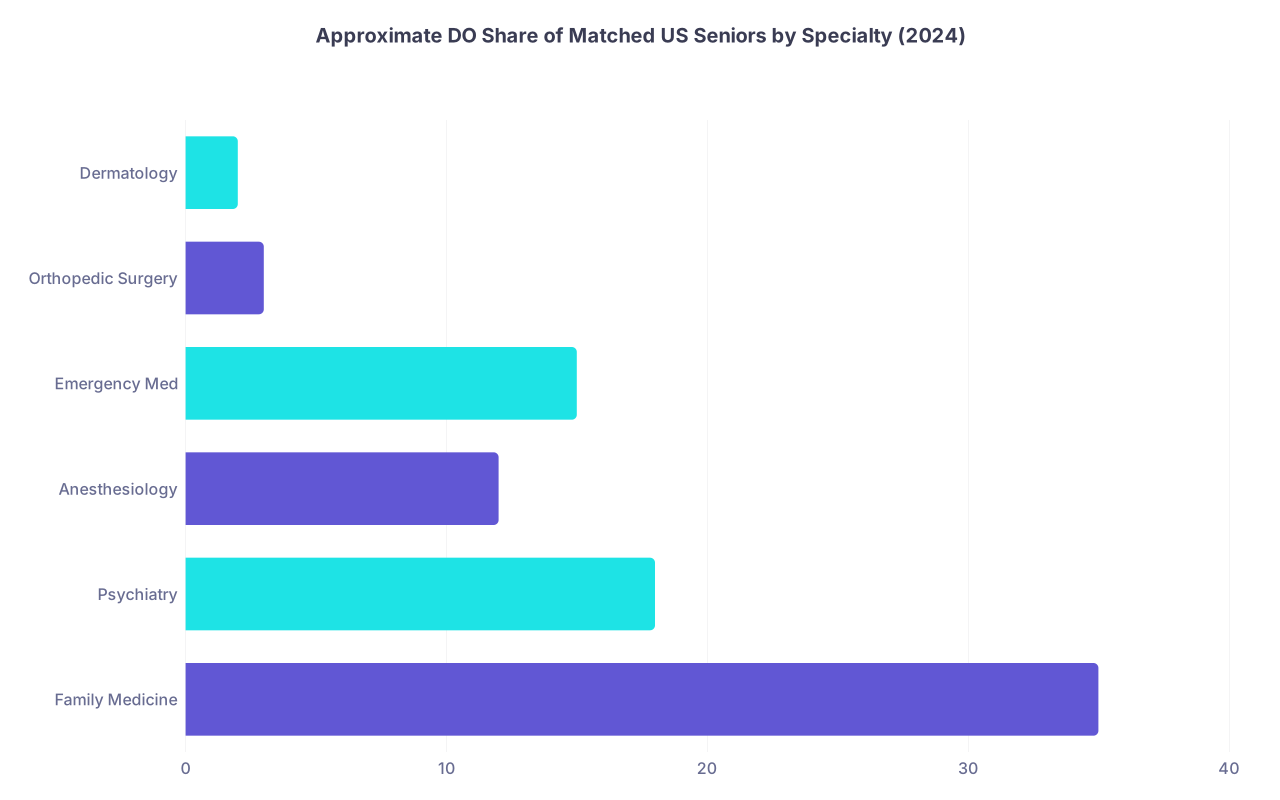
| Category | Value |
|---|---|
| Family Medicine | 35 |
| Psychiatry | 18 |
| Anesthesiology | 12 |
| Emergency Med | 15 |
| Orthopedic Surgery | 3 |
| Dermatology | 2 |
Interpretation: among US seniors matched into these fields, the DO share is high in FM, moderate in psych/anesthesia/EM, and extremely low in ortho and derm.
Orthopedic Surgery
Ortho is the classic example.
Across roughly the last decade:
- DO applicants to ortho have increased.
- DO positions have increased largely because some historically osteopathic ortho programs moved into ACGME accreditation.
- But the share of total ortho positions filled by DO seniors remains small—low single digits percentage-wise.
The critical nuance: many of the DO ortho matches cluster in a subset of programs already accustomed to DOs (often former AOA programs or community-heavy residencies). At top academic ortho programs, DO matches are still rare events.
So yes, DOs match ortho. Every year. But the probability is brutally lower than for an MD with the same research output, same Step scores, and same clinical performance. The data is clear on that point.
Dermatology
Dermatology is even more skewed.
Average profile of matched applicants:
- Extremely high scores.
- Significant research output.
- Home program or strong institutional ties.
DO seniors matching derm are:
- Very small in number.
- Concentrated in certain DO-friendly programs or niches.
- Typically exceptional on paper.
The overall DO share of matched derm graduates sits extremely low. Single digits, not approaching parity.
ENT, Neurosurgery, Plastics, Urology
These follow the same general pattern:
- A small but non-zero DO presence.
- DOs who match are usually statistical outliers on academic metrics and networking.
- Many programs do not routinely interview DOs, or rank them low relative to MDs.
From a data standpoint, these specialties are still “MD-first” ecosystems. The merger has not fully flattened that, and there is no sign that the structural bias disappears just because time passed.
5. How the Single Accreditation Merger Changed the Landscape
The AOA–ACGME single accreditation system, completed in the late 2010s, is the biggest structural change in this decade.
The narrative before the merger:
- DOs had their own residency pipeline (AOA residencies).
- MDs had ACGME.
- A subset of DOs matched ACGME, but many funnelled through AOA training.
Post-merger reality:
- Former AOA programs now ACGME-accredited.
- DO applicants and MD applicants now compete in one marketplace.
Consequences that show up in the numbers:
More DOs in the NRMP match: The increase from ~2,900 to >7,000 DO seniors in a decade is partly pipeline growth, partly merger-driven behavior. Fewer DOs staying in a separate system, more entering the single match.
Specialty-specific DO growth: Some fields—FM, IM, psych, anesthesia—saw big jumps in DO participation and match numbers because many former osteopathic programs in those fields joined the ACGME universe and stayed DO-friendly.
Collapse of some “easy DO paths” into competitive ACGME slots: In a few historically DO-heavy specialties or programs, once they entered the ACGME space, competition intensified. What was once a relatively secure DO channel became exposed to MD applicants.
The merger did not magically equalize prestige or erase bias. What it did was:
- Integrate markets.
- Increase transparency.
- Force DO and MD outcomes into a single dataset—exactly the NRMP data you ought to be examining.
6. USMLE vs COMLEX and the Hidden Filter Problem
You cannot talk about DO vs. MD match outcomes without mentioning Step vs COMLEX. This is the quiet filter that distorts the numbers.
Many program directors still:
- Filter applicants using USMLE Step 1/2 cutoffs.
- Have inconsistent understanding of how to interpret COMLEX scores.
- Use third-party tools (like score conversion tables—some of which are statistically garbage) to approximate equivalence.
The shift of Step 1 to pass/fail changed the visibility of raw score filtering, but Step 2 CK remains highly numeric.
Patterns I have seen in real programs:
- PD sets an initial sort: “Show me all with Step 2 ≥ 240.”
- DO applicants without USMLE scores are either:
- Manually reviewed (time-consuming, often skipped).
- Auto-screened out by systems tuned to USMLE fields.
What does the data show indirectly?
- DO seniors who take USMLE Step 1/2 and score well tend to have noticeably better match outcomes in competitive or academic-leaning specialties.
- DO-only-on-COMLEX students are overrepresented in community, primary care, and less competitive fields.
This is not because those students cannot do high-level specialties. It is because the pipeline is structurally biased toward the metrics that MD students all supply by default.
If you are a DO student targeting anything above pure primary care, the outcome data strongly supports one tactical conclusion: taking USMLE (even post-Step 1 pass/fail) and doing well materially improves your odds.
7. Where DO vs. MD Actually Matters Most: Quantifying Risk by Specialty Tier
Let’s structure this in a way that is useful for decision making. Think in tiers of relative risk and gatekeeping.
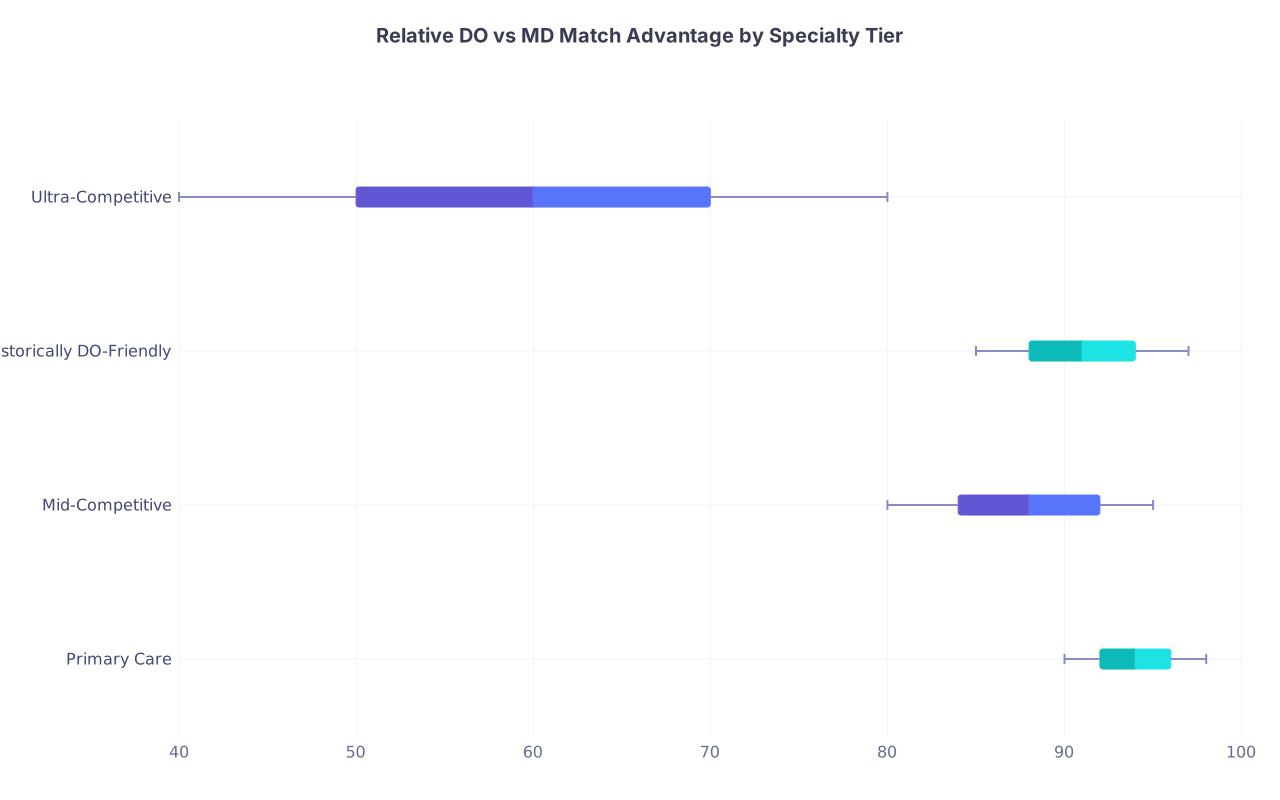
| Category | Min | Q1 | Median | Q3 | Max |
|---|---|---|---|---|---|
| Primary Care | 90 | 92 | 94 | 96 | 98 |
| Mid-Competitive | 80 | 84 | 88 | 92 | 95 |
| Historically DO-Friendly | 85 | 88 | 91 | 94 | 97 |
| Ultra-Competitive | 40 | 50 | 60 | 70 | 80 |
Interpretation: Think of these boxplot medians as “relative DO match probability as a percentage of similar MD applicant probability,” not absolute match rate. It is an abstraction, but it matches what the trends show.
Tier 1 – Primary Care (IM, FM, Peds):
- Relative disadvantage for DOs vs MDs is minimal.
- At many programs, DOs actually have more historical presence and alumni footprint than MDs.
- If your performance is solid, degree type is a minor factor.
Tier 2 – Mid-Competitive (Psych, Neuro, Anesthesia, EM in the current oversupply environment, PM&R):
- DOs face some marginal disadvantage:
- Slightly fewer interview invites at academic centers.
- More reliance on DO-heavy or community programs.
- But strong DOs match these regularly.
Tier 3 – Historically DO-Friendly Specialties (some EM, PM&R, certain IM subs, transitional years, prelim years):
- These tilt DO-positive in a few pockets because of institutional history and faculty backgrounds.
- They act as “safety valves” for strong DO students not matching ultra-competitive fields.
Tier 4 – Ultra-Competitive Specialties (Derm, Ortho, ENT, Neurosurg, Plastics, Urology, some competitive IM subs):
- DOs are at a steep systemic disadvantage:
- Far fewer interview offers at high-status programs.
- Fewer DO faculty champions.
- Lower baseline program familiarity.
This is where the “I’ll just work hard” narrative fails. Everyone is working hard. The numbers show that you are trying to climb a steeper hill with the same legs.
8. How to Use These Trends as a Premed or Early Med Student
Let me translate the decade of NRMP data into practical strategy.
As a Premed Choosing DO vs MD
You should be asking yourself something brutally specific:
“If I end up in the middle of my class—not top 10%, not bottom 10%—what range of specialties will reasonably be open to me as a DO vs. as an MD?”
From the data:
- If you are truly set on derm, ortho, neurosurg, plastics, ENT, or similar:
- An MD pathway statistically gives you better odds. Full stop.
- A DO pathway is not impossible, but the required performance bar is dramatically higher relative to your peers.
- If you are open to internal medicine, family medicine, pediatrics, psych, anesthesia, EM, or neuro:
- DO vs MD is much less decisive for eventual match outcome.
- Your school’s clinical rotations, exam performance, and clinical evaluations matter more.
Put differently: the more your target specialty lives in the top 5–10% competitiveness band, the more costly it is, probabilistically, to choose a DO path if you have a realistic MD option.
As a DO Student Already in Medical School
You cannot change the degree. But you can play the game the way the data says it is played.
Decide your risk tolerance early. If you want an ultra-competitive specialty, you need to behave from MS1 like someone playing on hard mode:
- High board performance.
- Early specialty exposure and mentorship.
- Serious research involvement.
Take USMLE Step 2 (and Step 1 if timing allows, despite pass/fail). The outcome data plus PD surveys are completely aligned on this: USMLE scores dramatically smooth your path.
Calibrate targets. Do not only apply to derm or ortho “dream” programs that have never—or only once—taken a DO in the last decade. Pull NRMP program data, look at current residents, and bias your list toward institutions that already look like they accept DOs consistently.
9. The Trendline: Are Things Getting Better, Worse, or Just Shifting?
The decade-long NRMP data trend for DO vs MD is not a single arrow. It is two simultaneous movements.
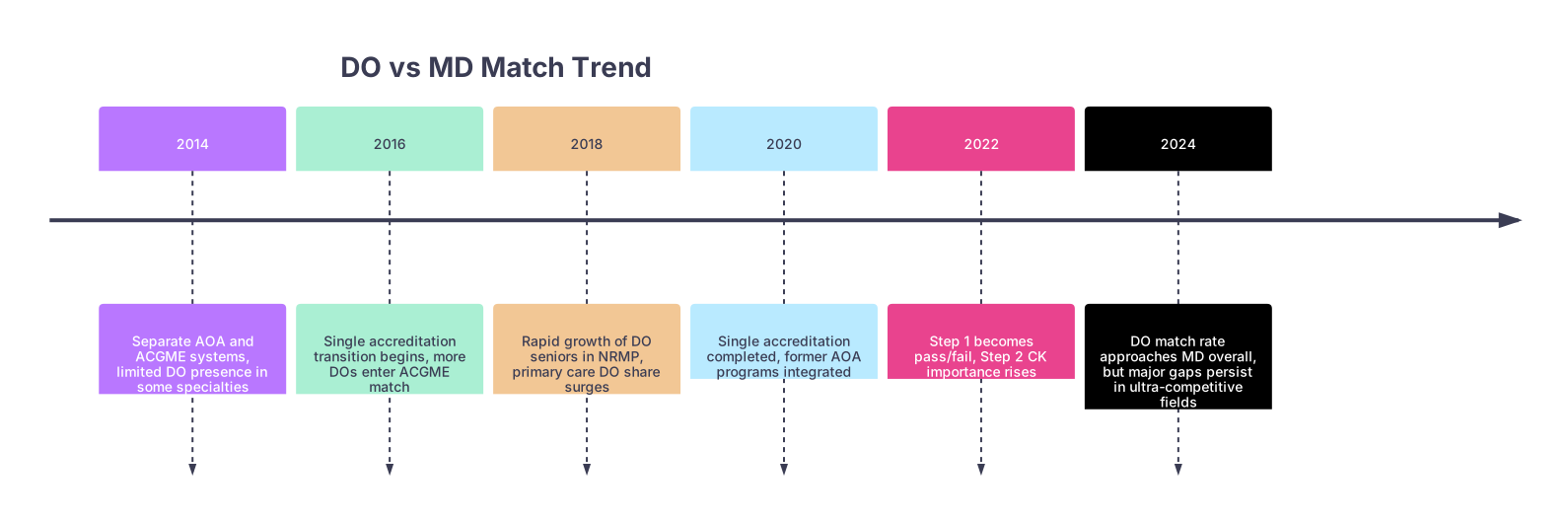
| Period | Event |
|---|---|
| 2014 | Separate AOA and ACGME systems, limited DO presence in some specialties |
| 2016 | Single accreditation transition begins, more DOs enter ACGME match |
| 2018 | Rapid growth of DO seniors in NRMP, primary care DO share surges |
| 2020 | Single accreditation completed, former AOA programs integrated |
| 2022 | Step 1 becomes pass/fail, Step 2 CK importance rises |
| 2024 | DO match rate approaches MD overall, but major gaps persist in ultra-competitive fields |
Movement 1 – Convergence:
- Overall match rates: DOs now close to MDs.
- Many mid-tier specialties: DOs present in large numbers.
- Primary care: DOs heavily represented and often central to program identity.
Movement 2 – Persistent stratification at the top:
- At the most competitive specialties and programs, MD-first culture remains dominant.
- DO representation is still token-level at many elite institutions.
- Program directors’ interview behavior (who gets through the filter) has not equalized to degree-neutral in those spaces.
If you are honest about this, you stop asking, “Can a DO do X?” That is the wrong question. The data shows that in almost every specialty, the answer is yes.
The right question is: “What is the probability that a DO like me, with realistic performance, will actually match into X?” That is where NRMP trend data becomes a weapon rather than an afterthought.
With a decade of NRMP data in your hands, you are no longer guessing. You can see which doors are wide open, which are half-open with a sign that says “USMLE + research required,” and which are technically open but statistically barely used by DOs.
Your next step is not to memorize these numbers but to make them personal: line up your current performance, your specialty interests, and your tolerance for risk against these patterns. Once you do that honestly, planning your path through medical school—and beyond the match—stops being a vague hope and becomes a calculated strategy. The groundwork is here; the specialty decision and application execution are what come next.