The biggest mistake DO and MD students make is pretending COMLEX and USMLE are “basically the same exam.” They are not. And if you prep like they are, you leave points—and often entire score ranges—on the table.
Let me break this down specifically.
You are dealing with two different licensing ecosystems:
- Different blueprints
- Different question styles
- Different scoring expectations
- Different program cultures around each exam
If you are a DO, your strategic plan is fundamentally different from an MD’s. And if you are comparing COMLEX vs. USMLE without understanding how residency directors actually think, you are flying blind.
1. High-Level Reality: Who Needs What, and Why It Matters
Here is the blunt version.
- MD students: You live in the USMLE world. COMLEX is irrelevant for you. Your entire strategy is Step-focused.
- DO students: You live in a split universe. You must pass COMLEX. But the decision point is whether you also take USMLE for competitiveness and access to certain residencies.
Residency programs fall into three rough buckets:
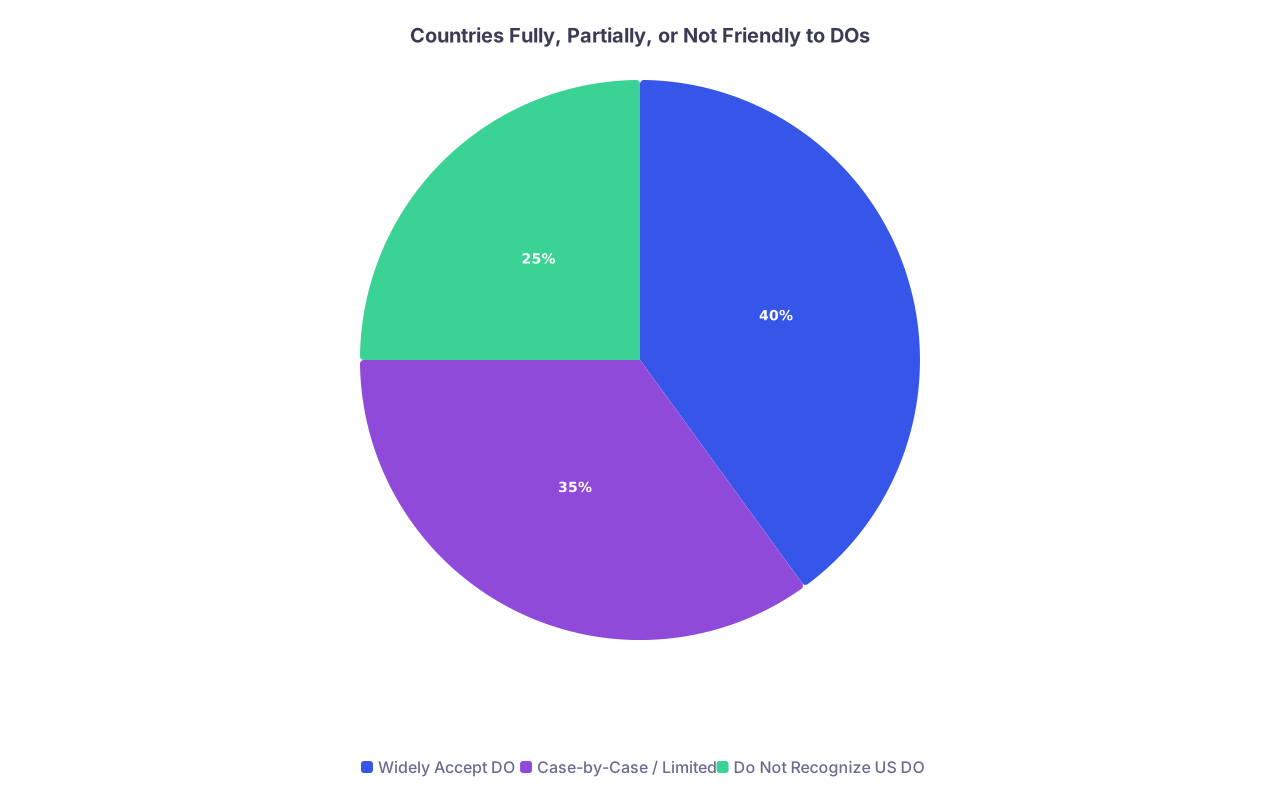
- Programs that truly accept COMLEX-only and see DOs as equivalent
- Programs that say they accept COMLEX but heavily prefer USMLE scores
- Programs that practically require USMLE (especially historically MD-heavy, competitive specialties)
So the core strategic questions for a DO are:
- Which specialties am I realistically targeting?
- Which programs do I actually want to be competitive for?
- Does not taking USMLE close doors I care about?
Many DO students ask the wrong question: “Is USMLE required?”
The correct question: “What are my odds without a USMLE score at the programs I actually want?”
2. Blueprint Differences: COMLEX vs. USMLE Is Not Just Branding
Both licensing bodies obsess over “competencies” and “systems-based” language. Ignore the buzzwords. Think about what actually shows up in questions.
2.1 Structural and Content Emphasis
USMLE (especially Step 1 pre-pass/fail and Step 2 CK now) is built around:
- Mechanisms: pathophysiology, pharmacodynamics, molecular details when they matter clinically
- Integration: multi-step logic, multi-order thinking
- Vignette density: long stems, subtle clues, layered decision-making
- Evidence: guidelines, next best step, risk stratification
COMLEX is built around:
- Broad systems with clinical application
- Heavy coverage of primary care, ambulatory medicine, and generalist decision-making
- Safety, ethics, and public health questions and “what is safest/most appropriate” type items
- OMM/OMT: diagnosis, techniques, models, and contraindications
And yes, COMLEX stems are often clunkier. Less polished. Sometimes oddly worded. That is not your imagination.
2.2 OMM: The Unique COMLEX Burden
USMLE: zero osteopathic content.
COMLEX: OMM is not a side topic. It is baked into multiple domains.
You are expected to know:
- Somatic dysfunction diagnosis:
- Fryette principles, segment diagnosis (e.g., T5 F RrSr)
- Sacral, innominate, rib dysfunction patterns
- OMT modalities:
- HVLA, ME, FPR, Still, counterstrain, BLT, articulatory, MFR
- Indications, contraindications, setup, direction of force
- Viscerosomatic relationships and autonomic levels:
- Heart (T1–T5), lungs (T2–T7), upper GI, lower GI, pelvic organs, etc.
- Lymphatics and chapman points
- Osteopathic philosophy: models (biomechanical, respiratory-circulatory, neurologic, metabolic, behavioral)
If you walk into COMLEX with “I’ll just wing OMM from memory of lab,” you are volunteering to lose an entire scoring domain.
3. Exam Format and Question Style: Where People Get Burned
3.1 Length, Interface, and Fatigue
Historically:
- COMLEX Level 1/2: more questions, more blocks, more overall fatigue, clunkier navigation.
- USMLE: fewer but denser blocks, better interface, more refined item quality.
This matters for prep. You can be “fit” for USMLE and still run out of gas on COMLEX if you underestimate the slog.
3.2 Question Style
USMLE questions:
- Long clinical vignettes with multiple diagnostic and management forks
- Clear single best answer (usually); ambiguity is less common
- Heavy integration of labs, imaging, and multiple disciplines in one question
COMLEX questions:
- Often shorter but more numerous
- More “primary care office” style: “What is the next best step?” “What vaccine?” “What counseling?”
- More ethics/public health/safety items than people expect
- More OMM scattered unpredictably
And something that trips up strong USMLE-preppers: COMLEX sometimes tests lower-level recall or “board buzzwords” in a way USMLE has moved away from. You cannot assume more sophisticated reasoning always wins; sometimes it is literally the memorized pair.
4. Scoring and Competitiveness: How Programs Actually Read These Numbers
USMLE:
- Historically: three-digit score (e.g., 225, 240, 255)
- Step 1 now: Pass/Fail
- Step 2 CK: still three-digit and now the main numerical filter
COMLEX:
- Three-digit score (e.g., 480, 550, 620)
- Much less intuitive to MD program directors
- Percentiles often misunderstood; score ranges do not map cleanly to USMLE
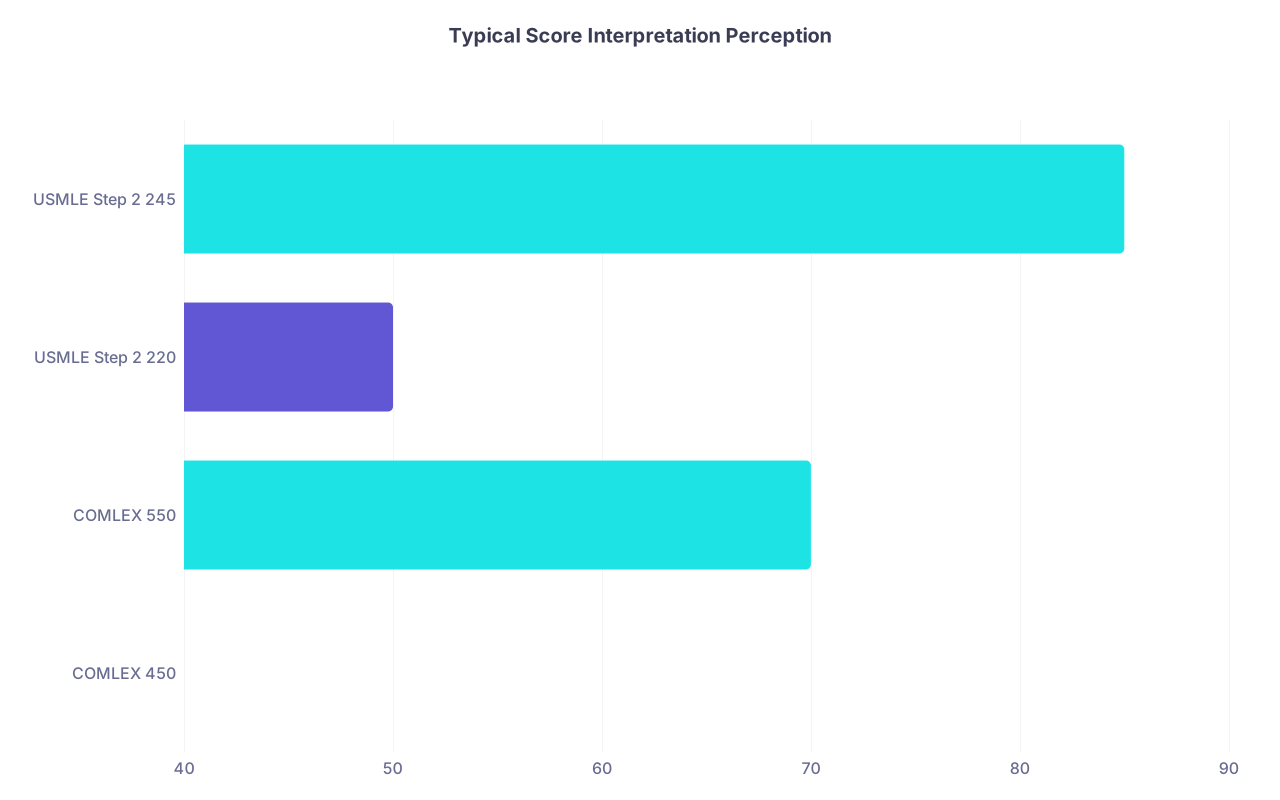
| Category | Value |
|---|---|
| COMLEX 450 | 40 |
| COMLEX 550 | 70 |
| USMLE Step 2 220 | 50 |
| USMLE Step 2 245 | 85 |
That chart is conceptual: it reflects approximate “perceived competitiveness” score out of 100 in the minds of many program directors, not literal data. The point is this: a COMLEX 550 does not automatically trigger the same recognition as a USMLE 245 in a busy PD’s brain.
So for DOs:
- COMLEX is binary in many MD PD brains: Pass vs. “really high” if they are even COMLEX-literate
- USMLE Step 2 CK gives you a precise, comparable anchor
A DO with:
- COMLEX 580 + USMLE Step 2 CK 245–250
is much easier to “slot” than: - COMLEX 650 only
Fair or not, that is how people actually read applications.
5. Prep Strategy for DOs: Four Distinct Scenarios
This is where most DO students need hard guidance. Stop asking generic Reddit.
Scenario 1: DO, Primary Care–Bound, Mostly Community or DO-Friendly Programs
Think FM, IM, Peds, Psych at community or regionally DO-heavy programs.
Strategic reality:
- Many of these programs truly accept COMLEX-only
- Your clinical performance, letters, and commitment to the region will matter more than an extra exam
- USMLE may not add enough ROI to justify the extra months of stress
Blueprint focus:
- COMLEX Level 1 and 2 content
- OMM mastery, not just survival
- Primary care, chronic disease management, screening guidelines, vaccines, prenatal care, behavioral health, patient counseling
Resources:
- A standard USMLE-style resource backbone (e.g., UWorld + something like AMBOSS or Boards & Beyond for systems)
- PLUS a dedicated COMLEX Qbank (COMBANK/TrueLearn or COMQUEST) for:
- OMM
- COMLEX-style ethics/public health
- Shorter, weirder stems
Schedule:
- Primary: UWorld systems-based + core content
- Parallel: 10–20 COMLEX-style questions per day early, increasing to 40–80 toward exam
- Dedicated OMM review: 2–3 focused sessions per week + one cumulative review day every 1–2 weeks
You are optimizing to:
- Pass comfortably
- Be in the “solid” COMLEX range for your programs of interest
- Avoid overextending into USMLE unless there is a realistic benefit
Scenario 2: DO, Wants Mid-Competitive IM/EM/Psych in Mixed DO/MD Environments
This is the “grey zone” group. Larger academic centers, some university-affiliated EM, hospital-based psych.
Strategic reality:
- COMLEX-only can work, but you have to be very strong elsewhere and target explicitly DO-friendly places
- A solid USMLE Step 2 CK score broadens options and reassures traditional MD programs
- Not taking USMLE does close some doors, even if no one wants to say it directly
Recommendation:
I usually tell students in this group: strongly consider USMLE Step 2 CK even if you skipped Step 1. Step 2 CK is now the main objective metric.
Prep blueprint:
- Treat your core content as USMLE-level.
- Treat COMLEX as an overlay, not a separate universe.
Practical plan:
- Early 3rd year: build your Step 2 CK foundation with UWorld + one good Step 2 content resource (OnlineMedEd, Boards & Beyond Step 2, or similar).
- Simultaneously, integrate OMM and COMLEX-style Qs during rotations:
- Example: On FM rotation, do 20 UWorld Qs + 20 COMLEX-style Qs daily.
- Before exams:
- Take NBME practice exams for Step 2 CK
- Take COMSAE/SCORE practice for COMLEX
You are aiming for:
- Step 2 CK: ≥ 235–240
- COMLEX Level 2: ≥ 550–600
Those are not magic numbers, but they are where programs stop worrying about your test-taking and start judging the rest of your file.
Scenario 3: DO, Aiming for Competitive MD-Dominated Specialties (Derm, Ortho, ENT, Urology, Radiology, Anesthesia at certain places)
Here the discussion gets blunt.
Strategic reality:
- COMLEX-only is a handicap at a huge proportion of these programs
- Some will filter you out on “no USMLE” alone
- Others “accept” COMLEX but never actually interview COMLEX-only DOs at a meaningful rate
Unless you have a hyper-focused DO-heavy network and are content with a very narrow list, you take USMLE. Ideally both Step 1 and Step 2, but now that Step 1 is pass/fail, Step 2 CK is absolutely critical.
Prep blueprint:
- Your baseline must be USMLE-level granularity. No shortcuts.
- OMM and COMLEX prep become an additional layer, not the core.
What this looks like day-to-day:
- Preclinical:
- Study as if you are an MD taking Step 1
- Use: Pathoma, Sketchy, UWorld, Boards & Beyond, Anki if you tolerate it
- Add: a COMLEX Qbank 1–2 blocks/day during dedicated, specifically for:
- OMM
- Public health/ethics
- Random lower-yield “COMLEX-isms”
- Dedicated for Step 1 / Level 1:
- First 4–5 weeks: 90% USMLE-style, 10% COMLEX-style
- Final 1–2 weeks: 60–70% COMLEX, 30–40% targeted USMLE review
- Take Step 1 first, then Level 1 within 1–2 weeks while material is hot
Then repeat a similar pattern for Step 2 CK / Level 2:
- Step 2 CK: main studying and score chaser
- Level 2: assure pass and decent score with focused COMLEX-style practice + OMM review
This route is brutal. It is also how DOs actually match into some of the most selective MD-heavy programs. I have watched it work repeatedly.
Scenario 4: MD Student (Just to Anchor the Contrast)
Your life is simpler:
- You ignore COMLEX entirely.
- You build preclinical around Step 1-level conceptual depth (even though it is pass/fail, it still matters for your fund of knowledge).
- You prioritize Step 2 CK for actual competitive scoring.
Your blueprint:
- Early: concept mastery (B&B/Pathoma/Sketchy)
- Mid: UWorld early and often, strong integration with systems
- Dedicated: NBMEs, UWorld reset or second pass, targeted weak area repair
You never have to think “Is this COMLEX-y enough?” which is a luxury DOs simply do not have if they are taking both.
6. Concrete Blueprint Differences: What You Must Over-Prep or Under-Prep
Let me be very literal.
COMLEX Over-Weights (Relative to USMLE)
You should overweight these for COMLEX prep:
OMM/OMT:
- Sacral/innominate mechanics
- Fryette, typical vs. atypical ribs
- Muscle energy setups and directions
- HVLA lines of drive and contraindications
- Chapman's points and autonomic levels
Public Health / Ethics / Systems:
- Vaccine schedules
- Screening guidelines
- Occupational exposures
- “What is the safest / best practice / most appropriate counseling”
Bread-and-butter Primary Care:
- Diabetes outpatient adjustments
- Hypertension stepwise management
- Preventive care timelines
- Prenatal visits & basic OB
USMLE Over-Weights (Relative to COMLEX)
You should overweight these for USMLE work (especially Step 2 CK):
Complex hospital management:
- ICU-level decisions
- Ventilator management basics
- Inpatient antibiotic selection nuance
- Perioperative risk stratification
Detailed diagnostic algorithms:
- “Which test next?” vs “What is the diagnosis?”
- Appropriate imaging choice based on radiation risk & test characteristics
Biostatistics and evidence:
- Test characteristics, bias, study designs
- “What is the most appropriate study to answer this question?”
- Interpreting graphs, Kaplan-Meier, etc.
Both exams touch all of these areas. But how many questions, how deep, and how fussy each gets about certain details varies. Your prep should mirror those tendencies.
7. Practical Resource Mapping: Stop Duplicating Effort
Here is how I usually structure efficient resource use for a DO who will take both exams.
| Domain | Primary Resource (USMLE-style) | COMLEX-Specific Add-On |
|---|---|---|
| Systemic Path/Phys | UWorld, Pathoma, B&B | None (USMLE-level is sufficient) |
| Pharmacology | UWorld, Sketchy Pharm | Occasional COMLEX Qs for style |
| Microbiology | Sketchy Micro, UWorld | COMLEX Qs for vaccine/screening |
| OMM / OMT | — | Savarese, OMM-specific Qbank |
| Ethics / Public Health | UWorld + COMLEX Qs | COMQUEST/COMBANK sections |
| Question Style Training | UWorld | COMLEX Qbank (daily mixed blocks) |
The point: you do not need two separate full content universes. You need one strong USMLE-level content spine and a COMLEX overlay that targets OMM + style-specific quirks.
8. Timeline and Practice Testing: How to Layer Practice Exams
Here is what a rational dual-exam third-year timeline might look like for a DO planning both Step 2 CK and Level 2.
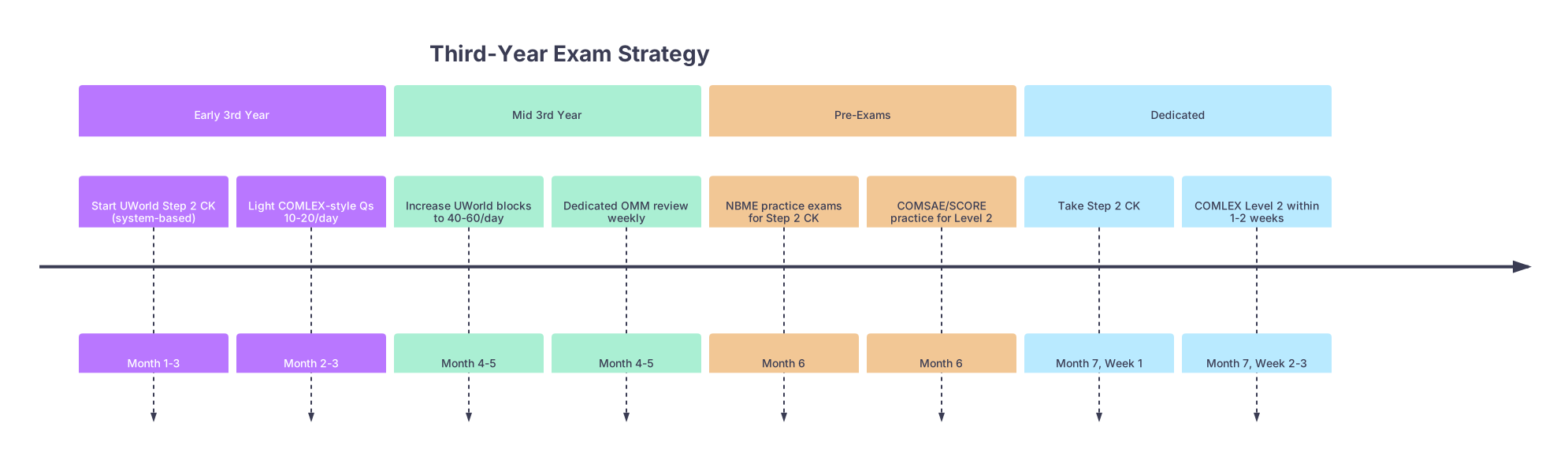
| Period | Event |
|---|---|
| Early 3rd Year - Start UWorld Step 2 CK (system-based) | Month 1-3 |
| Early 3rd Year - Light COMLEX-style Qs 10-20/day | Month 2-3 |
| Mid 3rd Year - Increase UWorld blocks to 40-60/day | Month 4-5 |
| Mid 3rd Year - Dedicated OMM review weekly | Month 4-5 |
| Pre-Exams - NBME practice exams for Step 2 CK | Month 6 |
| Pre-Exams - COMSAE/SCORE practice for Level 2 | Month 6 |
| Dedicated - Take Step 2 CK | Month 7, Week 1 |
| Dedicated - COMLEX Level 2 within 1-2 weeks | Month 7, Week 2-3 |
You can adjust months and intensity, but the principles hold:
- Continuous USMLE-level QBank work
- Continuous, lighter COMLEX-style exposure
- Concentrated, exam-specific practice and review in the 4–6 weeks before each test
9. Common Mistakes and How to Avoid Them
I have seen the same errors repeat every application cycle.
DO students relying only on COMLEX-style Qbanks and ignoring UWorld.
Result: Shaky fundamentals, especially for complex hospital questions and Step 2 CK.Treating OMM as “I’ll just cram Savarese the week before.”
Result: Missed OMM questions across multiple blocks and a score ceiling you built yourself.Taking Step 2 CK and Level 2 months apart.
Result: You are essentially restudying for the same exam twice.MD students downplaying Step 2 CK because “Step 1 is pass/fail now.”
Result: Weak Step 2 CK that is very hard to hide on ERAS.DOs in competitive specialties skipping USMLE entirely based on one advisor’s reassurance.
Result: Shockingly short interview list when reality hits.
If you do nothing else, at least avoid these five.
10. Quick Decision Framework for DO Students
You want a clear yes/no guide for taking USMLE? Here is a blunt one.
You should almost certainly take USMLE Step 2 CK if:
- You are considering any competitive, MD-heavy specialty
- You want large academic programs or university hospitals as your main targets
- Your preclinical performance and practice exams suggest you can be at least “solid” (i.e., projected ≥ 230–235)
You can reasonably skip USMLE if:
- You are firmly primary care–bound or targeting clearly DO-friendly IM/Peds/Psych/FM
- Your school’s match list for your target specialty shows many COMLEX-only DO matches at the types of programs you want
- Your practice exams are borderline for USMLE and you risk a low visible score that actually hurts you
This is not about ego. It is about options versus risk.
FAQ (Exactly 6 Questions)
1. If I am a DO and only want Family Medicine, is there any real reason to take USMLE?
Usually no. For most FM programs, especially community and DO-heavy ones, a solid COMLEX performance, strong clinical evaluations, and clear commitment to primary care matter more than a USMLE score. The exceptions are rare academic FM departments that behave more like IM departments in terms of selectivity; if you are targeting those, ask specifically how they view COMLEX-only DO applicants.
2. How much OMM do I actually need to know for COMLEX if I am terrible at it?
You need more than “I remember lab vaguely.” OMM is not optional padding; it is a tested domain. At minimum, you need: somatic dysfunction diagnosis for spine, ribs, sacrum, innominates; major OMT techniques with indications/contraindications; autonomic levels and viscerosomatic patterns; and basic Chapman’s points and lymphatics. A focused 2–3 week OMM push with Savarese + an OMM-focused Qbank can move you from guessing randomly to reliably picking up those points.
3. Are COMLEX practice exams (COMSAE/SCORE) as predictive as NBME exams for USMLE?
They are less polished and a bit noisier, but still useful. NBME forms correlate more cleanly with final USMLE scores because they are built by the same test makers with tighter psychometrics. COMSAEs and SCORE exams vary more in style and quality, but your trend across them is still meaningful. You should not ignore them; you just interpret them with a slightly wider error bar.
4. Can I prepare only with UWorld and still do well on COMLEX?
You can pass COMLEX with UWorld as your main content engine, but you will be unprepared for OMM and for some of the exam’s stylistic quirks. That usually means leaving 20–40 points on the table. The better strategy is: UWorld as your backbone, plus a COMLEX Qbank for 20–40 questions per day and dedicated OMM review. That small additional investment gives you a disproportionate return.
5. If I already took Step 1 as a DO and the score is mediocre, should I still take Step 2 CK?
In most cases, yes. Step 2 CK is now seen as the “fix it” or “confirm it” exam. A stronger Step 2 CK score can soften a weaker Step 1, especially if you are applying to programs or specialties that weigh clinical performance heavily. Programs care far more that your trajectory is up and that you can handle clinical decision-making than that you were a superstar memorizer preclinically.
6. How close together should I schedule USMLE Step 2 CK and COMLEX Level 2?
Ideally within 7–14 days. You build the bulk of your studying around Step 2 CK’s higher bar for reasoning and detail, then pivot quickly into COMLEX-specific practice and OMM refinement in the final 1–2 weeks. Waiting 4–6 weeks between them forces you to restudy, dilutes retention, and usually does not improve scores enough to justify the time.
Key takeaways:
First, COMLEX and USMLE are not interchangeable; treat USMLE as your content spine and COMLEX as an overlay if you are a DO taking both. Second, your exam strategy must match your specialty goals and target programs, not vague internet advice. Third, if you are a DO and ignore OMM or USMLE entirely without a clear plan, you are choosing to limit your own ceiling.