Osteopathic Manipulative Treatment is either the most underused asset in sports medicine—or a wasted opportunity—depending entirely on how you train and where you end up. There is no in‑between.
You, as a premed or early medical student, are being sold two half-truths:
- “OMT will make you magically more competitive for sports medicine.”
- “OMT is useless; nobody in real sports medicine cares about it.”
Both are wrong. Let me walk through what actually happens at the career level—who uses OMT in sports medicine, how, and what that should mean for your decisions now.
1. Where OMT Actually Shows Up in Sports Medicine Careers
First, strip away the marketing. Forget school brochures with glossy photos of DOs doing thoracic HVLAs on CrossFit athletes.
At a career level, OMT in sports medicine lives in four main environments:
- Private practice sports & spine clinics
- Collegiate and professional team coverage
- Primary care sports medicine in large health systems
- Niche cash-pay or concierge sports/performer practices
Let me break these down.
1. Private Practice Sports & Spine
This is where OMT can become a legitimate workhorse. Typical settings:
- MSK-focused DO practice with a sports flavor
- Sports + spine + chronic back/neck pain mix
- Sometimes co-located with PT, chiropractic, or pain management
In these practices, OMT is used for:
- Acute low back pain in athletes and “weekend warriors”
- Rib dysfunctions and thoracic pain in rowers, baseball players, swimmers
- Cervical dysfunction and headache in contact athletes or lifters
- Pelvic/sacroiliac issues in runners, gymnasts, dancers
Here OMT can:
- Shorten visit times (hands-on exam plus focused treatment)
- Reduce imaging and medication dependence
- Justify better reimbursement if coded properly (99213/99214 + OMT CPT codes)
- Build reputation: “The doc who actually treats with their hands”
This is the classic “DO sports doc who really uses their OMT.” They exist. I have seen their schedules packed 4 weeks out with word-of-mouth referrals: “Go see Dr. X; she’ll actually fix your back.”
2. Collegiate and Professional Team Coverage
This is where premeds have the biggest fantasy disconnect.
At major Division I programs and pro teams:
- The sports medicine physician (MD or DO) is often surrounded by:
- Athletic trainers
- Physical therapists
- Strength and conditioning coaches
- Chiropractors or manual therapists in some organizations
Does OMT get used on the sideline or in training rooms? Yes, but:
- It competes directly with:
- High-level PT manual therapy
- ART (Active Release Techniques)
- Chiropractors doing HVLA
- Time is limited—sideline care is fast and function-driven
Where OMT fits:
- Subacute issues during training weeks (rib, cervical, SI joint)
- Adjunct to rehab plans built by ATC/PT
- Occasional acute pain relief when imaging is normal but the athlete “does not feel right”
At professional level (NFL, NBA, NHL, MLB, MLS):
- Some organizations specifically like having a DO who does OMT
- Others do not care at all; they care about your:
- Fellowship training
- Experience with high-level athletes
- Communication and politics with coaching staff
You will not build an entire pro team role on “I do OMT.” That is fantasy. But OMT can become:
- A differentiator between you and other docs
- A way to quickly win trust with certain athletes who love hands-on care
- A tool that makes you valuable in the training room when everyone else is out of tricks
3. Primary Care Sports in Large Systems
Think: big health systems, academic centers, multispecialty groups.
These jobs often:
- Have RVU and time pressures
- Expect 15–20 minute follow-ups
- Have built-in PT and imaging pipelines
What happens to OMT here?
- If you are efficient and disciplined, you can integrate short, targeted OMT sessions (1–3 techniques per visit)
- If you are slow or try to do 25-minute OMT in a 15-minute slot, you will abandon it in 6 months
I have watched multiple newly-minted DO sports docs say, “I’ll definitely keep using OMT,” and by year 2 they are doing it on less than 5% of patients. Not because they stopped believing. Because the system made it painful.
In these systems, OMT primarily survives if:
- You carve out dedicated “OMT slots”
- You document and code correctly (OMT CPT + E/M)
- Your leadership actually cares about non-procedural MSK care (some do, many do not)
4. Niche Cash-Pay / Concierge Practices
This is where OMT can truly become a cornerstone of your identity.
Think:
- High-income urban market
- Athletes, dancers, performers, serious fitness clients
- Out-of-network or direct pay
Here OMT is often:
- Bundled with movement assessment
- Tied into long-term performance optimization
- Mixed with ultrasound-guided injections, PRP, or regenerative stuff
These practices use OMT as:
- A high-touch, high-value service
- Part of a recurring care model (monthly or quarterly tune-ups)
- A differentiator from orthopedic surgical groups and standard PT
You do not get here accidentally. You plan for it. You train for it. You build a reputation over years.
2. Training Pathways: How DO vs MD Actually Plays Out
You want sports medicine. You are trying to decide: DO vs MD. And you keep seeing “OMT is an advantage.” Let me be blunt: OMT is not your golden ticket to a sports fellowship. Your overall application is.
But OMT can:
- Make your DO training more aligned with MSK care
- Be a meaningful part of your toolkit if you commit to it
Core Pathways to Sports Medicine
The three dominant routes into primary care sports:
- Family Medicine → Sports Medicine Fellowship
- Internal Medicine → Sports Medicine Fellowship (less common for field coverage jobs, but still legit)
- Emergency Medicine → Sports Fellowship (more competitive for traditional primary care sports roles)
Orthopedic surgery → Sports surgery fellowships is a separate world; OMT is functionally irrelevant there.
Both DO and MD applicants:
- Match into primary care sports fellowships
- Work at all levels from high school to professional sports
- Can do excellent MSK medicine without ever touching OMT
What changes with a DO degree:
- You learn OMT as required curriculum
- Some DO residencies and fellowships value OMT more explicitly
- Certain programs are historically DO-heavy and more open to OMT in clinic
3. Sports Medicine Fellowships: Where OMT Matters (and Where it Does Not)
You will hear stories:
- “This fellowship loved that I do OMT.”
- “That program said they do not use it at all.”
Both are true. By program.
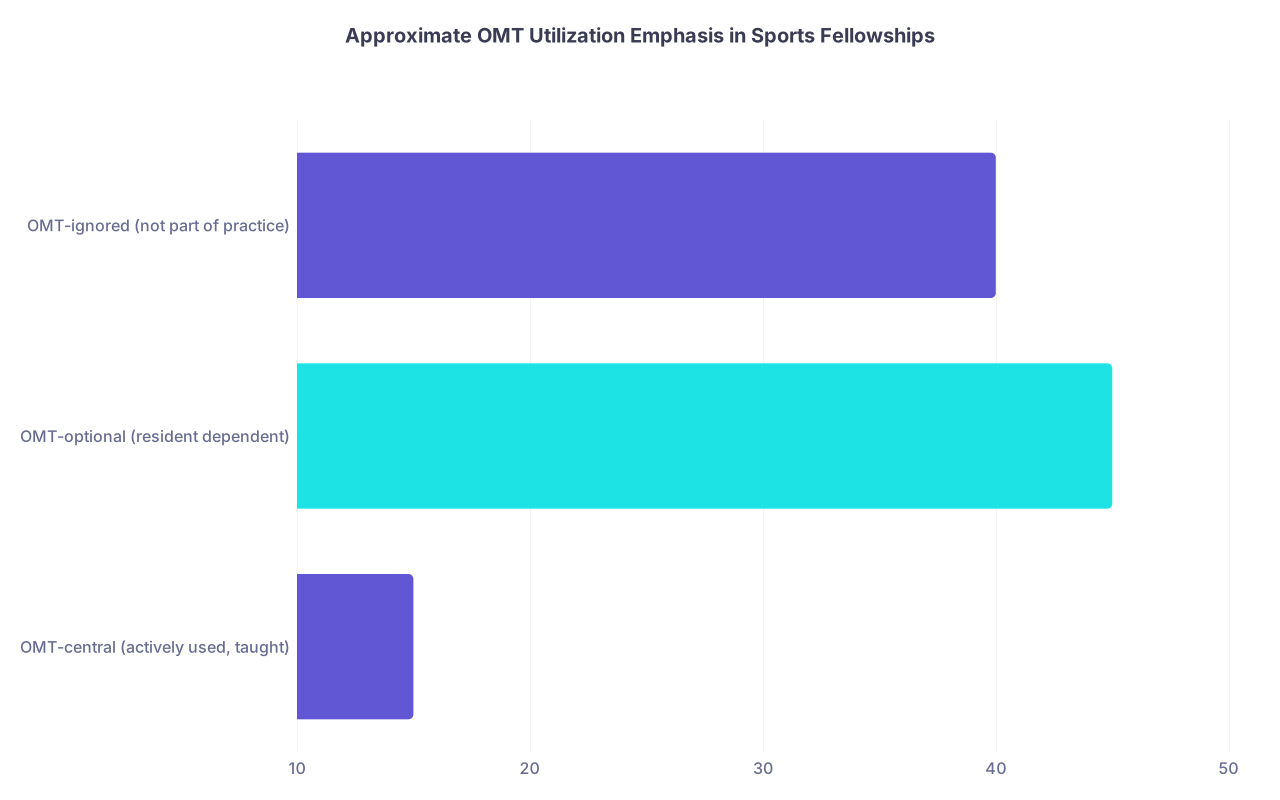
| Category | Value |
|---|---|
| OMT-central (actively used, taught) | 15 |
| OMT-optional (resident dependent) | 45 |
| OMT-ignored (not part of practice) | 40 |
These are rough proportions from what I have seen talking to fellows, faculty, and program directors.
OMT-Central Fellowships
Characteristics:
- Often DO-heavy or led by DO program directors
- Clinic explicitly includes OMT time
- Fellows are encouraged to build OMT into their identity
Examples (not an endorsement list, but patterns):
- Some Michigan State-affiliated programs
- Certain Midwest community sports fellowships with strong DO leadership
- A few East Coast programs historically tied to osteopathic institutions
Here:
- Your OMT experience in school and residency can be a plus
- They may ask on interviews how you actually use OMT, not just whether you passed COMLEX PE
- You will see attendings model clinical use of HVLA, MET, muscle energy for ribs, etc.
OMT-Optional Fellowships
Probably the largest group.
They:
- Do not officially teach or require OMT
- Are neutral: “If you do it, fine. If not, we do not care.”
- Focus their teaching on:
- Diagnostic ultrasound
- Injections and procedures (US-guided, landmark-based)
- Rehab principles
- Sideline coverage
In these:
- A DO with strong OMT skills can quietly build a niche with select patients
- You might become the “go-to” among fellows for tricky rib/neck/pelvis cases
- But nobody will restructure the clinic so you can do 30-minute OMT visits
OMT-Ignored Fellowships
Usually:
- Big-name academic centers
- Large ortho-dominated environments
- MD-heavy leadership with no exposure to or interest in OMT
They:
- Have zero hostility most of the time; just disinterest
- Care only that:
- You can read MRIs
- Manage concussion
- Run clinic efficiently
- Handle game coverage
If you insist on using OMT a lot:
- You will fight time constraints
- Your attendings may not be able to supervise OMT in any meaningful way (they simply do not know it)
- You might end up doing it only occasionally and informally
4. The Clinical Reality: How OMT Is Actually Used on Athletes
Let’s get out of the theory and into exam rooms and sidelines. This is where premeds and early med students either become realistic or stay in fantasy mode.
Sideline and Training Room Scenarios
Concrete situations where OMT is used:
Acute cervical spasm after impact:
A rugby player takes a hit, normal neuro exam, no midline tenderness, but painful movement.
What actually happens:- Thorough neuro/spine exam first.
- If cleared and stable: gentle soft tissue, muscle energy to upper traps/levator, maybe suboccipital release.
- No high-velocity neck thrusts right after trauma. That is how you get kicked out of a program.
Rib and thoracic dysfunction in rowers/baseball:
Athlete with normal imaging but persistent focal rib pain and restricted motion.
Many DO sports docs:- Use rib-raising, muscle energy for inhalation/exhalation rib dysfunctions
- Sometimes gentle HVLA when appropriate
- Combine with breathing mechanics retraining from ATC/PT
SI joint/pelvic asymmetry in runners, dancers:
You will see this constantly.
Useful OMT:- Muscle energy to correct innominate rotations
- Balanced ligamentous tension (BLT) techniques
- Counterstrain for tender points around the SI region
Then immediate functional test: single-leg stance, squat, gait.
Sports Clinic Scenarios
In typical sports outpatient days:
You see:
- Patellofemoral pain
- Shoulder impingement
- Chronic low back pain
- Hamstring strains
- Overuse tendinopathies
Where OMT fits in realistically:
- Adjacent segments to the injured area: thoracic mobility in shoulder cases, lumbar/sacral motion in hamstring cases
- Pain modulation: quick soft tissue / myofascial release + joint mobilization
- Short, focused visits: 5–8 minutes of OMT as part of a 20-minute visit, not the entire visit
If your mental picture of OMT is:
- 40-minute head-to-toe positional diagnosis
- 12 techniques per patient
You will not survive in sports medicine. That style lives more in dedicated OMT or neuromusculoskeletal medicine (NMM) practices, not busy sports clinics.
5. Coding, Billing, and Productivity: The Boring Stuff That Decides Whether You Use OMT
Here is where careers live or die. You can love OMT philosophically, but if the system punishes you for doing it, you will stop.
The Billing Reality
OMT is billed with:
- E/M code (e.g., 99213, 99214) +
- OMT CPT code (98925–98929 depending on number of body regions)
Regions matter (cervical, thoracic, lumbar, sacrum, pelvis, UE, LE, ribs, abdomen).
To bill cleanly:
- You must document:
- Somatic dysfunction in each region treated
- Techniques used
- Rationale (pain, restriction, etc.)
Common problems:
- Sloppy documentation → denials
- Poor understanding of which regions count → undercoding
- Clinics not set up to schedule appropriately long visits → constant time pressure
In a well-run sports/OMT hybrid practice:
- OMT can actually improve RVUs per visit
- Short but focused treatments on 1–3 regions coded correctly add up financially
In a poorly structured hospital clinic:
- You are pressured to see more patients
- OMT is viewed as “extra” that slows you down
- Nobody helps you set up appropriate templates or educate billing staff
Guess which scenario is more common.
6. The MD Angle: Can an MD Compete Without OMT?
Yes. 100%.
MDs in sports medicine:
- Use:
- PT-based rehab plans
- Manual therapy performed by PTs or ATCs
- Injections
- Ultrasound
- Exercise prescription
They are not behind because they do not personally perform hands-on manipulation.
Many high-level programs and pro teams have:
- MD sports docs +
- Chiropractors or PTs doing manipulation and manual therapy
So DO vs MD is not about:
- “Only DOs can treat with their hands.” They cannot corner that market. PTs and DCs are deeply embedded in sports systems.
The unique DO angle is:
- You can integrate your own hands-on assessment and treatment
- You can sometimes shorten the chain from:
- “Athlete in pain” →
- “Biophysical assessment” →
- “Manual correction attempt + exercise prescription”
But you have to actually be skilled. Not just “I passed the OPP exam in second year.”
7. What You Should Do Now as a Premed or Early Med Student
Here is the practical section you actually care about.
If You Are a Premed Deciding DO vs MD
Ask yourself:
- Do you genuinely like the idea of hands-on patient care?
- Are you willing to spend extra time in school and early training mastering manual skills?
- Are you attracted to primary care sports, not just orthopedic surgery?
If:
- You want a primary care sports path
- You are drawn to the idea of blending hands-on diagnostics and treatment
- You like the MSK-heavy, clinic-based, relationship-focused practice style
Then a DO route can give you:
- Earlier comfort with MSK exams
- Built-in OMT exposure that is useful for sports medicine
- Access to DO-heavy sports fellowships that value this background
If:
- You mostly want pro team coverage prestige and do not care about hands-on treatment
- Or you are aiming for sports surgery (orthopedics)
Then:
- MD vs DO matters far more for ortho matching than for primary care sports
- OMT will not move the needle for surgical sports careers
- Your priority should be: school quality, match rates, Step/COMLEX performance, research, and mentorship
If You Are a DO Student Who Thinks They Might Want Sports
You have a clear decision to make early:
Option A: Be the DO who “sort of remembers OMT” and never uses it.
Option B: Be the DO who is legitimately competent with sports-relevant OMT.
If you want Option B:
- Do extra OMT electives (especially with faculty who see athletes, not only chronic pain)
- Focus on:
- HVLA mechanics with safety and precision
- Muscle energy for ribs, pelvis, cervical
- Soft tissue / myofascial / articulatory techniques that can be done quickly
- Ask to shadow DOs who do sports + OMT, not just academic OPP faculty who only see generalized pain cases
You are training for speed and specificity:
- 1–3 techniques per visit
- Objective, functional pre- and post-assessment
- No fluff, no 45-minute rituals

| Step | Description |
|---|---|
| Step 1 | Premed: Interested in Sports Medicine |
| Step 2 | DO School with Strong OMT |
| Step 3 | MD School |
| Step 4 | Extra OMT Training Focused on MSK |
| Step 5 | FM/IM/EM Residency |
| Step 6 | Sports Med Fellowship |
| Step 7 | Practice with Integrated OMT |
| Step 8 | Choose DO or MD |
Notice something important: both paths converge at residency and fellowship. The DO route simply adds the extra skill set. It does not replace the need for everything else.
8. Where OMT in Sports Medicine Actually Shines Long-Term
Let me be positive for a moment. When OMT is done well and integrated intelligently, it creates specific career advantages.
1. Complex, “Nothing Works” MSK Patients
Every sports doc gets saddled with the “chronic but not surgical” population:
- Persistent back pain
- Vague hip/pelvic pain
- Never-ending neck and headache cases in athletes who “have tried everything”
A DO sports doc with good OMT can:
- Reframe these visits from “we have nothing left” to “let’s reassess your mechanics and see if hands-on work plus targeted rehab changes things”
- Offer a very different experience than:
- Another steroid injection
- Another “just do PT again” referral
You become the person patients bounce to when the default algorithm fails.
2. Building a Reputation Among Athletes and Trainers
Athletes talk. Athletic trainers seriously talk.
If you consistently:
- Listen
- Put your hands on the problem area
- Make a visible change in motion or pain in the room
Word spreads:
- “She’s the doc who actually fixes my rib when it pops out.”
(Yes, the phrase “rib popped out” is biomechanically wrong, but athletes say this. Constantly.)
That sort of reputation:
- Drives self-referrals
- Makes ATCs more likely to send the tricky cases to you
- Can accelerate your path to becoming the “preferred” physician for certain teams or training rooms
3. Differentiation in Saturated Markets
In cities overloaded with:
- Orthopedic surgeons
- Pain management
- General PM&R
- Cookie-cutter sports clinics
A DO sports doc who:
- Uses high-quality diagnostic ultrasound
- Does injections competently
- AND offers integrated manual OMT with a sports lens
Can stand out. Especially if you lean into it in your branding and practice design.
9. What OMT Will Not Do For You
Let me undercut the hype so you do not build your career fantasies on nonsense.
OMT will not:
- Guarantee you a sports medicine fellowship
- Substitute for being excellent at MSK diagnosis, imaging, rehab principles
- Make up for poor exam scores or weak clinical evaluations
- Single-handedly land you a job with an NFL or NBA team
Pro teams and big-name universities care about:
- Your training pedigree (where you did fellowship, who you worked with)
- Your ability to communicate with coaches and front office
- Whether athletes trust you
- Whether you show up, handle pressure, and do not create drama
OMT is an add-on. A good one. But still an add-on.
10. Red Flags and Bad Assumptions You Should Drop Now
A few things I have seen repeatedly that derail students:
“I’ll just use OMT instead of learning imaging and injections.”
Disaster. Sports medicine is procedurally heavy. Ultrasound and injections are core skills, not optional.“Any DO program will automatically make me great at OMT.”
Completely false. Many DO students graduate barely comfortable with basic techniques. Excellence requires seeking out strong mentors and reps.“If I do lots of OMT in school, fellowship programs will overlook my weaker scores.”
They will not. OMT is a plus, not a rescue line.“OMT is only for chronic pain or old people, not athletes.”
Lazy thinking. Athletes’ spines, ribs, and pelvises respond very well to targeted manual work, as long as you match it with proper rehab.
11. How to Prepare Now if You Really Want OMT in Your Future Sports Practice
Concrete steps, not vague advice.
As a Premed
- Shadow:
- A generic DO PCP who rarely uses OMT → to see the default
- A DO who does sports + OMT or OMM/NMM + athletes → to see the potential
- Ask each:
- How often do you use OMT?
- What actually limits you (time, support, reimbursement, demand)?
- Choose DO vs MD with eyes open, not based on slogans
As an OMS1–OMS2 (DO student)
- Prioritize:
- Anatomy → especially spine, ribs, pelvis, gait mechanics
- OPP labs with sports-relevant thinking: “How would I use this in a runner? A pitcher?”
- Get extra practice:
- OMT clubs
- Evening labs with faculty who are clinically active
- See if any sports docs at your school actually use OMT and ask to observe
As an OMS3–OMS4
- On rotations:
- Take every MSK complaint seriously as a learning opportunity
- Ask to perform brief OMT when appropriate and when your preceptor is open to it
- Start learning how to deliver 5–8 minute treatments, not 40-minute student marathons
- Seek:
- Rotations in FM/PM&R/sports clinics where OMT is used
- Mentors who actually blend OMT + sports medicine
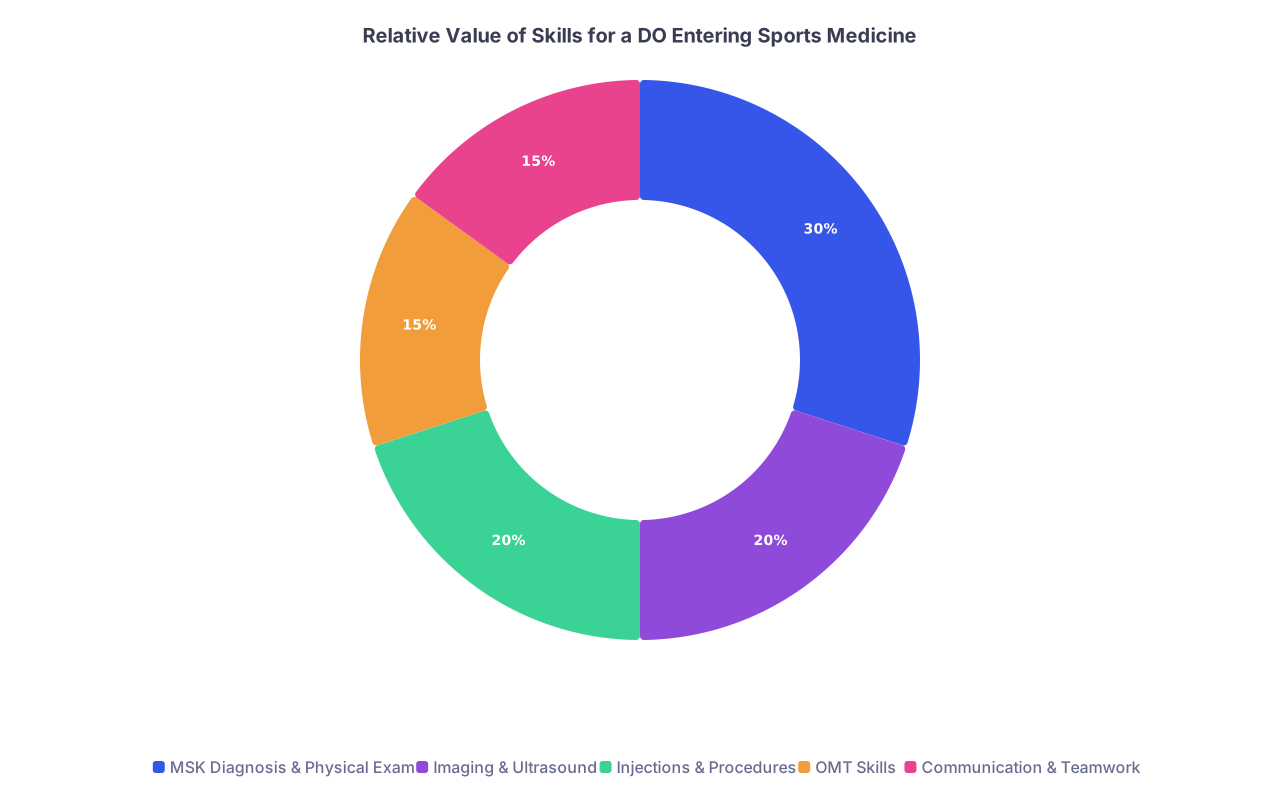
| Category | Value |
|---|---|
| MSK Diagnosis & Physical Exam | 30 |
| Imaging & Ultrasound | 20 |
| Injections & Procedures | 20 |
| OMT Skills | 15 |
| Communication & Teamwork | 15 |
Notice OMT is not the majority. It is meaningful, but it must sit on top of a strong sports medicine foundation.
Key Takeaways
OMT in sports medicine is not magic and not useless. It becomes powerful only when combined with strong MSK, imaging, and rehab skills, and when your practice environment actually supports it.
Choosing DO gives you the possibility—not the guarantee—of integrating OMT into a sports career. Turning that possibility into reality requires deliberate training, efficient technique, and often consciously choosing jobs and fellowships that value manual care.
If you are serious about using OMT at the career level, stop romanticizing 40-minute full-body sessions and start mastering short, precise, sports-focused treatments that fit into real-world clinic and team settings.