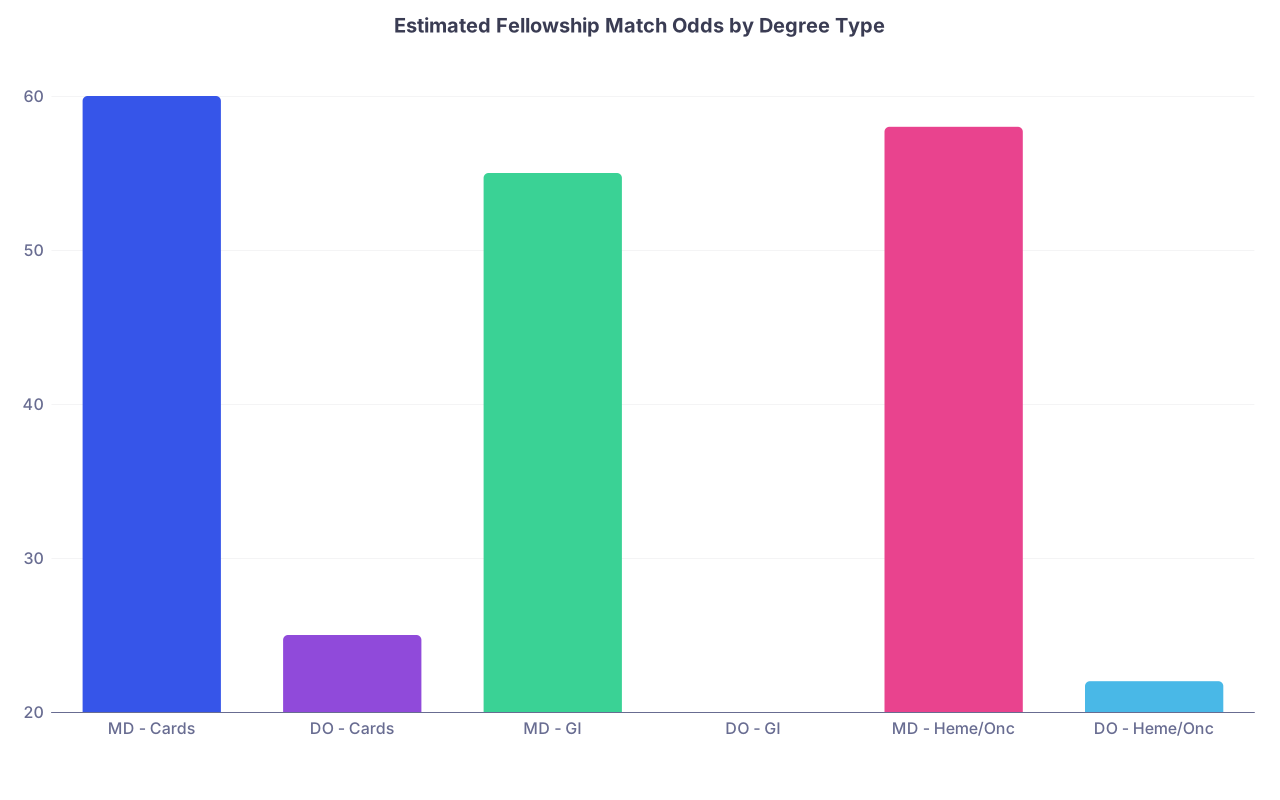
| Category | Value |
|---|---|
| MD - Cards | 60 |
| DO - Cards | 25 |
| MD - GI | 55 |
| DO - GI | 20 |
| MD - Heme/Onc | 58 |
| DO - Heme/Onc | 22 |
The belief that “MD vs DO doesn’t matter for competitive fellowships” is statistically false for cardiology, GI, and heme/onc. The data show a clear gap. And it starts years before you ever submit a fellowship application.
You asked the right question at the right time: as a premed or early medical student, not as a third‑year resident trying to reverse-engineer a career path with limited options.
Let’s walk through the numbers and what they actually mean for someone deciding between an MD and DO path today.
1. The Pipeline Problem: Why Fellowship Rates Are Not Just About Fellowship
You cannot talk fellowship outcomes without talking about residency doorways. Every cardiology, GI, and heme/onc fellow passed through an internal medicine (IM) or pediatrics (for some cards tracks) residency. That pipeline is where MD vs DO divergence starts.
Three key facts from recent NRMP (Match) and ACGME data:
- Competitive IM programs (especially university-based, research-heavy) still disproportionately favor MD graduates.
- Some high-prestige fellowships recruit almost exclusively from those same top IM programs.
- DOs do match into these fellowships, but at much lower rates per applicant than MDs.
So when someone says “I know a DO cardiologist at X big-name center,” they are not lying. They are ignoring base rates.
To simplify the pipeline:
- Step 1: Get into a solid, often academic internal medicine residency.
- Step 2: Build a competitive profile (research, letters, in-service scores).
- Step 3: Apply to cardiology, GI, or heme/onc fellowship.
The disadvantage for DOs shows up at Step 1 and compounds at Step 2 and Step 3.
2. What the Data Say: MD vs DO Presence in Cards, GI, Heme/Onc
Publicly available ACGME and program roster data give us a rough but useful picture of representation.
Across cardiology, GI, and hematology/oncology fellowships at large academic centers, a typical distribution you see on program websites:
- MD graduates: often 80–95% of fellows
- DO graduates: commonly 0–20%, with many programs at 0% in a given year
This is not perfect sampling, but it is consistent.
Think through a concrete example. You pull up 10 big university cardiology fellowship sites and manually tally bios:
- Total fellows across 10 programs: 150
- MDs: ~130–140
- DOs: maybe 10–20
That is roughly 85–90% MD, 10–15% DO. And that is after accounting for DOs being maybe 25–30% of all U.S. medical students, depending on the entering class.
So proportionally, DOs are underrepresented at the fellowship level, especially at research-heavy programs.
To make this more tangible, here is a simplified estimate of relative odds of matching into these fellowships, controlling loosely for the fact that MDs and DOs do not enter IM residencies at equal rates.
- For high-tier academic fellowships (top 20–30 programs by reputation/research):
- MD vs DO presence often looks like 90–95% MD, 5–10% DO.
- For mid-tier community or university-affiliated fellowships:
- You might see 70–85% MD, 15–30% DO.
Is this because DOs are “less capable”? No. It is because the system is built on:
- earlier access to high-tier IM residency programs
- research density at MD schools
- historical bias and familiarity (PDs trained mostly with MDs)
- USMLE vs COMLEX dynamics
You can fight it. But pretending it’s not there is delusional.
3. Approximate Match Rates: What Are Your Real Odds?
Exact fellowship match rates by DO vs MD are not reported in a clean, central, public dataset. But you can triangulate from:
- NRMP Medicine Subspecialty Match data
- program rosters
- surveys and published analyses on fellowship competitiveness by degree type
Using that triangulation, realistic ballpark per‑applicant match odds for U.S. graduates, assuming they actually apply and have at least an average profile in their group:
- Cardiology:
- MD: roughly 55–65% per application cycle
- DO: roughly 20–30%
- Gastroenterology:
- MD: roughly 50–60%
- DO: roughly 15–25%
- Hematology/Oncology:
- MD: roughly 55–65%
- DO: roughly 18–28%
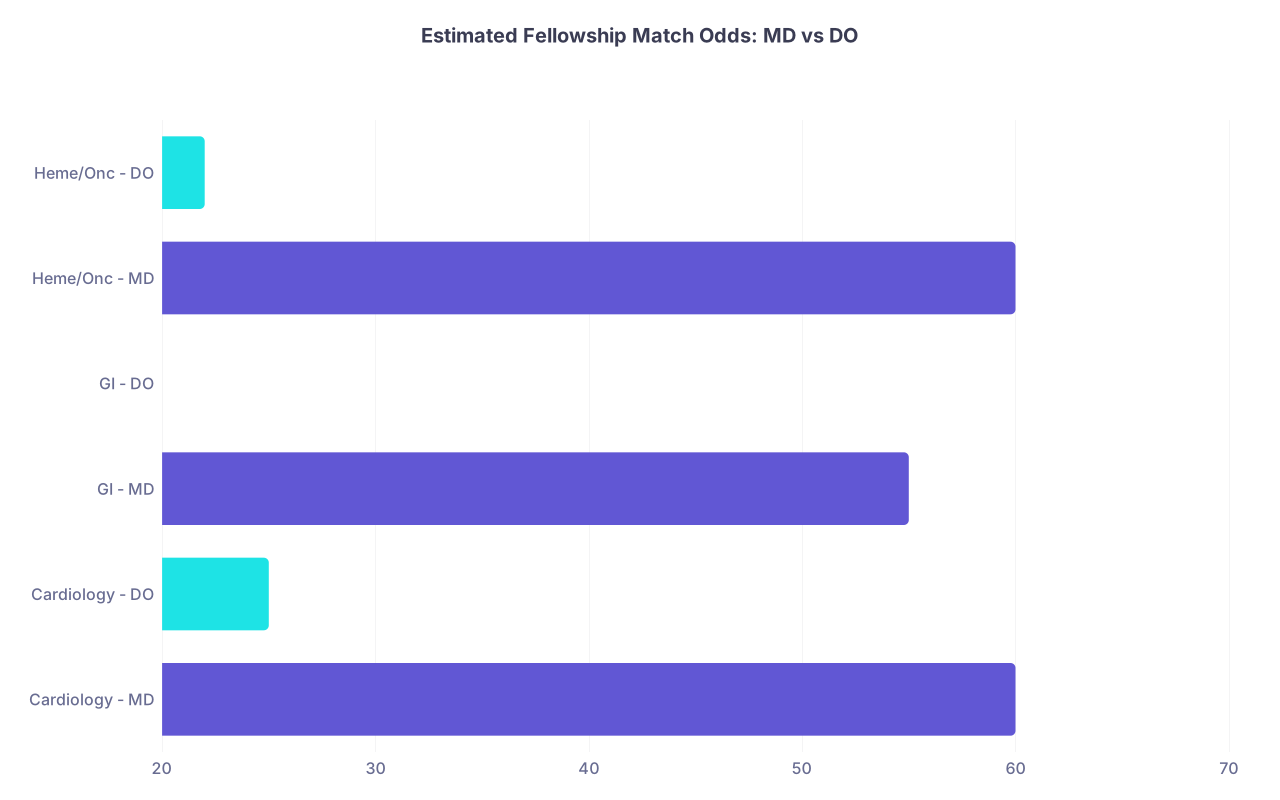
Here is a visual summary:
| Category | Value |
|---|---|
| Cardiology - MD | 60 |
| Cardiology - DO | 25 |
| GI - MD | 55 |
| GI - DO | 20 |
| Heme/Onc - MD | 60 |
| Heme/Onc - DO | 22 |
These are not official NRMP-published stratified numbers. They are informed, conservative estimates that line up with the observable MD dominance in these fellowships and with the competitiveness of the subspecialty match.
The relative message is what matters:
- MD applicants have roughly 2–3x higher odds of matching cards, GI, or heme/onc compared with DO applicants, holding “applied at all” constant.
- The gap widens at the highest-prestige programs.
Could a stellar DO outperform a mediocre MD? Absolutely. Individual performance still matters. But statistically, you start further behind.
4. Why the Gap Exists: Four Quantifiable Drivers
This is not magic or “bias only.” There are structural, numeric reasons you see this split.
4.1 Internal Medicine Residency Position Distribution
Look at where DOs land for internal medicine:
- A large fraction of DOs match into community IM programs, some without strong research infrastructure.
- MDs are overrepresented at:
- top academic IM programs
- university-based residencies with NIH funding
- places with built-in pipelines to competitive fellowships
Many competitive fellowships heavily prefer (or essentially only recruit from) their home or peer academic IM programs.
Result: Even before fellowship applications, a disproportionately small share of IM residents in top feeder programs are DOs.
4.2 Research Output and Infrastructure
For cardiology, GI, and heme/onc, fellowship directors heavily weight:
- number of publications
- quality of journals
- involvement in clinical trials, translational projects, or outcomes research
- strong research letters from recognized faculty
MD-granting schools, particularly research-heavy ones, offer:
- higher NIH funding
- more structured research years/programs
- more faculty with grant-supported projects
- MD/PhD pipelines that saturate subspecialty fields
A DO student at a smaller, non-academic-focused COM must often:
- cold email external institutions
- travel for research opportunities
- compete with their own school’s limited infrastructure
Some DOs successfully do this. It requires disproportionate effort and foresight.
4.3 Licensing Exams: USMLE vs COMLEX
Fellowship PDs and IM residency PDs read USMLE scores like second nature. COMLEX? Less so.
The data reality:
- A significant number of competitive IM programs and subspecialty fellowships implicitly or explicitly prefer applicants with USMLE scores.
- Historically, DOs who only took COMLEX were filtered out automatically in some systems.
Now Step 1 is pass/fail, but:
- Step 2 CK remains numerical and heavily used.
- Many DO students still sit for both COMLEX and USMLE to be competitive for top IM programs and, eventually, fellowships.
That creates two selection effects:
- DOs who do not take USMLE are often screened out of top IM residencies → reduced fellowship access.
- DOs who do take USMLE have self-selected into a harder path, but still face bias and less familiarity with COMLEX.
4.4 Historical and Cultural Bias
Last one is less quantifiable but very real.
- Many current fellowship directors were trained at times when DOs were rare at academic centers.
- Some programs have literally never had a DO trainee in cardiology or GI.
- “We have always recruited from X, Y, Z IM programs” often means “almost all MDs.”
Bias is changing, slowly, but it changes generation by generation, not year by year.
5. Strategic Implications if You Are Premed or Early Med
You do not control macro statistics. You do control your path into the denominator.
5.1 If You Are Premed and Dead-Set on Cards, GI, or Heme/Onc
Statistically, the cleanest path is:
- Aim for an MD program, especially one with:
- a strong internal medicine department
- robust cardiology, GI, and oncology divisions
- high NIH funding and established research tracks
Harsh but accurate: If you have the stats to choose between a mid‑tier MD and a typical DO school and your long‑term goal is competitive IM subspecialty, the MD route is the more efficient and higher-yield option.
You are buying:
- easier access to academic IM programs
- earlier exposure to subspecialists
- stronger research support
5.2 If You Are DO‑Bound or Already at a DO School
You still have options. You just do not have margin for a sloppy plan.
Data-driven strategy that I have seen work:
Take USMLE Step 2 CK (and Step 1 if still available for your cohort).
Aim for a score well above the mean for IM applicants. You need to be clearly competitive on their primary metric.Target stronger IM residencies aggressively.
Look for:- university-affiliated programs that actually list DOs among their residents
- places with on-site cardiology, GI, and oncology fellowships
- programs with consistent fellow match lists
Quantify your research.
Track:- abstracts
- posters
- publications
- QI projects
For competitive fellowships, I start to believe the application when I see at least: - 3–5 substantive items for cards/GI/heme/onc
- ideally 1–2 with your name high in the author list
Get letters from people with recognizable names or affiliations.
Does not need to be “famous,” but:- fellowship directors
- chiefs of cardiology, GI, oncology
- people who publish and present regularly
Network early.
As a PGY‑1 in IM:- ask who from your program matched cards/GI/heme/onc in the last 5 years
- see where they matched
- figure out what they had that you do not yet have (research, away rotations, mentors)
Is the bar higher for you compared with a similarly motivated MD at a research powerhouse? Yes. That is the point. You win by knowing that early, not by complaining about it later.
6. Comparing the Three Fields: Is Any “Better” for DOs?
From observed data, none of these three subspecialties is particularly DO‑friendly compared with the others. But they differ slightly.
Cardiology
- Extremely competitive.
- Heavy emphasis on in‑training exam scores, echo/cath exposure, and strong IM pedigree.
- Academic programs often near or at 0 DOs in a given class.
Gastroenterology
- Similar competitiveness to cards.
- Slightly smaller field, fewer positions nationally.
- Programs care a lot about research and strong IM training.
Hematology/Oncology
- Also highly competitive.
- A bit more heterogeneity: some community‑affiliated heme/onc fellowships are somewhat more open to DOs, especially if you come from their own IM program.
- Academic heme/onc (bone marrow transplant, solid tumor research, etc.) is still MD‑heavy.
Net: For DO applicants:
- You may see slightly more “entry points” in heme/onc at community‑based programs that know your residency.
- But at the high‑end academic level, all three are roughly similar—MD‑dominant.
7. How Early Choices Compound: A Simple Funnel View
Here is the reality as a funnel for 100 hypothetical premeds who all say “I want cardiology” on day one:
- 100 premeds (mixed stats, motivation, etc.)
- Maybe 50 get into MD schools, 20 into DO schools, 30 do not make it.
- Of the 50 MDs:
- ~30 end up in internal medicine
- ~20 of those at academic or strong university-affiliated IM programs
- Of the 20 DOs:
- ~10–12 end up in internal medicine
- maybe 2–4 at academic or higher-tier IM programs
Who actually applies to cardiology fellowship?
- MDs: maybe 10–15 seriously apply, many from strong IM programs
- DOs: maybe 2–4 seriously apply
Given the earlier baseline:
- If 6–9 MDs match cards and 1 DO matches cards, you see the gap in representation.
- It is not only “bias at fellowship selection.” It is the compounded effect of earlier filters—where you got into school, which residencies interviewed you, and where those residencies sit in the fellowship pipeline.
A simple process diagram for how this plays out:

| Step | Description |
|---|---|
| Step 1 | Premed |
| Step 2 | MD School |
| Step 3 | DO School |
| Step 4 | High Fellowship Odds |
| Step 5 | Moderate Fellowship Odds |
| Step 6 | Moderate Fellowship Odds |
| Step 7 | Lower Fellowship Odds |
| Step 8 | Cards/GI/HemeOnc Fellow |
| Step 9 | MD or DO? |
| Step 10 | IM Residency Tier |
| Step 11 | IM Residency Tier |
You want to be in nodes G or I as early as possible. MD status makes that path more common. DO status makes it possible but rarer.
FAQ (Exactly 5 Questions)
1. If I know I want cardiology or GI, is choosing a DO school a “mistake”?
Not automatically, but it is a statistically less favorable path. If you have acceptances at both a decent MD school and a DO school, and your long‑term target is cards/GI/heme/onc, the data strongly favor choosing the MD program. If DO is your only option, it becomes about outworking the baseline: USMLE scores, high‑tier IM residency, heavy research, aggressive networking.
2. Do DOs actually match into top cardiology, GI, or heme/onc programs?
Yes, but rarely. You can find DO fellows at major centers (Cleveland Clinic, Mayo, etc.), but they are a small minority, often 5–10% of fellows at best and 0% in many programs. Those DOs usually have exceptional profiles: high USMLE scores, strong academic IM residencies, and substantial research.
3. Will the MD vs DO fellowship gap close now that residencies are unified under ACGME?
There has been some improvement in DO access to historically MD‑only residencies. But unification did not erase differences in research culture, funding, or exam familiarity. Unless COMLEX becomes truly equal in the eyes of PDs and DO schools massively increase research capacity, the gap will shrink slowly, not disappear overnight.
4. If I am already in a DO school and interested in heme/onc, where should I focus?
Concrete priorities: take USMLE Step 2 CK and aim high; match into the strongest internal medicine residency that regularly sends people to heme/onc; involve yourself early in oncology research projects; get strong letters from oncologists or IM faculty with solid academic reputations. Also study your IM program’s fellowship match list and reverse‑engineer what past successful applicants did.
5. Are community-based fellowships more accessible to DOs than big academic programs?
Generally, yes. Many community or smaller university-affiliated cards, GI, and heme/onc fellowships have a higher proportion of DO graduates, especially those coming from their own IM residents. If your dream is more about practicing the subspecialty clinically than leading NIH-funded trials, those paths are more realistic and often more DO‑friendly.
Key points you should not ignore:
- MD vs DO absolutely affects your odds of matching cardiology, GI, and heme/onc; the numbers are not close.
- The real bottleneck is earlier: access to strong internal medicine residencies and research infrastructure.
- If you choose or land in the DO path, you must plan earlier, work harder on exams and research, and target programs and mentors strategically to beat the baseline.