Last week I watched a DO student in our clinic do OMM on a patient with chronic neck pain. The patient literally said, “No one’s ever touched my neck like that before… it’s the first time it hurts less walking out than coming in.” And my immediate second thought—after “wow, that’s amazing”—was: “Great. And half the MD world will say this looks like witchcraft.”
That’s the tension, right? You love OMM. You love the hands-on part, the treating-the-whole-person thing. But in the back of your mind there’s this constant fear: does this make me look less scientific? Less serious? Like I’m choosing vibes over evidence?
Let’s just say it out loud so it stops running laps in your brain.
The Fear Underneath: “Am I Torpedoing My Career?”
You’re not just worried people will judge OMM. You’re worried they’ll judge you.
That you’ll walk into an MD-heavy residency program and the attending will see “osteopathic manipulative medicine” on your eval and silently think: soft. Pseudoscience. Not like the “real doctors.”
You worry some program director at a competitive residency will glance at your app and think, “They’re probably into that OMM stuff,” and subtly push you down the pile. That if you talk about OMM in your personal statement, you’ll sound like you’re avoiding “hard science” and hiding in “holistic” fluff.
You’re not crazy. I’ve watched DO students whisper to each other, “Don’t talk about OMM too much in interviews, you don’t want to sound like that DO.” I’ve seen premeds ask in forums if liking OMM is a “red flag” for academic programs.
It’s messed up. But it’s not entirely imaginary.
So let’s separate three things:
- What some people actually think about OMM
- What’s just your anxiety screaming
- What you can do so your love of OMM helps you, not hurts you
And yeah, I’m going to be blunt, because false reassurance doesn’t help.
Where OMM Actually Stands in the “Science” World
On one extreme you’ve got people who treat OMM like magical hands that fix everything. On the other, people who think it’s no better than essential oils with better marketing.
Reality is messier.
There is evidence for some OMM applications. Low back pain, some neck pain, a bit in headache, pregnancy-related pain, some respiratory mechanics stuff. Not miracle-level, but comparable to other non-pharmacologic interventions. Is the evidence base as deep and massive as, say, cardiology meds trials? Of course not. But “not as studied as…” isn’t the same as “fake.”
There’s also a reason legit academic centers include OMM/OMT in large institutions:
- Michigan State University College of Osteopathic Medicine
- Rowan-Virtua SOM
- TCOM (UNTHSC)
- PCOM
and DO departments attached to big health systems where OMM is integrated into pain clinics, primary care, sports medicine.
Are there skeptics? Very much yes. Some MDs think OMM is at best a placebo with stretching. Some DOs don’t care about it at all and never touch it after COMLEX.
But here’s the piece you actually need to hear: the residents who get crushed aren’t the ones who like OMM. They’re the ones who can’t back up anything they say with actual knowledge or data.
If your love for OMM comes across as, “I like doing stuff with my hands and believing in energy,” you’ll lose people. If it comes across as, “I understand biomechanics, pain pathways, and the limits of what we know, and I use OMM as one of several tools, not a religion,” you look like a thoughtful clinician.
That’s the line you have to walk.
DO vs MD Optics: The Ugly Stuff People Won’t Say Out Loud
You’re applying in a world where DO vs MD is still a thing, even if on paper it’s “equivalent.” You’re smart to worry about optics. Denial is dumb.
Here’s the harsh landscape:
- Some MD attendings still think DO = lesser. They might not say it, but you can feel it in how they react to your school name.
- Some competitive residencies (ortho, derm, plastics, ENT, maybe even rads/anesthesia in certain places) are just starting to seriously consider DOs, and you don’t want to feed any bias that you’re “less rigorous.”
- Even among DOs, there’s a split: the OMM “true believers,” the respectful skeptics, and the “I just want to do hospital medicine and never HVLA anyone again” crowd.
Now layer on your fear: if you highlight OMM, are you painting yourself into the first group in everyone’s mind? The stereotype of the DO who wants to do rib raising while the patient is in status asthmaticus?
Here’s my take:
If you’re going into primary care, FM, IM, peds, sports med, PM&R—OMM is either neutral or a plus, if you frame it correctly.
If you’re aiming for hyper-competitive, procedural, or heavily academic specialties, then you need to be strategic. Not silent. Strategic.
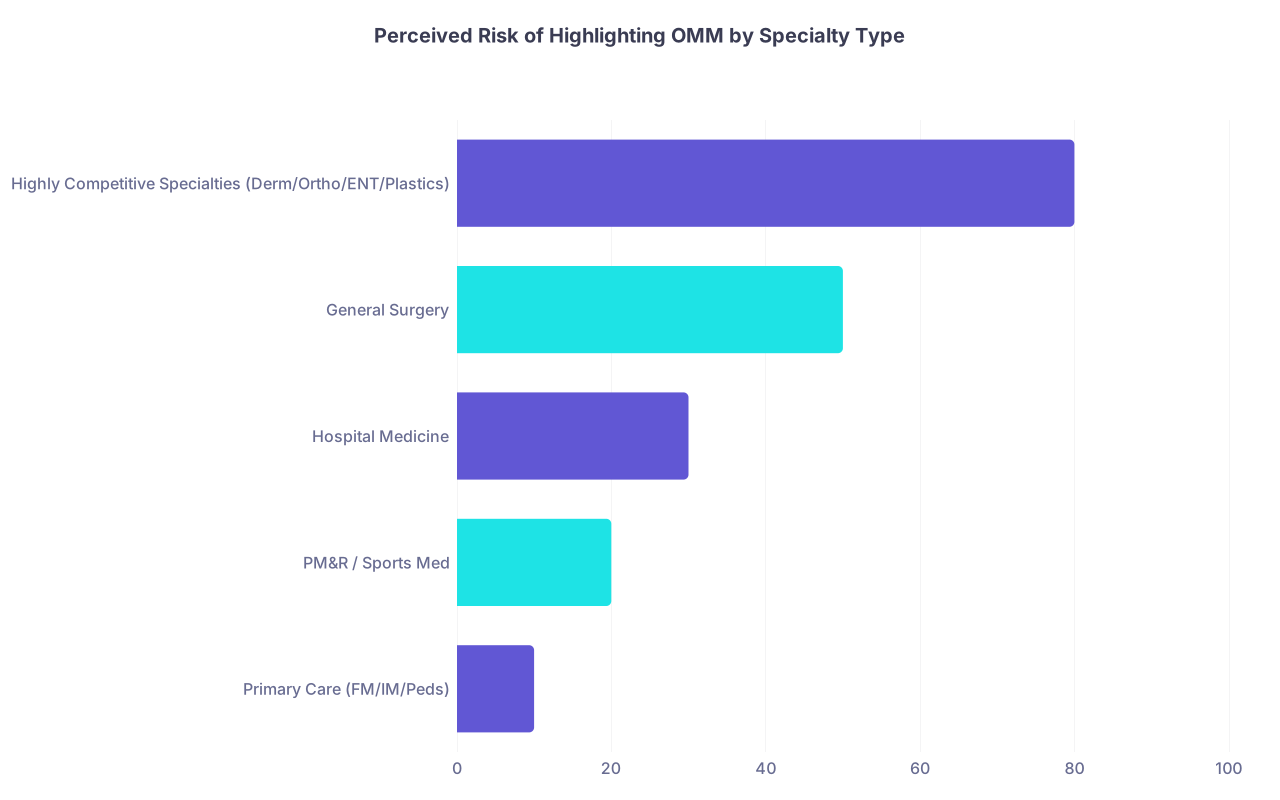
| Category | Value |
|---|---|
| Primary Care (FM/IM/Peds) | 10 |
| PM&R / Sports Med | 20 |
| Hospital Medicine | 30 |
| General Surgery | 50 |
| Highly Competitive Specialties (Derm/Ortho/ENT/Plastics) | 80 |
That chart is how this usually feels, not some published data. But it tracks with what a lot of DO students sense on the trail.
You don’t have to hide. You just have to speak a language the skeptics respect: outcomes, mechanisms, limits, and integration with standard of care.
Balancing Passion and Optics: How to Talk About OMM Without Looking Flaky
This is the core: you’re not actually afraid that OMM is “less scientific.” You’re afraid people will assume you are.
So when you talk about it—in personal statements, secondaries, interviews, even with attendings—you need to hit three notes:
- You understand and respect evidence-based medicine
- You know OMM is a tool, not a cure-all
- You’re not trying to replace established care, you’re trying to enhance it
Let me show you the difference.
Weak, anxiety-triggering version:
“I love OMM because it’s holistic and focuses on the body’s ability to heal itself.”
Translation in some people’s heads: “Doesn’t like drugs. Might be anti-vax in disguise. Believes in vibes.”
Stronger, optics-safe version:
“I’m drawn to OMM because it gives me another way to manage pain and function, especially when medications alone aren’t enough or carry side effects. For example, I’ve seen patients with chronic low back pain get measurable improvements in range of motion and function when OMM is used alongside standard therapies. I don’t see it as magic—I see it as biomechanics, anatomy, and patient-centered care layered onto evidence-based practice.”
See the difference? Same passion. Different framing.
If someone challenges you—“Do you really think OMM works?”—the worst thing you can do is get defensive or mystical. A better answer is:
- “I think it has real value for some conditions, especially musculoskeletal, but I’m also aware the evidence base is still growing and not all claims are backed by strong data. I’m interested in both using it thoughtfully and understanding where it’s most effective.”
Now you sound like a scientist. Who just happens to use their hands.
How This Plays Out in Premed and Med School
You’re probably also wondering: where in the pipeline are you “allowed” to mention OMM without hurting yourself?
As a premed (applying DO vs MD)
If you’re applying only DO:
You can absolutely highlight that you’re interested in osteopathic principles, like seeing patients as whole people, structural-functional relationships, preventative care. But don’t write a manifesto about OMM as the cure for everything. Show that you understand OMM exists within modern medicine, not outside it.
If you’re applying both DO and MD:
Here’s the anxiety: if you say you love OMM, will MD schools toss you? Probably not, if you don’t make it sound like you think MDs are “less holistic” or “less caring.” Talk about why you want to be a physician first. Talk about patient care, systems thinking, communication. If OMM comes up, tie it to a bigger value: curiosity about non-pharmacologic interventions, interest in pain management, or wanting more tools than just prescriptions.
In medical school (especially DO school)
Here’s where people get burned: they either:
- Act like OMM is beneath them to seem “more MD,” which reads as insecure
- Or go all-in zealot and lose credibility with classmates and faculty who are more skeptical
You don’t need either.
Do your OMM labs. Learn the techniques well. Take it seriously enough that if you use it, you’re not sloppy. But also be honest with yourself: where does it seem to help? Where does it not? Ask questions like, “What’s the proposed mechanism here?” Don’t worship it. Don’t trash it.
And for optics: crush the objectively measurable stuff. Step/COMLEX, clinical evals, shelf exams, procedures. The more your knowledge and performance scream “competent scientist,” the less anyone will question your credibility if you also happen to treat a rib dysfunction.

| Step | Description |
|---|---|
| Step 1 | Premed |
| Step 2 | Discuss OMM interest openly |
| Step 3 | Frame OMM as one of many tools |
| Step 4 | Show understanding of evidence |
| Step 5 | DO School Years 1-2 |
| Step 6 | Learn OMM seriously |
| Step 7 | Build strong scientific foundation |
| Step 8 | Clinical Years |
| Step 9 | Use OMM selectively & appropriately |
| Step 10 | Residency Applications |
| Step 11 | Highlight integration, not ideology |
| Step 12 | Applying DO Only? |
That’s the game plan. Not all-or-nothing. Thoughtful integration at every stage.
Worst-Case Scenarios You’re Secretly Imagining (And What Actually Happens)
Let’s drag the nightmares into the light.
Nightmare 1:
You mention OMM in a residency interview and the PD decides you’re not “serious” and doesn’t rank you.
Reality:
If a program is that hostile to the entire concept of OMM—and uninterested in hearing you talk about it in an evidence-based way—it’s probably not a healthy place for a DO in general. The programs that actually rank DOs highly and treat them decently usually fall into the “skeptical but curious” or “neutral” categories.
Nightmare 2:
Your classmates think you’re weird or less smart because you practice OMM in clinic.
Reality:
They might tease. Some will roll their eyes. But when they see a patient say “My pain is a 4 instead of an 8 now,” and they see you still ordering appropriate imaging, labs, and meds—they soften. Respect follows consistent competence. Especially on the wards.
Nightmare 3:
OMM locks you out of academic medicine or research.
Reality:
You know what academic programs actually respond to? Publications. Posters. Quality improvement. If you care about OMM, do a small project. Case series. Chart review. Patient satisfaction study. Even if it’s not in JAMA, the message becomes: “I question, I measure, I don’t just believe.” That’s academic thinking.
If you’re going to worry—and you will—worry about something productive: your exam scores, your clinical performance, your communication skills. Those will sink you long before “likes OMM” will.
How to Keep Loving OMM Without Letting It Define You
This is the middle road you’re actually searching for: “How do I not abandon what I like… but also not let it be my whole identity?”
Here’s how I’d phrase it, if I were you:
- You’re a future physician first. A DO second. Someone who can use OMM third.
- You’re interested in every tool that safely helps patients: meds, procedures, counseling, rehab, OMM, whatever.
- You’re not loyal to techniques. You’re loyal to outcomes and patient well-being.
So when someone asks, “Do you plan to use OMM in your career?” you don’t lock yourself in a box. You say something like:
“I hope to. Especially in musculoskeletal and pain-related conditions where there’s at least some evidence for benefit and low risk when properly applied. But ultimately my goal is to use whatever combination of approaches—medications, procedures, rehab, OMM—that best serve my patients, within the standards of care of my specialty and institution.”
That answer plays everywhere. Primary care. Sports. Hospital. Even in more competitive fields where you might use OMM less, you still sound grounded and sane.
Here’s what you can do today, before spiraling again:
Open a blank document and write three sentences about why you’re drawn to OMM—no fluff, no buzzwords, just real reasons. Then rewrite each sentence so it sounds like something a skeptical, hardcore evidence-based MD could respect. Keep that version. That’s the one you’ll use in your essays, your interviews, and your own head when the “less scientific” fear kicks up again.