Last week I was on the phone with a junior who’d just gotten her first acceptance—into a DO school. She should’ve been thrilled. Instead, she whispered, “Does this mean I’ll never be able to do derm or ortho now?” Then there was this awful silence where I could hear her trying not to cry.
If you’re reading this, I’m guessing you know that exact knot in your stomach. The “Did I just close doors I don’t even fully understand yet?” feeling.
Let me be blunt: the fear that “DO will limit my specialty options” is not made up. It’s not all in your head. But it’s also not as simple—or as doom-y—as the Reddit threads make it sound.
The Core Truth: Are Doors Actually Closed To DOs?
Here’s the ugly, bottom-line version you probably want:
No, being a DO does not automatically block you from any specialty. There is no official list of “for MDs only” specialties.
But. Some doors are heavier. Harder to push open. And if you’re a DO aiming for certain highly competitive specialties, you have less margin for error than the average MD applicant.
Think of it like this: you’re not banned from the building. You’re just starting at the back of the line for some of the more exclusive rooms.
The key nuance:
- For primary care (FM, IM, peds, psych, etc.): Being a DO is almost a non-issue if your application is solid.
- For moderately competitive specialties (EM, anesthesia, OB/GYN, neuro): It matters some, but a strong DO applicant can absolutely match.
- For very competitive specialties (ortho, derm, plastics, ENT, neurosurgery, rad onc, some fellowships): Being a DO can be a real disadvantage at certain programs, and the bar is higher.
So the fear is “real” in the sense that your path might be narrower and more work. It is not real in the sense of, “You will be blocked forever and doomed to only do family medicine if you go DO.” That’s just not true.
To make it less abstract:

| Category | Value |
|---|---|
| Primary care | 90 |
| Moderately competitive | 70 |
| Highly competitive | 35 |
These are ballpark vibes, not exact NRMP numbers, but this is the pattern I’ve watched play out year after year.
Where The Fear Comes From (And What’s Still Left Over From The Old System)
A lot of this anxiety is PTSD from the pre-2020 world when there were separate MD (ACGME) and DO (AOA) residencies. Back then, some MD programs literally did not even consider DOs.
We live in a “single accreditation” world now. Officially, all residencies are under one system, and DOs and MDs go through the same NRMP Match.
But old attitudes didn’t vanish overnight. Some programs:
- Technically “accept” DOs but almost never rank them high.
- Filter DO applications out automatically at the ERAS stage.
- Only consider DOs from a short list of “top” DO schools.
- Quietly prefer MDs for ultra-competitive spots.
I’ve seen PDs say things like, “We’d take a strong DO for IM, but derm? Realistically… no.” They don’t put that on their website, obviously. But it leaks out in conversations, in who they interview, in who actually matches.
And yet at the same time, I’ve also seen DOs match:
- Orthopedic surgery at university programs.
- Dermatology via a research year plus brutal numbers.
- Neurosurgery after serious networking and away rotations.
So the real story is maddeningly gray. Not “you’re locked out,” not “it doesn’t matter at all.” It’s “it matters, but you can still win if you’re willing to pay the price.”
Specialty By Specialty: How Much Does DO Really Matter?
This is what you’re actually wondering, right? “If I go DO, what’s realistically on the table?”
Obviously, exact numbers change every year, but the general pattern stays weirdly stable.
Safest Ground As A DO
These are the fields where being a DO is usually not the thing that makes or breaks you:
- Family Medicine
- Internal Medicine (especially community and many university-affiliated programs)
- Pediatrics
- Psychiatry
- PM&R (Physical Medicine & Rehab), though getting more competitive
- Some community EM, community OB/GYN, and community anesthesia programs
For these, your Step 2 (and COMLEX) scores, clinical grades, letters, and interview skills matter much more than the letters after your name.
If you told me, “I’m fine doing IM or FM. I mainly want to be a good doctor and not struggle to match,” then a DO school with strong clinical training is not some catastrophic decision. At all.
Middle Zone: Possible But Tighter
These specialties often still open to DOs but the competitiveness starts to bite:
- Emergency Medicine (though the landscape is messy right now with job market stuff)
- Anesthesiology
- OB/GYN
- Neurology
- Some surgical subspecialties at community or lower-tier academic programs
- Radiology (diagnostic)
Here, being a DO can matter, but I’ve watched plenty of DOs match into all of these with:
- Strong Step 2CK (and often also taking Step rather than relying only on COMLEX)
- Strategic audition rotations
- Good letters from known faculty
- Realistic program lists (not only aiming at the top 10 in the country)
Hard Mode: Where The Fear Is Most Justified
This is where your anxiety lives, probably. Highly competitive specialties where DOs are a minority and the path is brutally steep:
- Dermatology
- Plastic Surgery
- Neurosurgery
- ENT (Otolaryngology)
- Orthopedic Surgery
- Integrated Vascular/Thoracic Surgery
- Some super competitive fellowships (cards at certain big-name places, GI, etc.)
Can a DO match into these? Yes.
Is it common? No.
Will you need to be better-than-average compared to MD peers? Yes.
I’ve seen DOs break into ortho by doing a research year, scoring high 250s+ on Step 2, crushing away rotations, and having mentors willing to go to bat hard for them. It’s possible. But you don’t stumble into it. You basically live and breathe that specialty for 3–4 years.
So if your question is, “Is it harder as a DO to get derm/ortho/ENT/neurosurg?” the answer is simply: yes, it is.
If your question is, “Is it impossible?” the answer is no.
Both of those can be true at the same time.
The Part Nobody Says Out Loud: You Might Change Your Mind
Here’s the other fear nobody wants to admit: “What if I go DO, tell myself I don’t care about competitive specialties, and then in MS3 I fall in love with ortho or derm? Will I be screwed?”
Maybe. Maybe not. But you’re ignoring one huge reality.
Most premeds are terrible at predicting their future specialty.
The number of people who swear they’re going into neurosurgery at age 21 and end up in psych or anesthesia is… high. I’ve lost track of the people who told me:
“I’d never do primary care,”
then matched into IM and are now perfectly content.“I want high acuity, trauma bay type stuff,”
then realized they hated shift work and EM politics.
You don’t know yet what it actually feels like to live those specialties day-to-day. You’ve probably seen curated social media versions or a shadowing day where everyone was on their best behavior.
But yes, there is risk. If you are the 1 in 100 who really does fall in love with derm halfway through MS3, as a DO you’ll be up against an uphill climb that your MD classmates may not face to the same extent.
That’s the part that stings.
How Much Of This Is Actually Under Your Control?
This is where the fear either becomes paralyzing or motivating.
You can’t control:
- Biased PDs who assume DO = lower quality
- Historic patterns and prestige obsession
- Where some top programs simply won’t seriously consider DOs
You can control:
- How early you crush Step 2 (and yes, as a DO you almost certainly should take Step if you’re eyeing anything remotely competitive)
- Your research output if you’re shooting high (especially in derm, ortho, neurosurg)
- How strategically you pick schools and rotations
- Whether you aim for programs that actually have a history of taking DOs
- The consistency of your performance: no major red flags, remediations, professionalism issues
If you go DO and want options, you have to treat your application like there’s zero safety net.
Very rough reality check
If we mapped “how much extra you need to do as a DO” compared to a similar MD applicant also going for competitive stuff:
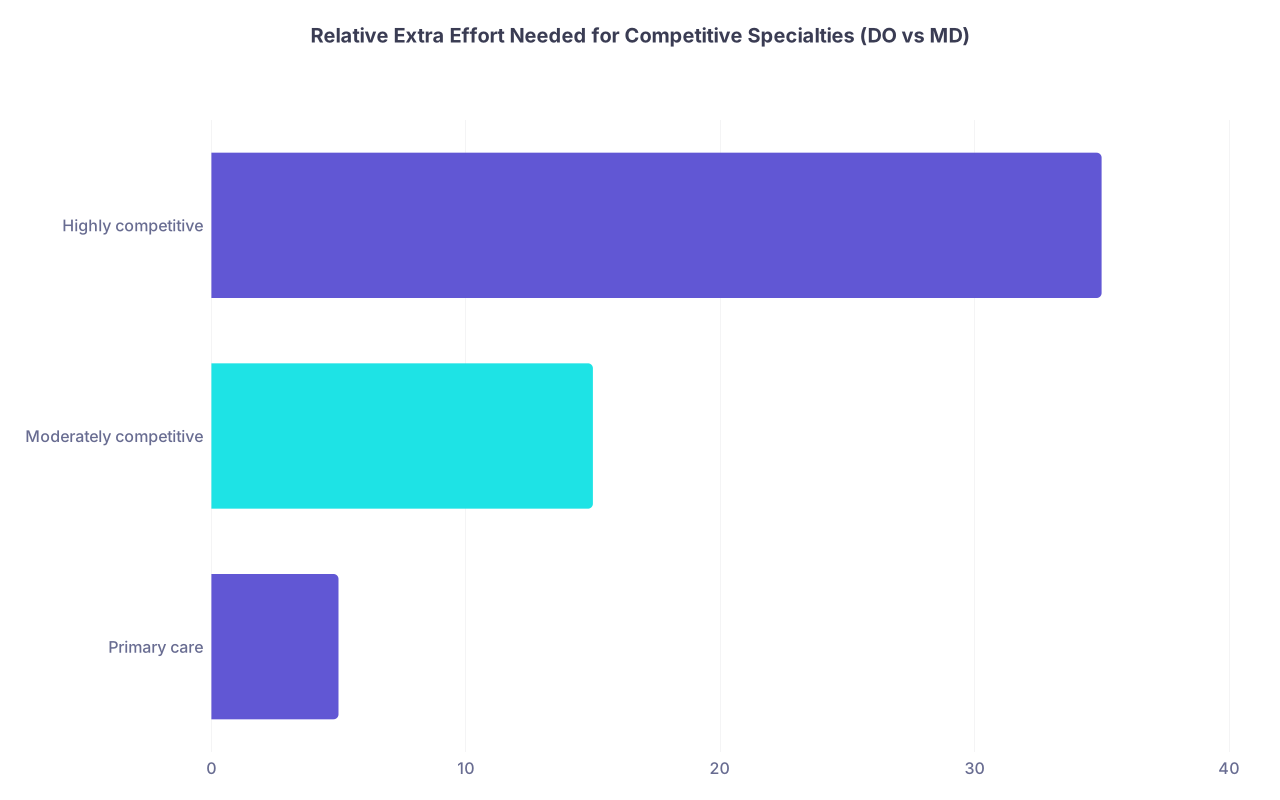
| Category | Value |
|---|---|
| Primary care | 5 |
| Moderately competitive | 15 |
| Highly competitive | 35 |
Again, not scientific. But emotionally, that’s how it feels watching these cycles.
So… Should You Avoid DO If You’re Even Slightly Ambitious?
This is the nasty question underneath all of this, right?
If you have a realistic shot at an MD acceptance and you know you’re going to be deeply bothered by any extra barrier, then yeah—MD is the path of less resistance. It just is.
If you have:
- Strong GPA (3.7+),
- Solid MCAT,
- Reasonable chances at multiple MD schools—
then choosing DO purely to go “faster” or “cheaper” while dreaming of derm/ortho/ENT is, honestly, probably not a great trade for most people.
But if your choice is:
- DO acceptance in hand
vs - Reapplying and maybe never getting MD
then the calculation changes.
Because the worst-case scenario isn’t “I go DO and can’t do derm.”
The worst-case scenario is “I never become a physician at all because I chased a perfect pathway that never materialized.”
And I have seen that. More than once. People who said “I’m too good for DO,” reapplied two, three times, burned years, burned out… and quietly disappeared from medicine.
If you know you want to be a doctor—full stop—and you can live with the possibility that some hyper-competitive doors may be harder to open, DO is not some tragic consolation prize. It’s a real medical degree with real patients and real impact.
The trick is being brutally honest with yourself now about your tolerance for risk and your obsession level with specific high-prestige specialties.
How To Make Peace With This (And Still Protect Your Future Self)
If you’re leaning DO and you’re scared, there are a few things you can do so you don’t wake up in MS4 full of regret.
First, pick the DO school carefully. They’re not all the same. Look for:
- Match lists with at least some representation in the more competitive specialties you might be curious about.
- Strong affiliated hospitals, preferably with residencies on-site.
- A track record of grads matching into solid IM/EM/Anesthesia/OB if that’s your “middle ground” comfort zone.
Second, plan from day one like you might want something competitive, even if you’re not sure. That means:
- Aim to crush pre-clinical content so Step 2 prep is easier.
- Don’t tank early exams assuming “I’ll just do primary care anyway.”
- Get to know faculty who have academic connections, not just those totally isolated in community practice.
Third, accept that your path might require more intentional hustle than some of your MD counterparts. Not because you’re less capable, but because the brand name you write on your white coat still matters to some people who make decisions.
That sucks.
It’s also reality.
But it doesn’t have to define your ceiling. It just defines how hard you’ll have to push to get there.
FAQs
1. If I go DO, is it basically impossible to match derm/ortho/neurosurg?
Not impossible. Just rare and demanding. You’ll likely need standout Step 2 scores, strong research (often a dedicated research year), and excellent connections through away rotations. As a DO, one mediocre piece of your app can be fatal in those fields in a way it might not be for a similarly “average” MD applicant. So if you’re not willing to go all-in, you should assume those specialties are long shots.
2. Should I reapply for MD instead of taking a DO acceptance?
If your stats are borderline for MD already and your DO offer is from a decent program, turning it down to “chase MD” is a big gamble. Some people win that gamble. A lot don’t. If you’re dead-set on a hyper-competitive specialty and have a realistic shot of boosting your MD chances (higher MCAT, stronger app), reapplying can make sense. If not, walking away from a DO seat just to avoid the DO letters is risky bordering on self-sabotage.
3. Do I have to take USMLE Step 2 as a DO student?
If you want to keep as many options open as possible—especially anything competitive—yes, you should plan on Step 2. Program directors understand COMLEX more than they used to, but many still default to USMLE for direct comparisons. Some programs quietly filter out applicants without Step scores. It’s extra work and extra money, but as a DO trying to keep doors open, Step 2 is almost a necessity.
4. Are there specific DO schools that are better for competitive specialties?
Yes. Some DO schools consistently match a few students into more competitive fields or strong academic programs. Schools with attached teaching hospitals and established residencies (especially in surgical fields) give you more chances to impress people who actually run those programs. Before committing, dig through multiple years of match lists—not just the single “highlight reel” year they show on the website.
5. Will being a DO hurt me if I eventually want a competitive fellowship like cardiology or GI?
It can, depending on where you train and what you bring to the table. For fellowships, where you did residency and how strong you were there matters more than whether you’re DO or MD. If you’re a DO who matches into a solid IM program, aces your in-training exams, does research, and gets strong letters, you can absolutely land cards or GI. The hard part is often getting into the most fellowship-feeding residencies in the first place, where MD bias can still be a factor.
6. What if I honestly don’t know what specialty I want yet—does that make DO too risky?
Not necessarily. Almost nobody really knows at the premed stage. If you’d be genuinely happy in a range of fields (FM, IM, peds, psych, EM, anesthesia, OB, neuro), DO is not some awful trap. If you know you’d be miserable unless you match one of 2–3 ultra-competitive specialties, then yes, DO adds risk. The honest test: Can you picture yourself as a happy, fulfilled physician in at least three non-super-competitive fields? If the answer’s yes, DO is a reasonable path. If the answer’s no, you may need to think carefully before locking it in.
If you strip away the noise, three things remain: DO doesn’t slam doors shut, it just makes some of them heavier; your specialty odds will depend far more on your performance than just your degree letters; and the worst outcome isn’t “I became a DO and couldn’t do derm”—it’s never becoming a physician at all because fear kept you from taking the path that was actually open to you.