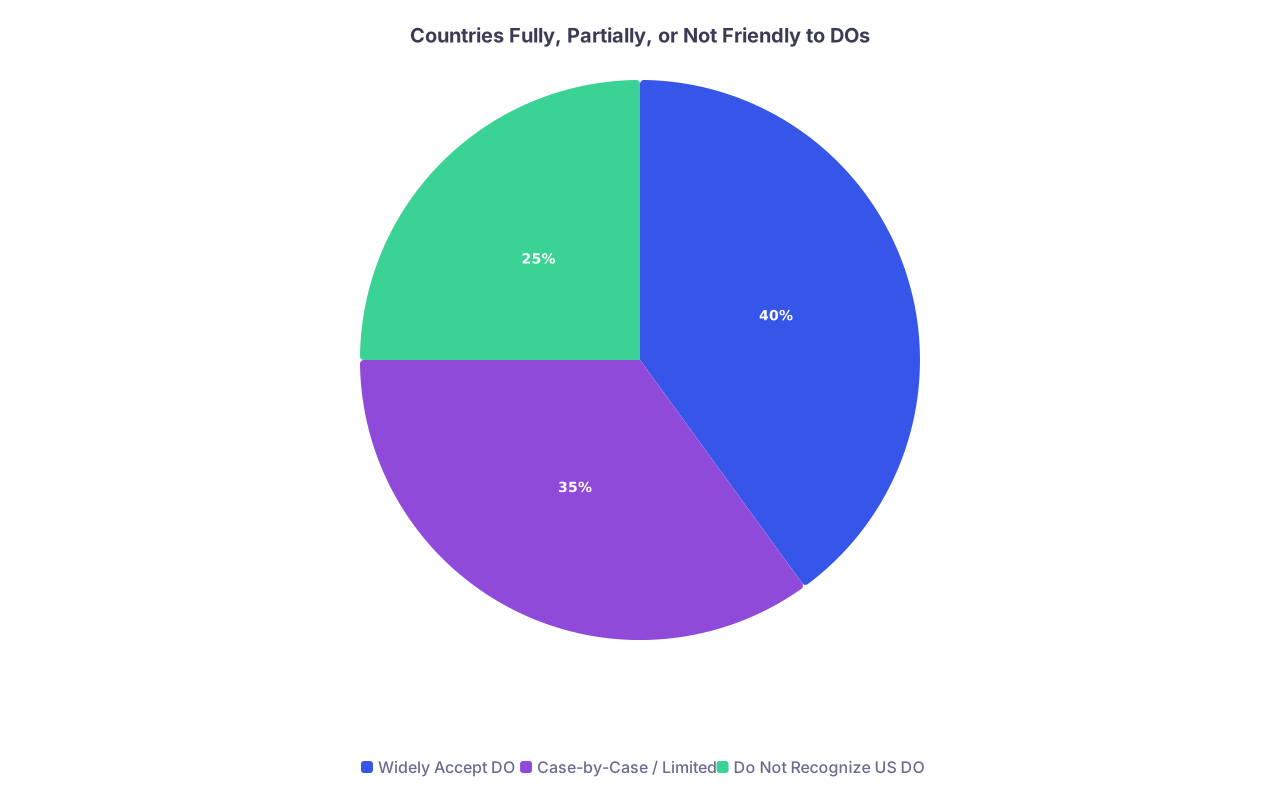
, USMLE only, Both COMLEX & USMLE](https://cdn.residencyadvisor.com/images/articles_svg/chart-licensing-exams-taken-by-do-students-7942.svg "Licensing Exams Taken by DO Students")
| Category | Value |
|---|---|
| [COMLEX only](https://residencyadvisor.com/resources/do-vs-md/comlex-vs-usmle-for-do-vs-md-blueprint-differences-and-prep-strategies) | 45 |
| USMLE only | 5 |
| Both COMLEX & USMLE | 50 |
The worst-kept secret in DO school is this: you’re quietly expected to be bilingual in exam misery.
You don’t just have to survive COMLEX. You’re hearing that you probably “should” also take USMLE if you want a real shot at the more competitive residencies. And no one gives you a straight answer: is it actually worth it, or are you about to ruin your sanity for an exam you might not even need?
Let me say the blunt part out loud:
If you’re a DO student and you might want a competitive specialty or a big-name academic program, skipping USMLE can absolutely hurt you. But taking both can crush you if you go in without a clear strategy.
So yeah. You’re not crazy for spiraling over this.
What You’re Actually Afraid Of (And You’re Not Wrong)
I know the soundtrack in your head:
- “If I don’t take USMLE, will every decent program just auto-screen me out?”
- “If I do take it and bomb, will that permanently destroy my application?”
- “What if I burn out trying to prep for two exams that are almost-but-not-quite-the-same?”
- “What if I pick the wrong path and it closes doors I don’t even know I want yet?”
Let me break the fears into real buckets.
Fear #1: Being filtered out by MD programs
A lot of MD programs are still set up around USMLE. Their filters, spreadsheets, “minimum score” rules—built on USMLE. Even now with Step 1 pass/fail, Step 2 CK is still a huge filter. Some PDs still quietly prefer USMLE over COMLEX because it’s what they know.Fear #2: COMLEX ≠ USMLE, and that mismatch is terrifying
COMLEX hits OMM, weird question style, different emphasis. USMLE is cleaner, more straightforward, less OMM, more biochem-ish path-heavy logic. Studying for one doesn’t perfectly cover the other. That’s what makes this decision feel dangerous: you’re not just doing the same thing twice.Fear #3: The “What if I get a bad USMLE score?” trap
You can’t hide a USMLE score once you take it. If you take it and underperform relative to your COMLEX, some programs will judge you by the lower number or by the standardized thing they understand better (USMLE). So yeah, it’s not free upside.Fear #4: Burnout and timing
USMLE and COMLEX often get stacked within days or weeks. That means: prep for both styles, cram OMM for COMLEX, review slightly different content emphasis… all while maybe trying to pass your courses and not destroy your mental health.
You’re afraid of picking the path that maximizes regret. That’s really what this is.
When Taking Both Exams Is Actually Worth It
Let’s get concrete. There are situations where taking both USMLE and COMLEX is clearly worth the pain.
1. You’re interested in competitive specialties
If any part of you even vaguely daydreams about:
- Dermatology
- Orthopedic Surgery
- Plastic Surgery
- ENT
- Neurosurgery
- Radiology
- Certain competitive anesthesiology, EM, or surgical subspecialty spots
…you should strongly assume USMLE is expected.
Plenty of program directors in those fields straight-up say it: they feel more comfortable comparing one USMLE number to another USMLE number. COMLEX-only applicants often land in a “we don’t know how to interpret this” pile—even if that’s unfair.
Does that mean a DO with only COMLEX can never match ortho or derm? No. But the odds are already stacked, and skipping USMLE stacks them more.
2. You want big academic centers or name-brand institutions
If your dream list includes places like:
- Mayo
- Cleveland Clinic
- Mass General/Brigham
- UCSF
- University of Michigan
- Any large, historically MD-heavy academic center
A lot of them still strongly prefer, or quietly expect, USMLE. Some will technically “accept COMLEX” but are honest in surveys: they rank USMLE more heavily.
It sucks. It’s biased. It’s reality.
3. You have a strong test-taking record and you know you can crush it
If:
- Your practice NBMEs are consistently solid
- Your COMSAEs are decent
- You did well on in-house exams
- You’re not barely holding yourself together mentally
Then USMLE can be a huge asset. A strong Step 2 CK score especially can:
- Offset a not-amazing COMLEX
- Help programs who don’t understand COMLEX see, “Oh, this student is actually excellent”
- Make you competitive beyond the traditional “DO-safe” scope
In that scenario, not taking USMLE can be leaving points on the table.
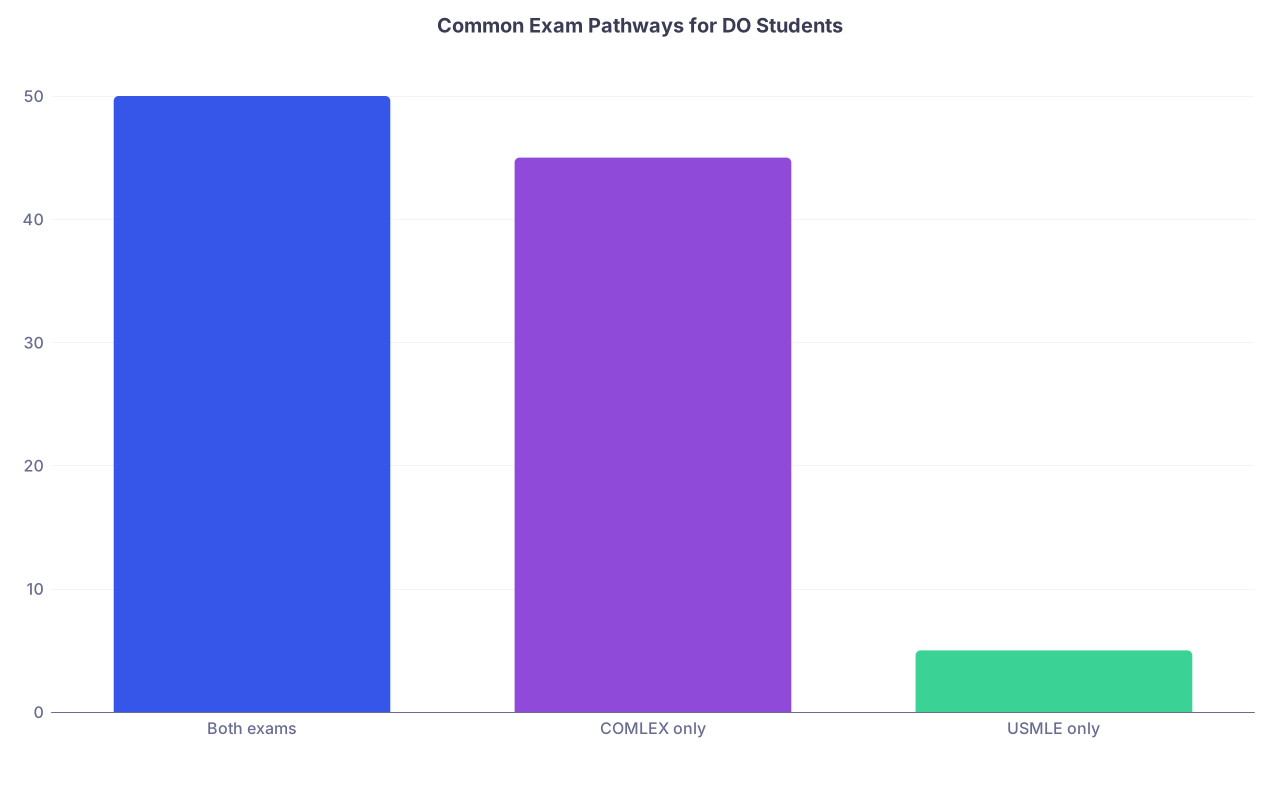
| Category | Value |
|---|---|
| Both exams | 50 |
| COMLEX only | 45 |
| USMLE only | 5 |
When Taking Only COMLEX Is Completely Reasonable (And Smart)
Despite all the fearmongering on Reddit, taking only COMLEX can absolutely be the right call.
Here’s when that choice makes sense.
1. You’re pretty sure you want a less competitive, DO-friendly specialty
Things like:
- Family Medicine
- Internal Medicine (non-competitive programs)
- Pediatrics
- Psychiatry (many programs)
- PM&R
- Some OB/GYN and EM programs depending on region
These fields have a lot of DO presence. Tons of programs are used to COMLEX and don’t require USMLE. Many community-based programs couldn’t care less as long as you pass your boards and aren’t a red flag.
If the idea of derm/ortho/ENT makes you physically ill and your heart’s in primary care? You might not need to torture yourself with USMLE.
2. Your test-taking is already fragile
If:
- You barely passed earlier exams
- COMSAE practice scores are borderline
- The idea of one board exam already wrecks your sleep
- You’re fighting anxiety, depression, or burnout
Then forcing USMLE on top isn’t “ambitious.” It’s reckless.
A failed or low USMLE score can be harder to explain than just never having taken it. It can drag you down. In that situation, focusing on destroying COMLEX, protecting your mental health, and building a strong application (letters, rotations, networking) is a smarter play than chasing a test that might break you.
3. Your school or mentors know your target region well
Some regions and hospital systems are very DO-friendly and totally fine with COMLEX only:
- Certain Midwest communities
- Some Southern and Rust Belt programs
- Systems with historically many DO attendings/faculty
If your school’s match list shows that people in your shoes, with similar stats, are matching where you’d be happy without USMLE, then you’re not sabotaging yourself by skipping it. You’re being strategic.
The Ugly Practical Stuff: Time, Money, and Sanity
You’re not just deciding “take one exam or two.” You’re deciding:
- More months of serious studying
- Extra exam fees
- Extra resources (UWorld, NBME, etc.)
- More time feeling like everything you do is graded
And there’s another trap: trying to “study for both” simultaneously but not doing either efficiently.
The reality:
- The core high-yield content overlaps: UWorld, Pathoma, Boards & Beyond-style resources cover most of Step 1/COMLEX 1 material.
- But COMLEX needs extra: OMM, weird question style, some different emphasis.
- Step 2 / COMLEX 2: more clinical, again lots of overlap, but different formatting and style.
A lot of people do this:
- Study like a USMLE student (UWorld, NBME, etc.)
- Schedule USMLE
- Cram OMM and COMLEX-style Qs in the last 2–3 weeks
- Take COMLEX shortly after
And that can work—if your foundation is strong and your mental health is not in pieces.

| Step | Description |
|---|---|
| Step 1 | Start DO School |
| Step 2 | Plan for USMLE + COMLEX |
| Step 3 | Consider COMLEX only |
| Step 4 | Talk to advisors & review match data |
| Step 5 | Focus on strong Step 2 + COMLEX 2 |
| Step 6 | Maximize COMLEX + rotations + letters |
| Step 7 | Decide by early 2nd year |
| Step 8 | Competitive specialty? |
| Step 9 | DO-friendly specialty? |
If you’re already underwater academically, trying to play both games can just lead to two mediocre scores instead of one solid one.
How To Decide Without Losing Your Mind
You want a formula. There isn’t one. But here’s a pretty close decision script you can actually use.
Step 1: Be brutally honest about your goals
Write down:
- Top 3 specialties you’re currently considering
- Types of programs you’d actually like: big academic, community, specific cities or regions
If any of those specialties are moderately or highly competitive, treat USMLE as strongly recommended.
Step 2: Look at objective data, not vibes
Pull up:
- Your school’s match list
- NRMP Charting Outcomes for DOs (when available)
- Program websites for places you like — see if they explicitly say USMLE required/preferred
You’ll often see patterns like: “Top-tier programs in X specialty: almost all their DOs had USMLE.” That’s not random.
Step 3: Look at your current performance
Ask yourself:
- How are my class scores?
- How are my practice questions going?
- Am I someone who historically tests at my potential, or below it because of anxiety/time issues?
If you consistently underperform on standardized tests, voluntarily adding another one is not kind to yourself.
Step 4: Talk to people who actually match DOs
Not just Reddit. Not just that one super-gunner on Discord.
Go to:
- Your school’s advising office
- Recent grads from your school in the specialties and programs you’re eyeing
- Residents who were DOs and matched 1–3 years ago
Ask them:
- Did you take USMLE?
- Would you do it again?
- Were there programs that flat-out told you they filtered COMLEX-only?
You’ll notice a pattern by about the 5th conversation.
| Situation | USMLE Recommendation | Why |
|---|---|---|
| Interested in derm/ortho/ENT/rads | Strongly yes | Programs compare USMLE easily, many expect it |
| Wants academic IM at big-name places | Yes | More competitive, PDs like USMLE data |
| Aiming for community FM/IM/Peds | Optional | Many accept COMLEX-only without issue |
| History of poor standardized testing | Usually no | Risk of low score outweighs benefit |
| Severe burnout/anxiety already | Usually no | Mental health cost likely too high |
The Worst-Case Scenarios You’re Probably Playing in Your Head
Let’s actually name them instead of letting them haunt you.
Scenario 1: You don’t take USMLE, then late 3rd year you suddenly want a competitive specialty
This one hurts, but it’s not instant death. What you can do:
- Target DO-friendly or regional programs in that specialty
- Do away/audition rotations and absolutely crush them
- Network like your life depends on it
- Consider a backup specialty more DO-accessible if needed
Yeah, you will probably have fewer options. That’s the real cost. But it’s not “you’ll never match anything.”
Scenario 2: You take USMLE and score much lower than expected
Miserable feeling. But reality:
- Strong Step 2 CK can partially redeem a weak Step 1
- Great clinical grades, strong letters, and audition rotations can soften the hit
- Some programs truly do holistic reviews and won’t toast you for a single number
It’s not game over. It just changes your target list and maybe your level of competitiveness.
Scenario 3: You stretch to take both, burn out, and underperform on both
This is the one I’m honestly most afraid of for people.
Because then you’ve:
- Hurt your confidence
- Lost the benefit of even focusing on one exam
- Entered clinical years already exhausted and cynical
That’s why “everyone should just take both” is lazy advice. For some students, it’s actively harmful.
So… Is It Worth It?
Here’s the take you probably want me to give you:
If you’re a DO student who is even moderately serious about a competitive specialty or big-name academic program, then yes—taking both COMLEX and USMLE is probably worth it, if you can realistically score well and not destroy your mental health in the process.
If you’re leaning clearly toward primary care, community programs, or DO-heavy fields, and exams already take a lot out of you, then no—you’re not sabotaging your life by doing COMLEX only. You’re choosing a sane, focused path.
The real question isn’t “Is it worth it in general?”
It’s: “Is it worth it for me, given my goals, my test-taking history, and my mental bandwidth?”
If you ignore your own brain and just copy whatever the loudest people online do, that’s when this decision backfires.

FAQ (Exactly 5 Questions)
1. If I take USMLE, do I have to take both Step 1 and Step 2, or can I just do Step 2?
You can absolutely just take Step 2 CK. In fact, a lot of DO students now skip Step 1 and only do Step 2 CK + COMLEX Level 2. Step 2 is often more important for residency anyway, and it’s closer to real clinical medicine. But some very old-school programs might still ask why you never took Step 1; usually, a clear explanation and strong Step 2 score is enough.
2. What if my COMLEX score is good but my USMLE is mediocre—how do programs judge that?
Different programs handle this differently, which is the annoying part. Some will weigh USMLE more heavily because they understand it better. Others will look at both and consider the stronger performance. A few might quietly screen you out based on the weaker score. That’s why you don’t take USMLE “just because”—you take it when you’re reasonably confident you can perform at or above your COMLEX level.
3. Are there programs that won’t even consider me if I only have COMLEX?
Yes. Some MD programs—especially historically competitive or academic ones—either explicitly state “USMLE required” or effectively use USMLE-only filters in their application software. You can still build a great career at places that accept COMLEX, but your pool of options is smaller if you never take USMLE. That’s the tradeoff: fewer exams now vs fewer possible programs later.
4. Can I decide about USMLE later, like during clinical rotations?
For Step 1, not really—timing gets tight. For Step 2, you have a bit more flexibility. But waiting too long compresses your clinical responsibilities, shelf exams, and board prep into a miserable block of time. Realistically, you want a tentative plan by early second year, even if you leave some wiggle room. “I’ll just figure it out later” often becomes “I ran out of time.”
5. Is it true that DO students need USMLE to match at all?
No. That’s fear talking, not data. Tons of DOs match every year with COMLEX only, especially into primary care and DO-heavy fields. Where USMLE matters most is for competitive specialties and big-name academic programs. If someone says “You’ll never match without USMLE,” they’re either exaggerating or talking only about certain specialties. It’s not an across-the-board rule.
Open a blank page right now and write down: your top 3 possible specialties, your honest test-taking track record, and how much more stress you can realistically handle. Then, based on that, make a provisional decision about USMLE—yes or no—and schedule a meeting with an advisor or recent DO grad this week to sanity-check it.