Last week I watched a DO MS2 stare at a spreadsheet of match stats with tears in her eyes. “What if I don’t match and all my MD friends do?” she asked. “What if I’m the only one who fails? What if going DO was a huge mistake?”
I’ve heard some version of that exact fear way too many times. And if you’re reading this, I’m guessing that scenario is already playing in your head on repeat.
Let’s walk straight into that nightmare scenario—because ignoring it doesn’t make it go away—and then actually plan for it so it loses some of its power.
First: Are You Really More Likely to Not Match as a DO?
Let me be blunt: yes, statistically, DO students are a bit more vulnerable than MDs. Not catastrophically. But enough that your anxiety isn’t totally imaginary.
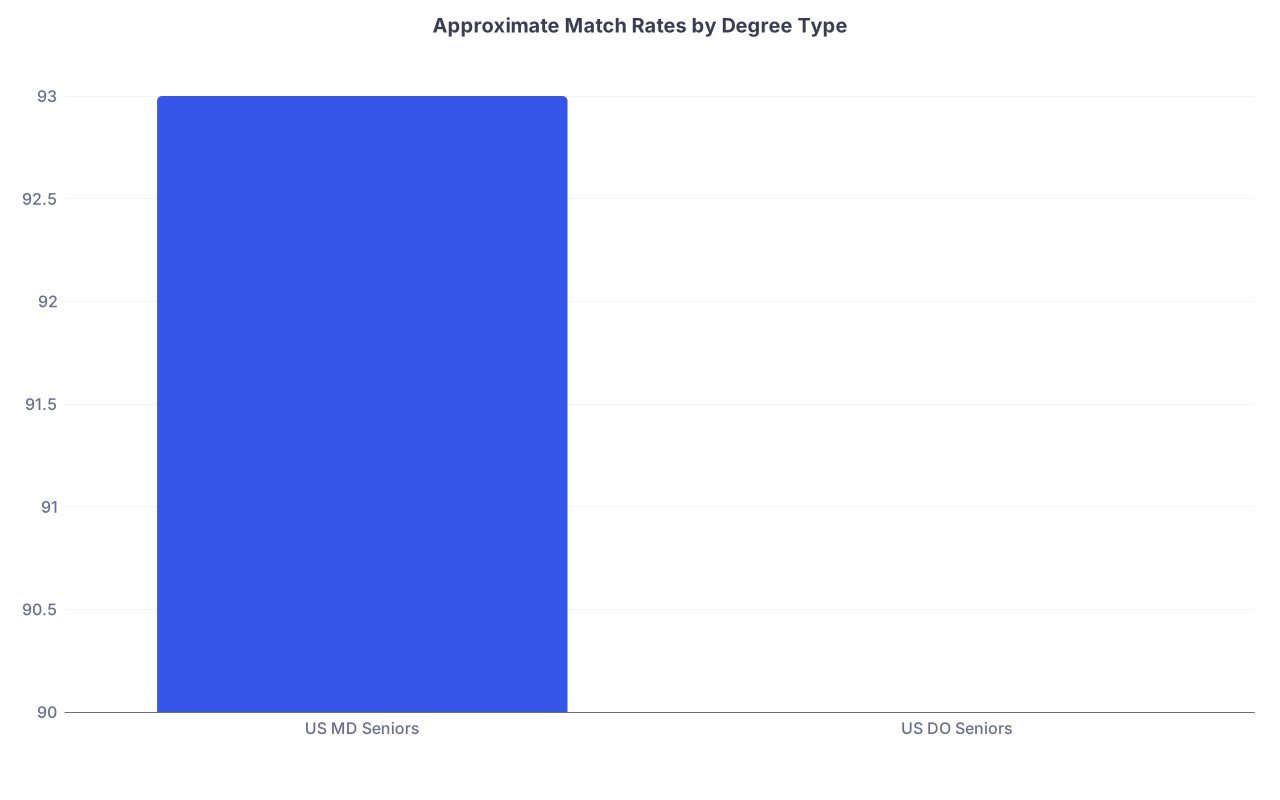
| Category | Value |
|---|---|
| US MD Seniors | 93 |
| US DO Seniors | 90 |
Those numbers are recent-ish NRMP-ballpark territory (they move a little each year, but this is the vibe):
- US MD seniors: low-90s% match rate
- US DO seniors: high-80s to ~90% match rate
So no, DO doesn’t equal “you’re doomed.” It does mean you can’t be sloppy about planning. You don’t get as much margin for error.
What increases the risk for a DO applicant?
- Applying late.
- Weak or average scores for the specialty you’re targeting.
- Over-reaching (all competitive programs, no safeties).
- Poor advising, especially from people who don’t understand DO-specific realities.
- Not being willing to relocate or apply broadly.
You know what’s NOT on that list? “Being DO instead of MD” all by itself.
The fear isn’t crazy. But the “I’m definitely going to be the one DO who doesn’t match while my MD group chat celebrates” story your brain is telling? That’s anxiety fiction, not data.
The Worst-Case Scenario: You Don’t Match, and Your MD Friends Do
Let’s drag the monster fully into the light.
Match Week. Your phone doesn’t buzz with “I matched!” but instead with that soul-crushing email: “We are sorry to inform you…” Meanwhile, your MD classmates are posting photos with their partners, crying happy tears, plastering Instagram with “Future [Specialty] Resident!” posts.
Here’s what that actually looks like behind the scenes—not the dramatized version in your head:
You get the “you did not match” email on Monday.
That punch-in-the-gut feeling is real. You’ll compare yourself to every MD you know. You’ll question your entire path.You enter SOAP (Supplemental Offer and Acceptance Program).
This is not just “desperation scramble for rejects.” Real programs with real training spots fill through SOAP. Plenty of DOs land solid positions there.You either:
- Match in SOAP (different specialty or location than planned), or
- Don’t land a spot and are officially unmatched that cycle.
Your MD friends match and move on.
Some will be kind, some awkward, some self-absorbed. That’s true whether you’re DO or MD, honestly.
Dark enough? Yes. But here’s the part your brain keeps skipping: people survive this. A lot of them end up fully practicing physicians. Often in solid, fulfilling careers that have nothing to do with that first Match result.
You’re not imagining that this would hurt. You are imagining that it would be the end. It’s not.
How to Plan Now So “Not Matching” Becomes Less Likely
If you want to calm the fear, you can’t just tell yourself “It’ll probably be fine.” Your brain doesn’t buy that. You need a plan that changes the odds.
1. Choose Targets That Match Your Reality, Not Your Ego
The DO vs MD thing gets exaggerated when you pick a specialty like you’re shopping on Instagram instead of reading data.
Ultra-competitive for DO (especially with average stats):
- Dermatology
- Plastic surgery
- Neurosurgery
- Ortho (still doable, but brutal)
- ENT
If you’re at a smaller DO school with limited research, average scores, and no strong home program, trying to brute-force one of these without a backup is how you end up unmatched while your MD friends slide into IM or FM.
You don’t have to give up on a dream specialty early. But you do need:
- A realistic backup specialty
- A clear understanding of what your target specialty actually wants: Step 2 scores, research, letters, geography
If you’re premed or early med school: pick your school, rotations, and mentors with these realities in mind. Don’t hide from them.
2. Stats Strategy: You Need Less “Vibes,” More Math
You can’t out-network your way past a weak set of scores in competitive fields, especially as a DO.
Non-negotiables if you’re DO:
- Take COMLEX seriously from day 1.
- Strongly consider taking USMLE Step 2 if you want any moderately competitive specialty or academic programs.
- Don’t accept “That’s fine for DO” if your score is actually below the average for your target specialty.
You should know:
- The Step/COMLEX averages for your target specialty.
- How your school’s DO grads have historically matched. Not the rumor mill. Actual lists.
If you’re premed choosing between DO schools, ask directly:
“What were last year’s match outcomes—by specialty—for your DO students?” If they dodge, that’s info too.
3. Apply Like Someone Who Knows the System Is Biased… and Still Wants to Win
Are there programs that quietly prefer MDs? Yes. Pretending otherwise is naïve.
So you compensate by being methodical:
- Apply broadly. More programs than your MD friends with similar stats.
- Favor DO-friendly programs (look at current residents—are there DOs there?).
- Include a range: a few reaches, a solid core of realistic targets, and true safety options. Yes, even if your ego hates that.
And please don’t do the “I only applied to 30 programs in a competitive specialty because my MD buddy did it and matched.” You’re not playing the same game with the same odds.
Ok, But What If I Still Don’t Match? Actual Paths Forward
Let’s say the thing you’re scared of happens. You don’t match while your MD friends do. What now?
Here are the actual paths I’ve seen DOs take after an unmatched year—not fantasies, real stuff.
1. SOAP Into Another Specialty or Location
Not glamorous. Often humbling. But lots of DOs land perfectly respectable FM, IM, psych, peds, or prelim spots in SOAP.
This path usually looks like:
- Original target: competitive specialty at limited locations.
- SOAP result: less competitive specialty (or prelim year) in a less popular location.
A prelim year + reapply path is especially common for people who aimed high the first time. It’s not fun. But it’s real and it works.
2. Take a Dedicated “Glide” Year and Reapply Stronger
Brutal to think about, but powerful if done right.
Things that actually move the needle during a gap year:
- Strong clinical work (e.g., research coordinator with patient contact, or legit clinical job).
- Real research with publications/posters in your field of interest.
- High-quality new letters from people who will go to bat for you.
- Strategic rebranding: changing specialty to something more realistic given your stats.
Things that mostly don’t fix the problem on their own:
- Random non-clinical jobs just to “stay busy.”
- Doing nothing but more test prep unless your scores were the clear limiting factor.
- Reapplying with the exact same application and expecting a miracle.
During that year, a lot of unmatched DOs realize something painful: their first application strategy was fantasy-based. Their second one, built from data and honest self-assessment, works.
3. Switch Specialty Targets Entirely
This feels like failure when you first say it out loud. “I didn’t get derm so I went into IM” sounds tragic in your head.
But I’ve watched this shift look like:
- “I realized I actually don’t like clinic days in derm. I like sick patients. I just liked the status.”
- “I thought I’d be devastated not doing ortho. Turns out I love anesthesia and the lifestyle more.”
Your unmatched year might be the thing that forces you to ask:
“Do I want this specialty… or do I want what it signals about me?”
That question can save you years of misery.
4. Worst-Case: Two Unmatched Cycles
Yes, this happens. Rare, but not zero. Usually in people aiming for ultra-competitive specialties without adjusting.
Even there, I’ve seen DOs:
- Pivot into another field entirely (tech, consulting, MPH, MBA, clinical research, hospital admin).
- Come back later through non-traditional routes.
- Build meaningful careers that they actually like, even if the “attending physician” title never happens.
No one wants that path. But your life does not permanently “fail” if you don’t end up an attending. Your anxiety keeps telling you this is the only acceptable future. It’s lying.
Emotional Side: Watching MD Friends Match While You Don’t
Let’s just name what really terrifies you. It’s not just “not matching.” It’s:
- The group chats where everyone posts their happy emails and you stay silent.
- The family questions: “But I thought you were almost a doctor?”
- The shame of being “the one who didn’t make it.”
This stuff hurts more than the actual logistics sometimes.
A few things that help, from people who’ve been through it:
Create a small “need-to-know” group now.
One or two friends (DO or MD) who will know your full situation. People you trust to support you if things go sideways.Pre-plan your social media strategy.
Decide: will you go offline that week if needed? Will you post later with a simple update like “Taking an alternative path this year—more to come soon”?Prepare one calm answer for family and curious classmates.
Something like:
“I didn’t match this cycle, which happens to some applicants. I’m working with my advisors on next steps and I’ll be reapplying with a stronger application.”
You don’t owe anyone more detail.Don’t compare your raw timeline to someone else’s highlight reel.
Match Day is the loud, public milestone. The quiet, private reality is: everyone’s career unfolds at different speeds. No one remembers who finished “on time” 10 years later.
If You’re Still Premed or Early in DO School: Playing the Long Game
You’re in a better position than you think because you haven’t “screwed up” anything yet. You can build your whole plan around reducing unmatched risk.
Focus on:
- Choosing a DO school with strong match outcomes and transparent data
- Building relationships with mentors who’ve actually placed DOs into good programs
- Doing rotations at places that historically take DOs
- Getting serious about Step/COMLEX from day 1 instead of “I’ll start grinding MS2 spring”
And mentally: accept that you may need to apply more broadly, be more flexible, and work the system harder than some MD classmates. That’s not fair. It is reality.

| Step | Description |
|---|---|
| Step 1 | Dont Match |
| Step 2 | Accept SOAP Spot |
| Step 3 | Complete Residency |
| Step 4 | Glide Year: Research/Work |
| Step 5 | Alternative Careers |
| Step 6 | New Specialty or Strategy |
| Step 7 | Reapply Next Cycle |
| Step 8 | SOAP Offers? |
| Step 9 | Reapply? |
| Step 10 | Match? |
The Truth Your Anxiety Hates: You Have Levers to Pull
You’re not just drifting toward a future where your MD friends match and you don’t. You have actual levers:
- Specialty choice
- School choice
- Test performance
- Research and letters
- Number and type of programs you apply to
- Willingness to move and compromise
You can’t control program bias. You can’t magically become MD. But you can absolutely tilt the odds hard enough that “not matching while all my MD friends do” goes from “guaranteed doom” to “low probability worst-case with a backup plan.”
And once there’s a backup plan? The fear loses teeth.
FAQ (Exactly 6 Questions)
1. If I’m premed, should I avoid DO altogether because of match risk?
No. That’s overreacting. DO can be a great path, especially if:
- You’re flexible on specialty and location
- You’re willing to work a bit harder on strategy and planning
If you already have acceptances, look at each school’s match list. Choose the one with the strongest proven outcomes, not just the nicest campus.
2. Do I absolutely need to take USMLE as a DO student?
If you’re even thinking about a competitive specialty or academic programs, yes, I’d strongly recommend it. Some community and DO-heavy programs won’t care. But many ACGME programs still feel more comfortable comparing USMLE numbers. Skipping it narrows your options, and as DO, you really don’t want to shrink your option pool.
3. What’s the biggest reason DO students don’t match?
Honestly? Misalignment between goals and reality. A DO student with okay scores, minimal research, and no strong specialty mentorship applying mostly to derm or ortho at big-name academic centers, with few backups. It’s less “being DO” and more “applying like you’re a top-tier MD with a different profile.”
4. If I go unmatched once as a DO, are my chances ruined forever?
No. You’re behind, not done. A well-structured glide year plus a more realistic specialty and better application strategy can absolutely lead to a match the next cycle. Programs don’t automatically blacklist you for being unmatched once; they do expect clear growth and a coherent story.
5. Is it true that some programs won’t even look at DOs?
Yes, there are still programs like that, even if they won’t say it out loud. That’s why you study their current residents. If there are zero DOs in the last several classes, don’t build your whole application strategy around those places. Apply if you want, but don’t count on them.
6. What can I do today to lower my unmatched risk as a future DO?
Two concrete things:
- Look up NRMP Charting Outcomes and COMLEX/USMLE score ranges for your dream specialty and at least one backup specialty. Compare honestly to where you’re likely to be.
- Identify one faculty mentor or advisor who actually understands DO match realities and email them to set up a meeting to talk long-term planning. Not vibes. Data and strategy.
Open a blank doc right now and write the heading: “If I don’t match, my Plan B is…” Then outline what specialty, what kind of gap year, and what changes you’d make. Once you’ve written that down, you’ve already taken power back from the fear instead of letting it run the whole show.