Last week, someone DM’d me a screenshot of their first medical school acceptance. It was a DO school. Their message under it: “I should be happy, right? Why do I feel… like I failed?”
If you’re reading this, you probably know that exact sick-to-your-stomach mix of relief and disappointment. You wanted MD. Your parents say “a doctor is a doctor,” but that little voice in your head keeps whispering: “What if this ruins everything?”
Let’s talk about that voice.
The Honest, Ugly Feelings About “Only DO”
Everyone tells you to be grateful. “Plenty of people would kill for any acceptance.” You know that. You’re not stupid. But you also can’t turn off the part of you that’s mourning the vision you had for years: white coat with “MD” on the badge, big-name academic center, matching into something competitive.
So it turns into this constant spiral:
- “What if I never get taken seriously?”
- “Will patients think I’m second-rate?”
- “Am I closing doors forever before I even start?”
And then the really dark one:
- “Did I just hit my ceiling?”
I’ve watched people carry that shame quietly through all four years of med school. They don’t say it out loud, but it shows up in thoughts like “I’m just a DO” when they compare themselves to MD friends. It can poison everything if you don’t deal with it now.
Here’s the blunt truth: DO vs MD matters in some ways. It absolutely does. But not in the cartoon, worst-case way your brain is feeding you at 2 a.m.
Let’s separate the real obstacles from the horror movie version your anxiety is making up.
What Actually Changes If You Go DO (And What Really Doesn’t)
First: DO ≠ “not a real doctor.” That’s nonsense. You’ll be licensed the same way. You’ll take care of patients the same way. You’ll prescribe, admit, do procedures, be on call, all of it.
Where it can matter most is in residency competitiveness, especially in certain specialties and at certain programs.
To ground this in something visual:
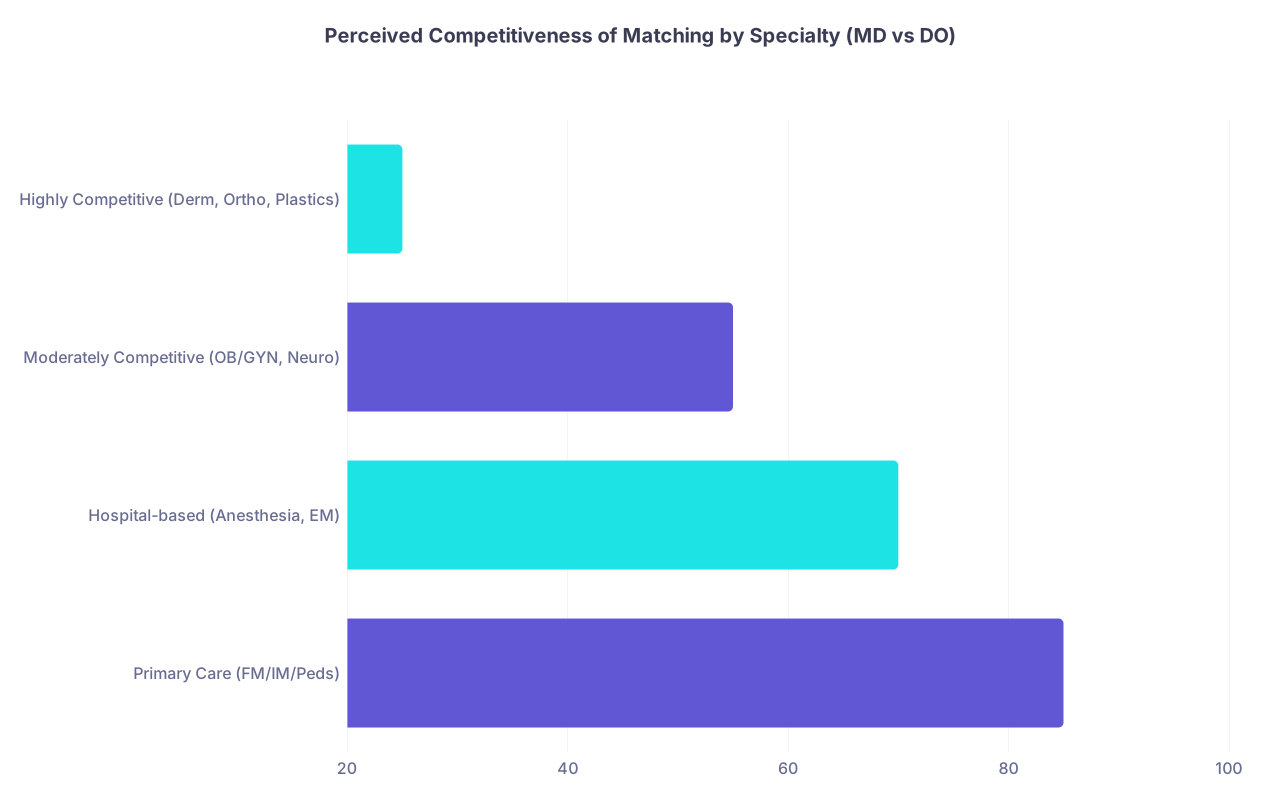
| Category | Value |
|---|---|
| Primary Care (FM/IM/Peds) | 85 |
| Hospital-based (Anesthesia, EM) | 70 |
| Moderately Competitive (OB/GYN, Neuro) | 55 |
| Highly Competitive (Derm, Ortho, Plastics) | 25 |
Interpret this like this: as a DO, your realistic probability of matching is very strong in primary care, pretty solid in mid-tier specialties if you’re strong on paper, and definitely tougher in the ultra-competitive ones.
But your brain is probably going: “So basically I’m doomed unless I want primary care in the middle of nowhere, right?” No. That’s the spiral talking.
Here’s what’s true:
Patients don’t care nearly as much as you think. Most just want someone who listens and knows what they’re doing. I’ve literally heard attendings introduce themselves as “Dr. X, one of the doctors here” and that’s it. Nobody pulls out a microscope to inspect the letters on the badge.
Most non-ultra-competitive residencies absolutely take DOs. Tons of them. Internal medicine, family, pediatrics, psych, neurology, anesthesia, EM at many places — DOs are everywhere.
The prestige-obsessed internet crowd is louder than it is accurate. Reddit makes it seem like if you’re not MD at a top-20 you might as well open a crystal healing clinic. Walk into an actual hospital and you’ll see DOs on staff, in leadership, in fellowship, teaching.
But also:
- If your dream is something like dermatology, neurosurgery, ortho, plastics, ENT, or big-name academic programs, your path as a DO will be steeper. Not impossible. Steeper. You’ll need stronger scores, better clinical performance, more hustle with research, and a lot more strategy.
The question you really need to answer isn’t “Is DO bad?” It’s: “What am I willing to do, and what am I willing to give up, to chase a particular three-letter dream (MD or a specific specialty)?”
Do You Reapply for MD or Take the DO Seat? The Brutal Cost-Benefit
This is the part that keeps you up at night. You’ve got a DO acceptance. Maybe more than one. Maybe an MD waitlist somewhere. And there’s this voice saying: “If you really believed in yourself, you’d reapply for MD.”
Let’s slow that down.
Here’s the decision tree you’re actually in:
Ask yourself some painfully honest questions:
Can you realistically improve your app?
Not hypothetically. Specifically. Are you sitting on a 507 MCAT and thinking you’ll magically jump to a 519 while working full-time? Did you already apply broadly and get almost nothing back, or did you clearly under-apply and rush secondaries?What’s your mental health doing right now?
Another cycle isn’t just “one more year.” It’s another year of limbo, of explaining to family, of stalking email. Some people can handle that. Some people actually break under it. You know which one you are better than anyone else.What’s the timeline cost?
Every extra year waiting is one less year as an attending. That’s not just money, it’s also life. Family. Burnout. Fatigue. You don’t feel it now, but you will when you’re six years into training and your college friends are buying houses and having kids.Are you chasing MD letters or a specific career outcome?
If what you really want is to be a solid physician in, say, internal medicine or family medicine, a DO acceptance is already a perfectly good route. If what you really want is to keep the door open for a hyper-competitive field at a top academic center, that’s a different calculation.
Here’s what I’ve actually seen happen in real life, not fantasy:
Student A: Turned down DO, spent a year “improving” but only nudged MCAT 2 points and did some mediocre volunteering. Reapplied. Got… the same DOs and fewer MD interviews. Ended up at the same DO school, just one year older, one year poorer, and 10x more tired.
Student B: Took the DO acceptance. Crushed COMLEX + Step 1/2 (when available), honored rotations, did research. Matched into EM at a solid university program. Now nobody cares how they got there.
Student C: Took 2 years off, completely rebuilt their app: huge MCAT jump, serious research with pubs, high-level letters. Went from DO-only to multiple MD acceptances. It happens — but they treated it like a full-time job, not wishful thinking.
Reapplying for MD isn’t “bad” or “good.” It’s a tradeoff. If you’re going to reject a DO seat, that decision has to be built on actual data and a concrete plan — not just pride and magical thinking.
If You Go DO: How to Protect Your Future Options Instead of Shrinking Them
Let’s say you decide to take the DO route. Anxiety brain immediately screams: “Well, that’s it. Path closed.”
No. Your life is not scripted by the day you choose MD vs DO. What you do inside school matters more than you want to admit, because it means the responsibility comes back to you.
Here’s what quietly moves the needle most as a DO:
You need top-tier exam performance.
Historically that’s COMLEX, and when Step 1 was scored, a strong USMLE showed programs you could hang with MD peers. Now, Step 2 is even more important. Average isn’t going to cut it if you’re trying to match more competitive fields.You need strong clinical evals.
Shelf exams matter. Rotation comments matter. If attendings love you and your evals say “top of class, would take as resident,” that carries serious weight.You probably need research if you’re eyeing non-primary care or academic jobs.
Doesn’t mean 10 Nature papers. But show that you’ve engaged with academic medicine at some level, especially for things like anesthesia, EM at big centers, neuro, etc.You must choose school and rotations strategically.
You want a DO school that has:- Good match rates into the kind of specialties you’re considering.
- Solid affiliated hospitals and elective rotations at MD academic centers.
- Upperclassmen matching into fields you’d like to keep open.
If your anxiety is about doors closing, your best weapon is information. Ask current students where people are matching. Stalk their match lists like it’s your job.
Here’s a reality check visual:
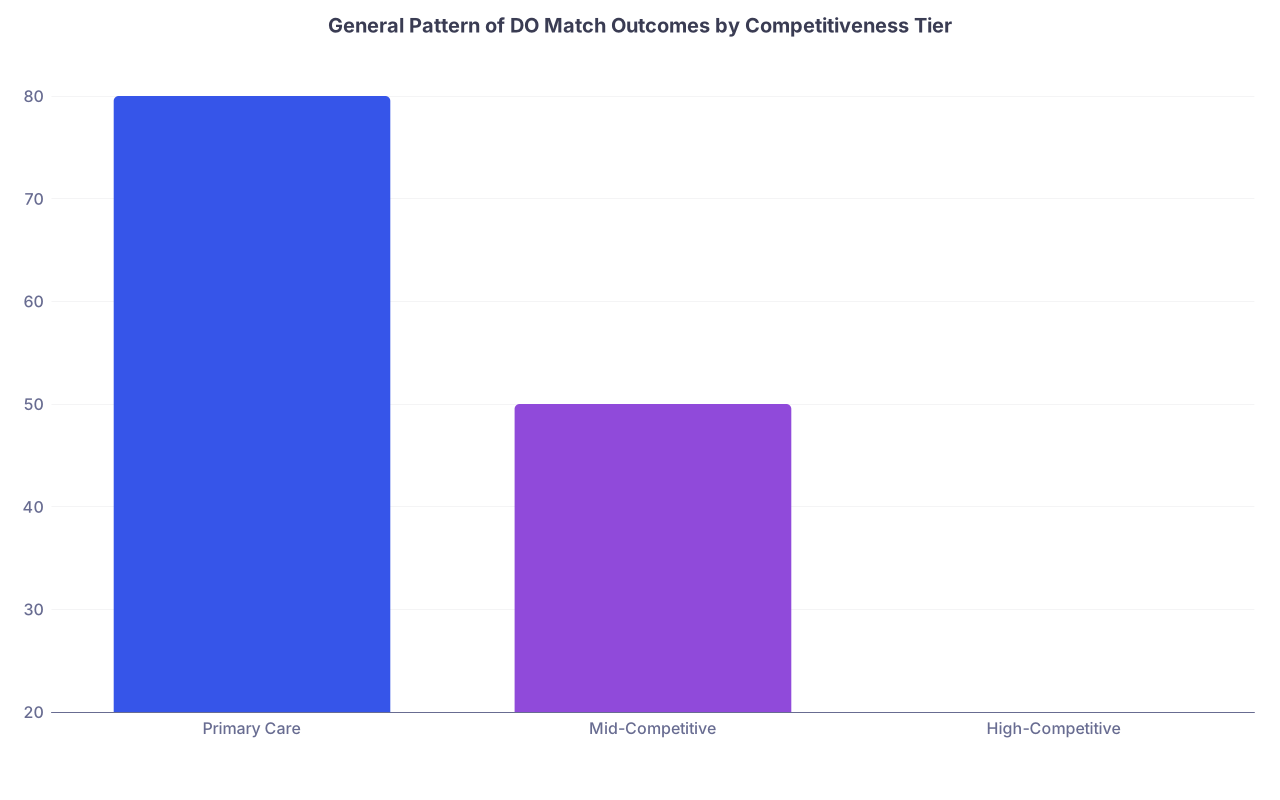
| Category | Value |
|---|---|
| Primary Care | 80 |
| Mid-Competitive | 50 |
| High-Competitive | 20 |
Those aren’t exact numbers, obviously, but that’s the vibe: as a DO, your odds are strong in primary care, decent but more dependent on performance in mid-tier fields, and tight in ultra-competitive ones. Notice something important: not zero.
The difference between DOs who match into their dream-ish specialty and those who feel “stuck” often isn’t the letters after their name. It’s how they responded to those letters.
Grieving the MD Dream Without Getting Stuck There
Nobody really talks about this, but you’re allowed to grieve. To feel sad. To feel like you worked hard and still didn’t get the version of the future you thought you’d have.
What messes people up is not the sadness. It’s the shame about the sadness.
So they:
- Pretend they don’t care.
- Or swing hard in the other direction and say MD is trash and DO is the only “real” holistic medicine.
- Or stay in this middle place: always slightly bitter, always comparing.
You don’t need to perform fake gratitude. You can literally tell yourself:
“Yeah, I wanted MD. I didn’t get it. That hurts. And I’m still going to be a damn good physician anyway.”
If you skip this emotional processing step, you drag the resentment into school, into every exam, into every introduction where you feel compelled to over-explain yourself. That’s exhausting.
It’s okay to say: “This isn’t what I pictured. But it’s not the end of the story. It’s the start of a different one.”
What You Can Do Today So You Don’t Feel Helpless
Let me give you something concrete so this isn’t just abstract pep talk.

If you already have DO acceptances:
- Make a brutally honest pros/cons list of:
- Taking the DO acceptance this cycle
- Reapplying for MD Include money, mental health, timeline, realistic ability to improve. Not just feelings.
- Email or talk to at least one current student at that DO school. Ask about match outcomes, rotations, and how happy they are with their choice.
- If you lean DO, decide now what you might want specialty-wise (it can change!) and identify what kind of performance you’d need to keep that open.
If you’re pre-acceptance and terrified you’ll “only” get DO:
- Be honest with yourself about why MD is so important to you. Prestige? Family? Certain specialty? The answer matters.
- Build a school list that reflects reality, not ego. If your stats fit DO better, include DOs deliberately — not as an afterthought.
And if you’re completely stuck? Do this one small thing:
Write down three specialties or types of patients you could realistically be happy caring for long-term. Then ask yourself: Do those careers actually require MD to be meaningful and fulfilling?
For most people, the answer is no.
FAQs
1. Will patients think I’m a worse doctor because I’m a DO, not an MD?
Most won’t even notice. I’m not being cute — I mean literally, they’re in pain, they’re scared, they’re tired. They care if you listen, explain things, and help them feel better. Some will ask “What’s a DO?” You give a one-sentence answer: “Same training as MDs, plus extra in musculoskeletal and a holistic focus.” Then you move on and treat them well. The respect comes from what you do in the room, not the letters.
2. Am I basically shutting the door on competitive specialties if I go DO?
You’re making the door narrower, not slamming it shut. Derm, ortho, neurosurgery, plastics, ENT — they’re hard for everyone, and harder on average for DOs. That means if you go DO and want those, you need to be brutally high-performing: top scores, strong clinicals, real research, networking, and often strategic audition rotations. Is it harder than from a top MD? Yes. Is it “don’t even bother” impossible? No.
3. If I have a DO acceptance, is it dumb to reapply for MD next year?
It’s only dumb if your plan is “hope things somehow go better.” If you have a concrete way to significantly strengthen your app (big MCAT jump, real research, stronger clinical exposure, better school list strategy), and you can afford the time and emotional cost, then reapplying can make sense. If all you’d be doing is sitting in the same job, writing the same essays, and praying for different results — you’re gambling a guaranteed medical career for pride.
4. Will program directors automatically rank MDs higher than DOs?
Some will favor MDs, especially at old-school academic places and in ultra-competitive fields. That bias still exists. But a lot of PDs care more about: “Will this person work hard, be teachable, not be a problem at 3 a.m., and pass their boards?” Strong DO applicants absolutely get ranked highly — I’ve seen DOs be top residents in their programs. Bias is real, but it’s not absolute. Your job is to make it as hard as possible for someone to dismiss you on paper.
5. If I go DO, should I still try to take USMLE in addition to COMLEX?
If you’re even vaguely considering a specialty or program that skews MD-heavy or competitive, I’d strongly lean yes — assuming you can realistically prep well. Many PDs are more comfortable comparing Step 2 than COMLEX alone. A strong Step 2 score can neutralize a lot of “DO vs MD” noise. But don’t do it halfway. A mediocre USMLE + mediocre COMLEX helps nobody. If you can’t prep properly, then focus on crushing COMLEX and building your application in other ways (research, rotations, letters).
Open a blank page or notes app right now and write this sentence:
“If I go DO, the kind of doctor I become will depend more on what I do in the next 7–10 years than on these two letters.”
Then underneath it, jot down three specific things you’d commit to doing as a DO student to build the future you actually want — not the one random strangers on the internet tell you matters.