It’s 1:17 a.m. Your browser has 19 tabs open: “DO vs MD”, “Can DOs match derm?”, “Are DOs real doctors?”, Reddit threads with way too many opinions, NRMP data tables you don’t fully understand. You’ve half-filled one application to an osteopathic school and now your brain is screaming:
“What if I choose DO… and regret it forever? Is this decision basically permanent?”
Let me just say the scary thing out loud: it can feel like you’re about to lock in your entire future with one checkbox. MD or DO. Door A or Door B. No takebacks.
So you start spiraling:
- What if I decide later I want a super competitive specialty?
- What if residency programs secretly hate DOs even if they say they don’t?
- What if I marry someone who’s MD and I feel “less than” forever?
- What if my parents never really get over it?
I know that headspace. The “I’m about to ruin my life with one slightly-lower-MCAT-fueled decision” panic. Let’s unpack this in a way that’s actually useful, not sugar-coated.
First: Is Choosing DO a Forever Decision?
Short answer: It’s mostly a long-term decision, but not a prison sentence.
Here’s the blunt breakdown.
Things that are basically the same whether you’re DO or MD in the U.S.:
- You’re a fully licensed physician.
- You can prescribe, operate, admit, run a clinic, be an attending.
- You can match into the majority of specialties and residencies.
- Patients mostly don’t know or care about the letters.
Things that feel different and can matter:
- Some hyper-competitive specialties and programs are harder as a DO.
- Certain academic/research-heavy institutions still lean MD.
- Some older physicians and a few programs are weirdly biased.
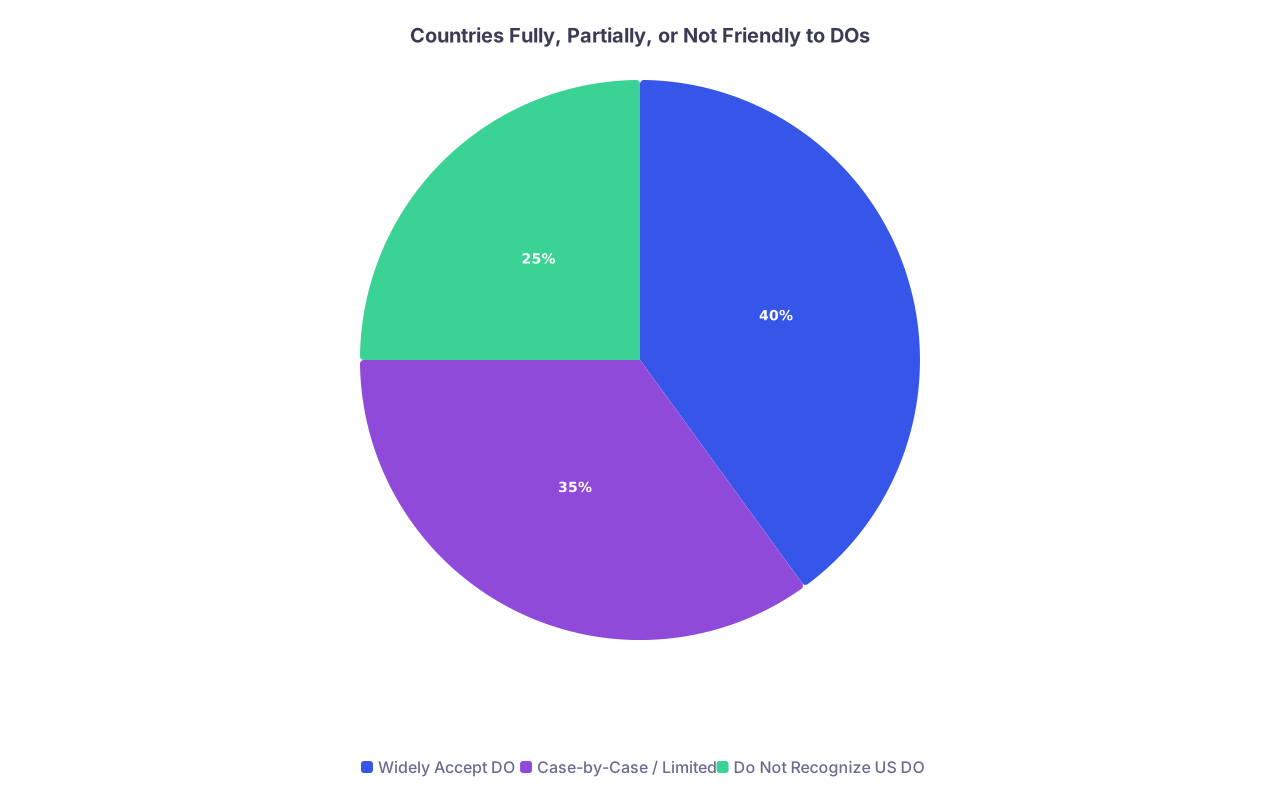
- International recognition can be messier for DOs in some countries.
So is it reversible? Not in the sense of “I’ll just switch to MD later like transferring undergrad majors.” That basically doesn’t happen. There’s no pathway where you complete a DO degree and then magically flip it to an MD. You can’t repeat med school just to change letters. Schools won’t waste a seat on that.
But can you still course-correct within medicine if you choose DO? Yes. With caveats. Let’s break down all the angles you’re probably thinking about at 1 a.m.
Scenario 1: “What If I Want a Competitive Specialty Later?”
This is the big fear, right? You’re fine now with IM, FM, peds… but future you suddenly wants derm, ortho, neurosurg, plastics, ENT, optho, gas at Mass Gen, etc.
Hard truth: being DO makes some doors harder, not impossible.
Here’s roughly how it plays out in real life.
If you’re DO and want something moderately competitive (EM, anesthesia, radiology, PM&R, some surgery programs):
- You need:
- Strong board scores (COMLEX and ideally USMLE Step 2 if still offered when you’re there).
- Solid clinical grades.
- Research or at least some scholarly output in that area.
- Good letters from people in that field.
DO students do this every year. They match. They’re attendings. They’re fine.
If you’re DO and want the top-tier competitive fields (derm, ortho, ENT, neurosurg, plastics):
- Is it impossible? No.
- Is it much harder than as an MD, especially from a big-name school? Yes.
- You’ll probably:
- Need to crush exams.
- Need research. A lot of it. Often at academic places.
- Need away rotations where you prove you’re not just “a DO applicant.”
- Accept that some programs will filter your app out before even reading it.
So here’s the key question I’d ask you if we were sitting in a coffee shop:
Do you want “open as many doors as possible” or “I just want to be a physician and I’d be okay in many specialties”?
If you’re 100% hung up on keeping the path maximally open for derm/ortho/neurosurg at a powerhouse academic center, DO is not your ideal path. Could it still work? Yes. But you’re intentionally adding friction.
If you just want to be a good doctor, and you’d genuinely be okay with things like:
- Internal medicine
- Family med
- Peds
- Psych
- EM
- Anesthesia
- Ob/Gyn
- PM&R
- Neuro, etc.
Then DO is usually not going to “ruin your life.”
Is this reversible later? Kind of. You can:
- Lean into strong USMLE/COMLEX performance.
- Aim for less elitist programs that care more about numbers and performance than letters.
- Adjust your specialty preference once you see who actually shows you interest on the interview trail.
But no, you can’t at 4th year randomly decide “I want Harvard derm” and not feel the DO disadvantage.
Scenario 2: “What If I Just Want To Be MD Later?”
This is where people start Googling “bridge DO to MD program” at 2 a.m.
Reality: there is no standard, legitimate path in the U.S. to “convert” from DO to MD.
Options people fantasize about:
- Doing DO school, then going back to an MD school = no. MD schools are not taking someone who’s already a licensed DO just to redo med school.
- Getting a foreign MD later = you’d then be a foreign medical grad MD in the U.S. system, which can actually be worse than just being a DO here.
- Doing some “dual degree” hack = those don’t really exist in the way people want.
The only real “reversal” path is:
- Decide before starting DO to re-apply MD-only in another cycle.
- Or drop out early in DO, re-apply MD (which also looks weird and risky and doesn’t guarantee anything).
So if your main question is: “Can I do DO now and flip to MD later if I don’t like it?”—then no, assume this part is not reversible. You’re choosing your degree type for life.
Scenario 3: “What If I Regret Not Waiting/Reapplying MD?”
This one hits hard emotionally.
You’re probably thinking:
- “If I wait one more year, maybe I could get an MD.”
- “What if I’m settling because I’m scared of not getting in anywhere?”
- “Will I always feel like I gave up too soon?”
Honestly? I’ve seen all versions of this:
- The person who took the DO acceptance and is now a happy attending who doesn’t care about initials at all.
- The person who took DO, got bitter about doors closed, and complains constantly that they “could’ve done MD.”
- The person who turned down DO, reapplied, got MD, but lost a year or two and still ended up in community IM and realizes it didn’t matter as much as they thought.
- The person who turned down DO, reapplied MD-only, didn’t get in, and now is out of the game completely.
You’re trying to future-proof your feelings. You can’t. But you can reality-check the risks.
If your stats realistically make you a borderline MD applicant and a solid DO applicant, you’re choosing between:
- Certainty of becoming a doctor (DO) sooner
- Gamble on MD later, with:
- More money on extra cycles/apps.
- More emotional toll.
- Non-zero chance you never get in.
Is that gamble right or wrong? Depends on your tolerance for risk and what you’d do if it fails.
And here’s the brutal part people don’t talk about:
Most attendings I’ve seen are too tired, too busy, and too deep into life to romanticize their initials. They care more about:
- Their call schedule.
- Their loan payments.
- Their kids.
- Whether admin is killing their clinic.
The regret I see more often isn’t “I chose DO.”
It’s “I let prestige anxiety run my life.”
Scenario 4: “What About International Work or Moving Abroad?”
This is one area where DO can be messier.
Some countries recognize DO = physician like MD. Others don’t, or they make it bureaucratically painful.
Rough version:
- US DOs are fully physicians here.
- Many countries increasingly accept DOs, especially if you completed ACGME residency.
- But the process can be slower and more annoying vs MD. Some places treat DO differently or require extra verification or may not recognize it fully.
Is this reversible later? Kind of, but not elegantly. Usually the workaround is:
- Do residency/fellowship in the US.
- Get board certified.
- Then apply as a fully trained specialist — which often matters more than your initials.
If your dream life is “I want to easily move/practice in random countries without friction,” MD is safer. If you might want it but it’s not the core of your identity, DO can still work, just with more paperwork headaches.
Scenario 5: “What If I Feel ‘Less Than’ Around MDs Forever?”
This one’s more psychological than logistical. But it’s real.
You’re probably imagining future you:
- In a hospital with MD badge next to DO badge.
- Family flexing to relatives: “My child is an MD” and you’re the “oh, they’re a… DO?” sibling.
- Feeling like you have to prove yourself twice as hard.
Here’s what I’ve actually heard in hospital hallways:
- “She’s a beast of a clinician, I don’t even know where she went to med school.”
- “He’s DO but he outworks everyone.”
- “Honestly the DO residents know MSK better than we do.”
- “He’s an MD from [big name] and still kind of useless on the floor.”
I’ve also heard:
- “Program X doesn’t really look at DOs.”
- “That attending still talks down to DOs.”
So yeah, the bias isn’t 100% gone. But your internal narrative will matter more than theirs.
If you walk in thinking, “I’m lesser,” you will feel it.
If you walk in thinking, “I got here through a slightly different door, but I’m still here,” you’ll be fine.
No degree fixes an inferiority complex. If you chase MD to silence that voice, it often finds a new target:
- Not top-20 MD.
- Not academic enough.
- Not competitive specialty.
- Not big-name fellowship.
You can easily spend your entire life feeling “less than” for something.
What Parts Of This Are Actually Reversible?
Let’s be precise.
Not really reversible:
- DO vs MD initials once you start and finish med school.
- The extra uphill climb for certain hyper-competitive specialties.
- Some international license quirks.
Partly reversible / adjustable:
- What specialty you aim for (you can recalibrate to fields more DO-friendly).
- How academic vs community your career is.
- Where you practice (rural vs urban, big-name vs smaller system).
- Whether you double down on research, teaching, leadership to build your own “brand” beyond DO vs MD.
Totally in your control long-term:
- How competent you become.
- How you treat patients and colleagues.
- How bitter or content you let yourself become about past decisions.
If You’re Still Spiraling: Questions To Ask Yourself
Forget forums for a second. Ask yourself:
- If I never matched derm/ortho/neurosurg, would I still be happy being a doctor?
- If I turn this DO offer down and never get into med school again, can I live with that?
- Am I saying “no” to DO because I truly care about certain career paths, or because my ego hates the idea?
- In 10 years, what will matter more: being a practicing physician, or having those two letters specifically?
No one on the internet can answer these for you. But you need to. Otherwise you’ll second-guess every path.

| Step | Description |
|---|---|
| Step 1 | Have DO Acceptance? |
| Step 2 | Ask: Would I be happy as a doctor in many specialties? |
| Step 3 | Strongly consider taking DO seat |
| Step 4 | Consider reapplying MD-only |
| Step 5 | Wait and strengthen MD app |
| Step 6 | Yes |
| Step 7 | Can you tolerate risk of never getting in? |
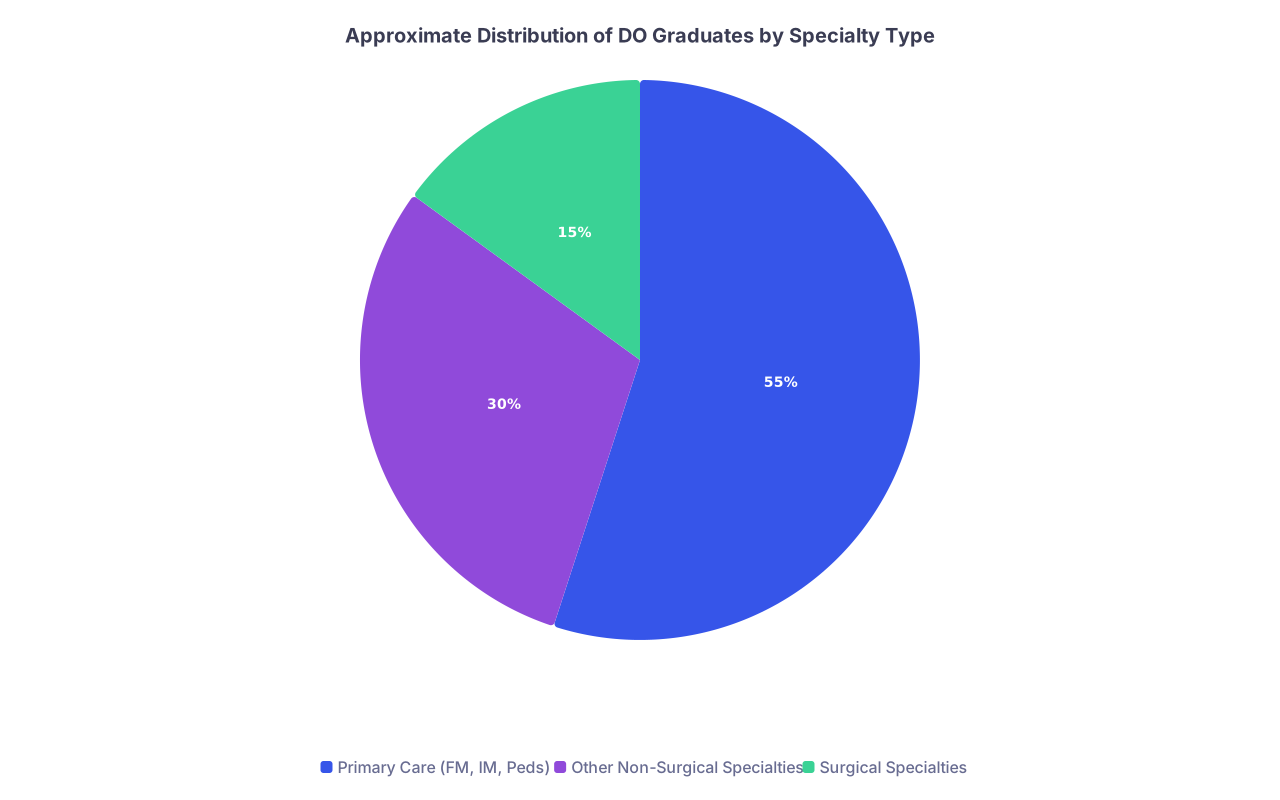
| Category | Value |
|---|---|
| Primary Care (FM, IM, Peds) | 55 |
| Other Non-Surgical Specialties | 30 |
| Surgical Specialties | 15 |

| Area | MD Advantage | DO Disadvantage Level |
|---|---|---|
| Hyper-competitive specialties | Strong | High |
| Academic powerhouse programs | Moderate to strong | Moderate to high |
| Community programs | Mild | Low |
| International mobility | Moderate in some countries | Moderate |
| General US practice rights | Basically none | None |
FAQ (Exactly 4 Questions)
1. Can I transfer from a DO school to an MD school later if I change my mind?
Almost never. MD schools don’t have a standard pathway to accept mid-program transfers from DO schools, and they’re not interested in taking someone who’s already committed to a different degree path just to swap letters. You should assume that once you start a DO program, your terminal degree will be DO, not MD. If the idea of never being MD is unacceptable to you, you need to sort that out before matriculating.
2. Are there specific specialties where I’ll almost certainly feel the DO disadvantage?
Yes. Derm, ortho, neurosurgery, ENT, plastics, and sometimes ophthalmology. That doesn’t mean no DOs match those—some do—but you’ll be fighting an uphill battle: fewer programs willing to look at DOs, more emphasis on research and spotless metrics, and more silent bias. If those fields are your deep, long-term dream and you’re not okay with significantly reduced odds, you should think hard before locking into DO.
3. If I choose DO now, will patients or coworkers think I’m less of a doctor?
Most patients won’t even notice, and many don’t understand the difference. Among coworkers, some older-school physicians or certain programs still carry bias, but day-to-day, people care way more about whether you’re competent and easy to work with than whether your badge says DO or MD. You’ll encounter occasional ignorance or snark, yes. But whether that becomes your identity or just occasional background noise is largely up to you.
4. How do I know if I’ll regret not holding out for MD?
You can’t be 100% sure, but you can pressure-test it. Imagine two futures:
Future A — You took the DO seat, you’re a practicing physician in a decent specialty, maybe not the flashiest, but you have a life, income, and your training is behind you.
Future B — You turned DO down, spent an extra 1–2 years reapplying, maybe got MD, maybe didn’t.
Which regret would sting more: “I might’ve had an MD instead of DO,” or “I might have thrown away my safest route into medicine” if things don’t pan out? The one that scares you more is telling you something about what you actually value.
Years from now, you won’t be up at 1:17 a.m. staring at DO vs MD forums. You’ll be up at 1:17 a.m. because your pager went off, or your kid is sick, or you’re finishing notes after a brutal call. The letters after your name will matter less than you think. How you handled this moment—this messy, anxious, what-if-filled decision—that’s what’ll quietly shape the kind of physician you become.