
It’s late. Your browser has 14 tabs open: “DO vs MD match ortho,” “Can DOs do neurosurgery,” “Dermatology DO match rates,” Reddit threads full of panic. You keep seeing conflicting answers:
“DOs can do anything MDs can!” “Don’t go DO if you want competitive specialties.” “DO is fine if you’re top of your class.”
You’re trying to make one big decision: Should I aim DO or MD if I want ortho, neuro, or derm? And you’re not starting with a 3.9/522. Maybe you’re sitting at:
- 3.3 GPA with a bad freshman year
- 505–510 MCAT
- Or you’re a reapplicant with a prior cycle of MD rejections
You’re not asking “What’s theoretically possible?” You’re asking, “If I start where I am right now, what path actually gives me the best shot at a brutal specialty?”
Let’s treat this like what it is: a strategy problem, not a feelings problem.
1. First Reality Check: What You’re Up Against in Ortho, Neuro, Derm
Before DO vs MD, you need to understand the mountain you’re trying to climb.
Ortho, neurosurgery, and dermatology sit in the “you need to look exceptional” tier. That hasn’t changed with the merger.
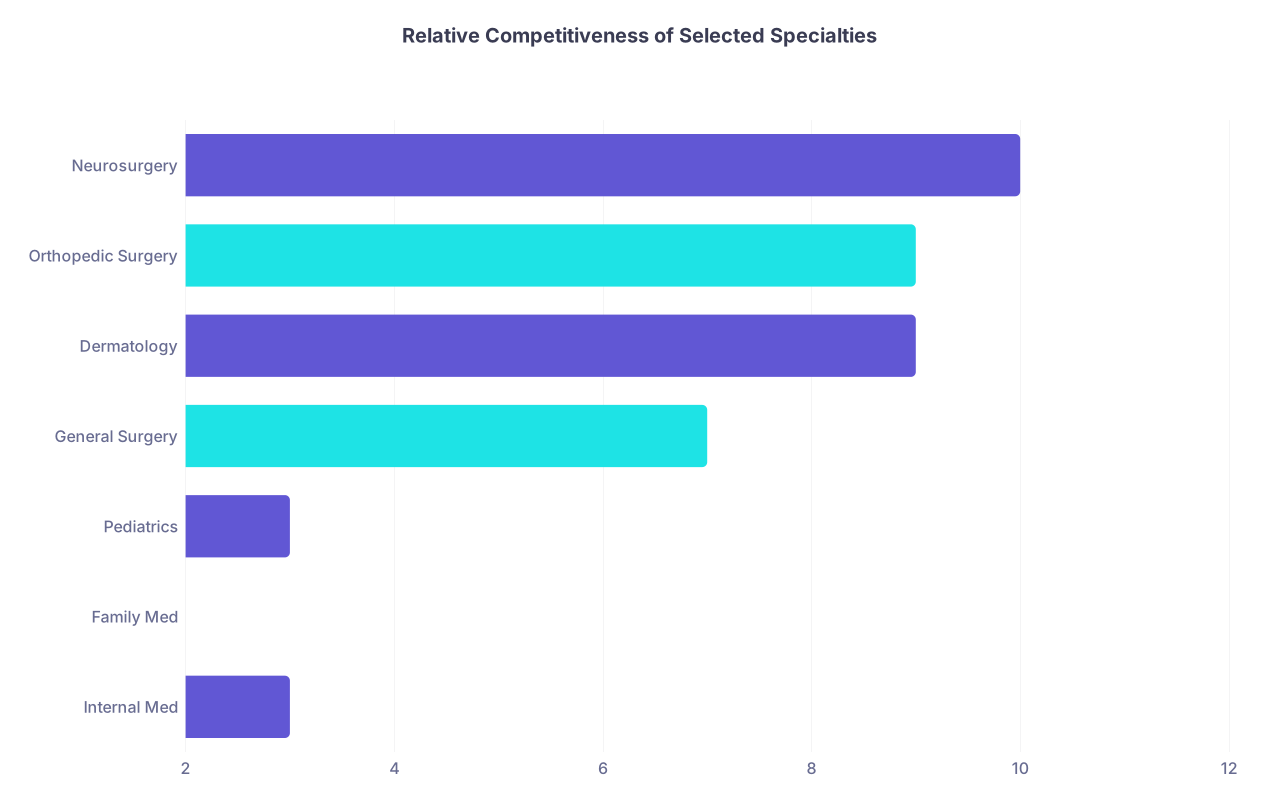
| Category | Value |
|---|---|
| Internal Med | 3 |
| Family Med | 2 |
| Pediatrics | 3 |
| General Surgery | 7 |
| Dermatology | 9 |
| Orthopedic Surgery | 9 |
| Neurosurgery | 10 |
(10 = bloodbath, 1 = almost everyone with a pulse and a license gets in. Rough, not official, but you get the idea.)
What these specialties usually expect from you by the time you apply for residency:
- Top-ish of your class (esp. for DOs)
- Strong board scores (COMLEX and usually USMLE)
- Substantial research (especially neuro and derm)
- Excellent letters from known people in the specialty
- Audition rotations at target programs where you perform well
For DO students, the standards to “break in” are often higher, not lower. You’re proving you’re outstanding despite bias and fewer home programs.
If that sounds discouraging, good. This is not a “manifest your dream” situation. It’s math, timing, and leverage.
2. How Your Starting Point Changes the Equation
There is no universal answer. It depends on where you are right now. Let’s break it into starting scenarios.
Scenario A: Strong Applicant (MD-Competitive Already)
You’re sitting around:
- GPA: 3.7+
- MCAT: 515+
- Solid clinical exposure, some research, decent story
If that’s you and you’re dead set on ortho, neuro, or derm, then my opinion is blunt:
You should prioritize MD.
Why?
- MD schools:
- Have more home programs in competitive fields
- Have stronger research infrastructure on average
- Face less bias from some old-school program directors
Could you go DO and still match competitive? Yes. I’ve seen DOs match derm, ortho, neurosurgery. But when the MD door is clearly open, choosing DO when your goal is a hyper-competitive specialty is just making the game harder.
Plan if you’re Scenario A:
- Apply MD-heavy with a targeted list.
- Add some DO schools as insurance.
- If you only get DO, then re-evaluate (we’ll cover that later).
Scenario B: Borderline MD / Strong DO Candidate
You’re somewhere like:
- GPA: 3.4–3.6
- MCAT: 507–512
- Upward trend, but not amazing
MD is possible, but not “I’m getting in somewhere for sure.” DO schools will likely be more welcoming, especially if you have strong clinical and a story.
Here’s where it gets tricky.
If you truly want ortho, neuro, or derm, and you go DO, your path becomes:
- Be top 10–20% of your DO school
- Crush COMLEX (and usually USMLE Step 1 and 2)
- Build research and specialty connections early
- Plan for away rotations strategically
Still doable. But the margin for error is razor thin.
If you go MD (mid-tier or lower-tier), your path is:
- Still need high boards and class rank
- But slightly more institutional support and less systemic bias
- Often more research access and home specialty departments
For Scenario B, here’s my honest recommendation:
- Apply broadly MD + DO your first cycle.
- If you get any MD acceptance and you’re serious about competitive specialties, take it.
- If you get only DO, don’t panic—but go in with your eyes wide open and a ruthless plan.
Scenario C: Weak for MD, Reasonable for DO
You’re here:
- GPA: 3.0–3.3 (maybe with an SMP or post-bacc rescue)
- MCAT: 498–506
- MD reapplicant or big academic recovery story
Can you apply MD? Sure. Will it be high-yield? Probably not.
If you start med school from this position, here’s the truth: your #1 mission is to become a physician. Not a neurosurgeon. Not a dermatologist. A physician.
When you’re this far from MD-competitive, choosing DO is often the only actual medical school door. That door is worth a lot.
But then what about ortho/neuro/derm?
Here’s the harsh reality I’ve seen:
DO students who came in as “rescued” applicants with borderline stats very rarely end up in those top-3 competitive specialties. Some do. Most don’t. Not for lack of desire. Because:
- They’re already behind academically
- They’re spending energy just passing exams and adapting
- The curves are brutal; being top of class is harder
So for Scenario C, if you go DO:
- Assume you are likely heading for IM, FM, EM, anesthesia, psych, peds, etc.
- If you crush med school and new data changes things, great—you can pivot up.
- But don’t go DO telling yourself, “I’ll definitely do derm” from this starting point. That’s fantasy, not planning.
3. MD vs DO for Ortho, Neuro, Derm: Structural Differences That Matter
Ignore the feel-good “same license” talk for a minute. On paper, yes, DO and MD have the same legal practice rights. In practice, some differences still affect competitive matches.
3.1 Program distribution and home advantage
- Many academic derm/neurosurg programs are at MD-heavy institutions.
- Ortho has more DO-friendly programs historically, but those slots are limited and also getting more competitive.
Having a home program matters. It gives you:
- Easier research access
- Home rotations
- Letters from known faculty
- A default place to audition
Many DO schools:
- Have fewer or no home programs in derm or neurosurg.
- Or they’re affiliated with community hospitals with less research weight.
3.2 Research environment
Derm and neurosurgery especially are research-heavy. If your school has:
- NIH funding
- Dedicated neurosurgeons or dermatologists on faculty
- Ongoing clinical trials
…your life is much easier.
Some DO schools have this. Many don’t. Many MD schools do. Not all, but more.
3.3 Perception and bias
Is bias against DOs decreasing? Yes.
Is it gone? No.
I’ve heard faculty literally say in rank meetings:
- “This DO applicant is great, but look at the MD pile.”
- “If we take a DO this year, they have to be absolutely stellar.”
That doesn’t mean it’s hopeless. It means you’re competing with a handicap in some programs.
4. Flowchart: What To Do From Where You Are Right Now
Let’s map this as a decision process.
This looks simple, but the sticking point is emotional: people romanticize derm/ortho/neuro and underestimate how fast their priorities change once they’re drowning in anatomy and trying to pass their first block exam.
5. If You Go DO and Still Want a Shot: How to Play It
Let’s say you either chose DO or that was your only acceptance. You still want one of those three. Then your mindset must be: I have to be an outlier.
Here’s what that actually looks like, step by step.
5.1 Before matriculation (you’re not in yet, but accepted DO)
Use your pre-matriculation year to:
- Fix any bad habits now. Weak study skills will destroy you.
- Learn how to use Anki and question banks effectively.
- Start light reading on how COMLEX and USMLE work.
- If possible, connect with upperclassmen at your school who matched competitive spots. Ask exactly what they did.
5.2 M1–M2: Academic dominance and early specialty alignment
Your goals these first 2 years as a DO student who wants derm/ortho/neuro:
Be near the top of your class.
- That means your priority isn’t hobbies, side hustles, or extra degrees.
- It’s exams. Then boards.
Prep for both COMLEX and USMLE (if the climate at the time you’re reading this still strongly favors USMLE for competitive programs—varies year by year).
- Use resources that cover both (UFAPS-type combo, check current best).
- Target above-average, ideally high scores.
Find a mentor in your target specialty early.
- Cold email faculty at affiliated hospitals.
- Ask upperclassmen who matched where they did research.
Start research by late M1 or early M2.
- Doesn’t have to be basic science. Case reports, chart reviews, retrospective studies count.
- Aim for something that will result in a poster or publication before M4.
5.3 M3: Clinical performance and specialty exposure
During M3:
Crush core rotations. Honors/High Pass as often as possible.
Ask to rotate at sites with your target specialty.
Get on the radar of:
- Ortho: busy volume centers, sports med attendings, joint replacement folks
- Neuro: any neurosurgeon or neurology department with neurosurg overlap
- Derm: outpatient derm clinics and academic derm groups
Ask explicitly for letters from people who know you and are known in the field.
5.4 M4: Audition rotations and reality check
In 4th year:
Do away rotations at programs that:
- Actually take DOs
- Have taken DOs in the last few years (look at resident lists)
On those rotations:
- Be early, prepared, normal to work with
- Ask for feedback and adjust
- Secure at least 1–2 strong specialty letters
Parallel to this, you need to reassess honestly:
- Are your boards strong enough?
- Are your letters glowing or generic?
- Did your mentor say, “You’re competitive,” or “Maybe we need a backup plan?”
If the numbers aren’t there, you pivot—probably to something like anesthesia, PM&R, IM with subspecialty, or EM, depending on your clinical strengths.
6. If You Go MD and Want to Maximize Your Edge
If you land in an MD program, especially one with home ortho/neuro/derm, your to-do list is similar but the environment is a bit more favorable.
Your edge:
- More structured research
- More built-in specialty exposure
- Less default skepticism from some program directors
Your job:
- Same academic excellence expectations
- Use your home department aggressively:
- Research with them
- Shadow
- Attend conferences
- Get known by faculty early
The MD degree doesn’t save you from being mediocre. I’ve seen MD students with average scores and minimal research fail to match derm while a DO with monster scores and multiple papers did.
7. Some Hard Lines I’d Draw (My Actual Opinions)
Let me be direct.
I would NOT:
- Go DO with a 3.1/500 and tell myself I’m “definitely” going into derm. You’re setting yourself up for pain.
- Turn down a solid MD acceptance (even at a lower-tier school) to wait and reapply in hopes of a “better name” for ortho/derm. Once you’re in, you can perform.
- Obsess over specialty as a premed when you haven’t passed a single medical school exam yet.
I WOULD:
- Take the MD if you have any MD acceptance and you’re serious about ortho, neuro, or derm.
- Choose DO without regret if it’s your shot at becoming a physician, and keep the door cracked for competitive fields by overperforming from day 1.
- Allow your specialty choice to evolve once you’ve met real patients and seen real rotations.
8. Quick Comparisons: DO vs MD If You Want Ortho, Neuro, or Derm
| Factor | MD School | DO School |
|---|---|---|
| Baseline bias | Lower in most competitive programs | Higher in some programs; must stand out more |
| Home derm/ortho/neuro programs | More common | Less common, depends heavily on school |
| Research infrastructure | Often stronger | Variable; some strong, many limited |
| Need to take USMLE | Often expected but changing over time | Frequently expected for top competitive specialties |
| Typical bar for competitiveness | High, but institutional support helps | Very high; usually need top class rank + strong boards |
9. What You Should Actually Do This Week
Stop doom-scrolling vague Reddit answers. Here’s what you can do right now, based on your phase:
If you haven’t applied yet:
- Write down your current cGPA, sGPA, and MCAT.
- Categorize yourself: Strong / Borderline / Weak for MD.
- Build a school list with appropriate MD/DO ratios based on that.
If you already have acceptances:
- Put your options in a table: MD vs DO, location, home programs, research.
- If you have any MD, ask: “Am I serious enough about these specialties to take this MD even if it’s not my dream school?”
- 90% of the time, the answer should be yes.
If you’re already DO and early in school:
- Identify 1–2 faculty in your desired specialty and email them this week.
- Start a structured board prep plan.
- Decide if you’re truly willing to live the “top 10–20% or bust” lifestyle for the next few years.
FAQ (Exactly 5 Questions)
1. Can a DO realistically match into derm, ortho, or neurosurgery today?
Yes, but “realistically” means: top of the class, excellent COMLEX (and often USMLE) scores, research in the specialty, strong letters, and smart away rotations. It’s not impossible. It’s just not common. You need to assume you have to outperform the average MD applicant.
2. If I know I want one of those three specialties, should I refuse a DO acceptance and reapply MD?
If you’re reasonably competitive for MD (e.g., 3.6+/510+ and your application weaknesses are fixable), maybe it’s worth one more MD-focused cycle. If you’re sitting at 3.2/502 and got a DO acceptance, declining it to chase MD is usually reckless. You’re risking no acceptance at all for a specialty goal you might abandon by M3.
3. Do I absolutely need to take USMLE as a DO for these specialties?
Right now, in most competitive programs, yes or strongly yes. Some programs are getting more comfortable with COMLEX-only, but many still want USMLE for comparison. This could change over time, but if you’re aiming high, plan as if you will need USMLE until multiple mentors in that specialty tell you otherwise.
4. Is it better to go to a low-tier MD or a strong DO program for a competitive specialty?
For ortho/neuro/derm, I’d still lean low-tier MD in most cases, because of institutional bias and more research/home program access. There are a few DO schools with strong ortho and some derm footprints; if you have a specific DO school with a proven track record and mentorship, that can be competitive. But as a default, low-tier MD gives you a slightly better starting field to play on.
5. What if I start DO thinking I’ll do derm, then realize I’m not top of my class?
Then you pivot early. Talk to mentors. Look at fields that keep parts of what you liked:
- Derm → consider allergy/immunology (via IM or peds), rheumatology, or outpatient-heavy IM/FM with procedural clinics.
- Ortho → consider PM&R, sports medicine (via FM or IM), or anesthesia with pain.
- Neurosurg → consider neurology, interventional neurology, or radiology.
You’re not “settling for garbage.” You’re picking from a lot of good options that still pay well and offer real satisfaction.
Action step for today:
Write your actual current stats (GPA, sGPA, MCAT) at the top of a page. Underneath, list 3 columns: “MD Path,” “DO Path,” and “No Acceptance.” Sketch out what your next two years look like under each. Seeing it on paper will force you to stop thinking in vague “maybe I’ll just get derm” terms and start making real, grounded decisions.