
The biggest mistake reapplicants make is clinging to MD-only dreams long after the data says it is time to pivot.
If you’ve already been rejected from MD programs and you’re trying to decide whether to go hard on DO, you’re not dealing with a “preference” question. You’re dealing with a risk management problem. And the clock is not your friend.
Let me walk through when you should seriously pivot to DO, when you still have a realistic MD shot, and what an actual, concrete plan looks like if you’re sitting on one or more MD rejection cycles.
Step 1: Get Real About Your Current Profile (No Fantasy Versions Allowed)
You cannot decide MD vs DO until you face your actual numbers and history, not your “if I just had one more year” fantasy.
Here’s the brutal framework I use with reapplicants:
- Number of cycles you’ve already applied MD
- Your cGPA and sGPA
- Your MCAT attempts and best score
- Your state of residence
- Whether you have any acceptances/waitlists, or just rejections
- Major red flags (institutional actions, poor trends, >3 MCATs, etc.)
Now let’s put rough data around it.
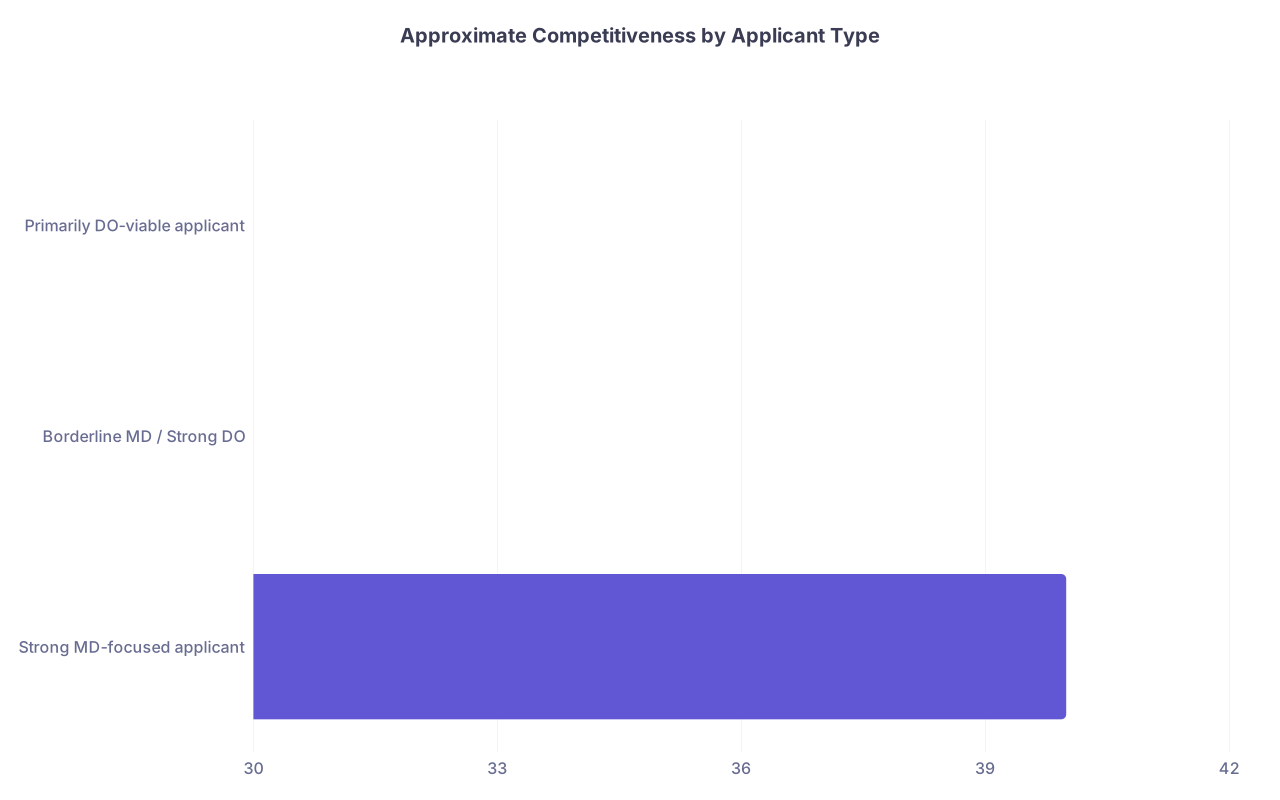
| Category | Value |
|---|---|
| Strong MD-focused applicant | 40 |
| Borderline MD / Strong DO | 30 |
| Primarily DO-viable applicant | 30 |
That’s not exact AAMC data; it’s how I’d roughly categorize reapplicants I see:
- “Strong MD-focused” = can aim primarily MD with DO as backup
- “Borderline MD / Strong DO” = should apply both, not MD-only
- “Primarily DO-viable” = should be DO-focused with maybe a small MD list
Quick Reality Checks
Use these as hard lines, not suggestions.
If ANY of these are true and you’ve already had 1 unsuccessful MD cycle, you should be strongly considering DO now:
- cGPA < 3.4 OR sGPA < 3.3, and you’re already graduated
- MCAT best score ≤ 508 after 2 attempts
- You are on your 2nd or 3rd full MD rejection cycle (no A’s, maybe a WL at best)
- You’re from a highly competitive state (CA, NY, MA, NJ, etc.) with mid stats
- You have institutional actions / professionalism issues and nothing stellar to offset them
If you hit multiple bullets above and are still applying MD-only, that’s not strategy. That’s denial.
Step 2: Identify Which Bucket You’re Actually In
I’ll break this into realistic profiles I’ve seen over and over. Find yourself and follow the advice. No sugarcoating.
Profile A: First MD Cycle Rejection, Stats Close to MD Median
Example:
- cGPA: 3.6, sGPA: 3.5
- MCAT: 514 (one attempt)
- Decent clinical, okay shadowing, light research
- Applied to 18 MD schools, no DO, late secondaries, a bit of a bland story
What this usually means: You’re not an automatic DO pivot. You’re an under-optimized MD applicant.
What to do next cycle:
- Fix the application process before assuming you’re not MD-viable:
- Apply earlier (June submission, July secondaries done)
- Expand your MD list (30–35 schools) with more mid-tier/private and your state schools
- Add 10–15 DO schools as insurance
- Strengthen 1–2 clear weaknesses (e.g., very little longitudinal clinical work, generic activities, weak letters)
When to seriously pivot to DO:
- If you run a second well-optimized MD-heavy cycle (broader list, early, stronger narrative) and still get nothing but rejections/interview silence, the third cycle should be DO-focused with some MD sprinkled in, not the other way around.
Profile B: Reapplicant, Mid-3 GPA, Sub-510 MCAT
Example:
- cGPA: 3.35, sGPA: 3.25, downward trend early, slight improvement
- MCAT: 505 and then 508
- 2 full MD cycles, both with only a couple of interviews and no acceptances
- Mostly mid-tier MD schools, few or no DO applications
This is the classic “you should’ve pivoted a cycle ago” situation.
For MD admissions, this profile is fighting upstream:
- Your GPAs are on the low end for MD (especially sGPA)
- Your MCAT is serviceable but not compensating for the GPA
- You’ve already shown the committee your ceiling twice
In this scenario, a smart, serious pivot to DO should look like:
- DO-heavy list: 15–20 DO schools minimum
- MD applications only to:
- Your in-state MD schools (especially lower to mid-tier publics)
- A small handful (3–5) of mid-low tier MDs historically more friendly to reinvention
If you insist on “one more MD-only cycle” with that profile, you’re just burning money, time, and emotional reserves.
Step 3: Understand the Real Differences That Actually Matter for Your Decision
DO vs MD is not Coke vs Pepsi. It’s closer to “slightly different doors into mostly the same building, but one door is more guarded.”
You should know these differences, but don’t exaggerate them:
Residency Competitiveness
- Some hyper-competitive specialties and certain academic institutions still lean MD.
- But for core fields (FM, IM, peds, psych, EM, many surgical prelims), strong DOs match perfectly well.
- The real bottlenecks now: board scores, clinical grades, letters, research for competitive fields.
Geographic Bias
- A small number of top academic centers are still quietly biased toward MD.
- If your dream is faculty at MGH or Hopkins in a niche specialty straight out of training, DO adds friction. Not impossible, but harder.
Training & Day-to-Day Practice
- Patients do not care about MD vs DO nearly as much as premeds think.
- Your life satisfaction will depend infinitely more on specialty, location, schedule, and call burden than those two letters.
Where I draw a hard line:
- If your profile is weak for any medical school, and you are not from a highly-connected, wealthy background, it’s irresponsible to gamble multiple cycles on MD-only while ignoring perfectly good DO paths.
Step 4: Timelines – How Many MD Rejections Before a Serious DO Pivot?
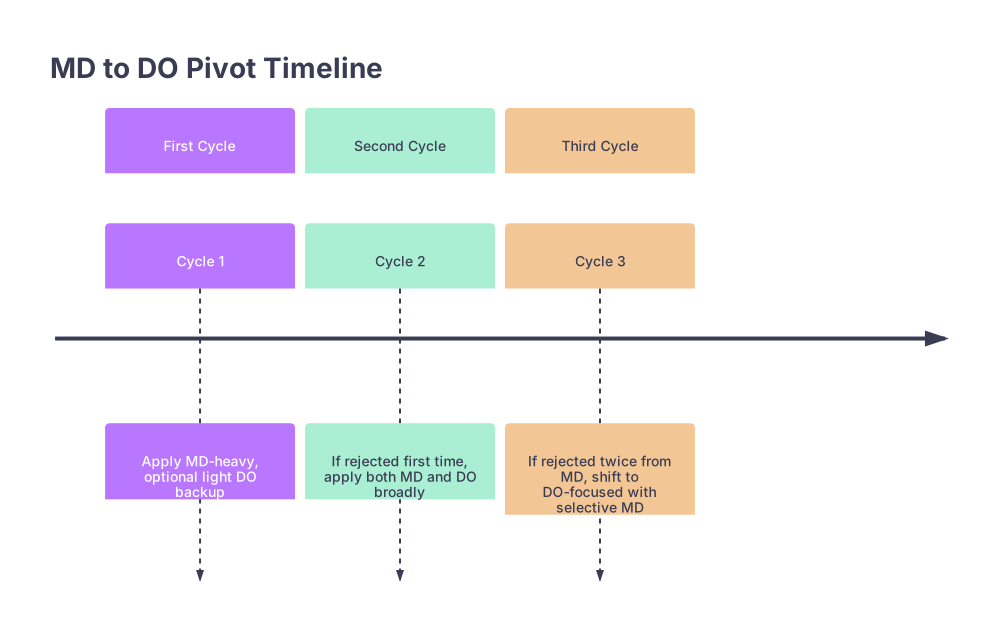
Here’s the simple timeline I wish more people followed:
| Period | Event |
|---|---|
| First Cycle - Cycle 1 | Apply MD-heavy, optional light DO backup |
| Second Cycle - Cycle 2 | If rejected first time, apply both MD and DO broadly |
| Third Cycle - Cycle 3 | If rejected twice from MD, shift to DO-focused with selective MD |
Translate that:
Cycle 1 (first-ever application year)
- MD-focused if your stats justify it.
- Optional DO backup depending on GPA/MCAT.
Cycle 2 (first reapplication)
- If fully rejected first time, default should be both MD and DO, not MD-only.
- Only exception: you dramatically changed your stats (big GPA repair program, huge MCAT jump) and your first application was a mess (super late, terrible school list, weak essays).
Cycle 3 (second reapplication)
- If you’ve taken two real swings at MD and walked away empty both times, the third swing should be:
- DO-focused with
- MD as a side bet, not the main play.
- If you’ve taken two real swings at MD and walked away empty both times, the third swing should be:
If you are on Cycle 3 or 4 and still refusing DO purely for ego, that’s not ambition. That’s self-sabotage.
Step 5: How to Build a DO-Focused Plan Without Burning Bridges
Let’s say you accept the pivot. Good. Now you need a method, not vibes.
1. Fix your story as a reapplicant
MD and DO schools both hate lazy reapplications. You must answer one question clearly across your app:
“What is meaningfully different now?”
That can be:
- A formal post-bacc / SMP with strong A’s in upper-division sciences
- A higher MCAT (ideally 3–4+ point jump)
- Significant, longitudinal clinical / community service that reshapes your story
- Improved maturity, insight, and letters (letters matter more than you think)
2. Target DO schools strategically, not randomly
Some DO schools are more reapplicant-friendly and more stats-flexible. Others are quietly competitive.
Common mistakes:
- Applying to only flashy, newer DO schools with “good locations” (TX, CA, FL) while ignoring solid but less glamorous options (e.g., KYCOM, WVSOM, LECOM campuses, etc.).
- Ignoring mission fit: rural focus, primary care focus, underserved focus. Schools actually mean that in DO-land.
3. Decide how many MD schools (if any) to keep
Use this rule-of-thumb:
If your best MCAT is ≥ 510 AND cGPA ≥ 3.5, and you’ve clearly improved since last app:
- You can keep 10–15 MD schools (state + reasonable mid-tier) while still being DO-heavy.
If your best MCAT is 505–509 and cGPA ≤ 3.4 after graduation:
- You’re primarily DO.
- Keep maybe 3–6 MD schools (state, mission-fit, more holistic) if you must. No more.
Step 6: Special Situations Where You Should Pivot Even Faster
There are a few situations where I tell people to go DO-heavy now, even if they’ve only done one MD cycle.
Situation 1: You’re older (late 20s / 30s) and already used 1–2 cycles
If you’re:
- 27–30+
- Two degrees in, in a non-clinical job, and you’ve already burned one MD cycle with no interviews or acceptances…
You do not have infinite time. Every reapplication pushes your training, your income, your family plans further out.
In this case, even with OK stats, I usually recommend:
- Apply MD and DO together
- But be mentally prepared and fully accepting of starting at a DO school next year.
- Stop gambling on “perfect MD” when the cost is literally years of your life.
Situation 2: GPA is structurally low and hard to fix
If your cGPA is in the low 3.2–3.3 range and you’ve already taken a ton of credits, a DIY post-bacc might bump you to 3.3–3.4 if you crush it. That’s still rough for MD, especially as a reapplicant.
DO schools have grade replacement historically (less so now with AACOMAS changes, but they’re still more forgiving about academic redemption). MD schools are much less forgiving once you’re several years and cycles in.
If your transcript is a mess but your last 40–60 credits are A/A-, DO should be seriously on the table early.
Situation 3: Multiple MCAT attempts with a low ceiling
If you’re on:
- 3rd MCAT attempt and plateaued at 505–508
- Or you’ve gone 502 → 505 → 506
MD programs read that as: “This is likely their testing ceiling.”
In that scenario, your best-case MD odds are slim unless you have something ridiculously strong elsewhere. DO schools will still take that narrative seriously if your GPA, clinical experience, and letters are solid.
Step 7: Ego, Family Expectations, and the “MD or Nothing” Trap
Let’s be honest. A lot of people stay stuck chasing MD-only because of:
- Parents who only know “MD” from their country of origin
- Friends who matched MD and are posting white coat photos
- Their own idea of what “top doctor” looks like on paper
Here’s the blunt version:
In 15 years, your patients will not care, your paycheck will not care, and your burnout level will not care whether you went to an MD or DO school. They’ll care if you’re competent and present.
You know what will care? How many years you spent in limbo reapplying, retaking MCAT, and explaining to your aunt why you still aren’t in medical school.
If your actual dream is to be a physician — not just win a label contest — then a strong DO path beats a fantasy MD path every single time.
Step 8: If You’re Deciding Right Now for the Upcoming Cycle
Here’s the “you’re in this situation today, what do you do this week” version.
You are:
- A prior MD reapplicant with no acceptance
- Deciding whether to add DO this upcoming cycle
Run this checklist:
- Have I already applied MD at least once with a reasonably broad list (20+ schools) and on-time secondaries?
- Are my stats clearly below the 50th percentile of most MD matriculants (GPA and/or MCAT)?
- Has anything dramatic changed since last cycle (huge MCAT jump, SMP with 3.8+, major new leadership/clinical story)?
- Am I willing to risk another entire year with no acceptance just to keep the MD label pure?
If:
- You answer “yes” to 1 and 2, and “no” to 3 → you add DO now.
- You hesitate on 4 because of ego or external pressure → you add DO especially now.
Do not wait for some imaginary perfect future version of yourself that magically becomes MD-competitive without major structural changes. That version rarely shows up.
FAQ (Exactly 3 Questions)
1. If I pivot to DO, should I completely stop applying MD?
Not necessarily. What you should stop doing is acting like you’re a primarily MD-viable applicant if two cycles and your stats say otherwise. For many reapplicants, the smart move is DO-focused with a small MD list (state schools, realistic mid-tiers, places aligned with your story). But if your GPA and MCAT are borderline and you’ve already re-applied, DO should be your main path, not your backup fantasy.
2. Will going DO close the door on competitive specialties forever?
No. It makes them harder, not impossible. A DO student with top board scores, strong clinical evaluations, research, and good networking can still reach competitive fields, especially if they’re flexible about geography and specific programs. But if your profile is already struggling just to get into medical school, banking on a hyper-competitive specialty is not a rational plan whether you go MD or DO. Focus first on getting in, then on being top-tier wherever you land.
3. Should I do an SMP or post-bacc first instead of pivoting to DO?
Only if you’re confident you can absolutely crush it (3.7–3.8+ in rigorous, graduate-level or upper-division science) and you have a clear plan for fixing your MCAT if needed. SMPs are expensive, risky, and not a magic MD ticket, especially for reapplicants with multiple weaker cycles. For many reapplicants with mid-3 GPAs and sub-510 MCATs, a direct, well-planned DO application is safer, cheaper, and more likely to actually get you into medical school than gambling more time and money on an SMP hoping for MD.
Bottom line:
- After one full MD rejection, you should be seriously considering DO.
- After two full MD rejections without big changes, you should be seriously pivoting to DO.
- Your actual goal is becoming a physician, not winning a letters contest. Make your strategy match that reality.