Out-of-State Applicant Eyeing DO vs. MD: Handling Residency and Tuition Issues
What do you actually do if your best acceptances are out-of-state DO schools with lower stats, but your long-term dream is a competitive MD-type residency… and you’re staring at $70k/year OOS tuition?
This is a messy, real situation. Not theoretical. I’ve watched people blow six figures because they panicked, and I’ve watched others make very calculated “non-prestige” choices that set them up perfectly.
Let’s walk through what you do if you’re:
- An out-of-state premed
- Debating DO vs MD
- Worried about both residency options and insane OOS tuition
I’m assuming you’re not choosing between Harvard and PCOM. You’re probably looking at something like:
- OOS DO: tuition $55–70k, low chance of in-state reclassification
- OOS MD (mid-tier or your state’s MD where you didn’t get in) not available… yet
- MCAT/GPA are borderline for MD this cycle, decent for DO
You’re trying to decide: Do I jump on a DO OOS now and eat the cost / risk, or do I regroup for a stronger MD shot (or cheaper DO scenario) later?
Step 1: Get Honest About What You Actually Want Long-Term
Before talking tuition, you need to be brutally clear about your real target.
Three buckets:
- You just want to be a physician; you’re flexible on specialty.
- You want a fairly competitive specialty (roughly: EM, Anesthesia, Gas, maybe Heme/Onc, GI, etc.).
- You’re locked on something brutal: Derm, Ortho, ENT, Ophtho, Plastics, IR, etc.
If you’re in bucket 1, the DO vs MD argument is much more forgiving. Out-of-state DO with higher tuition might still make sense if:
- You’re okay with FM, IM, Psych, Peds, maybe Gas/EM if you crush boards and performance.
- You’re willing to live in less competitive markets for residency (Midwest, South, certain community programs).
If you’re in bucket 3, going to a random high-debt OOS DO and hoping to “gun for derm later” is frankly reckless. Yes, a tiny fraction succeed. But most of those people had:
- Top-class rankings
- Massive research
- High Step 2 scores
- Heavy networking, often at strong academic centers
You cannot plan your entire financial life around a path that requires you to be the 1%.
So first decision point:
- If you’re bucket 1: DO vs MD is more a cost and geography question.
- If you’re bucket 2 or 3: DO vs MD is strategy and ceiling plus cost.
Step 2: Understand Residency Reality as a DO vs MD (Post-2020)
The match is now “single accreditation.” But it’s not a single playing field.
Here’s the blunt version:
- MDs, on average, still place more smoothly into competitive residencies and academic programs.
- DOs match very well into primary care and many community programs, and an increasing but still smaller share into academic/competitive specialties.
- Bias hasn’t disappeared; it’s just softened.
But I’ve seen DOs match into:
- EM at solid university programs
- Anesthesia at academic centers
- IM, then Cards/Heme-Onc from DO-friendly academic IM residencies
The pattern is consistent: the DOs who do this are very intentional. They do not just “see what happens.”
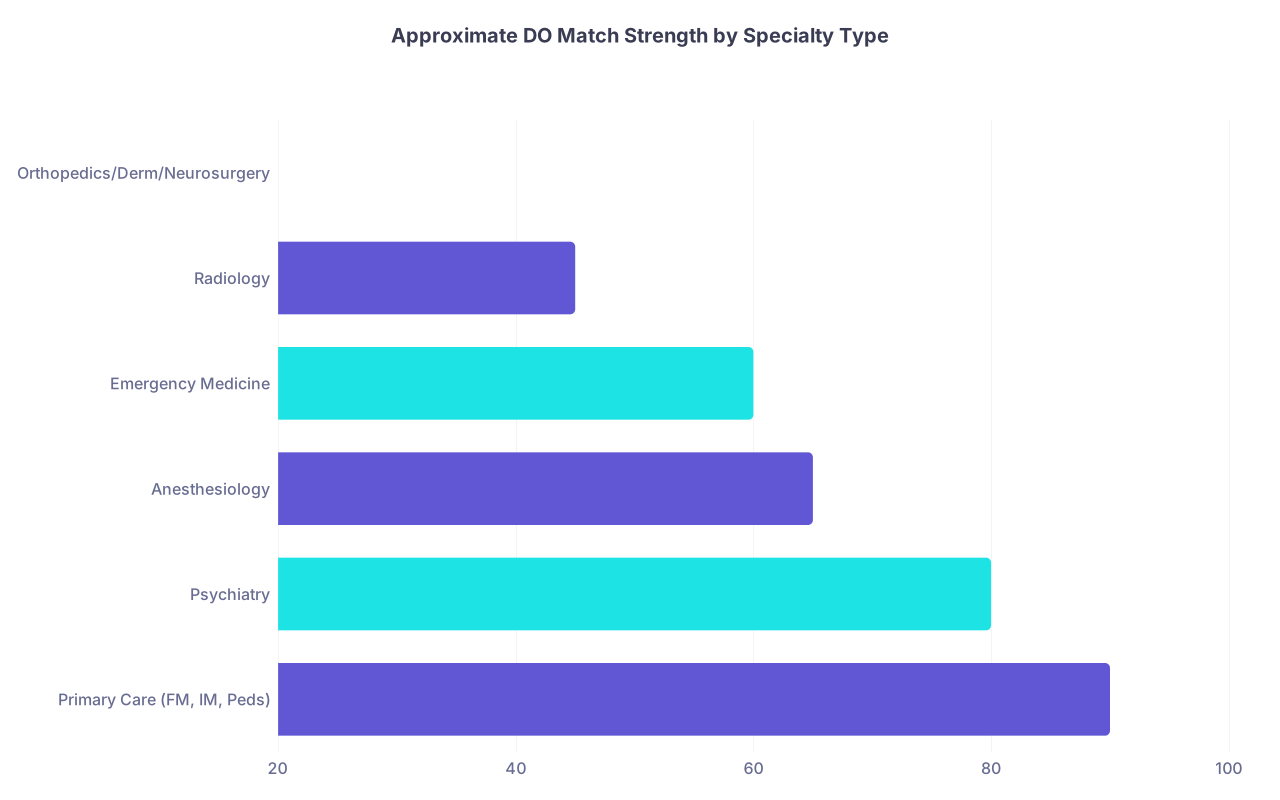
| Category | Value |
|---|---|
| Primary Care (FM, IM, Peds) | 90 |
| Psychiatry | 80 |
| Anesthesiology | 65 |
| Emergency Medicine | 60 |
| Radiology | 45 |
| Orthopedics/Derm/Neurosurgery | 20 |
(Those are illustrative, not literal NRMP numbers, but the relative pattern is real.)
If you go DO and you care about competitive residencies, your life becomes:
- Step 2 (since Step 1 is P/F) becomes critical.
- Class rank and clerkship performance matter a lot.
- You’ll probably need research, ideally at an MD-affiliated place.
- You’ll have to be more proactive in networking and audition rotations.
If this already sounds exhausting, you should not casually pay $280k+ tuition for an OOS DO slot.
Step 3: The Tuition Landmine – OOS at DO vs MD
Let’s talk money like adults.
Many OOS DO schools are:
- Private, high tuition, no in-state discount ever
- Or public, but with extremely limited or delayed in-state reclassification, and only for “real” residents (not people who moved there solely for school)
You need to stop guessing and confirm three things with each school directly:
- Is in-state reclassification possible at all?
- If yes, what percentage of out-of-state students successfully do it?
- When does it kick in (Year 2, 3, 4) and what exactly does it save you?
Call or email financial aid and ask exactly that. Don’t take Reddit as gospel.
| School Type | Year 1 Tuition (OOS) | Years 2–4 (If IS) | Total 4-Year Tuition |
|---|---|---|---|
| Private DO (no IS) | $62,000 | $62,000 each | ~$248,000 |
| Public DO (IS Year 2–4) | $60,000 | $40,000 each | ~$180,000 |
| Public MD (your state) | $42,000 | $42,000 each | ~$168,000 |
Now add living costs, interest, and realize that $70k/year OOS vs $45k/year IS over 4 years can easily become a $150k+ real difference with interest over your career.
Bottom line: Paying insane OOS tuition at a DO can still make sense, but only if:
- You’ve tried at least 1–2 cycles aiming for MD and/or cheaper DO with an improved application,
- Or you’re older / career-changer and time is now a bigger factor than money,
- Or your family financial situation is unusually strong and debt isn’t choking your future.
Everyone else? You at least owe yourself the math and a serious conversation about reapplying.
Step 4: Should You Reapply Instead of Taking the OOS DO Now?
This is the part people avoid because it’s uncomfortable. But this is the crossroads.
You consider reapplying if:
- Your GPA is fixed but competitive (say 3.5+),
- Your MCAT is clearly below what you could hit with focused prep (e.g., 503 with sloppy prep, practice tests in the 509–512 range),
- You applied late or poorly (too few schools, weak personal statement, no tailoring, late primary/secondaries).
You probably should not reapply if:
- You have a weak GPA (e.g., 3.1 science) with no realistic path to meaningful repair,
- Your MCAT is already reflective of maxed-out ability after multiple serious attempts (e.g., three tries, all 503–505),
- You’re already older (30+), with family obligations and a strong acceptance in hand.
But here’s the key: don’t just “reapply.” Rebuilding your app has to be intentional.
That means:
- Fixing the MCAT (retake only if you can realistically improve ≥3–4 points).
- Adding meaningful clinical hours (not just 30 hours of shadowing).
- Better school list strategy: heavy on your state MDs, DOs with more reasonable cost structures, and some regionals where your stats are on target.
Step 5: How DO vs MD Interacts with “Where You Want to End Up”
You’re OOS now. Where do you want to be for residency and beyond?
Programs are lazy. They draw heavily from:
- Local medical schools
- Local students who rotate in their hospitals
- Regional affiliations
If you attend a DO school in, say, rural Missouri, and your dream is to build a life and a highly competitive residency spot in Boston… you can do it, but you’re swimming upstream.
I’ve seen this pattern play out:
- Student attends OOS DO in the Midwest.
- Wants East Coast academic IM → Cards.
- They:
- Do summer research at an East Coast academic center.
- Arrange 2–3 away rotations at East Coast institutions / DO-friendly academic IM programs.
- Crush Step 2.
- End up matching IM at a decent East Coast program, then fellowship.
Doable. But note the deliberate steps.

| Step | Description |
|---|---|
| Step 1 | Start at OOS DO School |
| Step 2 | Excel in Preclinical Years |
| Step 3 | High Step 2 Score |
| Step 4 | Summer Research in Target Region |
| Step 5 | Away Rotations in Target Region |
| Step 6 | Strong Letters from Regional Faculty |
| Step 7 | Rank DO-friendly Regional Programs |
| Step 8 | Match in Preferred Region |
If you don’t want to live your entire training like a long-distance relationship with your desired region, then region should matter now, at the school choice stage.
You want to practice in:
The state you grew up in?
→ Strong argument to reapply and gun hard for your state MD, or at least a DO in that region that places well locally.A specific city (e.g., Seattle, San Diego, Boston)?
→ Try to train there as early as possible. If that’s not available for med school, you need to strategically plan rotations and research there.
Step 6: Concrete Scenarios and What I’d Do in Each
Let’s get specific.
Scenario A: 23-year-old, 3.65 GPA, 505 MCAT, OOS DO at $68k/year
Wants: “Maybe EM or Anesthesia, but open.” No MD acceptances. Applied somewhat late, MCAT rushed.
What I’d recommend:
- Strongly consider reapplying.
- Spend 1–2 years:
- MCAT retake → aim 509–512 with serious prep.
- Clinical job (scribe, MA, EMT).
- Apply early and broadly to:
- Your state MD(s)
- Reasonable DOs with non-insane tuition or IS chance
- A few out-of-region MDs where your improved stats are viable
Taking the $68k OOS DO now locks you into massive debt for a path where you don’t even know your specialty yet. Too early to mortgage the house.
Scenario B: 28-year-old career changer, 3.4 GPA, 508 MCAT, OOS DO $58k/year
Wants: IM or FM, flexible on region, just wants to practice medicine before 35. Already tried one MD-heavy cycle, no MD II’s, multiple DO interviews.
What I’d recommend:
- Accept the DO if:
- Debt is unpleasant but survivable with income-based repayment.
- You’re not obsessed with hyper-competitive specialties.
- Try to confirm whether any tuition relief or IS classification is possible. Even $5–10k/year helps.
- Plan early for strong board prep and solid clinical performance to keep options open (e.g., Cards, Hospitalist, etc.).
Here, the time-value of getting started probably outweighs the dream of a cheaper or MD option that may never come.
Scenario C: 24-year-old, 3.8 GPA, 507 MCAT, OOS mid-tier MD waitlist, OOS DO acceptance
Wants: Ortho or maybe EM. Strong extracurriculars, only took MCAT once, obviously underperformed relative to GPA.
What I’d recommend:
- If you’re serious about Ortho or similarly competitive, don’t casually lock into a random high-debt DO.
- I’d lean:
- Take 1 year, fix MCAT (510+), reapply early.
- If still no MD, then re-evaluate DO options, ideally with a school that has some track record of matching into your target specialties or reasonable cost.
You’re giving up a strong MD ceiling too easily here if you just grab the first DO seat.
Step 7: Tactical Questions to Ask Every DO and MD Program You’re Considering
If you’re in this OOS DO vs MD limbo, here’s what I’d actually ask schools (by email or at second look):
For DO schools:
- “What percentage of your graduates match into ACGME-accredited residencies in the last 3 years?”
- “Do you have a match list available by specialty and program?”
- “How common is it for out-of-state students to gain in-state tuition, and when?”
For any school:
- “Where do most of your grads end up regionally?”
- “Which specialties did your students match into over the last 2–3 years?”
- “Do students commonly do away rotations at [region you care about]? Any institutional connections there?”
If a DO school dodges these questions or only sends vague marketing fluff, that’s a flag. You’re about to give them $200–300k. You’re allowed to demand real data.
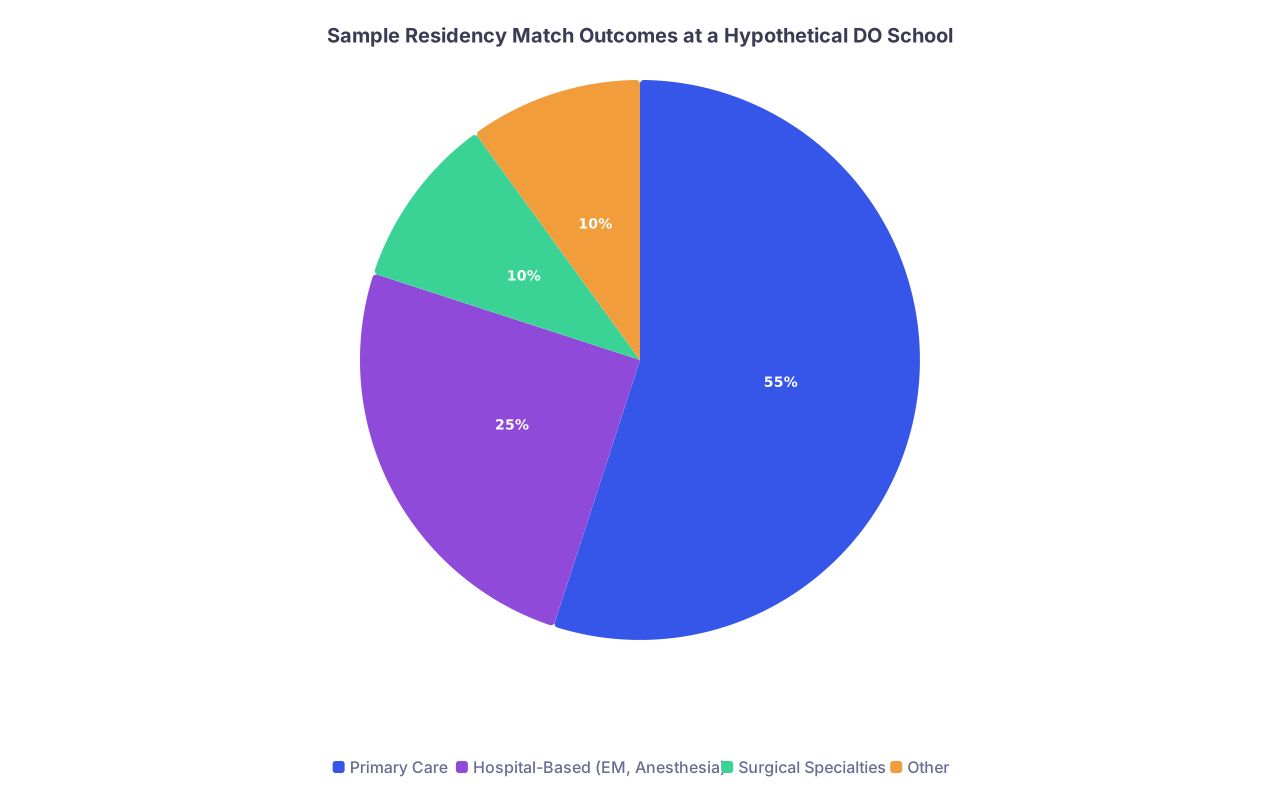
| Category | Value |
|---|---|
| Primary Care | 55 |
| Hospital-Based (EM, Anesthesia) | 25 |
| Surgical Specialties | 10 |
| Other | 10 |
Step 8: Realistic Debt and Lifestyle Conversation
This part is boring but it decides how trapped you’ll feel at 35.
Rough mental math:
- High OOS DO tuition total cost (tuition + living + interest): easily $350–450k by repayment time.
- A more affordable in-state MD/DO: maybe $250–320k.
That $100k+ gap, with interest, can be:
- A down payment on a house.
- The difference between feeling forced into a high-paying specialty or location vs choosing more freely.
- Multiple years of actual financial breathing room.
If you’re okay with primary care or hospitalist work, high debt is still doable, but it may:
- Force you into higher RVU / high-volume jobs early.
- Delay major life decisions (kids, home buying, etc.).
If your family’s financial support or scholarships substantially offset that, fine. Most don’t have that. Don’t pretend you do.
Step 9: How to Decide in 1–2 Weeks if You Have a Pending Deadline
Let’s say your OOS DO deposit deadline is in 10 days. No MD acceptance yet. You’re stuck.
Here’s how I’d triage:
Write on paper:
- Specialty: “I’d be okay with ____.”
- Region: “I’d like to end up roughly here: ____.”
- Age now vs age starting if you reapply.
Get real match data from the DO school:
- Recent match lists, not cherry-picked brag slides.
- DO grads going into your interest area? Into your region?
Run a simple loan calculator:
- Estimate total borrowed vs expected attending salary in your most likely specialty.
- See payback timelines under standard vs income-based repayment.
Ask: “If I reapply with an improved MCAT and a better application, do I actually have a plausible shot at lower-cost MD or DO options?”
- If yes, reapplying is not crazy.
- If no, and you really want to be a physician, then you’re probably taking that DO seat, negotiating costs however you can, and planning carefully for residency.

FAQs
1. As an out-of-state applicant, is DO always worse than MD for getting a good residency?
No. It’s not “always worse,” but the path is more constrained. If you want primary care or mid-competitive fields and you perform strongly (Step 2, clinical grades, letters), DO can get you a very good residency. For the most competitive specialties and top academic programs, MD still has a clear structural advantage. The real question is whether your goals and work ethic line up with what it takes as a DO.
2. Can I move to a state, establish residency, and then apply to that state’s MD or DO schools as in-state?
Sometimes, but this is heavily state-specific and people misunderstand it constantly. Many states require 1–2 years of real residence with tax filing, employment, and no full-time student status before you count as in-state for med school. You need to check each state’s and each school’s policies—not just the general university rules. If your whole “plan” hinges on magically becoming in-state somewhere, verify it in writing with admissions or residency/records offices.
3. If I start at an expensive OOS DO, can I transfer later to a cheaper MD or DO school?
Very unlikely. Transfers between med schools are rare and usually reserved for extreme circumstances (school closure, spouse relocation, etc.), often only between LCME-accredited MD schools. DO-to-MD transfers are practically nonexistent. You should assume that where you start is where you finish. Don’t enroll expecting to “switch later” to fix tuition or prestige issues.
Key points to hold onto:
- Don’t ignore tuition. High OOS DO cost vs realistic future salary matters just as much as DO vs MD letters.
- Match outcomes are not magic; they’re patterns. Look at each school’s actual data and see if it aligns with your goals.
- If you can realistically improve your application and target better-cost MD or DO options, reapplying is often smarter than grabbing the first expensive OOS DO seat out of fear.