
The idea that choosing DO means “settling” is lazy, outdated thinking—and it’s holding a lot of nontraditional applicants hostage.
If you’re a nontraditional premed with lower stats, here’s the truth: using DO schools strategically can be the difference between becoming a physician and endlessly “reapplying next cycle.” And you can do it without selling yourself short—if you stop chasing someone else’s idea of prestige and start playing your actual hand well.
This isn’t theory. I’ve watched:
- A 31-year-old former teacher (3.3 GPA, 503 MCAT) get into multiple DO schools and end up a chief resident in IM.
- A 28-year-old EMT with a 2.9 → 3.2 upward-trend GPA and a 505 MCAT match EM from a DO program.
- A mom of two with a 3.1 cGPA, 3.6 post-bacc, 502 MCAT land DO, then match OB/GYN.
Same pattern every time: once they stopped obsessing over MD-only and started seeing DO as a different pathway to the same job—not a demotion—their entire strategy changed. And they got in.
Let’s walk through how you should think and what you should do if this is you.
1. Get Real About Where You Actually Stand
You can’t plan if you won’t look at the numbers.
If you’re nontraditional with “lower stats,” that generally means something like:
- cGPA under ~3.5
- sGPA under ~3.4
- MCAT under ~510
- Or big red flags like F’s, withdrawals, long gaps, career changes, or old coursework
Now look at how those numbers usually play out.
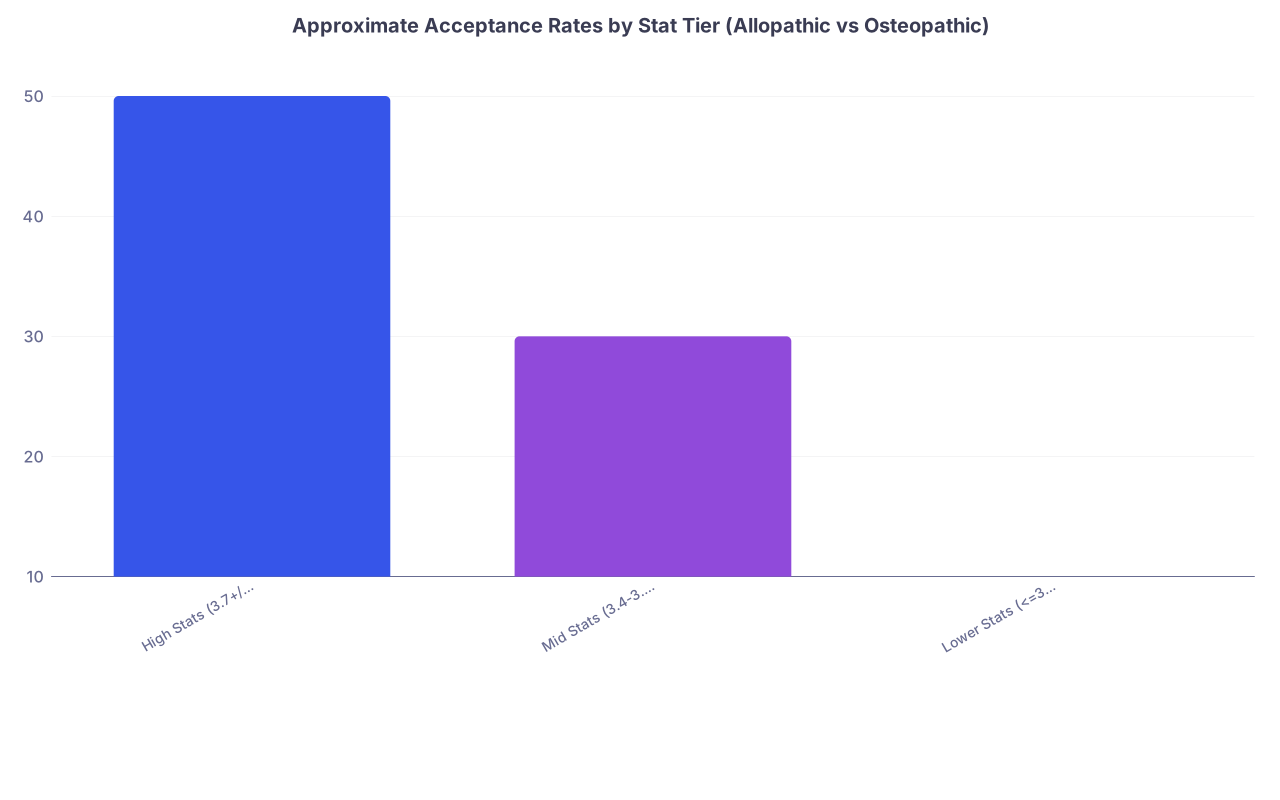
| Category | Value |
|---|---|
| High Stats (3.7+/515+) | 50 |
| Mid Stats (3.4-3.69/507-514) | 30 |
| Lower Stats (<=3.39/506 or below) | 10 |
That last bar is where most nontrad, low-stat applicants live. Ten percent-ish. Sometimes less if you apply badly.
Here’s the part people don’t like to admit:
- If you’re in your late 20s, 30s, or older
- You’ve got family, bills, or a career you can’t stall forever
- You’re not pulling a 520+ MCAT and redoing your entire GPA
…then chasing only MD schools at the edge of your stats range can be a 2–4 year detour to nowhere.
You’re not a college sophomore with unlimited attempts. Your time costs more now.
So you have to make a decision like an adult, not like a Reddit commenter:
Do you want to optimize for letters (MD vs DO) or optimize for actually becoming a physician?
If the answer is “I want to be a doctor, I have constraints, and I’m not a 518/3.9 candidate,” then DO schools are not your backup. They’re your primary strategic weapon.
2. Understand DO vs MD in 2026 Terms, Not 1995 Myths
Old myths will wreck your decision-making. Let’s kill a few quickly.
Myth 1: DO can’t match competitive specialties.
Wrong. It’s harder. Not impossible. The gap is narrowing, but it still exists. The more competitive the specialty (derm, plastics, ortho, ENT, some surgical subs), the more MD-heavy it is. But for:
- Internal Medicine
- Family Medicine
- Pediatrics
- Psychiatry
- PM&R
- Emergency Medicine (yes, EM is chaotic right now, but still)
- OB/GYN and even some surgical fields in the right conditions
A strong DO applicant is competitive.
Myth 2: DOs are seen as “lesser” in hospitals.
Occasionally you’ll meet an older attending with that attitude. They’re fading out. On the ground, what matters is: are you competent, prepared, and not a disaster on call? Residents know who can carry a list. Patients rarely care about the letters.
Myth 3: DO schools are “easier to get into, easier to get through.”
The first part is partially true—stat thresholds are generally lower. But the training is not soft. You’ll see patients, work 80-hour weeks, take call, cram for boards, and get yelled at in the OR just like MD students.
The difference is more about who they’re willing to bet on. DO schools tend to like:
- Nontraditional, career-changer profiles
- Upward trend after a rough start
- People with lots of real-world experience and maturity
They’re built to absorb people like you.
3. “Using DO Schools” Without Settling: The Mindset Shift
Here’s what “using DO schools without settling” actually means:
- You make a rational call that, given your stats and life stage, DO gives you the highest probability of becoming a physician.
- You still apply with intention. You don’t just shotgun every DO school and hope.
- You refuse to mentally downgrade yourself. You train, network, and hustle like someone who’s aiming high—because you are.
Think of it this way:
You’re choosing a more realistic entry point into the profession, not a lower ceiling for your career.
The ceiling is set later, by:
- Your board scores (COMLEX and often USMLE Step 2)
- Your clinical evaluations
- Your letters of recommendation
- Your research and networking
- How early and strategically you target programs
You control most of that. What you don’t fully control is whether MD schools will forgive a 3.1 GPA from ten years ago. DO schools are more willing.
4. Concrete Strategy: If You’re Applying in the Next 1–2 Cycles
You’re not here for philosophy. You’re asking: “What do I do this year?” Here’s the playbook.
Step 1: Decide if you need an academic repair year first
Ask yourself, honestly:
- Is your cGPA under ~3.2?
- Is your sGPA under ~3.0?
- Do you have a lot of C-/D/F grades in recent (last 3–5 years) science courses?
- Is your MCAT under 500?
If yes to one or more, you probably need one of these before applying:
- A post-bacc with A/A- science work
- Targeted upper-level sciences at a local university (not CC at this point, if avoidable)
- A serious MCAT retake with a structured plan
You want to walk into DO admissions looking like this:
- Upward-trending GPA, especially last 30–40 credits
- MCAT at least 500–505+ (ideally higher)
- Evidence you can handle full-time academic load now, not 8 years ago
Step 2: Build a DO-targeted school list (not random)
Most people apply dumb: 25 schools with no pattern. You should be the opposite.
| Bin Type | Example Criteria | Notes |
|---|---|---|
| Safer DO Schools | MCAT medians 502–506, GPA medians 3.3–3.5 | Strong focus here |
| Mid-Range DO Schools | MCAT medians 506–509, GPA 3.4–3.6 | Add where you align with mission |
| Reach DO Schools | MCAT medians 510+, GPA 3.6+ | Only if something in your app stands out |
You want:
- 60–70% of your list in the safer DO bin
- 20–30% in mid-range DO
- Maybe 0–3 reach DO and a small curated MD list if you can justify it (upward trend, strong MCAT, strong story)
Then go deeper than stats. Look at:
- Mission focus: rural, primary care, underserved?
- Regional ties: where you’ve lived, worked, have family
- Clinical rotation sites: hospital systems you’d actually want to train in
- Newer schools: more risk, but sometimes more open-minded about stats
Step 3: Rewrite your personal statement for DO reality
If you’re applying DO-heavy, your personal statement cannot read like you slapped “osteopathic” into an MD essay.
You need three layers:
Why medicine at all? Your core story—illness in family, years in EMS, career plateau, etc. This has to be specific and lived, not generic.
Why now as a nontraditional? Explain the delay without sounding like you’re making excuses. Example:
- “I spent five years in education leadership, but the part of my job that mattered most was directly supporting students’ health and crises. Over time that pull towards clinical work became impossible to ignore.”
Why DO specifically? Not: “I like holistic care and treating the whole person.” That’s brochure language, and every MD school says the same thing. Instead:
- A concrete osteopathic experience (shadowing a DO, OMM clinic, DO mentor)
- Specific aspects of DO philosophy that fit your life and history
Example angle:
“As a physical therapist, I’ve spent years working with patients whose back pain wasn’t just structural—it was psychological, social, and economic. What drew me to osteopathic medicine was seeing a DO physician in our clinic integrate manipulative treatment with that broader context instead of rushing to imaging or narcotics. That approach aligns closely with how I’ve already been working with patients.”
That’s not “settling.” That’s alignment.
5. Crafting Your DO School Secondaries Like a Nontraditional, Not a College Kid
Here’s where nontrad applicants either shine or implode.
DO schools love:
- Evidence of maturity
- Real jobs with responsibility
- Leadership outside formal clubs
- Actual understanding of osteopathic practice
You should be mining your real life for examples, not wishing you had more “premed club” stories.
Common DO secondary themes and how you answer them as a nontrad:
“Why osteopathic medicine?”
Tie a real patient or experience to an osteopathic concept: structure-function, mind-body-spirit, prevention, continuity. Name the DO(s) you’ve shadowed and what they do differently, in detail.“Describe a challenge or failure.”
Don’t hide your nontraditional bumps. Own them. Low early GPA, career pivot, burnout, divorce, financial strain—then show concrete growth, not vague “I learned resilience.”“How will you add to our class?”
Stop pretending you’re 21. You add:- Perspective from another career
- Comfort with difficult conversations (from teaching, EMS, social work, etc.)
- Experience juggling real-world responsibilities
“Demonstrate your understanding of our mission.”
If a DO school is heavy on primary care and underserved, talk about your track record in those settings, not your “interest.” Free clinic, FQHC, community mental health, rural rotations, etc.
6. Planning Now for Your Future Match as a DO Student
If you’re worried about residency as a DO, good. You should be. But don’t let that fear paralyze you—use it to plan.
Here’s what strong DO students who match well usually have in common:
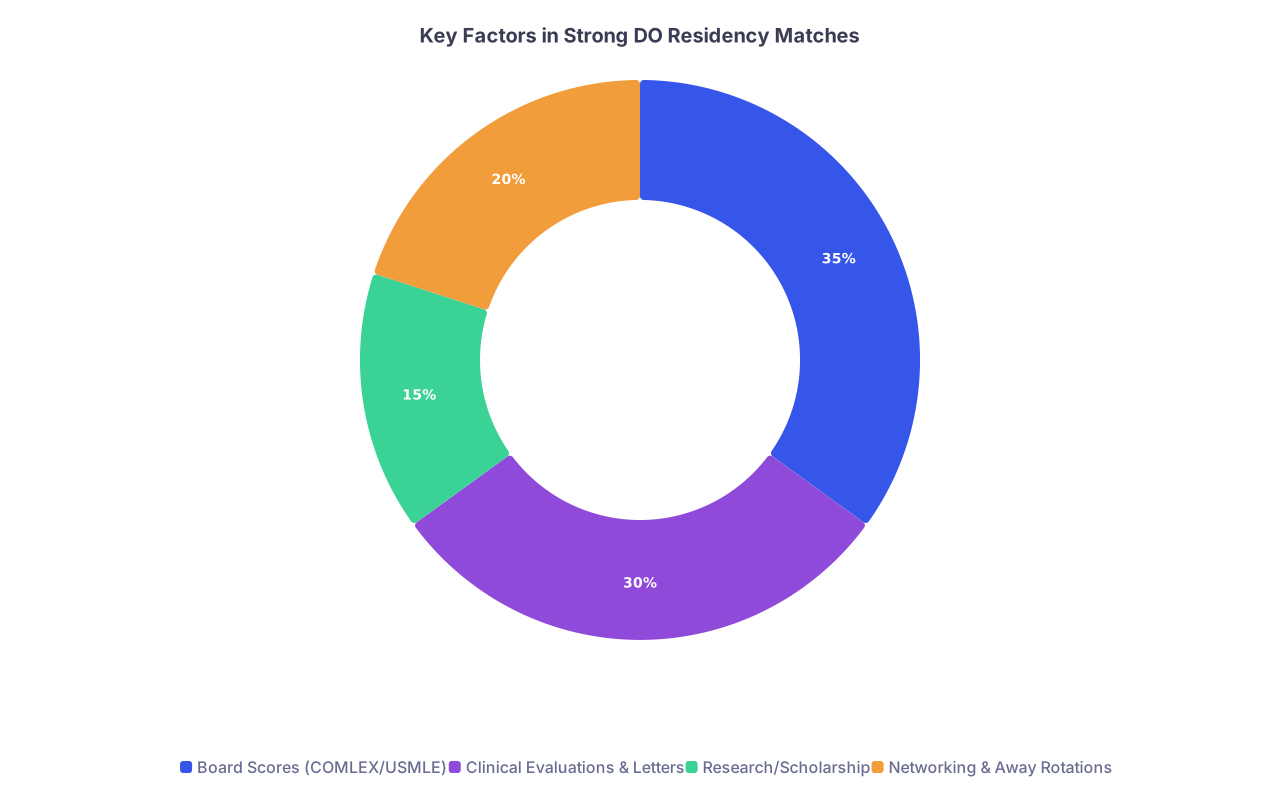
| Category | Value |
|---|---|
| Board Scores (COMLEX/USMLE) | 35 |
| Clinical Evaluations & Letters | 30 |
| Research/Scholarship | 15 |
| Networking & Away Rotations | 20 |
If you’re applying to DO schools now, you should already be thinking:
- Am I willing to take USMLE Step 2 in addition to COMLEX to be competitive at more programs?
- Can I see myself doing research or at least some scholarly activity during school?
- Do I understand that as a DO aiming for a competitive specialty, I’ll likely need aways and networking?
That doesn’t mean you must aim for derm. It means you stop treating DO as “well, if I get in, everything else will magically work out.” No. You’ll still need a plan.
If you lean PM&R, psych, FM, IM, EM, OB/GYN—great. These are highly reachable from DO. But they’re not automatic. Your nontraditional discipline can be an advantage here, because you’re already used to planning long-term.
7. What If You Still Want Some MD Schools on the List?
Fine. I’m not anti-MD. I’m anti-self-delusion.
Here’s when it makes sense to include a small MD list as a nontrad with lower stats:
- Your overall GPA is low-ish (say 3.2–3.4), but your recent 40–60 credits in a post-bacc or master’s are 3.8+ in hard sciences.
- Your MCAT is 508–512+.
- You have strong, clear nontraditional experiences that align with certain MD schools’ missions (rural, older students, community-focused, etc.).
- You’re realistic: you know your MD chances are slim, and you will be satisfied—and proud—going DO.
Target MD schools that:
- Are in your home state
- Explicitly mention nontraditional or older students
- Have slightly lower median stats
- Emphasize primary care or underserved work if that aligns with you
But again: DO should be your core strategy, not something you “throw in just in case.”
8. Emotional Side: Letting Go of Ego Without Lowering Your Standards
I’ve seen this sink people more than the numbers.
Pattern looks like this:
- 29-year-old applicant, 3.3 GPA, 505 MCAT
- Refuses to apply DO first cycle: “I’ll just try MD this time and see what happens”
- Applies to 25 MDs, 3 DOs as an afterthought
- Ends with 0 II, 0 acceptances, $4–6k gone
- Now they’re 30, burnt out, questioning everything
That year was wasted because of ego. Not strategy.
Here’s the reframe that works:
- You’re not lowering your ambition. You’re choosing a better-fit doorway into the same profession.
- Once you have “DO” after your name and an active medical license, almost nothing about your daily life will hinge on those two letters instead of “MD.”
- Your kids, spouse, parents, and patients will not care. At all. They’ll care whether you’re actually there and not perpetually “reapplying next cycle.”
If prestige is your primary driver, medicine might not be the best field anyway. The prestige fades mid-residency when you’re exhausted and living in scrubs.
9. Step-by-Step: What You Should Do This Month
Let me be very literal for a second. If you’re a nontraditional, lower-stat premed seriously considering DO, here’s your next 30–60 days:
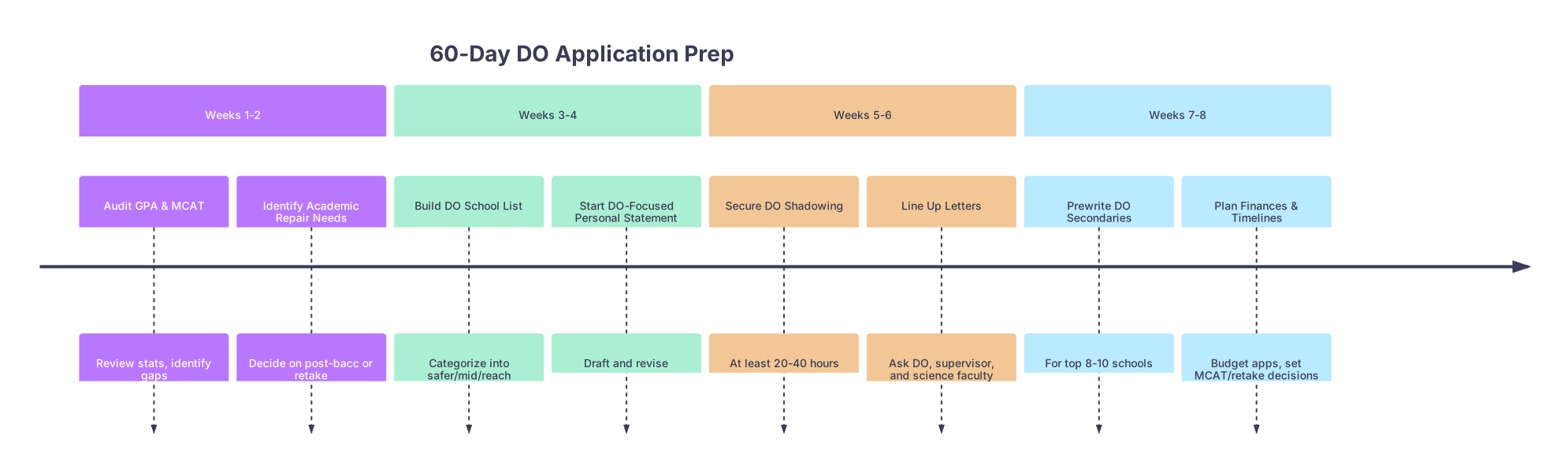
| Period | Event |
|---|---|
| Weeks 1-2 - Audit GPA & MCAT | Review stats, identify gaps |
| Weeks 1-2 - Identify Academic Repair Needs | Decide on post-bacc or retake |
| Weeks 3-4 - Build DO School List | Categorize into safer/mid/reach |
| Weeks 3-4 - Start DO-Focused Personal Statement | Draft and revise |
| Weeks 5-6 - Secure DO Shadowing | At least 20-40 hours |
| Weeks 5-6 - Line Up Letters | Ask DO, supervisor, and science faculty |
| Weeks 7-8 - Prewrite DO Secondaries | For top 8-10 schools |
| Weeks 7-8 - Plan Finances & Timelines | Budget apps, set MCAT/retake decisions |
Notice what’s missing? Endless browsing of anonymous forums arguing DO vs MD. You don’t have time for that.
FAQ (Exactly 5 Questions)
1. If I’m nontraditional with a 3.0 GPA and a 500 MCAT, should I apply DO this year or fix things first?
With those numbers, especially if your science GPA is weak or your grades are old, you’re usually better off doing structured academic repair before applying—even to DO. That means at least 20–30 credits of recent upper-level sciences with mostly A’s, and a serious MCAT improvement plan aiming above 505. Applying too early wastes money and an application cycle. Fix your file, then apply aggressively DO.
2. Do I absolutely need a DO letter of recommendation for DO schools as a nontraditional applicant?
Not every DO school requires a DO letter, but many strongly prefer it, and it’s a missed opportunity not to have one. As a nontrad, a strong DO letter says: “I’ve seen this person in a clinical environment and they understand what osteopathic practice looks like.” If at all possible, shadow a DO and get that letter. If you truly cannot, make sure your clinical letters are excellent and your “Why DO” explanations are airtight.
3. Can I still match a competitive specialty like EM or OB/GYN from a DO school with lower starting stats?
Yes—if you outperform during medical school. That means solid COMLEX, likely taking USMLE Step 2, strong clinical evals, letters from well-known faculty, and smart away rotations. Your low undergraduate stats mostly stop mattering once you’ve proven you can excel in med school. But your margin of error is smaller. You do not get to coast. If you’re okay with that, DO is a perfectly viable launchpad.
4. Should I bother taking the USMLE as a DO student, or is COMLEX enough?
If you want maximum residency flexibility, especially for anything beyond the most primary-care-focused fields, you should plan on taking at least USMLE Step 2. Many programs are more comfortable interpreting USMLE than COMLEX, and having a USMLE score makes comparisons easier. You don’t decide this in MS3. You plan your studying from day one as if you’ll take both, then adjust if something changes.
5. If I secretly feel “less than” for going DO, does that mean I’m making the wrong choice?
No. It means you’ve internalized a hierarchy you didn’t design. Almost everyone raised on US medical culture has some version of that voice. The question isn’t “Do I feel weird about this right now?” The question is “In 10 years, will I rather be an attending DO physician or a 40-year-old still explaining why I never got into med school?” Your feelings will catch up to your reality. Right now, you need to make the decision that gets you to actually treating patients.
Open a spreadsheet or a blank document right now and build a DO-focused school list with three bins: safer, mid-range, and reach—and force yourself to fill the safer bin first. That one step will tell you whether you’re actually serious about becoming a physician, or still chasing an image.