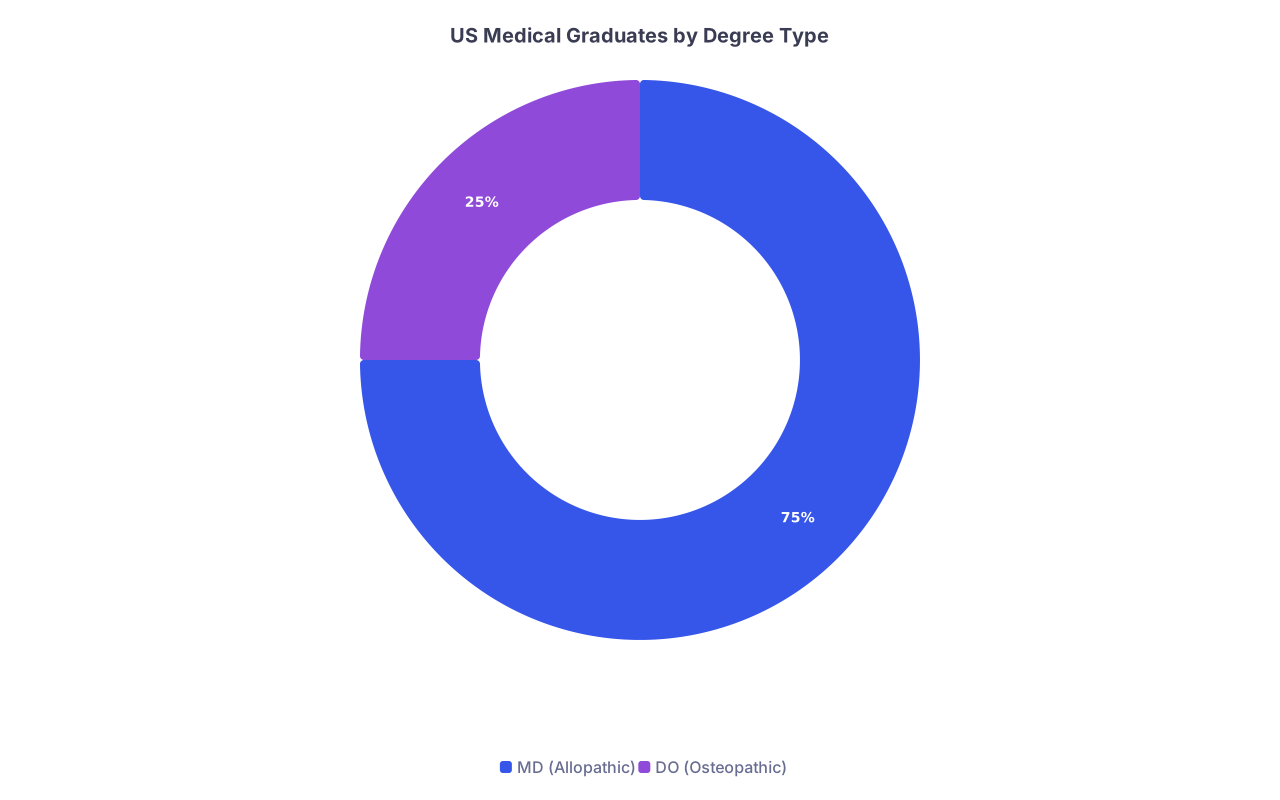
| Category | Value |
|---|---|
| MD (Allopathic) | 75 |
| DO (Osteopathic) | 25 |
The belief that “you must be an MD to do academic medicine” is outdated—and it’ll hurt you more than help you if you cling to it.
Here’s the answer you actually need: MD is not always better than DO for academic medicine. But MD is usually the easier path—especially for highly competitive research careers and elite institutions.
If you want academic medicine, you need a strategy, not a logo on your diploma.
Let’s break this down like an adult decision, not a Reddit argument.
1. What “Academic Medicine” Actually Means (And Why Degree Type Matters Less Than You Think)
People say “academic medicine” and mean five different things. You need to be precise, because the MD vs DO calculus changes depending on which path you want.
Academic medicine typically includes some mix of:
- Clinical work at a teaching hospital
- Teaching medical students and residents
- Research (from small QI projects to hardcore NIH-funded labs)
- Administration/leadership (program director, department chair, dean)
Now, here’s the part everyone gets wrong:
You don’t need an MD to:
- Teach in most residency programs
- Be core faculty at many community-based academic hospitals
- Do clinical research, QI, or education scholarship
- Hold titles like “Assistant Professor” at a lot of places
You’re judged on:
- Your residency and fellowship pedigree
- Your publications and research training
- Your networking and mentors
- Your clinical reputation
The letters (MD vs DO) are a filter, not a destiny. They shape:
- What schools and residencies you can realistically access
- How many hoops you have to jump through
- How many people give you the benefit of the doubt vs. make you prove yourself twice
That’s the real game.
2. Where MD Really Does Have an Edge for Academic Careers
Let me be blunt: if your dream academic life is “NIH-funded physician-scientist at a top-10 research institution,” you’re stacking the deck against yourself by choosing DO.
Not impossible. Just harder. A lot harder.
MD advantages for classic research-heavy academic careers
MD paths tend to offer:
- Stronger institutional research infrastructure (big grants, full-time research groups)
- More MD/PhD options and formal research tracks
- Easier access to high-impact mentors with national reputations
- Better name recognition when you apply for:
- Competitive residencies (Derm, Ortho, ENT, Plastics, Neurosurg, Rad Onc)
- Prestigious fellowships
- Faculty positions at top academic hospitals
Many top-tier academic centers are still MD-dominated—because historically they were built that way. The culture is changing, but slowly.
If you picture yourself at places like:
- Mass General / Brigham / Hopkins / UCSF / Penn / Stanford
- As a basic science-heavy researcher with major grants
Then yes, MD is the more rational choice if you can get into a solid MD school.
3. Where DO Can Still Absolutely Work for Academic Medicine
Now the part that the “MD-or-bust” crowd conveniently ignores: plenty of DOs are in academic medicine.
I’ve seen DOs as:
- Program directors and associate program directors
- Core teaching faculty in IM, FM, EM, Psych, Peds, Anesthesia, PM&R
- Clerkship directors at med schools
- Clinical faculty at major university-affiliated hospitals
- Leaders in medical education, simulation, and QI
Where DO works fine—if you execute well:
- Internal Medicine → Hospitalist + faculty + maybe fellowship
- Family Medicine → Community-based academic teaching programs
- Pediatrics → Many university-affiliated and community programs
- Psychiatry → Very DO-friendly in a lot of places
- Emergency Medicine → Historically DO-friendly, though more competitive now
- PM&R, Neurology, Anesthesia → Mixed, but absolutely doable
You can be a DO and:
- Have an academic title
- Teach students and residents
- Publish papers (especially clinical, education, QI, retrospective work)
- Present at national meetings
- Climb into leadership roles at many institutions
The price? You need to be:
- More deliberate about school choice
- More strategic about research exposure
- More aggressive about Step exams and networking
DO isn’t a closed door. It’s just a heavier door.
4. Hard Truths: Bias, Competitiveness, and Doors That Are Just Tougher as a DO
Let’s not sugarcoat this.
There are three areas where being a DO makes things objectively harder if you want serious academic juice:
1. Hyper-competitive specialties
Derm, Ortho, ENT, Plastics, Neurosurg, competitive Radiology, some surgical subspecialties. As a DO you’re:
- Fighting historical bias
- Competing with MDs from research-heavy schools
- Often shut out of some residency programs that quietly or openly rarely take DOs
Can you match those as a DO? Yes. People do. But it’s:
- Top-of-class + big Step scores + strong research + glowing letters + often extra time (research year, audition rotations)
If your academic dream is high-powered Derm researcher at a top institution, and you have realistic access to MD schools, choosing DO is working against yourself.
2. Pure research careers
If you want your career to be:
- 50–80% research
- Grant-funded
- Bench or translational science heavy
Then:
- MD/PhD or MD with strong research training beats DO almost every time
- NIH-heavy places are still very MD/MD-PhD biased
- Many DO schools don’t have the same research depth or culture
Can you still do research as a DO? Yes. But serious, grant-funded, lab-based careers are a steeper climb.
3. Top-tier academic faculty roles
Some top-10/20 institutions take almost no DOs as faculty in certain departments, or only take DOs who trained at elite MD residencies and fellowships with strong CVs.
The pattern I’ve seen:
- DO + strong MD residency/fellowship + strong research output = possible
- DO + DO residency with minimal research = much tougher at those places
So degree interacts heavily with where you train after med school.
5. The Real Decision Framework: MD vs DO for Academic Aspirants
You want a practical answer. Here’s how I’d think about it if you’re premed or early in the process.
Step 1: Be brutally honest about your goals
Which statement is closest to you:
- “I want to be a hardcore researcher / NIH-funded / at a top research center.”
- “I mostly want to teach, do clinical work, maybe some research, and be involved in academics.”
- “I’m not totally sure yet, but I like the idea of academic medicine and want to keep doors open.”
Now match that with this:
- If you’re a firm #1 → Prioritize MD. Strongly.
- If you’re solidly #2 → MD is easier, but DO can absolutely work if you’re intentional.
- If you’re #3 → If you can get into a solid MD school, it’s the safer hedge. If your choice is low-tier MD vs strong DO with great support, then it’s more nuanced.
Step 2: Look at your actual options, not fantasies
What’s on the table?
- Acceptance to a mid-tier or strong MD school
- Acceptance to only DO schools
- Potential to reapply for MD in a year or two vs go DO now
Rules of thumb:
- MD at nearly any accredited US school will generally give you more straightforward academic options than DO.
- But a supportive DO school with strong match history, good advising, and real research opportunities beats:
- A toxic or disorganized MD school
- Or rolling the dice for multiple years as a reapplicant with no guarantee
Sometimes “MD or I quit” is actually just a fear posture, not a strategy.
Step 3: Understand what you’ll need to do as a DO if you want academics
If you choose DO and still want real academic opportunities, you’ll need to:
- Take USMLE Step 1 and Step 2 (not just COMLEX) and score well
- Seek out research early:
- Summer between MS1–MS2
- Projects with clinically active faculty
- Multi-site or national student groups
- Target DO schools with genuine research infrastructure or strong university affiliations
- Crush clinical rotations—especially if you want solid academic residencies
- Network hard:
- Conferences
- Away rotations
- Mentors who can open doors into academic programs
It’s doable. It just requires intention from day one.
6. Common Scenarios and What I’d Actually Recommend
Let’s run through a few typical real-world choices I see.
Scenario A: Competitive applicant with MD and DO acceptances
You want: “Maybe heme/onc or cardiology. I like research. I think I’ll want to teach.”
Take the MD. Every. Time.
Not because DO is bad. But because MD makes:
- Academic IM residencies easier
- Fellowships slightly less uphill
- Access to research mentors more straightforward
Scenario B: Only DO acceptances, strong interest in IM/FM/Psych/Peds with teaching
You want: “I like the idea of being at a teaching hospital and maybe doing some research, but I mostly want to be a good clinician.”
You should strongly consider taking the DO:
- Pick a DO school with good match outcomes and teaching hospital ties
- Be intentional about research and exams
- You can absolutely end up faculty at a university-affiliated hospital
Waiting years just to maybe land at a lower-tier MD school isn’t automatically smarter.
Scenario C: Dreaming of Derm/Ortho/Plastics + heavy research, but only DO offers
This is where it gets uncomfortable.
If your numbers and trends suggest you really might reach MD in a future cycle (and advisors agree), a planned reapplication year or two aiming for MD might be rational.
But you need:
- Honest feedback (not from your parents—from people who read applications)
- A real plan to substantially improve stats and experiences
- A clear stop point where you say, “After X cycles, I’ll go DO or pivot.”
What’s dumb is:
- Going DO but pretending the specialty odds are the same as MD
- Or reapplying blindly for 3–4 years with no major profile change
7. Practical Checklist: If You Want Academic Medicine, Regardless of MD vs DO
No matter your degree, academic currency is the same:
You want to:
- Get into the strongest training programs you realistically can
- Stack your CV with:
- Research or scholarly work (posters, papers, QI, education projects)
- Teaching experiences
- Leadership roles
- Build relationships with mentors who:
- Are known and respected in your field
- Will actually pick up the phone for you
- Develop at least one “thing” you’re known for:
- Clinical niche
- Research area
- Education innovation
- Systems/QI expertise
The MD vs DO question matters. But it’s one variable in a 10-variable equation.

| Step | Description |
|---|---|
| Step 1 | Premed |
| Step 2 | US MD School |
| Step 3 | US DO School |
| Step 4 | Strong Clinical + Research |
| Step 5 | Competitive Residency |
| Step 6 | Academic Fellowship or Faculty Role |
| Step 7 | MD or DO? |
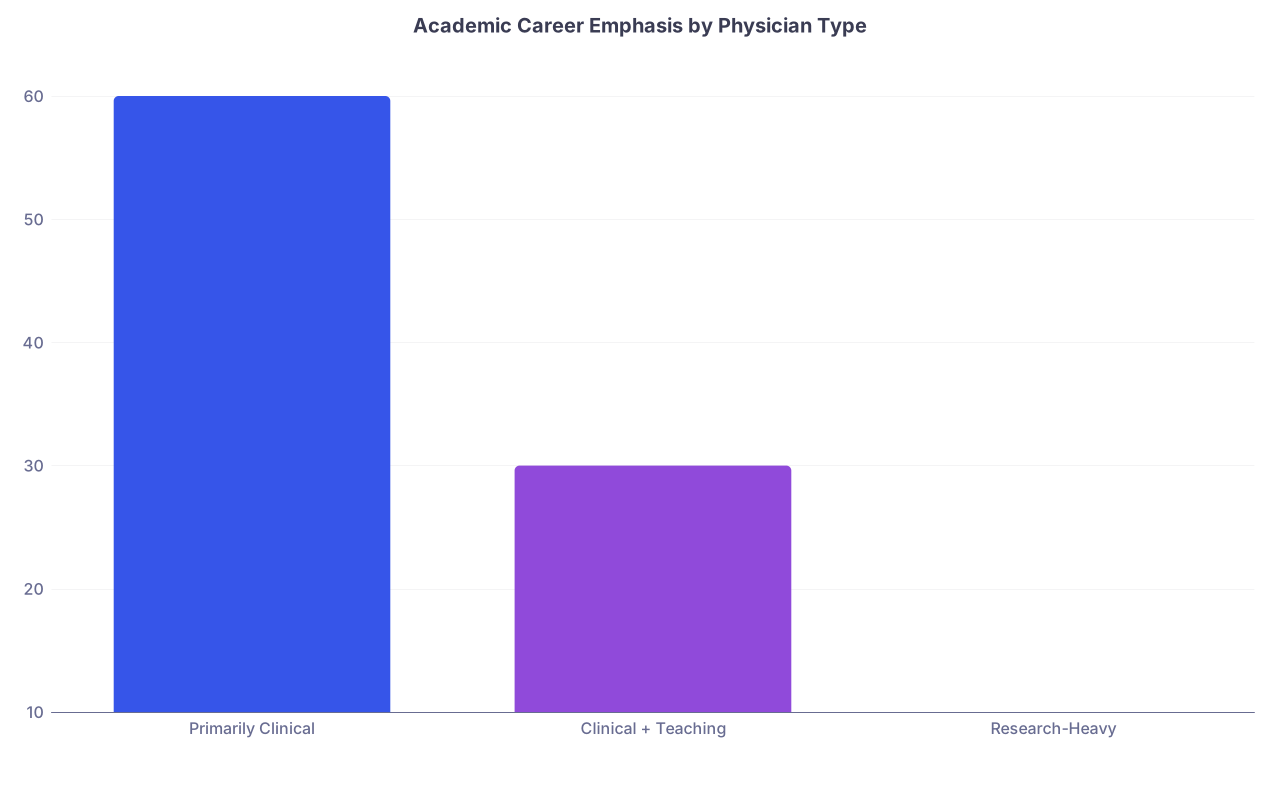
| Category | Value |
|---|---|
| Primarily Clinical | 60 |
| Clinical + Teaching | 30 |
| Research-Heavy | 10 |

FAQ: MD vs DO for Academic Medicine (7 Questions)
Can a DO become a professor at a medical school?
Yes. DOs can and do hold faculty titles (Assistant/Associate/Full Professor) at both osteopathic and allopathic medical schools. It’s more common at DO schools and community-based MD schools, but I’ve seen DOs on faculty at major university programs—especially in IM, FM, EM, Psych, and Peds. Your academic rank usually depends more on your CV than your degree.Do top academic hospitals hire DOs?
Some do regularly, some rarely, some almost never in specific departments. It depends heavily on the specialty, the department culture, and where you trained for residency/fellowship. A DO who trained at a name-brand MD residency with strong research is far more likely to get hired than a DO from a small, non-academic program with no publications.If I want to do a lot of research, is DO a bad idea?
For heavy, grant-funded, lab-based careers at elite research institutions, DO is usually the harder path and often a worse bet. For clinical research, QI, education research, or moderate research involvement while being mostly clinical, DO is fine—as long as you aggressively seek research opportunities and mentors along the way.Will being a DO hurt my chances of matching an academic internal medicine program?
It can, but it doesn’t have to. Plenty of academic IM programs take DOs, especially if you have strong board scores, good letters, and some research. Some elite IM programs still take few or no DOs, but many solid academic and university-affiliated programs are very DO-friendly. Your application strength matters more than the letters alone.Should I take a DO acceptance now or reapply for an MD next year if I want academics?
Depends on your profile and risk tolerance. If you’re competitive for MD and got waitlists/rejections that could realistically flip with targeted improvements, a reapplication year might be rational—especially if you want highly competitive specialties or research-heavy careers. If your application is marginal and unlikely to change drastically, taking a good DO spot and being strategic from day one is often the better move.Do I need to take USMLE as a DO if I want academic medicine?
In practice, yes, if you’re aiming for competitive residencies or academic programs. Many academic and university-based programs still prefer or require USMLE scores. Taking and doing well on Step 1 and Step 2 gives PDs an apples-to-apples comparison and keeps more doors open. It’s extra work, but it’s usually worth it if you’re serious about academics.If I’m not 100% sure I want academic medicine, should I still prioritize MD over DO?
If you have a real MD option, yes—MD generally preserves more flexibility, especially for research-heavy or elite academic environments. But if your realistic choice is between a strong DO program now and gambling on a future MD that might not materialize, the “MD at all costs” mindset can backfire. Pick the path where you can excel, get strong training, and build a serious CV, rather than chasing letters alone.
Bottom line:
- MD isn’t always “better,” but it usually makes high-level academic careers easier, especially in competitive fields and research-heavy roles.
- DO can absolutely lead to academic medicine—if you’re strategic from day one about exams, research, and training environments.
- Don’t obsess over the letters. Obsess over where you train, who mentors you, and what you actually build during med school and residency. That’s what academic medicine ultimately cares about.