The blanket advice “Every DO should take USMLE” is wrong. But “You’ll be fine without it” is also wrong.
You have to make a real decision here. With tradeoffs. Time, money, and sleep on one side; specialty options and competitiveness on the other.
Let’s walk through it properly.
The Core Question: Who Actually Needs USMLE?
Here’s the short version I’d give a first‑year DO student in my office:
- If you’re even half‑seriously considering a competitive specialty → you should plan to take USMLE.
- If you’re comfortable targeting primary care and community programs → you might not need it.
- If you’re not sure yet (and you’re premed or early MS1) → keep the door open and study as if you’ll take it.
For DO students, “Is it worth it?” really means:
- Will it materially improve my chances of matching the specialty and type of program I want?
- Will I get enough score benefit from adding USMLE to justify the cost and stress?
- Will skipping USMLE shut doors I might care about later?
There’s no universal answer. But we can get you to a rational one.
How Programs View DO Students with and without USMLE
Let me be blunt: some PDs still give extra weight to USMLE, even in the COMLEX world. They should not, but they do.
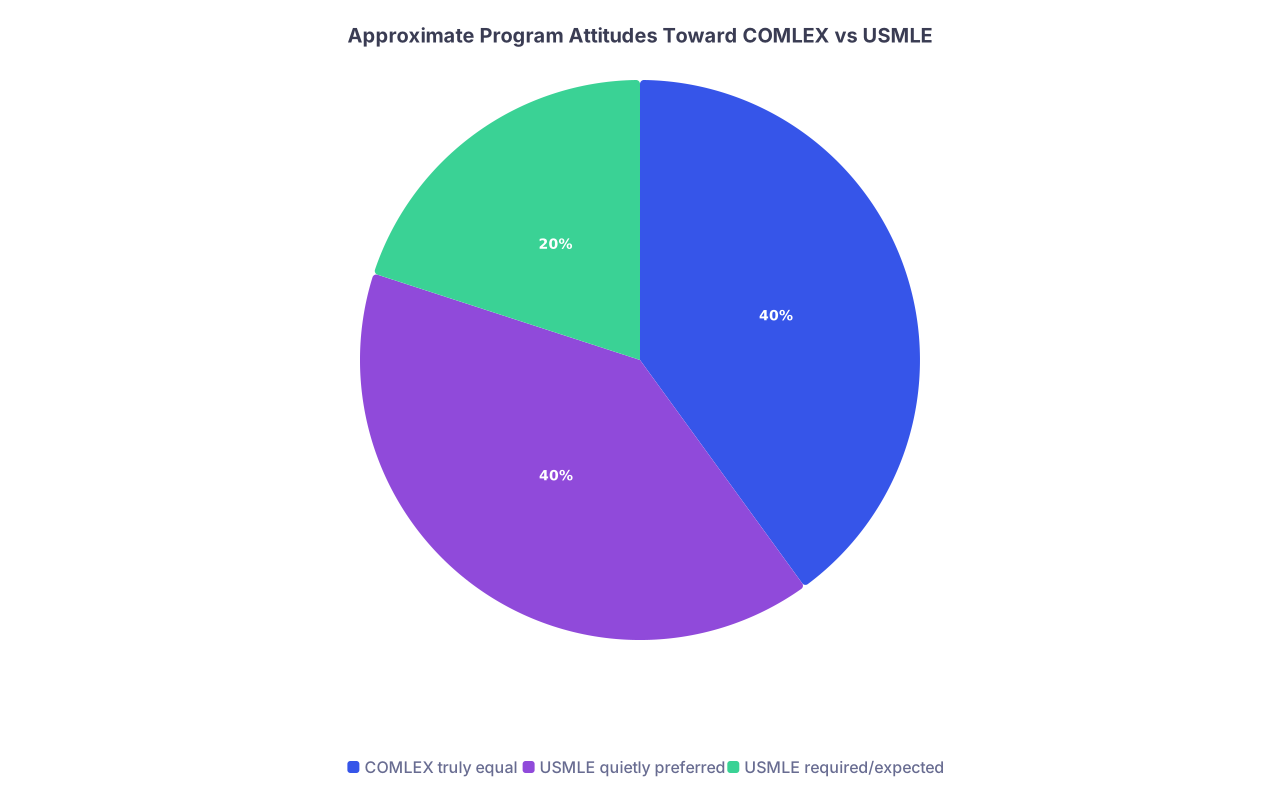
There are basically three buckets of programs:
Programs that require or strongly prefer USMLE
Think: many academic programs in competitive specialties (and some mid‑tier ones too).Programs that accept COMLEX equally and know how to interpret it
Usually DO‑friendly, often with a history of taking DO residents. Many community programs and some academic ones.Programs that claim COMLEX is fine but quietly filter or rank USMLE‑takers more easily
They use USMLE cutoffs in their software and never learned how to benchmark COMLEX scores properly.
| Category | Value |
|---|---|
| COMLEX truly equal | 40 |
| USMLE quietly preferred | 40 |
| USMLE required/expected | 20 |
Exact percentages vary by specialty, but that rough split matches what I see in advising.
So:
- If you only apply to bucket #2 programs → USMLE helps, but isn’t mandatory.
- If your dream list is heavy in bucket #1 and #3 → USMLE often becomes “very strongly recommended,” which is basically required.
Specialty‑by‑Specialty: Where USMLE Matters Most
Here’s where a lot of DO students get burned. They wait to decide until MS3, then suddenly want dermatology.
Too late.
I’m going to group specialties into three categories for DO students:
1. Very Competitive / USMLE Strongly Recommended
For these, not having USMLE hurts you more often than not, especially at academic centers:
- Dermatology
- Plastic surgery
- Neurosurgery
- Orthopedic surgery
- ENT (Otolaryngology)
- Interventional radiology / Diagnostic radiology
- Radiation oncology
- Some high‑end anesthesia and EM programs at big academic centers
If you are a DO student and serious about any of these, you should almost always take USMLE. Programs in these fields routinely compare applicants side‑by‑side using USMLE numbers. COMLEX‑only can make you harder to evaluate and easier to pass over.
2. Moderately Competitive / USMLE Helpful, Not Always Essential
Here it depends more on your specific goals and geographic targets:
- General surgery
- Emergency medicine (varies by region and program)
- Anesthesiology (community vs big academic splits)
- PM&R
- Neurology
- OB/GYN
If you want:
Academic / university programs
USMLE is often a big plus, sometimes pretty close to “must have.”Community / DO‑friendly programs
Strong COMLEX scores and solid application can be enough.
3. Less Competitive / USMLE Optional for Many DO Students
You can realistically match these with COMLEX only, particularly at DO‑friendly or community programs:
- Internal medicine (non‑elite programs)
- Family medicine
- Pediatrics
- Psychiatry
- Some community‑based IM subspecialties later (cards, GI, etc.) still like strong test performance, but you can get in through a strong IM residency first.
Notice I said “non‑elite” internal medicine. If you have your eye on places like MGH, Hopkins, UCSF, or top university IM programs as a DO, USMLE is often almost assumed.
COMLEX vs USMLE: What You’re Actually Signing Up For
You’re not just “adding another exam.” You’re changing your entire study plan.
Content Overlap and Differences
Reality check:
- Most of your core Step 1 / Level 1 study materials (UWorld, Anki decks, B&B, Pathoma, First Aid content equivalents) cover both tests.
- The big difference is in:
- Style: USMLE questions are more clinically grounded, with a certain logic. COMLEX adds more “weird” questions, sometimes vague stems, and OMM.
- Blueprint: USMLE ignores OMM. COMLEX leans into it.
If you study in a “USMLE‑first” way and then layer OMM on top, both tests are doable. The opposite direction (COMLEX‑only prep then trying to bolt on USMLE at the last second) is much harder.
Time and Burnout Costs
You’re trading:
- Extra question banks (or longer usage of UWorld)
- Possibly an extra 4–6 weeks of intense Step‑style focus
- Two high‑stakes test days instead of one
- More money in registration and resources
For many DO students, the mental load of two major exams in the same window is the worst part. I’ve seen people crush COMLEX but flame out on USMLE because they tried to cram it in 3–5 days later with no real separation.
If you’re already scraping by in coursework, or barely keeping your head above water, adding USMLE can push you into burnout. That’s real.
A Simple Decision Framework: 7 Questions to Answer Honestly
Stop asking, “Should DO students take USMLE?” Ask, “Should I take USMLE?”
Work through these in order:
What specialties are on your real shortlist?
List the top 3 you’re seriously considering. If any are in the “very competitive” group, lean heavily toward taking USMLE.Do you care about big academic/university programs or mostly community?
If the words “university‑based,” “research‑heavy,” or “top‑tier” sound like you, USMLE is usually smart insurance.What region do you want to match in?
Some areas (Northeast, West Coast, big metro centers) are more competitive and academic‑heavy. USMLE buys you more options there.How strong are your test‑taking skills really?
If you historically do well on standardized tests and your practice questions are solid, you’re more likely to benefit from USMLE.
If you struggle significantly with MCAT‑type exams and barely pass school tests, adding USMLE may not improve your application; it may just give programs another low number to judge.What does your school culture look like?
If 70–80% of your classmates take USMLE and match well with that strategy, that’s data. If only 10% take it and most match primary care locally without it, that’s also data.Can you realistically carve out the time to prepare properly?
“I’ll just wing it” is not a strategy. If you’re going to take USMLE, plan to prepare specifically for it, not treat it as an afterthought.What does your backup plan look like if you do not match your first‑choice specialty?
If you’d be content matching IM/FM/psych somewhere and trying to subspecialize later, maybe you don’t need USMLE. If that would feel like a real loss, you want every competitive edge you can get.
When Taking USMLE Is Probably Worth It
Let me be concrete. For a DO student, USMLE is likely worth it if:
- You’re MS1 / early MS2 and open to any competitive specialty.
- You have decent grades and strong practice performance on board‑style questions.
- You’re targeting:
- Academic or university programs
- Competitive metro areas or coasts
- Research‑heavy fields or institutions
And especially if:
- Your school has structured support for USMLE (dedicated time, faculty guidance, group resources).
- Prior DO grads from your school with USMLE matched well into the types of programs you want.
In these scenarios, USMLE is more like an investment than a gamble. You’re exchanging time and stress now for more control over your residency options later.
When Skipping USMLE Is Reasonable (and Not Career Suicide)
You’re not doomed if you never touch USMLE.
Skipping it is reasonable if:
- You are committed to:
- Family medicine
- Community internal medicine
- Pediatrics (non‑elite)
- Psychiatry
- Your goal is to practice in community settings or DO‑friendly regions.
- Your COMLEX practice scores are solid and you trust yourself to do well there.
- You’re already under heavy stress or at risk of burnout, and piling on USMLE prep would realistically harm your performance across the board.
I’ve seen plenty of DOs match into solid, satisfying careers with COMLEX only. Especially in primary care and psychiatry. They’re not sitting in clinic wishing they’d memorized random Step minutiae.
The key is alignment:
- Your test strategy (COMLEX only vs both) has to match your career strategy (type of specialty, program, and geography you want).
If you don’t care about the doors USMLE opens, you do not need to knock on them.
Tactical Advice If You Decide to Take USMLE
If you’re leaning toward “yes,” then do it right.
Plan early
From MS1, use resources aligned with USMLE style. UWorld, Anki, and high‑yield video resources that Step‑takers rely on. Then layer OMM and COMLEX‑specific prep on top.Do not schedule USMLE as an afterthought 3 days after COMLEX
Give yourself real prep time or at least structure: many do USMLE first, COMLEX 1–2 weeks later with OMM cram; others reverse it but still build a real bridge between them.Use practice exams to sanity‑check your decision
If NBME practice tests are coming back at very low pass‑borderline levels and you’re weeks out, reassess. A barely passing USMLE score can actually hurt you at some programs.Be realistic about Step 1 being pass/fail
Programs now lean more on Step 2 / Level 2 for numeric comparison—but Step 1 still matters as a gatekeeper at some places. If you take it, pass it cleanly and move on. Then make Step 2 your “show‑off” score.
Tactical Advice If You Decide Not to Take USMLE
Then you need to lean harder on everything else.
- Aim for very strong COMLEX scores (Level 1 and especially Level 2).
- Choose DO‑friendly rotations and audition electives; get letters from people who regularly advocate for DO students.
- Be strategic with your school’s match data—see where prior COMLEX‑only grads actually matched.
- Apply broadly and smartly—more programs, more DO‑heavy institutions, more realistic tiers.
You’re trading test score optionality for a narrower—but still workable—pathway. Just do it with your eyes open.

| Step | Description |
|---|---|
| Step 1 | DO Student |
| Step 2 | Take USMLE\nPlan Early |
| Step 3 | Reasonable to Skip\nFocus on COMLEX |
| Step 4 | Reassess Goals\nMaybe Take USMLE |
| Step 5 | Considering\nCompetitive Specialty? |
| Step 6 | Targeting Academic\nor Big City Programs? |
| Step 7 | Comfortable with\nPrimary Care/Community? |
| Category | Value |
|---|---|
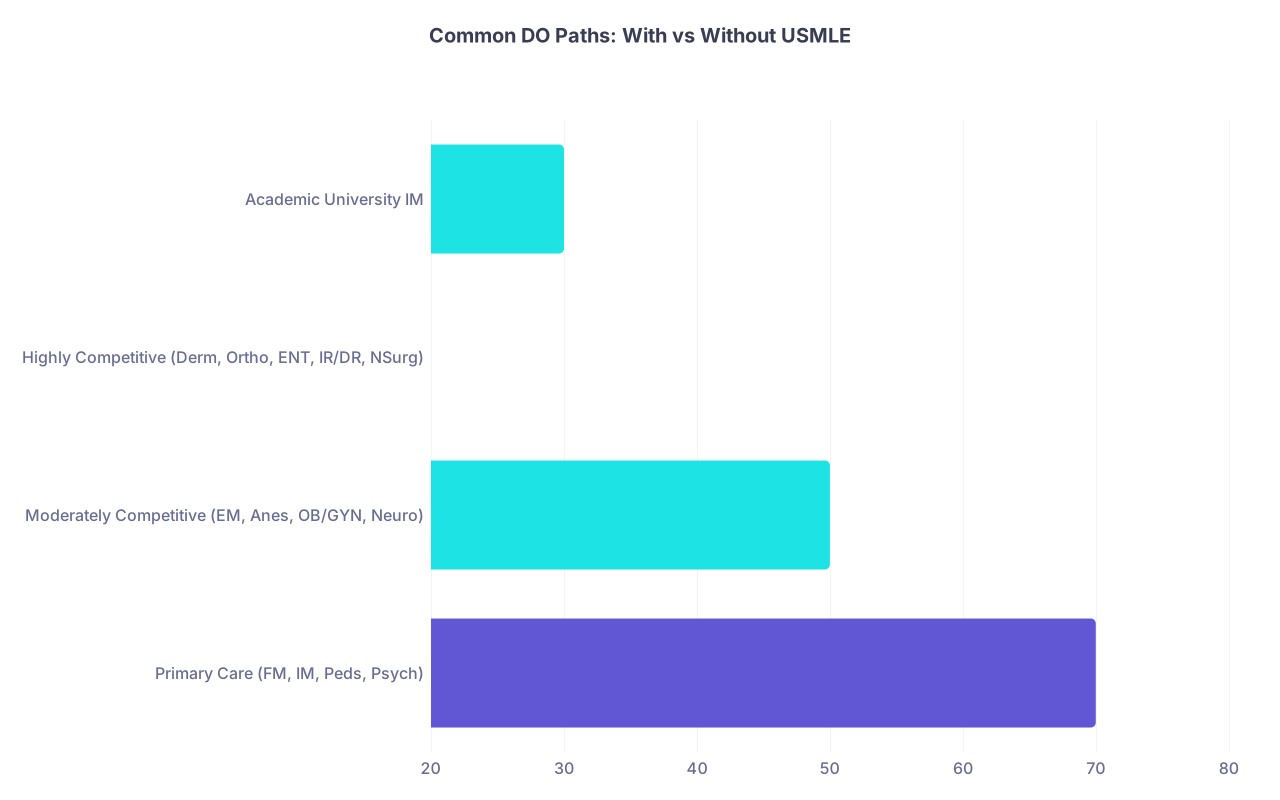
| Primary Care (FM, IM, Peds, Psych) | 70 |
| Moderately Competitive (EM, Anes, OB/GYN, Neuro) | 50 |
| Highly Competitive (Derm, Ortho, ENT, IR/DR, NSurg) | 20 |
| Academic University IM | 30 |
(Rough illustrative percentages of DO applicants in each group who benefit noticeably from USMLE—conceptual, not official NRMP data.)

| Scenario | USMLE Recommendation | Rationale |
|---|---|---|
| DO, considering derm/ortho/IR | Strongly recommended | Competitive fields heavily use USMLE for comparison |
| DO, wants academic IM at top program | Recommended | Many elite IM programs expect USMLE |
| DO, wants community FM in home state | Optional | COMLEX usually sufficient |
| DO, open to EM/anesthesia at university | Lean yes | Many EM/anesthesia programs favor USMLE |
| DO, historically weak test taker, aiming psych | Often skip | Focus on strong COMLEX and application |
| Premed, unsure of specialty, open to anything | Plan to take | Keeps maximum flexibility |

FAQs: USMLE for DO Students
If Step 1 is pass/fail now, does USMLE still matter for DO students?
Yes. Programs lost a clear numeric filter with Step 1 going pass/fail, so many shifted emphasis to Step 2 CK scores. But taking Step 1 still matters because:- Some programs quietly prefer applicants who passed Step 1 on the first try.
- Step 1‑style prep builds the foundation that makes Step 2 CK easier to crush.
- A clean pass avoids red flags.
It’s not the bragging score it used to be, but as a DO, having both USMLE Step 1 (pass) and a strong Step 2 CK can differentiate you from COMLEX‑only applicants.
Can strong COMLEX scores alone make up for not having USMLE?
Sometimes, but not everywhere. A 650+ on Level 1 and Level 2 looks very good and will open many doors at DO‑friendly and community programs. But some academic and competitive programs still don’t know how to interpret COMLEX well. They’re more comfortable with USMLE thresholds they’ve used for years. So yes, strong COMLEX helps a lot, but it doesn’t fully replace USMLE in all settings.What if I take USMLE and score average or even slightly below average—does that hurt me?
It can. Programs see the actual number, not just “pass.” A mediocre USMLE score alongside a decent COMLEX can drag down your perceived competitiveness at some places. That’s why you should not take USMLE “just to have it.” Take it only if you’re prepared enough to likely land at least a solid, clearly passing score that doesn’t undermine your file.Is it better to skip USMLE entirely than to have a fail or very low score?
Absolutely. A USMLE fail is a major red flag and far worse than not having taken the test at all. Even a very low passing score can be problematic at score‑sensitive programs. If your practice tests are consistently below passing close to your exam date, it may be safer to postpone or not sit for it than to gamble on a fail. Some PDs would rather see COMLEX‑only than a clearly poor USMLE performance.As a premed planning to attend a DO school, should I assume I’ll take USMLE?
Yes. If you’re premed or not yet deep into MS1, assume you’ll take USMLE and prepare accordingly. That does not mean you’re locked in—you can always choose not to register later. But you’ll study smarter and keep more options open if you follow a USMLE‑aligned approach. The big mistake is assuming you’ll never need it, then realizing in MS3 you want ortho or radiology and having no Step foundation.Do residency programs care which you take first: COMLEX or USMLE?
Most do not care about the order; they care about the outcomes. They want:- You passed on the first attempt.
- Your numeric scores (for Step 2 / Level 2) are competitive for their field.
The order is more about your performance strategy: many students do USMLE first (better resources, clearer style), then take COMLEX after a short OMM‑heavy review. Others reverse that. What matters is that you choose the sequence that gives you the best chance to succeed on both, not what sounds good on paper.
Bottom line:
- Competitive specialty or academic dreams as a DO? USMLE is usually worth it.
- Primary care or community focus and high burnout risk? COMLEX‑only can be a smart, deliberate choice.
- If you’re early and unsure, study like someone who will take USMLE—so you’re not closing doors before you even know you want them.