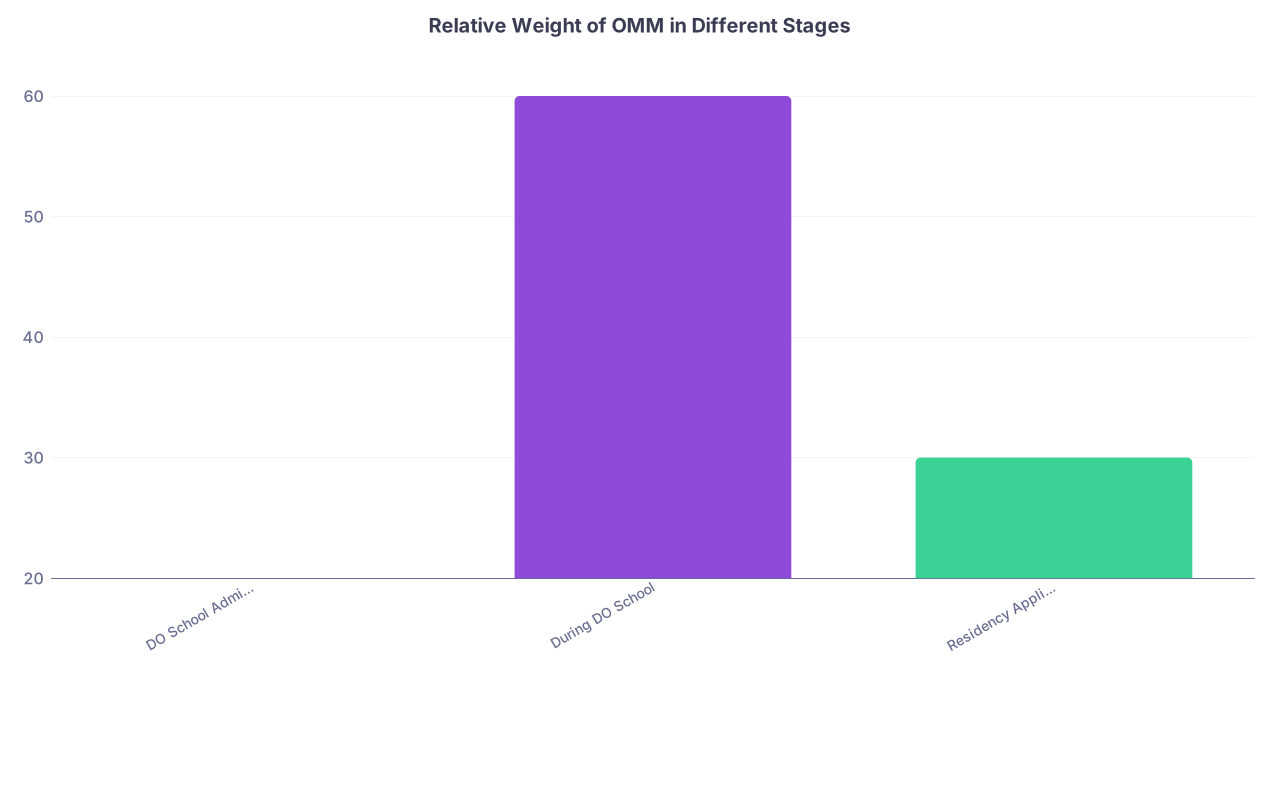
| Category | Value |
|---|---|
| DO School Admissions | 20 |
| During DO School | 60 |
| Residency Applications | 30 |
You’re a premed staring at two tabs: one for an MD program, one for a DO program. Or you’re an OMS-1 watching your classmates stress over Chapman reflexes and cranial while you’re thinking, “Is any of this actually going to matter when I apply to residency?”
Let me answer the question the way you actually want it answered:
OMM matters. But not in the way a lot of people think, and not equally in all phases.
We’ll break this into three buckets:
- Getting into DO school
- Surviving and doing well in DO school
- Applying to residency (COMLEX/USMLE and program directors)
Then I’ll tell you, bluntly, how much energy to give OMM at each stage.
1. How much does OMM matter for DO school admissions?
Short version: It matters some. It’s not the main thing, but you cannot ignore it.
Admissions committees at DO schools care about three things first:
- Can you handle the academics? (GPA, MCAT)
- Are you normal and safe? (interview, professionalism, letters)
- Do you understand and actually want osteopathic medicine, not “MD backup”?
OMM fits into that last part.
Where OMM actually shows up in DO admissions
Secondaries and interviews
If you write, “I’m applying DO because I love holistic care,” and that’s all you say, they’ve seen that 10,000 times. They want to see:- You know what OMM/OMT roughly is
- You’ve at least talked to a DO or shadowed one
- You understand DO ≠ MD minus prestige
Good answers sound like: “I shadowed a family medicine DO who used OMT for chronic low back pain and headaches. I saw how combining manipulative treatment with standard care improved function and reduced medication use. That approach—plus the DO emphasis on understanding structure and function—fits how I want to practice.”
That’s enough. You don’t need to quote Fryette’s laws.
DO letter / DO exposure
Most DO schools want a letter from a DO or proof you’ve engaged with osteopathic physicians. That’s the “OMM/osteopathic philosophy” box for admissions. It’s a filter. Not an obsession.Red flags you want to avoid
Things that can hurt you:- “I’m applying DO because MD didn’t work out.” (Even if true, don’t say it.)
- “I don’t really believe in OMM but I’ll tolerate it.”
- Zero DO exposure and zero effort to understand osteopathic training.
You don’t need to be an OMM zealot. You just need to not be openly hostile or ignorant.
Practical takeaway for premeds
Give OMM:
- Maybe 10–15% of your mental energy for DO applications.
- Enough to:
- Shadow a DO or two
- Learn the basic philosophy (structure-function, body as a unit, self-healing, prevention)
- Be able to tell one or two specific OMM/OMT clinical examples you’ve seen or read
Past that, MCAT, GPA, and your clinical exposure matter far more.
2. How much does OMM matter during DO school?
Here’s where it actually matters a lot. Not because you have to be an OMM guru, but because OMM is a required, tested, graduation-level competency.
You can’t “opt out” of OMM in DO school any more than you can opt out of pharm.
Why OMM is a big deal in preclinical and clinical years
It’s a core course with real grades
You’ll have:- Weekly labs
- Written exams (anatomy, biomechanics, clinical applications)
- Practical exams (set up, diagnose, treat, name techniques correctly)
Failing OMM can delay your progression or get you remediated. I’ve seen this happen. Not because people were dumb, but because they assumed “this doesn’t matter” and never practiced.
It’s all over COMLEX-Level 1 and Level 2
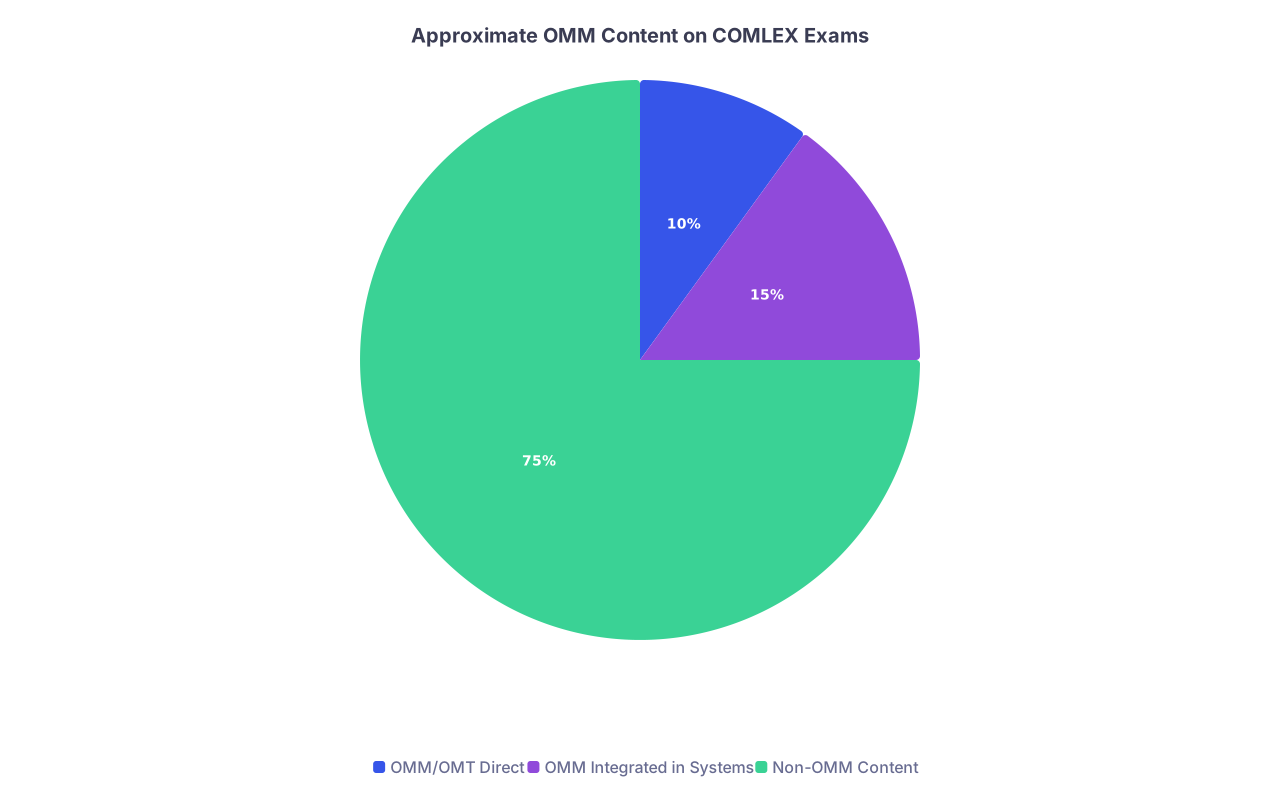
| Category | Value |
|---|---|
| OMM/OMT Direct | 10 |
| OMM Integrated in Systems | 15 |
| Non-OMM Content | 75 |
Rough ranges people actually feel on test day:
- Direct OMM / osteopathic principles questions: ~8–12%
- OMM integrated into MSK, neuro, pain, pregnancy, etc.: another ~10–15%
If you blow off OMM, you’re handicapping yourself on COMLEX. That’s just self-sabotage.
- It matters for clinical evals (more than students expect)
On rotations at DO-heavy sites:
- Attendings and residents may expect you to:
- Do a focused structural exam
- Suggest when OMT might help (e.g., rib dysfunction in pneumonia, low back pain in pregnancy, post-op ileus, headaches)
- At least talk intelligently about when OMT is appropriate or not (fracture? no. cauda equina? no.)
You don’t have to treat every patient. You do have to not look clueless about your own degree.
How good at OMM do you actually need to be?
Here’s the honest bar:
- You do not need to be an OMM wizard.
- You do need to be:
- Safe
- Competent at basic treatments (soft tissue, muscle energy, HVLA for a few regions if your school emphasizes it, counterstrain, etc.)
- Able to pass your school’s practicals without drama
- Comfortable enough to use it selectively on rotations when it makes sense
If you plan to go into:
FM, IM, EM, PM&R, sports, or pain:
Having functional, usable OMM skills can actually help you clinically and sometimes make you stand out.Derm, rads, path, anesthesia, competitive surgical subs:
You still must pass OMM and COMLEX, but you don’t need to turn into an NMM residency applicant.
Energy allocation during school
During preclinical:
- Treat OMM like any other system: invest enough to reliably pass exams and understand the patterns (inhalation vs exhalation ribs, sacral torsions, etc.).
During dedicated COMLEX prep: - Don’t ignore the OMM chapters. A solid 7–10 days of focused OMM review can move your score more than yet another week of random UWorld.
3. How much does OMM matter for residency applications?
This is the part people worry about the most. And it’s the most misunderstood.
You’re not matching into “OMM.” You’re matching into a specialty. Programs are asking:
- Can this person handle the work? (Scores, clinical evals)
- Are they safe and not a nightmare? (Letters, professionalism)
- Are they decent to work with? (Interviews)
OMM is a small but real part of that package—especially for DO-only or DO-heavy programs.
MD vs DO residency world post-merger
Post-ACGME merger, DOs are applying mostly to the same pool as MDs. What matters most:
- COMLEX (and USMLE if you take it)
- Class rank
- Clinical performance
- Fit for the specialty
OMM is rarely a primary filter. But it affects:
How PDs see DO training
Some PDs think:- “DOs get extra training in MSK and physical exam. Great for FM/IM/EM/PM&R.”
Others: - Barely think about OMM at all.
What PDs really care about is: do you pass boards, function on the floor, and not exaggerate your skills.
- “DOs get extra training in MSK and physical exam. Great for FM/IM/EM/PM&R.”
Niche programs where OMM/osteopathic identity does help
It can be a plus if:- The program director is a DO who actively uses OMT
- It’s an FM, NMM, sports, PM&R, EM program that has an osteopathic track or “bonus” for students who can actually treat MSK issues
In these settings, saying:
- “I use OMT for acute low back pain, headache, rib dysfunction, and I’m comfortable with muscle energy and soft tissue in clinic”
can be a selling point.
But compare that to:
- “I honored most of my core rotations, scored well on COMLEX/USMLE, and have strong letters.”
Scores and performance still outrun OMM.
How OMM shows up in your application materials
Personal statement:
- If you genuinely plan to integrate OMT in your future practice, say it.
- If you don’t, do not force it. PDs can smell fluff.
- One or two sentences is usually enough:
“As a DO, I’ve also seen the benefit of using osteopathic principles and OMT for musculoskeletal pain and headaches. I plan to continue using these skills when appropriate in my family medicine practice.”
Interviews:
Expect questions like:
- “How do you see your DO training influencing your practice?”
- “Do you use OMT? In what scenarios?”
Have specific, realistic answers. For example:
- “On my FM rotation, I used muscle energy and soft tissue techniques for acute low back pain and neck strain. Patients appreciated the hands-on approach, and it gave me another tool besides just meds and PT referrals.”
Do not say:
- “I can fix any back pain with OMT.”
You’ll sound naive. Or delusional.
Letters:
- Occasionally, a letter will highlight your OMM skills, especially from an OMM faculty or FM/IM preceptor who watched you treat patients. That can help at DO-heavy programs and FM/PM&R.
Where OMM barely matters
Ultra-competitive fellowships or subspecialties care far more about:
- Research
- Scores
- Reputation of your residency program
- Letters
Many MD-heavy programs look at:
- “Is this DO’s COMLEX/USMLE solid?”
- “Did they do well clinically?”
OMM rarely moves the needle either way unless you oversell it or act like a crusader.
How much should you care about OMM, practically?
Let me strip it down into blunt guidance by phase.
Premed:
- Learn the basics of what OMM/OMT is.
- Shadow a DO or at least talk to one.
- Be able to explain, in 2–3 sentences, why you’re okay training in a system that includes OMM.
- Then focus 90% of your energy on MCAT, GPA, and getting in.
During DO school:
Care enough to:
- Consistently pass OMM classes and practicals.
- Understand common patterns and treatments.
- Put real effort into OMM for COMLEX prep; it’s an easy scoring area if you’re not lazy.
If you like OMM:
Use it. Do extra OMM clinic, consider it as part of your FM/PM&R/EM identity.If you don’t love OMM:
Treat it like biochem. Learn it, pass it, use it when it’s obviously helpful, then move on. Don’t turn it into your personality either way.
Residency applications:
Use OMM as a supporting feature, not the headline.
Let your main selling points be:
- Scores
- Clinical performance
- Letters
- Specialty-relevant experiences
If asked about OMM:
- Be honest: “I’m comfortable with basic techniques for MSK pain and headaches and use it when appropriate, but my primary focus is being a strong [specialty] physician.”
That’s what most PDs actually want to hear.

| Step | Description |
|---|---|
| Step 1 | Premed |
| Step 2 | DO School Preclinical |
| Step 3 | DO School Clinical |
| Step 4 | Residency Applications |
FAQ: OMM and DO vs MD – 6 Common Questions
Will saying “I don’t really believe in OMM” hurt my DO school chances?
Yes. It’s one of the fastest ways to get quietly screened out. You do not have to worship OMM, but openly dismissing a core part of the degree tells schools you’re a bad cultural fit. Say you’re interested in learning it and seeing how it fits into patient care. That’s honest and acceptable.If I’m aiming for a competitive specialty, should I avoid DO because of OMM?
No. Your issue with competitive specialties as a DO will not be OMM. It will be: scores, school reputation, research, and networking. OMM is a small part of the picture. If you go DO, you still have to take OMM seriously enough to pass and do fine on COMLEX. But OMM itself will not block you from ortho, derm, or rads. Weak numbers will.Do residency programs actually care if I can do OMT on day one?
Most do not care that you can treat with OMT on day one. They care that you can function as an intern. Some FM/PM&R/EM programs will view OMT skills as a bonus. Many programs just see it as a neutral extra skill. If you use it, great. If not, they’re not losing sleep over it.Is it a mistake to say I plan to use OMT in residency if I’m not 100% sure?
It’s only a mistake if you oversell it. Safe version: “I’ve seen OMT help with MSK pain and headaches, and I’d like to maintain those skills and use them when appropriate.” Don’t promise you’re going to build a full OMT clinic if you know you won’t. Be realistic and non-dramatic.How much time should I spend studying OMM for COMLEX compared to everything else?
For most students, something like 7–10 focused days of OMM review across your entire dedicated period is enough, assuming you paid reasonable attention during the first two years. Use high-yield OMM resources and practice lots of questions. OMM is one of the easier ways to pick up extra points because many classmates neglect it.If I really hate OMM, should I still go DO?
If you truly hate the idea of touching patients for treatment, think OMT is fake, and have zero interest in even learning it, DO is probably a bad fit. You don’t have to love OMM, but you do have to tolerate learning and using it a bit. If you’re neutral or mildly skeptical but open-minded, you’ll be fine. If you’re hostile, do yourself a favor and stick to MD.
Key points:
- OMM matters a little for DO admissions, a lot for surviving DO school and COMLEX, and modestly for residency applications.
- Use it as a supporting skill, not your whole identity—unless you genuinely want an OMM-heavy practice.
- Don’t ignore it, don’t worship it. Learn it well enough to use it when it helps and to let your real strengths—scores, clinical skills, professionalism—carry your application.