How Should I Explain My DO vs. MD Preference in Interviews and Essays?
What do you actually say when an interviewer looks you in the eye and asks: “So… why DO and not MD?” (or the reverse) without sounding insulting, clueless, or fake?
Here’s the answer you’re looking for: you need a clear, honest, non-judgmental explanation that shows three things:
- you understand the difference,
- your preference comes from real exposure, and
- you’ll be a good doctor no matter the letters.
Let’s walk through how to do that without stepping on a landmine.
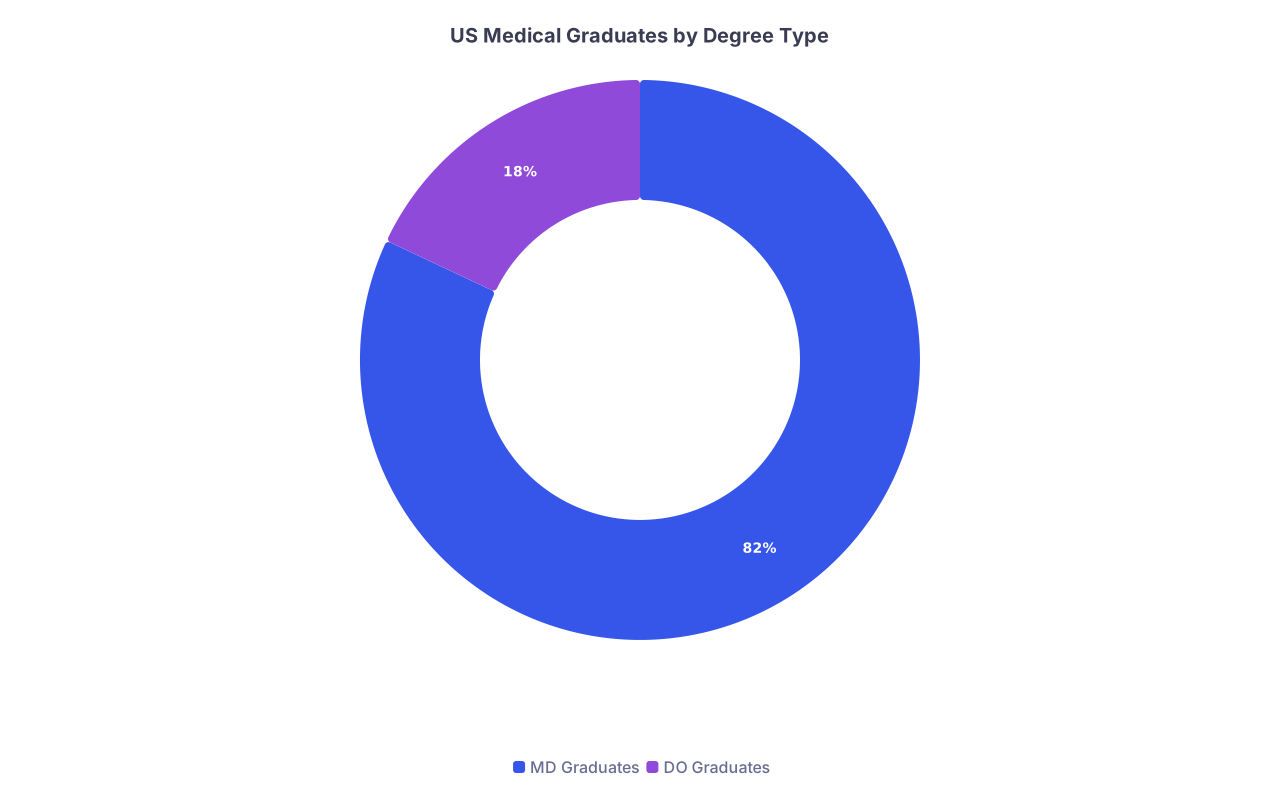
| Category | Value |
|---|---|
| MD Graduates | 82 |
| DO Graduates | 18 |
Step 1: Get Clear On What You Actually Prefer (And Why)
Before you write or say anything, you need clarity in your own head.
There are three legit bases for DO vs MD preference:
- Educational philosophy
- Training environment and culture
- Practical factors (geography, competitiveness, specialty goals)
If your current answer is “MD is more prestigious” or “DOs are more holistic,” that’s surface-level. Interviewers hear that 30 times a week. You need to go deeper.
If You Prefer DO
Good DO answers usually come from things like:
- You’ve shadowed DOs and seen osteopathic philosophy lived out in clinic
- You care about primary care, whole-person focus, or underserved areas and you’ve actually done work in those spaces
- You’re interested in OMT because you’ve seen it help patients (not because “it seems cool”)
Concrete examples:
- “I shadowed a DO family physician who used OMT for chronic low back pain in a patient who couldn’t tolerate NSAIDs. Watching her integrate manual treatment with counseling and medications made the DO approach click for me.”
- “Volunteering at a free clinic, I kept seeing complex social situations behind ‘simple’ problems. I like that osteopathic training formally emphasizes looking at structure-function and environment together, not just the diagnosis code.”
Weak DO answers:
- “I like holistic medicine” (everyone says this)
- “I didn’t think I could get into MD” (do not say this out loud, even if partly true)
- “DOs care more about patients” (insulting and untrue)
If You Prefer MD
Good MD answers typically come from:
- Strong interest in research or academic medicine with direct exposure
- You’ve worked with MD mentors in settings you want to emulate (academic hospital, subspecialty, etc.)
- You like the curricula or opportunities you’ve seen at specific MD schools
Concrete examples:
- “I worked in a cardiology outcomes lab where most of my mentors trained at MD institutions with strong research infrastructures. I’m drawn to that environment and want the option to combine clinical care with outcomes research.”
- “I spent two summers on a transplant unit at a large academic center and loved it. Many surgeons there trained at MD programs, and I’m aiming for a similar training path.”
Weak MD answers:
- “MD is more respected” (you’ll sound immature and uninformed)
- “MD has better residency chances” (very reductionist and partially outdated in the single-match era)
- “Because that’s what I always imagined” (fine as a feeling, useless as an interview answer)
Step 2: Ground Your Preference in Exposure, Not Stereotypes
Interviewers don’t want abstract theories. They want receipts.
You should be able to say something like:
For DO preference: “I shadowed two DOs in family medicine and sports medicine. Both used OMT selectively, but more importantly, they modeled that biopsychosocial, whole-person thinking I’d been reading about. It wasn’t marketing—it was how they practiced.”
For MD preference: “My main mentors in oncology are MDs at an academic center. I’ve seen how their training set them up for both complex inpatient care and clinical research. That environment clicked for me.”
If you haven’t shadowed a DO but are applying DO:
- Be honest about that, but don’t leave it there.
- Show you’ve at least done serious investigation: DO club meetings, talking with DO residents, reading COMLEX/USMLE/residency info.
Example: “I haven’t yet had the chance to shadow a DO physician, but I’ve actively sought out DO perspectives—through our pre-DO society, talking to DO residents at my local hospital, and learning about OMT and the osteopathic tenets. Based on that, I see a strong alignment with how I want to approach patient care.”
That’s fine. Not ideal, but honest and mature.

Step 3: How To Talk About DO vs MD Without Insulting Anyone
Here’s the part everyone messes up: you explain your preference, and in the process you accidentally trash the other degree.
Don’t do that.
Core rule: Always frame your preference as “fit,” not “better.”
Bad:
“I prefer DO because DOs are more holistic than MDs.”
Translation to the MD interviewer: “You don’t care about people.”
Better:
“I’m drawn to osteopathic training because I like how explicitly the curriculum incorporates whole-person principles and, in many schools, structured OMT training. I know all good physicians aim to care for the whole patient; I just appreciate that DO programs build that into their formal framework.”
Bad:
“I prefer MD because MD schools are more rigorous and competitive.”
Translation to the DO interviewer: “Your degree is second-tier.”
Better:
“I’m particularly interested in training in a large academic center with heavy research involvement. Most of my direct mentors happened to train at MD institutions that fit that profile, so that’s shaped my preference. I also recognize there are DO programs and DO graduates doing strong academic work.”
Admit this reality: both DO and MD physicians can:
- Match into competitive specialties
- Do academic medicine
- Run clinics, lead teams, do research, teach
If you sound like you think otherwise, you’ll lose points with almost any interviewer.
Step 4: Specific Language You Can Actually Use (Templates)
Let me give you concrete scripts. Tweak them to sound like you.
If You’re Applying Primarily DO
“For me, the biggest reason I’m drawn to osteopathic training is [specific reason tied to experience]. When I shadowed Dr. Smith, a DO in family medicine, I saw how she integrated musculoskeletal exams, lifestyle counseling, and patients’ social context into routine visits. That whole-person framework matches how I already think about patients.
I know MD and DO physicians both ultimately take care of patients and can end up in the same specialties. But the osteopathic emphasis on structure-function, preventive care, and in some programs hands-on OMT training aligns with the way I want to practice.”
That’s strong. It’s specific, respectful, and experience-based.
If You’re Applying Mix of MD and DO
You do not need two completely different worldviews. You need nuance.
General framing: “I’m applying to both MD and DO schools because my top priority is becoming a strong, competent physician who cares well for patients. I see both pathways as valid ways to get there.
I’m especially drawn to [for DO schools: osteopathic philosophy / OMT; for MD schools: academic environment / research / specific curriculum features], and I’ve tried to choose schools where there’s a clear alignment with my background and goals.”
Then you tune it:
At an MD interview: “I value whole-person care and a biopsychosocial approach. I’ve seen that in both DO and MD mentors. For MD schools specifically, I’m looking for [xyz: research, specific curriculum, certain clinical setting] because of [your experiences].”
At a DO interview: “I’m applying DO because I’m excited about the osteopathic philosophy and the opportunity to train with that lens from day one. I especially like that at schools like this one, OMT isn’t just a separate skill—it’s integrated into thinking about diagnosis and treatment.”
Step 5: What To Do If They Ask Directly “Why Not The Other Degree?”
You’ll hear some version of:
- “So if you got into both an MD and DO school, how would you choose?”
- “Be honest—why not go MD?”
- “Why apply DO if you’re also applying MD?”
Here’s how to handle that without digging a hole.
Strategy: Acknowledge overlap, then explain your tie-breakers
Example (at a DO school):
“I see MD and DO as two valid paths to the same endpoint: being a competent, compassionate physician. If I were fortunate enough to have options in both, I’d look at three things:
- Curriculum and philosophy – I’m strongly drawn to the osteopathic emphasis on whole-person care and the additional OMT training.
- Clinical environment – I’d prioritize schools that work heavily with underserved or primary care populations, which many osteopathic schools do.
- Fit with my experiences – since a lot of my background has been in [free clinic work, community health, etc.], the DO framework feels especially aligned.
So yes, I’m open to both, but I can very clearly see why a school like this one would be a top choice.”
At an MD school, mirror that but tuned to their strengths:
- Academic environment
- Research
- Specific clinical systems, etc.
Key points:
- Don’t say you’d always pick MD over DO or vice versa.
- Don’t claim DO is only a “backup” even if your stats are MD-competitive. That’s a fast way to sound arrogant.

| Step | Description |
|---|---|
| Step 1 | Know your real reasons |
| Step 2 | Ground in experiences |
| Step 3 | Emphasize research & academic exposure |
| Step 4 | Emphasize osteopathic philosophy & fit |
| Step 5 | Frame as fit not better |
| Step 6 | Use respectful, balanced language |
| Step 7 | Interview setting |
Step 6: Essays vs Interviews – How Your Explanation Should Differ
Essays and interviews play different roles.
In Essays
You want a clean, coherent narrative. No rambling DO vs MD debate.
If you’re writing a “Why DO?” essay:
- Start from an experience (shadowing, patient story, volunteer work).
- Tie that to osteopathic principles (whole person, structure-function, prevention, body’s self-healing).
- Mention OMT only if you actually understand what it is and have seen or used it.
Example structure:
- Patient/clinical moment
- What you noticed about the DO’s approach
- How that connects to osteopathic philosophy
- What that means for how you want to practice
For MD-focused personal statements:
- You usually don’t say “why MD” explicitly.
- You show it through your academic/research/clinical interests and the mentors you’ve worked with.
In Interviews
You shift from polished narrative to flexible conversation.
You should have:
- A 30–60 second core explanation
- 2–3 concrete examples ready (shadowing, research, patient interactions)
- A clear, respectful way to talk about both degrees
Don’t try to memorize a script. Memorize points, not sentences.

Step 7: Reality Check – How Much Does Your Preference Actually Matter?
Here’s the honest truth: your explanation matters less than:
- Your grades and scores
- Your clinical experience and insight
- Your maturity and self-awareness
But when interviewers ask this, they’re testing:
- Do you understand the training you’re signing up for?
- Are you thoughtful or just parroting Reddit?
- Will you bad-mouth colleagues or other training paths once you’re a physician?
If you:
- Stay grounded in real experiences
- Speak respectfully about both DO and MD
- Frame your preference as a matter of fit
you’ll be fine.
FAQ: DO vs MD Preference in Interviews and Essays
Do I have to declare a strong preference between DO and MD?
No. You need a coherent explanation for why you’re applying where you’re applying. You can absolutely say you see both as valid paths and highlight what draws you to each, as long as it doesn’t sound like you’re just spraying applications everywhere without thought.Is it bad to say DO is my “backup” to MD?
Yes, in an interview that’s a bad move. Schools don’t want to feel like your safety net. You can privately have a rank order of preference; publicly, you should talk about fit and what genuinely attracts you to that specific school and degree, even if MD might edge out overall.Can I talk about residency competitiveness as a reason for preferring MD?
You can mention long-term goals, but saying “MD because it’s easier to match competitive specialties” makes you sound transactional and partially out of date. Better: talk about the kinds of training environments, mentors, or research setups you’ve seen associated with MD paths, without claiming DO makes things impossible.How much should I emphasize OMT in a DO interview?
Mention it if you truly care and have some understanding. Don’t pretend you want to do OMT every visit if you’ve never even seen it. A solid line is: “I’m interested in learning OMT and understanding how to use it appropriately as an additional tool, not a replacement for standard care.”What if I’m applying DO with zero DO shadowing?
Then be transparent and proactive. Say you haven’t had DO shadowing opportunities but you’ve learned from DO residents, advisors, or structured events, and you’ve read and reflected on osteopathic principles. It’s not ideal, but with strong, authentic reasoning, you can still be credible.Should my MD and DO personal statements be totally different?
Your core story can be similar—why medicine, key experiences, what drives you. For DO-specific essays (secondaries or AACOMAS), explicitly connect your story to osteopathic principles and why the DO framework appeals to you. Don’t just paste an MD essay and add the word “holistic.”What’s one line I should absolutely avoid saying about DO vs MD?
Anything close to: “DO is just like MD but easier to get into.” That one sentence tells them you don’t understand the profession, you disrespect their training, and you’re treating their school as a consolation prize. You won’t recover from that.
Key takeaways:
- Base your DO vs MD explanation on real experiences, not clichés.
- Frame your preference as fit, never as one degree being “better.”
- Show you respect both paths and can articulate, calmly and clearly, why you’re choosing the one you’re sitting there interviewing for.