It’s sophomore year, you’re staring at MCAT prep books, and your browser has 19 tabs open: “DO vs MD prestige,” “Can DOs do dermatology,” “Are orthopedic surgery spots impossible for DOs now?” You’re not just picking a school type; you’re terrified you’re picking which doors will be permanently locked 10 years from now.
Let me answer the core question first, clearly:
No, choosing DO does not automatically close the door to any specialty. But for a few of the most competitive ones, it does make the door heavier, smaller, and harder to squeeze through.
You need specifics. Specialty by specialty. Not vague “it depends.”
So that’s what this is: a brutally honest, specialty-by-specialty guide to what choosing DO realistically means for your future options in the U.S. after the single accreditation merger.
Big Picture: What DO vs MD Actually Changes
There are three big levers that affect whether DO vs MD matters:
- Competitiveness of the specialty
- Program culture and bias (yes, it still exists)
- Your individual stats and track record
Here’s the pattern I’ve seen over and over:
- For primary care and many “middle-competitiveness” specialties: DO vs MD barely matters if you’re a solid applicant.
- For the “trophy” specialties (derm, plastics, ortho, neurosurg, ENT, urology, some competitive radiology/EM): being DO does make life harder. Not impossible. Harder.
- For ultra-competitive academic programs (top 10 brand-name university hospitals): DO applicants can match, but you’re starting slightly behind the line.
One more thing: Step 1 going pass/fail (while COMLEX still has numeric scores) changed the game. Many PDs prefer seeing USMLE Step 1/2 numbers to compare you directly against MD applicants. That means if you’re DO and aiming competitive, taking USMLE is almost mandatory.
Let’s go specialty by specialty.
Safest Ground: Specialties Where DO vs MD Matters the Least
These are fields where DOs are well-represented and program directors are used to training them. If you do well in school, pass your boards on time, and are not a disaster socially, you’re in good shape.
1. Family Medicine
Door status if you choose DO: Wide open.
Family medicine is loaded with DOs. Many FM program directors are DOs themselves. If you pass COMLEX, have decent clinical performance, and don’t have major red flags, you’ll match.
Want a competitive academic FM program at a place like University of Washington or UCSF? You’ll need stronger credentials (research, high board scores, strong letters) just like an MD would. But DO is not a major barrier.
2. Internal Medicine (community & many academics)
Door status: Open, with some brand-name exceptions.
Community IM and many academic programs are totally fine with DOs. You’ll see plenty of DOs in IM residencies across the country.
Where it gets trickier:
- Top-tier academic IM (MGH, Hopkins, UCSF, Penn etc.): You can match as a DO, but you need:
- Excellent board scores (including USMLE)
- Strong research
- Great letters and maybe home or away rotations at places that know you
But if your goal is “become an internist,” hospitalist, or even many fellowships (cards, GI, etc.), DO is very workable. The bottleneck is more about how strong you are as an applicant, not the degree label.
3. Pediatrics
Door status: Open.
Peds is friendly to DOs. Plenty of DOs in both community and academic pediatrics. If you want a super-elite academic peds program, same story as IM: you’ll need to be at the top of your class. But DO won’t kill your chances.
4. Psychiatry
Door status: Open and welcoming.
Psych has become more competitive, but it’s still very DO-friendly. Many psych programs specifically say they like DO applicants. If you’re interested in outpatient psych, inpatient, or even subspecialties (child/adolescent, addiction), DO is not a major barrier.
5. PM&R (Physical Medicine & Rehabilitation)
Door status: Open, but not automatic.
PM&R has historically had a strong DO presence. Some PM&R chairs and program directors are DOs. Still competitive, but very attainable as a DO if:
- You show genuine interest (shadow, electives)
- You perform reasonably well on boards
- You get some related exposure (sports, MSK clinics, rehab settings)
Middle Tier: Specialties Where DO vs MD Matters Some, But Not Dominant
These are fields where DOs match consistently, but there is some degree of bias or extra scrutiny at the more competitive programs.
6. Emergency Medicine
Door status: Partially open, more selective than it used to be.
Before the merger, DOs were very common in EM. Post-merger and with EM match volatility, some programs became pickier and more cautious.
As a DO aiming for EM:
- You should take USMLE Step 1 and 2.
- You need strong SLOEs (standardized letters) from EM rotations.
- Some higher-tier urban academic EM programs still favor MDs, but many community and mid-tier academic programs are fine with DOs.
Is choosing DO going to completely block EM? No. But if your dream is ultra-prestigious academic EM at a top-10 hospital, you’ll be fighting a slightly steeper uphill battle.
7. Anesthesiology
Door status: Open at many, tighter at the top.
DOs match anesthesia regularly. Strong DO candidates with USMLE scores, solid clinical performance, and maybe some related exposure (ICU, OR experience) are competitive.
The bias creeps in more at:
- Highly academic programs
- Big-name coastal institutions
You can absolutely become an anesthesiologist as a DO. Just don’t coast. You need to assemble a clean, strong application.
8. Neurology
Door status: Pretty open.
Neurology is steadily more competitive, but still quite friendly to DOs. Many programs genuinely don’t care about DO vs MD if your performance and letters are solid.
If you want high-end academic neurology with lots of research, then just like other fields, you’ll need research, Step scores, and strong mentorship.
9. OB/GYN
Door status: Open but competitive.
OB/GYN is not “easy” for anyone right now, DO or MD. But DOs match OB/GYN every year across the country.
To be realistic as a DO:
- Plan on USMLE Step 1 and 2.
- Aim for strong clinical evals in OB, good letters.
- Consider away rotations to show your face to programs that may be less familiar with your school.
Ultra-elite academic OB/GYN is harder as a DO, but community and many academic programs are reachable.
10. General Surgery (non-elite)
Door status: Open but narrow.
Here’s where people start to get nervous. Can DOs still do surgery? Yes.
But general surgery is picky. Many surgery programs still carry prestige bias and want:
- High USMLE Step scores
- Evidence you can handle the workload
- Strong letters from surgeons
You’ll see DOs in gen surg residencies. But you’ll also see more DOs getting filtered out early at certain brand-name academic places. If you’re DO and set on surgery, you need to be serious:
- Top clinical performance
- Take USMLE
- Possibly do auditions/aways at DO-friendly surgical programs
The door is not closed. It’s just heavy.
Hard Mode: Specialties Where DO vs MD Absolutely Matters
These are the fields where being DO doesn’t end the conversation—but it changes it. You’re judged more harshly up front and often need to significantly outperform the average MD applicant to get the same look.
11. Dermatology
Door status if you choose DO: Technically open, functionally very narrow.
Derm is one of the most competitive specialties in medicine, period. Many derm programs:
- Rarely or never rank DO applicants
- Prefer MDs from well-known academic schools
- Care a lot about research output, especially in derm
Can a DO match derm? Yes. I’ve seen it. But the DOs who match derm usually:
- Took USMLE Step 1 and 2 and crushed them
- Did heavy dermatology research (sometimes a dedicated research year)
- Have derm mentors, strong letters, and away rotations
- Often attend DO schools with strong derm connections
If you’re premed and derm is your non-negotiable dream, I’d strongly lean MD if you have the option. If you go DO, you need to walk in with eyes wide open and be ready for a hyper-optimized path from day one.
12. Orthopedic Surgery
Door status: Very narrow but not locked.
Historically there were AOA ortho spots more accessible to DOs. Post-merger, many of those spots remain DO-friendly, but still fiercely competitive.
Reality for DOs targeting ortho:
- You basically must take USMLE.
- You need strong clinical grades, great letters, and ideally research.
- You probably need multiple audition rotations at DO-friendly ortho programs.
- Some ortho programs will quietly (or openly) screen out DOs.
Again, not impossible. But DO vs MD matters here. If you’ve always wanted to be an orthopedic surgeon and you hold comparable MD and DO acceptances, MD gives you smoother odds.
13. Neurosurgery
Door status: Barely open.
Neurosurgery is small, hyper-competitive, academic-heavy, and prestige obsessed. DOs do match neurosurgery—but it’s rare and usually involves:
- Top-tier USMLE scores
- Multiple neurosurg publications
- Heavy mentoring and networking
- Rotations at neurosurgery programs that are explicitly DO-friendly
If you’re a premed saying “I’m going neurosurg or bust,” it’s reckless to ignore the DO vs MD factor. Take the MD seat if you have it. If DO is your only pathway into medicine, you can still aim high, but understand you’ll be fighting uphill hard.
14. Plastic Surgery (Integrated)
Door status: Almost shut, but not zero.
Integrated plastics is one of the top 2–3 most competitive matches. DOs do occasionally match, but it’s rare. Many plastics programs don’t interview DOs at all.
You’d need:
- Outstanding USMLE scores
- Extensive plastics research (posters, publications)
- Strong letters from well-known plastic surgeons
- Audition rotations at the few DO-friendly plastics programs
This is not about fairness. It’s about reality. DO isn’t a smart choice if your only goal in life is integrated plastics and you have an MD acceptance on the table.
15. ENT (Otolaryngology), Urology, and Some Competitive Radiology Programs
Door status: Cracked open, with bias.
ENT and urology are more DO-friendly now than 10–15 years ago, but there’s still definite bias. Same with some IR-heavy or elite diagnostic radiology programs.
As a DO, you’ll need:
- USMLE scores
- Research and strong mentorship within the specialty
- Strategic away rotations
If you crush everything, you can match. But MD has the smoother route on average.
How Much Does Program “Prestige” Matter for DOs?
Let’s be blunt: prestige matters most if you want:
- Very competitive fellowships (like interventional cards, GI, IR, some onc)
- A heavily academic career (NIH funding, major research, big-name faculty roles)
- Brand-name hospitals for ego or long-term academic positioning
As a DO, you can still land these. But you’re more likely to:
- Start at a mid-tier residency
- Work your way up via excellent performance and smart networking
- Take a longer route to reach the same academic height
Your degree type is one factor. Your choices, work, mentors, and timing are bigger ones over a career.
Smart Strategy if You’re Leaning DO
If you’re seriously considering DO, here’s how to avoid accidentally boxing yourself in:

| Step | Description |
|---|---|
| Step 1 | Start DO school |
| Step 2 | Plan to take USMLE Step 1 & 2 |
| Step 3 | Focus on class rank & COMLEX |
| Step 4 | Find specialty mentors early |
| Step 5 | Do research & electives in that field |
| Step 6 | Plan audition rotations at DO-friendly programs |
| Step 7 | Explore multiple specialties |
| Step 8 | Apply broadly & strategically |
| Step 9 | Want competitive specialty? |
Key moves:
- Decide early if a competitive specialty is even on your radar. If yes, behave like it from MS1. - Strongly consider taking USMLE in addition to COMLEX.
- Choose a DO school with:
- Good match lists in the fields you care about
- Real academic affiliations and residency connections
- Get mentors in your specialty of interest by early MS2/MS3.
- Do audition rotations where DOs have historically matched.
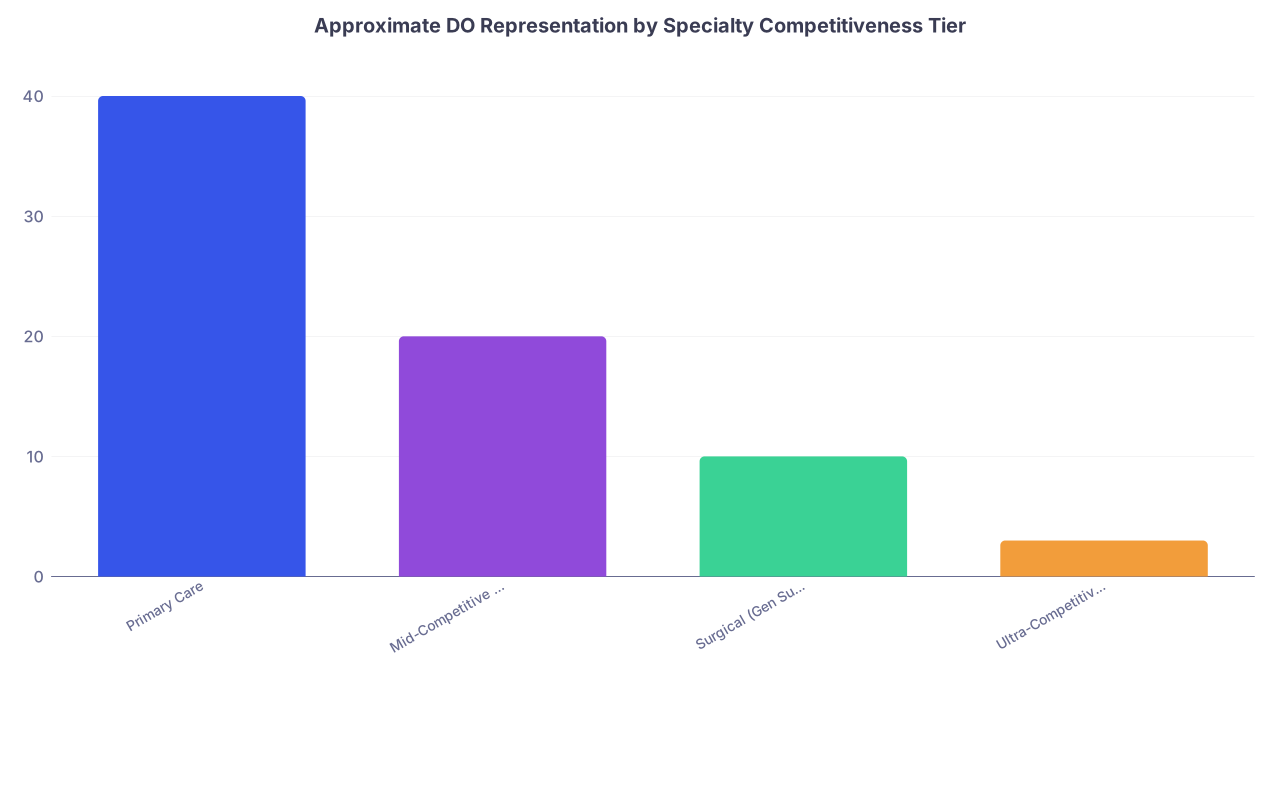
Quick Reality Snapshot: Where DOs Commonly Match
| Category | Value |
|---|---|
| Primary Care | 40 |
| Mid-Competitive (EM, Anes, Neuro, OB/GYN) | 20 |
| Surgical (Gen Surg, Ortho) | 10 |
| Ultra-Competitive (Derm, Plastics, Neurosurg) | 3 |
Those percentages aren’t exact NRMP values—they’re directional reality. The more elite and hyper-competitive you go, the fewer DOs you’ll see. But “fewer” isn’t “none.”
When Picking DO Is Actually the Better Move
There are plenty of times DO is the smarter decision:
- You want primary care, psych, PM&R, or similar and have a strong DO offer close to home.
- Your MD options are extremely weak (no support, poor match history) and you have a strong DO program acceptance with better outcomes.
- You like the osteopathic philosophy and don’t care about elite academic branding.
DO isn’t “settling” unless you’ve decided MD prestige is your identity. Most patients have no idea what the letters even stand for. They care if you’re competent and you listen.
FAQ: DO vs MD and Specialty Choice
1. Will choosing DO completely block me from dermatology, plastics, or neurosurgery?
Not completely, but it makes those paths much harder. You’ll need:
- Top-tier board scores (including USMLE)
- Strong research, often in that specialty
- Powerful letters and strong mentorship
If you already have an MD acceptance and your heart is set on those three, I’d favor MD.
2. Do I have to* take USMLE as a DO?
If you’re aiming for:
- Any competitive surgical field
- EM, anesthesia, radiology, ENT, urology, neuro, or competitive IM/OB/GYN
Then yes, practically speaking. Many PDs are more comfortable comparing USMLE scores. For primary care only (FM, many peds or psych programs), you might skip USMLE, but it does close some doors.
3. Are there still programs that just won’t take DOs?
Yes. Some programs:
- Quietly screen out DOs
- Publicly say they “prefer MD”
- Or simply never rank DOs in practice
You’ll see this mostly in hyper-competitive specialties and top-name academic hospitals. But there are also programs in those same fields that are DO-friendly. Strategy is knowing the difference.
4. How can I tell if a residency is DO-friendly?
Check:
- Current residents: are there DOs in the roster?
- Past match lists from DO schools: which programs consistently take DOs?
- Program websites and social media: any DO faculty?
This matters especially for audition rotations and where you choose to apply.
5. If I’m undecided on specialty, is DO risky?
Not automatically. It depends what’s realistically on your horizon. If you’re genuinely open to:
- FM, IM, peds, psych, PM&R, many neurology/anesthesia/EM/OB programs
DO is perfectly fine. If your personality and track record absolutely scream “I might go for derm/ortho/neurosurg,” then MD gives more breathing room if you can get in.
6. Bottom line: Will choosing DO close doors?
It can narrow doors in the very top, most competitive specialties and elite academic centers. It does not close the entire building. For the majority of real-world medical careers—primary care, hospitalist medicine, psych, many subspecialties—DO vs MD is a smaller factor than your performance, mentorship, and strategy.
Key takeaways if you skimmed:
- No specialty is officially off-limits to DOs, but a few (derm, plastics, neurosurg, ortho, ENT, urology) are noticeably harder.
- For primary care and many mid-competitive fields, DO vs MD matters far less than your board scores, clinical performance, and strategy.
- If you choose DO and want competitive specialties, plan early, take USMLE, get strong mentors, and be strategic about rotations and programs.