
It’s 11:45 pm in a dim call room. You’re a premed doom‑scrolling SDN and Reddit, staring at another “MD vs DO – Will attendings judge me?” thread. Or you’re an M2 at a DO school, sitting in the library, hearing upperclassmen say, “Yeah… that surgeon basically only takes MDs.”
Nobody will write this in an official policy. But behind closed doors, in selection meetings, resident eval sessions, and informal hallway conversations, attendings absolutely express quiet preferences between MD and DO trainees.
Let me tell you how it actually plays out.
The Real Hierarchy No One Puts on the Website
In faculty meetings, we do not say, “We prefer MDs.” That’s career suicide in 2026. But the hierarchy still shows up in how people talk, who they trust, and who they fight for on rank lists.
The unspoken truth in many academic and competitive environments looks like this:
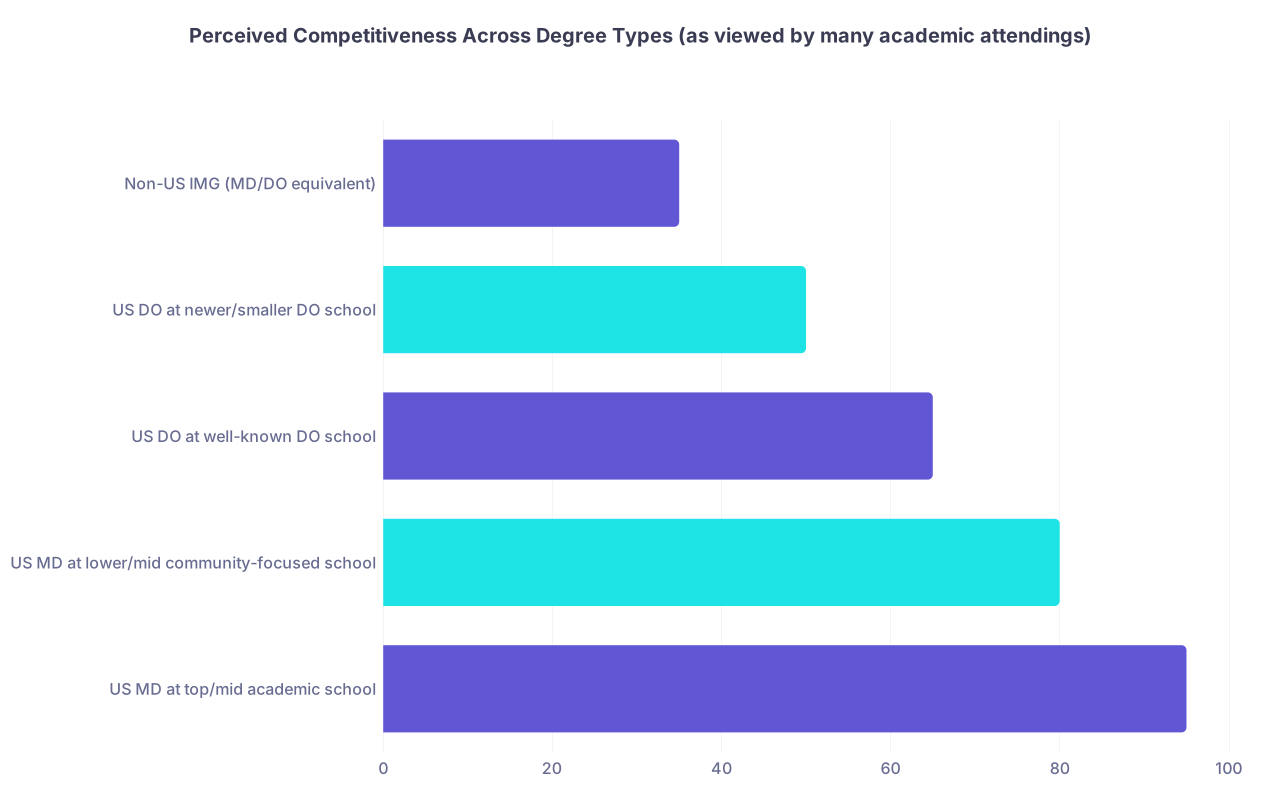
| Category | Value |
|---|---|
| US MD at top/mid academic school | 95 |
| US MD at lower/mid community-focused school | 80 |
| US DO at well-known DO school | 65 |
| US DO at newer/smaller DO school | 50 |
| Non-US IMG (MD/DO equivalent) | 35 |
No one will show you this graph. But this is the mental tier list some attendings and PDs use when they’re glancing at an ERAS page or deciding who gets the benefit of the doubt.
A few realities:
- Older, academically‑oriented attendings at big university hospitals are more likely to default to “MD first” thinking. They grew up in the “DO = backup” era.
- Community attendings who trained with excellent DOs often genuinely don’t care about letters after your name. They care if you show up on time and don’t scare patients.
- In ultra‑competitive fields (ortho, derm, ENT, plastics, interventional cards, neurosurg), there is still real bias against DOs at many big‑name institutions. They won’t say it on the website. You’ll hear it in the workroom.
None of this is about fairness. It’s about pattern recognition, prejudice, and departmental culture.
Where Attendings Quietly Favor MDs — And Why
Let’s go into where MDs usually get the silent nod and what’s really behind it.
1. Academic Prestige Signaling
Picture a faculty selection meeting for residency applicants at a mid‑tier academic program. PowerPoint slides, everyone a little tired. The PD is scrolling through candidates:
“US MD, top 30, strong Step 2, AOA, publications.”
Next slide. “US DO, solid scores, good letters, strong audition.”
Watch the room. People lean forward on the first one. They’re neutral on the second until someone advocates.
I’ve seen faculty say, off mic:
“MD from X school, we know their training is strong.”
“DO from Y school… anyone know what their clinical evals are like?”
Translation: MD here is shorthand for “I recognize this brand and trust its quality control.”
Drivers behind this:
- Familiarity. Many attendings trained in all‑MD environments and simply don’t know DO schools, so they don’t trust what they don’t recognize.
- Research and reputation. Big MD schools feed into big residencies, big fellowships, big journals. That halo effect doesn’t magically stop at graduation.
- Department ego. Academic departments like to brag about match lists, fellowship placements, medical school pedigrees of their residents and fellows.
So in these rooms, if everything else is equal on paper, the MD often gets the quick “yes” before the DO does. The DO needs someone to say, “I worked with them. They’re excellent. Take them.”
2. Competitive Specialties: The Bias Is Still Very Real
In ortho, derm, ENT, plastics, neurosurgery, and some high‑end cardiology or GI fellowships, the default is still MD > DO unless something intervenes.
Why?
Because in these fields, people are obsessed with risk management of training slots. They want “proven pipelines.” And historically:
- Those pipelines were all US MD.
- The top programs took almost no DOs, so they have no success stories to point to.
- Old myths about DO training (“less rigorous,” “more primary care focused,” “weaker shelf prep”) still circulate in the background.
I’ve heard exact phrases like:
- “We’ve just had better success with MDs from these 5 schools.”
- “If we’re going to take a DO, I want them to have killed it on rotations here.”
- “They’re DO and they didn’t rotate with us? Pass.”
So the DO bar becomes: you do not match by being “good.” You match by being indisputable. Top of class. Strong scores. Audition rotations where the attendings are basically begging the PD to rank you high.
If you’re DO aiming for one of these, you cannot play a soft game. You need:
- A killer away rotation where specific surgeons or subspecialists learn your name and back you.
- Strong letters from MD attendings in that specialty, ideally at known programs.
- Scores and clinical evals that make it easy for a PD to defend you in the room.
Because they will have to defend you. MDs from “known” schools often don’t.
Where DOs Win or At Least Don’t Lose
Now the flipside. There are places where DOs get real respect, or at least aren’t starting a step behind.
1. Community Hospitals and “Blue Collar” Specialties
Community internal medicine. FM. EM at non‑big‑name sites. Hospitalist‑oriented IM programs. Many of these were built by people who trained with DOs their whole careers.
At those institutions, the quiet preferences often flip:
- Attendings complain about the “entitled MD from Prestigious U” who doesn’t answer pages and thinks he’s too good for nights.
- They praise the DO resident who hustles, talks to nurses respectfully, explains things to patients clearly, and doesn’t meltdown on a busy night.
You’ll hear stuff like:
- “I don’t care if they’re MD, DO, alphabet soup. Just give me someone like Dr. S from last year.”
- “Our best chief last year was a DO. I’d take five more like them.”
In many of these places, DOs are not the exception. They are the norm. The attendings are DOs. The PD is DO. The culture is: show up, work, no drama.
If you’re DO and targeting these kinds of programs, the MD bias is usually muted to nonexistent. They may even look at your osteopathic background as “you’re one of us.”
2. Osteopathic-Heavy Departments
There are entire departments at some hospitals that are basically 70% DO faculty and residents. If you walk into an osteopathic‑heavy IM or FM program as a DO, no one is quietly questioning your legitimacy. They’re more likely to question the MD.
Faculty commentary I’ve heard in these environments:
- “The MD kids sometimes struggle more with the culture here. The DOs know the drill.”
- “We’ve been burned more by fancy MDs than the DOs who actually grew up in community care.”
In these settings, DO is neutral at worst, slightly advantageous at best. You don’t have to prove that your degree is valid. You just have to prove that you’re competent and not lazy.
3. Bedside Skills and Communication
There are attendings who genuinely believe DOs are better with patients. That they’re less robotic, more holistic, more human. Right or wrong, I’ve heard this exact take from a cardiology attending talking about his favorite residents.
In fields where patient interaction and communication are critical (FM, psych, palliative, some IM-heavy programs), I’ve seen DOs get strong “fit” comments like:
- “They’re not just smart—they actually talk to patients like people.”
- “You can tell they’ve been thinking about whole‑person care for a while.”
No one gives you a spot “because DO = nice person.” But the DO brand can soften some edges, especially if you’re competing against MDs that present as robotic or purely metrics‑driven.
How Preferences Show Up Day‑to‑Day on Rotations
On rotations is where these quiet preferences really crystallize. Not in formal policy. In the attending’s gut reaction to you on day 1.
1. First Impression: MD vs DO Badge
On your first day, your badge flashes “College of Osteopathic Medicine of X.”
Some attendings won’t care. Some will say, “Oh you’re DO, do you do OMM?” in a genuinely interested way. A few will mentally tag you: “Let’s see if this one’s solid.”
Here’s what actually happens inside some attendings’ heads:
- MD from a known med school: baseline expectation = competent until proven otherwise.
- MD from a tiny, unknown school: slight skepticism but curiosity.
- DO from a recognized DO school: neutral but watching.
- DO from a very new or obscure DO school: skepticism unless you impress fast.
Nobody says this out loud. You’ll feel it in how quickly they trust you with tasks, how long it takes before they stop double‑checking everything you write, how they talk about you to the residents.
2. The “I Had a Bad Experience with a DO Once” Problem
One bad DO trainee can poison the well for years, especially in smaller departments.
Example I’ve actually seen play out:
- A DO sub‑I on surgery who showed up late, flubbed anatomy repeatedly, tried to leave early, clearly wasn’t prepared.
- For the next cycle you hear someone in the room: “Last year’s DO student from that school was a mess. Let’s not go down that road again.”
Is that fair? No. Is it real? Yes. And the same thing happens with MD schools—one terrible MD student can sour a specific school’s name locally. The difference is: MD schools typically have longer‑standing reputations and more chances to redeem themselves. Some DO schools do not.
3. How DOs Flip the Script on Rotation
Here’s the good news. When a DO student crushes a rotation in a place that rarely takes DOs, the effect is dramatic. I’ve watched attendings change their mental model in real time.
They start phrases like:
- “We need to remember [Your Name] at rank time.”
- “I’d be happy to have them as an intern.”
- “We should probably look more closely at applicants from that DO school.”
You become the “exception DO” that starts to break the stereotype. And trust me, attendings remember these exceptions over time.
Program Directors: What They Say Publicly vs What Happens Privately
PDs are in a bind. Publicly, everything must be degree‑neutral. Legally, professionally, politically. Privately, they’re balancing risk, precedent, and what their attendings are whispering.

| Step | Description |
|---|---|
| Step 1 | Applicant Pool |
| Step 2 | Lower threshold for interview |
| Step 3 | Check scores and letters closely |
| Step 4 | Faculty advocate strongly |
| Step 5 | Higher bar for interview |
| Step 6 | Borderline decisions |
| Step 7 | Rank based on full picture |
| Step 8 | US MD or DO? |
| Step 9 | Known school? |
| Step 10 | Strong rotations with us? |
The truth from the PD chair:
- A strong MD from a known school often gets an interview by inertia. Nobody has to fight for them.
- A strong DO, especially from a less‑known school, usually requires evidence plus an internal champion.
PDs are also heavily influenced by their attendings’ experience:
- If the ward team loved a DO rotator, that person is golden.
- If 3 different attendings complain about a DO resident’s performance (fairly or unfairly), the PD will quietly hesitate on similar applicants going forward.
The PD is not sitting there hating DOs. They’re trying not to get burned by “unknown quantities,” and they lean on institutional memory to guide them. That memory is often skewed toward MD pipelines.
What You Should Actually Do With This Information (Premed + Med Student)
You’re not here just to hear the gossip. You want to know what to do.
If You’re a Premed Deciding MD vs DO
Here’s the cold version.
If you have realistic MD options, especially at mid‑tier or better US MD schools, and you’re aiming at competitive specialties or academic centers, you take MD every. single. time. The path is cleaner. There’s less bias to fight.
If your MD options are terrible or nonexistent (very low MCAT/GPA), and you can get into a solid DO school, DO is absolutely a valid path to being a physician. But understand the trade:
- Primary care, IM, psych, FM, EM (at many sites) will be open to you.
- Top derm/ortho/ENT/plastics/NSG spots will be significantly harder, sometimes nearly impossible at certain institutions, without insane performance.
If you know deep in your bones you want something hyper‑competitive, choosing DO means you’re signing up to massively overperform colleagues just to break even. Some people do it. Many don’t.
If You’re Already a DO Student
Stop pretending the bias doesn’t exist. But also stop acting like it’s a death sentence. It’s a tax. A real one. You can work around it.
Your job:
- Choose your clinical rotations wisely. Get time at hospitals and programs that actually take DOs in your specialty of interest.
- On every rotation, assume you’re being graded a half‑step more harshly than a comparable MD. You need to be clearly better, not “about the same.”
- Get MD attendings to write concrete, specific letters. Not “nice student, hard worker.” You want: “One of the best students I’ve worked with in the last 3 years, regardless of degree.”
And if you’re at a newer DO school with weaker name recognition? You’re playing life on hard mode. Plan accordingly. Strong Step 2 or COMLEX performance. Seek away rotations strategically at DO-friendly but reputable sites.
What Attendings Actually Respect (More Than MD vs DO)
Behind the letters, there are a few things that override bias for a lot of faculty.
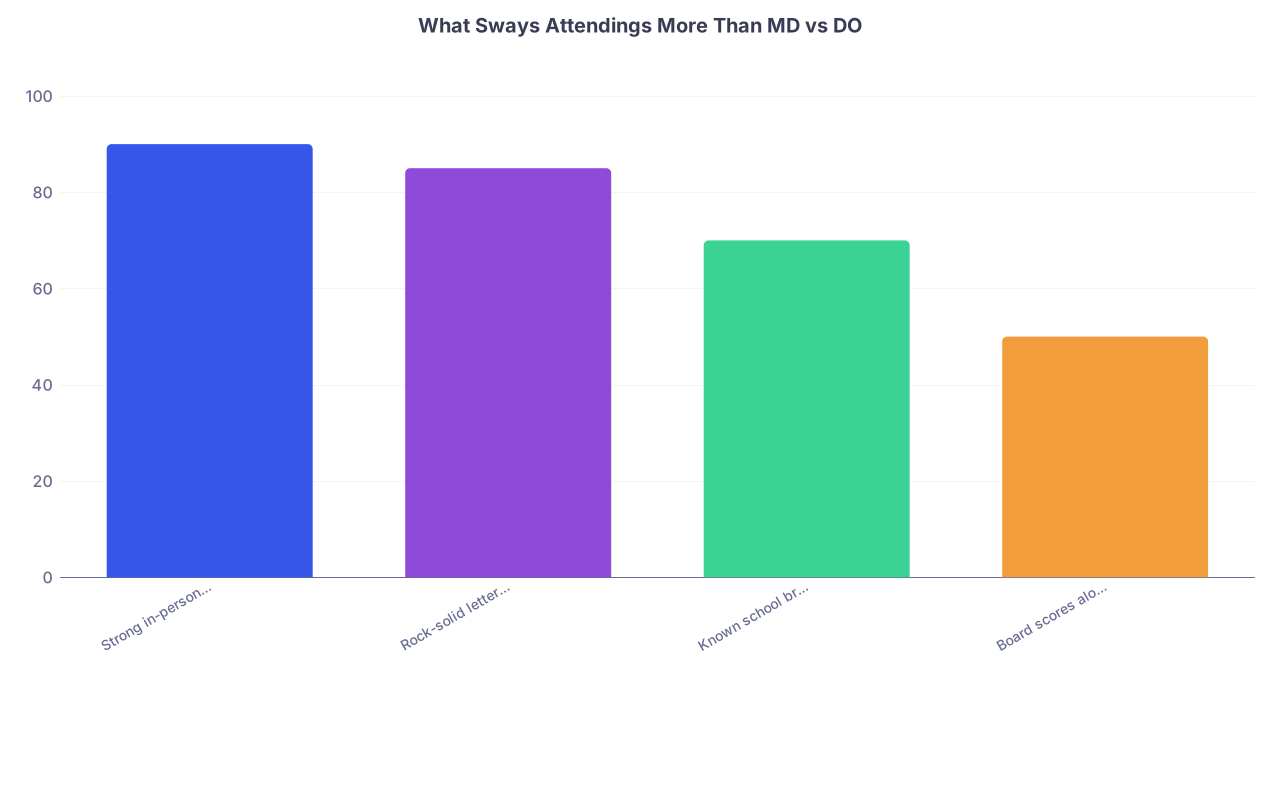
| Category | Value |
|---|---|
| Strong in-person performance | 90 |
| Rock-solid letters from trusted colleagues | 85 |
| Known school brand | 70 |
| Board scores alone | 50 |
If you show up, know your stuff, act like a decent human, and make your resident’s life easier rather than harder, most attendings will forget about your degree within a week.
The strongest shifts I see in faculty opinion are always due to:
- A DO student who clearly knows medicine cold and can apply it, not just recite it.
- A DO resident who handles a nightmare call night calmly while the MD from Big‑Name U is panicking.
- A DO fellow who publishes, presents, and carries themselves exactly like any other subspecialist in the field.
Bias exists. Performance can still blow through it.
A Quiet Reality: This Is Changing, Slowly
One more thing your message boards don’t capture: generational change.
The older attendings who still reflexively flinch at DO degrees are retiring. Younger faculty are more numb to it, especially the ones who trained in mixed MD/DO environments and have seen excellent DO colleagues.
I’ve heard younger attendings say:
- “Honestly I don’t even look at MD vs DO initially, I look at where they trained for residency.”
- “Some of our best recent chiefs were DOs. I trust this pipeline more than some of the newer MD schools.”
That doesn’t mean the bias is gone. It means it’s softening. But if you’re applying in the next 5–7 years, you’re still dealing with the tail of the old culture.
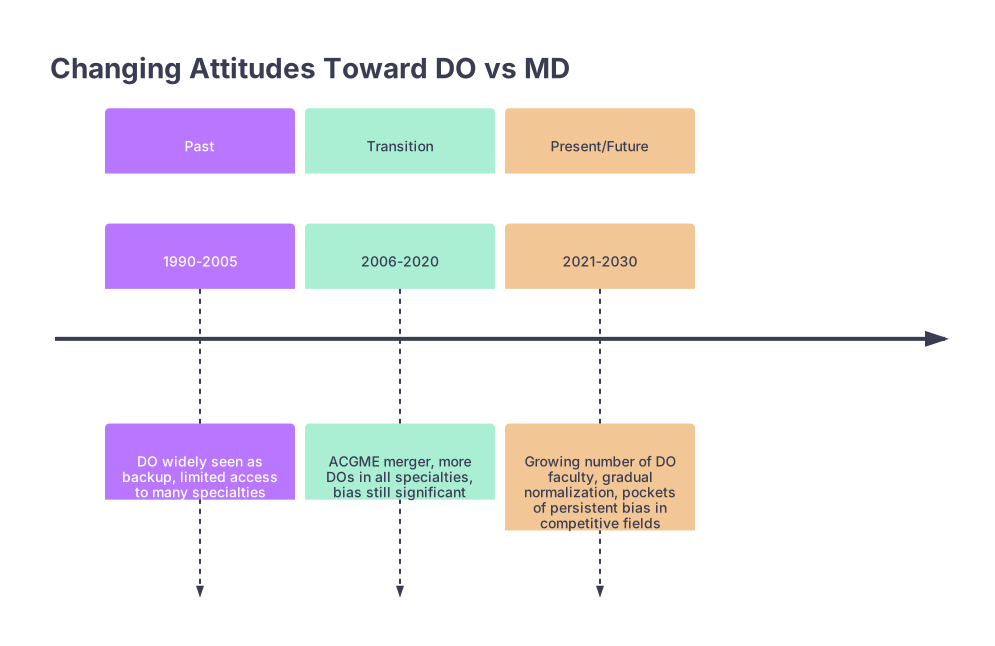
| Period | Event |
|---|---|
| Past - 1990-2005 | DO widely seen as backup, limited access to many specialties |
| Transition - 2006-2020 | ACGME merger, more DOs in all specialties, bias still significant |
| Present/Future - 2021-2030 | Growing number of DO faculty, gradual normalization, pockets of persistent bias in competitive fields |