It’s 9:15 p.m. in a windowless conference room. Half-empty Starbucks cups. A projector humming. On the screen: a spreadsheet of applicants for a competitive ortho program. Columns for Step scores, med school, AOA, research, letters, red flags.
Someone zooms the “School” column wider.
“Is this one DO or MD?”
The PD doesn’t even look up. “DO. Solid app though. What’s the Step?”
“262.”
Pause.
“Okay… they’re in. Flag them for interview.”
You are never in that room. You never hear those sentences. But you are absolutely being judged through that lens—DO vs. MD—especially for competitive specialties: derm, ortho, plastics, ENT, urology, interventional cards, neurosurgery.
Let me walk you through how the gatekeepers actually think. Not the PR-version on the website. The version I hear at 10 p.m. when everyone’s exhausted, annoyed, and honest.
The Ugly Truth: “DO vs. MD” Is Really “Risk vs. Default”
Most premeds ask the wrong question: “Do they discriminate against DOs?” That’s too simplistic.
What they actually do is this: they treat MD as the default, and DO as a risk that has to be overridden by strength somewhere else.
They won’t say “we don’t like DOs.” They say things like:
- “We just haven’t had many DOs here historically.”
- “Our DO residents struggled on boards in the past.”
- “We want to be supportive but we don’t have experience with that school.”
That’s code. For: “Choosing a DO means I’m taking on uncertainty compared to the MD applicant I understand better.”
Gatekeepers—PDs, selection committee chairs, senior attendings—are not sitting there trying to be fair philosophers. They’re trying to avoid problems: remediation, residents who can’t pass boards, people who can’t keep up with volume.
(See also: What Residency Committees Really Think About DO vs. MD Applicants for insights on how your application is perceived.)
So the mental calculus becomes:
- MD from a known school + decent numbers = safe choice
- DO + similar numbers = potential risk unless:
- numbers are clearly stronger
- letters are exceptionally strong
- someone on the committee is explicitly willing to go to bat for you
This is the real frame. Not “hate vs. love,” but “default vs. exception.”
The Silent Tiers: How They Actually See Your Degree
Nobody will give you this hierarchy publicly. But this is how conversations in competitive specialties often feel when you listen long enough:
Tier 1: US MD from a historically strong, research-heavy school
Tier 2: US MD from less research-heavy / regional schools
Tier 3: US DO with very strong board scores and objective metrics
Tier 4: US DO with average metrics
Tier 5: Any IMG (with some exceptions for known feeder schools)
Notice where DO lands: it can absolutely sit above some MDs if the numbers justify it. But by default, it starts lower.
Here’s what triggers mental “upgrading” of a DO application in those rooms:
- Step 2 score significantly above the program’s typical mean for matched residents
- Clear success of previous DO residents at that program
- Strong letter from a well-known faculty member in that specialty
- Proven grind: multiple away rotations in that field, strong comments in MSPE
The more of those you stack, the more your DO label becomes background noise instead of a red flag.
Boards: The Unofficial DO “Entrance Fee” for Competitive Fields
Forget the party line about “holistic review.” In competitive specialties, board scores often become the justification for taking a chance on a DO student.
The internal logic is simple and not very romantic:
- “We know DO schools are uneven.”
- “We don’t know their grading or rigor.”
- “Step/Level is standardized and brutal. If they crush it, they’re probably safe.”
So for DOs, high boards don’t just “help.” They are the price of admission to get taken seriously in derm/ortho/ENT/uro at many places.
Think of it like this:
- MD applicant with decent school prestige and “okay” Step 2 can still get a look based on school name, research, and letters.
- DO applicant with “okay” Step 2 is dead in the water at a lot of competitive programs. No one will say it on a podcast, but they will say it in that room.
The unspoken thresholds I’ve seen tossed around in very real, very unfiltered meetings for DOs aiming at top-tier competitive spots:
- Ortho / ENT / Uro / some surgical subs:
“If we’re going to bring in a DO, I want them well above our mean. Not just matching it.” - Derm / plastics / neurosurgery:
DOs are rare enough that the ones who get interviews often have eye-watering scores plus research.
Is that fair? No. Is it how they think? Yes.
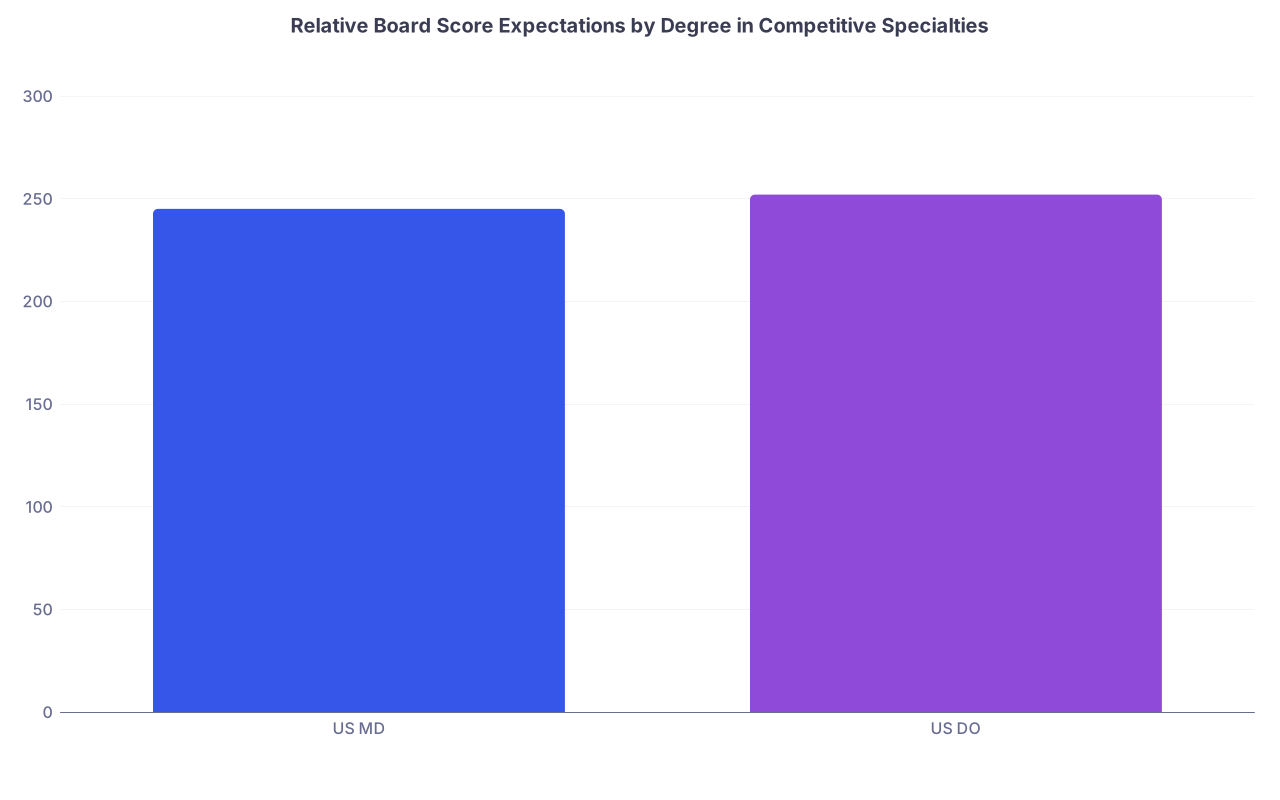
| Category | Value |
|---|---|
| US MD | 245 |
| US DO | 252 |
That bar chart isn’t official policy. But it’s how people talk. “If I’m going to go out on a limb for a DO, I want to see clearly stronger numbers.”
Programs Fall Into Three Buckets (Whether They Admit It or Not)
They won’t put this on their website, but almost every program in a competitive field falls into one of three unsaid categories when it comes to DOs.
1. The “We Basically Don’t Take DOs” Programs
Language they use:
- “We’re open to DOs.”
- “We evaluate all applicants holistically.”
Reality:
- They haven’t matched a DO in 5–10 years.
- When a DO shows up on an interview list, someone says, “How did they end up on here?”
What’s really going on:
- They have a deep pipeline of strong MD candidates from historically matched schools.
- Faculty bias: older attendings trained in an era when DOs really were external.
- Prior DO resident struggled, and that story is now lore.
If you’re DO and not off-the-charts strong, these programs are essentially closed. The gatekeepers there will never admit that out loud.
2. The “Token DO Friendly When Overqualified” Programs
Language:
- “We’ve had DOs do very well here.”
- “We’re excited when we see strong DO applicants.”
Reality:
- One or two DOs per class at most, often absolute rock-stars.
- They will take you… once you’ve already de-risked yourself by being obviously exceptional.
Thinking:
- “If the DO is clearly stronger than the mid-tier MD, I’m fine taking them.”
- “We don’t discriminate… but I’d rather not have to defend my choice to the chair.”
These are your targets if you’re willing to outwork and outscore the average MD applicant. They’re not anti-DO. They’re just conservative.
3. The “Genuinely DO-Friendly and Prove-It” Programs
Language:
- “We love our DOs.”
- “Our best residents are often DOs.”
Reality:
- Steady history of DOs in the program. Not one token person, but a real presence.
- Often in slightly less “prestige-obsessed” markets, or programs led by PDs who trained with or are DOs themselves.
Thinking:
- “If you can do the work and you’ve shown interest in our field, we don’t care about the letters.”
- “School type isn’t the main thing. Performance is.”
These programs still care about numbers. But they don’t require you to be superhuman to offset the DO label.
Your move as a DO: identify these programs early, rotate there, get known, and let your performance close whatever subconscious gap still exists.
Away Rotations: Where DO Bias Shows Up in the Hallway
Here’s where the DO vs. MD distinction becomes painfully real: sub-internships and away rotations in competitive fields.
When you rotate at a program, you’re often walking into this preloaded perception:
- “We’ve had MD rotators from X, Y, and Z top schools.”
- “We don’t know what to expect from a DO school.”
So you get watched a little closer at first. Attendings won’t admit it. Residents will, after a beer.
The quiet rules DO students discover:
- You do not get the same slack as the “home MD” student.
- Small mistakes or slow starts confirm the bias much faster.
- Exceptional performance flips that bias just as sharply in your favor.
I’ve seen this pattern more than once:
Day 1: “We have a DO rotator this month, right?” Neutral/curious.
Day 3: If you’re sharp – “That DO student is actually pretty good.”
Week 2: “Can we get them an interview spot? They’re better than some of the MDs we’ve seen.”
Or, if you stumble:
Day 3: “Our DO was kind of slow on pre-rounds today.”
Week 2: “Honestly, they’re nice, but I don’t see them in our program.”
For a DO in a competitive field, the away rotation isn’t just an audition. It’s your chance to blow up a stereotype someone might not even admit to themselves.
Research, Prestige, and the “Compensation Game”
There’s another ugly undercurrent: if your degree says DO, the game silently raises the bar on everything else.
Same CV, different reaction:
- MD from a mid-tier school with 2–3 publications? “Solid.”
- DO with 2–3 publications? “Okay, but from where? What journals? Who’s the PI?”
Programs lean on the familiar. They know the MD schools. They know some of the faculty names. So for you as a DO, research and networking become less optional and more… compensatory.
Inside conversations when a DO has serious research:
- “Wait, they worked with [known PI]?”
- “They have a derm paper in a decent journal? From a DO school?”
- “They did a year of research at [big-name institution]?”
Those facts do something important: they transfer some of your credibility from an unfamiliar DO brand to a familiar MD/research brand.
You don’t have to like that. But if you understand it, you can use it.
How They Actually Build the Interview List (and Where DO Gets Cut)
Let me strip the politeness away and show you the mental process that happens when a competitive program filters 800+ ERAS applications into 60–80 interview spots.
It often goes roughly like this:
- Hard cut on obvious red flags (fails, professionalism issues, etc.).
- Sort by some combo of:
- Step 2 score
- School type
- Specialty-specific experiences/research
- Now the quiet DO filter kicks in:
- “We have too many applicants. We need quick ways to trim.”
- “Okay, let’s be honest: for DOs, we only look closely if the board score is above X or the application is obviously stacked.”

| Step | Description |
|---|---|
| Step 1 | All Applicants |
| Step 2 | Remove Red Flags |
| Step 3 | Sort by Step 2 and School |
| Step 4 | MD: Review if score near cutoff |
| Step 5 | DO: Review only if score well above cutoff or strong signals |
| Step 6 | Invite or Reject |
| Step 7 | MD or DO? |
This is where a lot of DOs die quietly. Not because anyone said “We don’t want DOs,” but because, “We’re overwhelmed, and I’m not going to spend 5 minutes reading a borderline DO app when I have plenty of MDs above my threshold.”
Programs with a strong DO track record still do screening. But their internal thresholds are different:
- “We’ve had great DOs. Let’s not be stupid and auto-cut them.”
- “If they rotated here and we liked them, number games matter less.”
That’s why “DO-friendly” isn’t fluff. It’s code for: “Our filter logic doesn’t automatically bury you.”
The Geographic and Cultural Divide No One Talks About
There’s also a geography to DO acceptance that rarely gets discussed.
Patterns I’ve seen repeatedly:
- Midwest community and regional academic centers: actually pretty DO-friendly in a lot of specialties, including some surgical ones, if you’re strong and local.
- Northeast/Ivy feeder programs: far more MD-prestige focused; DO gets you seen only if you’re superlative.
- Southeast and some southern states: extremely variable; some PDs love DOs (often DO-trained themselves), others are old-school MD-only snobs.
- West Coast big-name academics: image-conscious, heavily research-driven; DOs usually get in through research years and personal connections, not cold applications.
Cultural factor: if the chair or PD trained with DOs or is a DO, your odds change overnight. I’ve watched programs evolve from “we’ve never had a DO” to “we match 1–2 every year” purely because the PD changed.
You should absolutely be stalking program websites and resident rosters to look for:
- Any DOs currently in the program
- DOs in leadership or faculty roles
- Regions where DO schools are physically nearby and sending grads regularly
That is not noise. That is signal.
What This Means for You If You’re Still Premed
Here’s the part most advisors sugarcoat. I won’t.
If you know you want a hyper-competitive specialty and you have the stats and resources to have a strong shot at MD:
Choosing DO is choosing the harder road. Not impossible. Just harder. Higher expectations, fewer defaults in your favor, more proving.
Some realities:
- DO → derm/plastics/ENT/neurosurg at top-tier places is possible but brutally rare. You’ll need:
- High Step 2 (now very high since Step 1 is pass/fail)
- Research at recognizable institutions
- Serious mentorship and networking
- DO → ortho, uro, EM, anesthesia, rads: doable with the right strategy and programs, especially at DO-friendly or regional centers.
- DO → IM, peds, FM, psych, many IM subspecialties: totally fine; bias exists but is much weaker.
If you’re premed deciding between an MD acceptance and a DO acceptance, and you’re dreaming of derm/ortho/ENT but only have DO in hand? You need a brutally honest conversation with yourself.
Do you:
- Take the DO, accept that you’ll be playing a harder game and start planning now?
- Or take a year (or two), reapply, and try to get into an MD program if you’re truly dead-set on the most prestige-obsessed specialties?
There’s no universal right answer. But pretending the difference does not matter for certain fields is how people end up very bitter in MS4.
If You’re Already DO and Eyeing a Competitive Field
You’re not doomed. You’re just not allowed to be average.
Here’s the internal mindset I’ve seen in DOs who do break into the hard fields:
- “I’m going to be so obviously good they can’t hide behind the letters after my name.”
- “I will treat every exam, rotation, and connection as an audition.”
- “I understand the game and I’m going to play it better, not whine about it.”
Concrete, behind-the-scenes levers that actually move the needle:
- Early contact with DO-friendly mentors in that specialty, ideally at places known to take DOs.
- Strategic away rotations at programs that already have DO residents—and crushing those rotations.
- Research not just anywhere, but with people whose names carry weight in that specialty.
- Step 2 score that makes the committee stop scrolling and say, “Okay, they’re for real.”
Because here’s the quiet upside they don’t tell you:
Once you break that first barrier as a DO in a competitive specialty—especially at a solid program—people love to talk about you.
- “Our best resident is actually a DO.”
- “We had this DO come through who was better than the Ivy MDs.”
You become the counterexample they use to pat themselves on the back for being “holistic.” That doesn’t feel fair, but it works in your favor once you’re in.
FAQ (Exactly 5 Questions)
1. Is it true that some competitive programs auto-filter out DOs?
Yes. Not always with an explicit “DO = reject” rule, but through combined filters: high Step cutoffs, preference for certain med schools, and a tendency to skip “borderline” DO apps when overwhelmed. Functionally, for many DOs, that’s the same as being auto-filtered.
2. Are there competitive specialties where DO vs. MD matters less?
Relatively less, yes: EM (historically), anesthesia, rads, some surgical fields at regional centers. But for derm, plastics, ENT, neurosurgery, and some elite ortho/uro programs, your DO degree absolutely changes the default threshold they expect you to clear.
3. Does doing an MD vs. DO actually change how good of a doctor I’ll be?
Clinically? Not in any systematic way. I’ve seen phenomenal and terrible doctors from both paths. What it changes is perception, default assumptions, and access to certain doors—especially early-career academic and ultra-competitive residency doors.
4. If I’m DO and my Step 2 is only around average for a competitive field, am I done?
For many top-tier, prestige-driven programs: yes, realistically. For mid-tier, DO-friendly, or regionally focused programs: not necessarily. You’ll need strong rotations, letters, and savvy program selection. But you should strongly consider keeping an open mind to slightly less competitive specialties or subspecialties.
5. Should a premed ever choose a DO acceptance over waiting/reapplying for an MD?
Sometimes, yes. If your academic profile is weak for MD, if you’re not fixated on derm/ortho/ENT-level competitiveness, or if your life circumstances make delay costly, DO can be the right move. But if you have a realistic shot at MD and your heart is set on a hyper-competitive specialty, reapplying is a rational choice—because, like it or not, specialty gatekeepers really do weigh DO vs. MD differently.
Key points to walk away with:
DO is not a career death sentence, but for competitive fields it is not a neutral label. Gatekeepers treat MD as the default and require DO applicants to be obviously stronger in objective metrics or performance to offset perceived risk. If you understand that early—premed or M1—you can plan strategically instead of learning the hard way when the interview list is already set and your name never comes up.