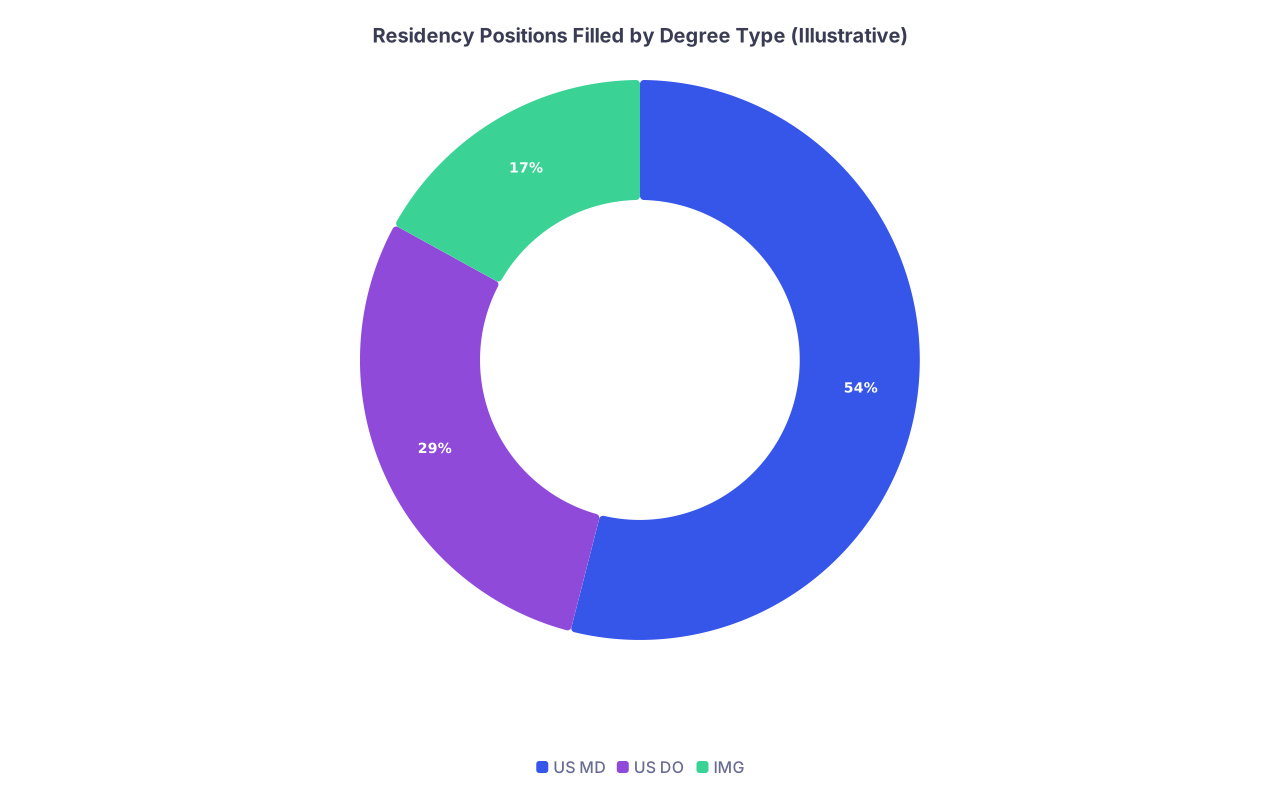
| Category | Value |
|---|---|
| US MD | 54 |
| US DO | 29 |
| IMG | 17 |
You are a sophomore staring at a spreadsheet of medical schools. Some are “College of Osteopathic Medicine,” others are straight “School of Medicine.” Your group chat is buzzing with half-baked takes:
- “Bro just go DO, they match the same now.”
- “If you want derm or ortho you MUST go MD.”
- “Residency programs cannot even tell the difference after the merger.”
You have not looked at a single NRMP Charting Outcomes table. No specialty-specific match data. But you are already building your whole career plan on a stack of hearsay.
This is where people make expensive, career-limiting mistakes.
Let me walk you through the most damaging DO vs. MD assumptions premeds make before they ever open the match data. If you avoid these, you will already be smarter than half of Reddit and a surprising number of first-years.
Mistake #1: “DO and MD Have Identical Match Outcomes Now That There’s a Single Match”
This is the flagship bad assumption.
People heard “single accreditation” and mentally translated it into “identical outcomes.” That is not how any of this works.
There is one match process. Yes. But program behavior, preferences, and historical patterns did not vanish in 2020.
Here is what actually happens in the real match:
- US MD graduates, on average, still match at higher rates and into more competitive specialties.
- US DO graduates match well overall, but the pattern by specialty and program tier is different.
- Certain specialties and certain academic programs historically take very few DOs. That did not magically normalize with the merger.
You see this clearly in NRMP’s public data. Not in Reddit anecdotes.
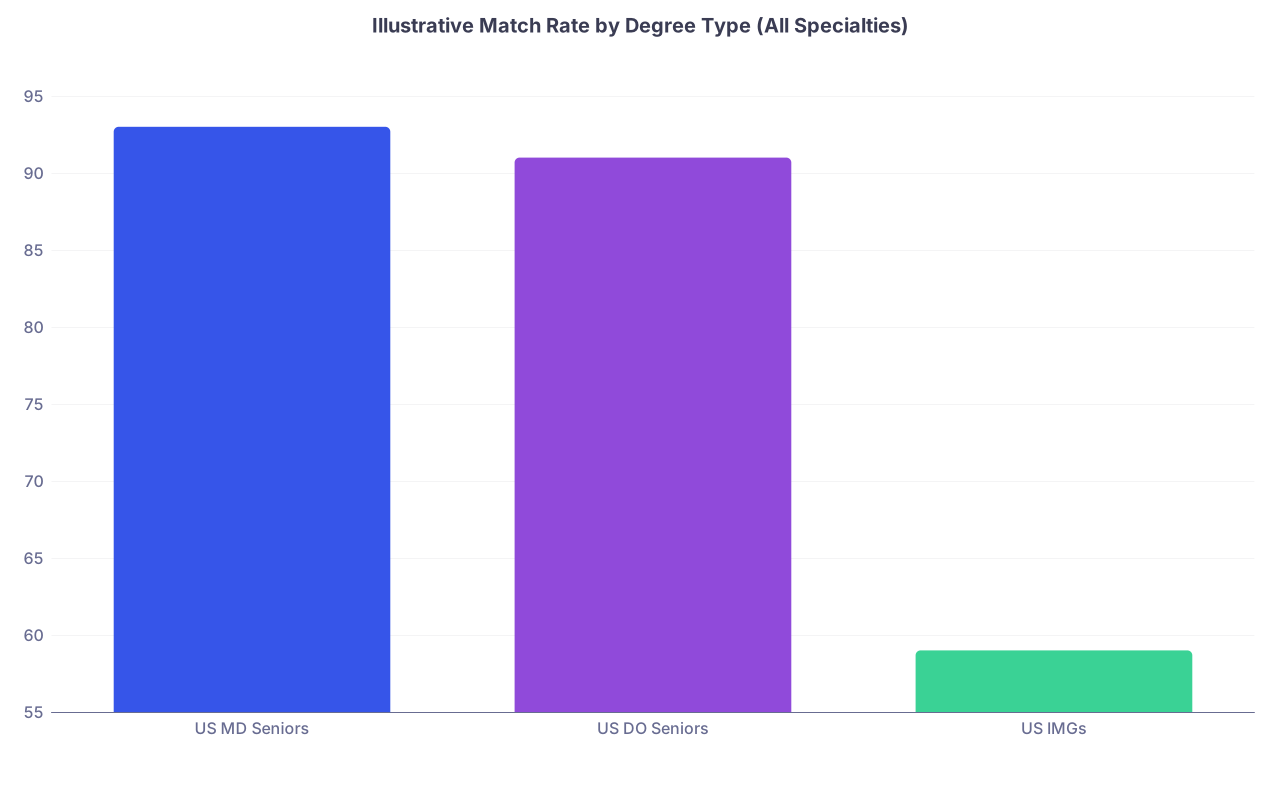
| Category | Value |
|---|---|
| US MD Seniors | 93 |
| US DO Seniors | 91 |
| US IMGs | 59 |
Those overall match rates might look “almost the same.” That is how people trick themselves.
The mistake: they stop there. They do not drill down into:
- Individual specialties
- Positions filled by degree type
- DO vs MD representation in competitive fields and academic programs
If you only look at the overall match rate, you are looking at the blur, not the pixels.
How to avoid this mistake
- Go to the NRMP website.
- Download:
- “Results and Data” for the most recent match.
- “Charting Outcomes in the Match” for both US MD and US DO.
- Compare:
- DO vs MD match rates in the specific specialties you care about.
- The percentage of positions filled by DOs vs MDs in those specialties.
- How often DOs match into categorical positions vs prelim / transitional.
Do this before you start saying “same outcomes” with any confidence.
Because in neurosurgery, dermatology, ENT, plastics, radiation oncology, and some others, that statement is just false.
Mistake #2: “DO Is Just the ‘Backup’ Version of MD — No Strategic Difference”
Another lazy assumption: “Apply MD first; if that does not work, there’s always DO. Same thing anyway.”
No. That is how people box themselves into terrible timelines and closed doors.
The MD vs DO decision is strategic, not cosmetic. Here is what changes when you choose one path over the other:
School list
- Some regions are dominated by DO schools (e.g., certain Midwestern states).
- Some academic health centers are MD-only and feed into specific residency pipelines.
Grade culture
- Some MD schools are aggressively pass/fail with robust resources.
- Many DO schools are newer, more exam-centric, and may have limited home residency programs.
Residency pipeline
- MD schools often have strong “home” programs in multiple specialties and established match histories into university programs.
- DO schools may lean heavily toward community programs and primary care, though there are exceptions.
The “backup” mindset is dangerous because:
- You apply only MD with a mediocre GPA / MCAT, then act surprised when the cycle fails.
- You delay applying to DO programs where you would have been competitive this cycle.
- You end up doing a costly, demoralizing reapp year for no good reason.
Reality check
If your stats are:
- GPA around 3.3–3.4
- MCAT 504–507
- Average extracurriculars, nothing extraordinary
You are not building a smart plan if you only apply MD and assume DO is your “backup later.” That is a denial strategy, not an application strategy.
How to avoid this mistake
- Build two lists:
- A realistic MD list aligned with your stats and state residency.
- A realistic DO list that you would be genuinely willing to attend.
- Decide now whether you are:
- MD-or-bust (and ready for the consequences: possible post-bacc, MCAT retake, extra years).
- MD + DO (maximizing your chances of becoming a physician in one cycle).
But do not pretend DO is a frictionless backup door you can just open any time. Application timing, letters, MCAT score age, and burnout all stack against that fantasy.
Mistake #3: Ignoring How DO vs MD Plays Out in Competitive Specialties
Here is where the lack of match data really bites people.
They say things like:
- “I want ortho, but if I end up DO, I will just work harder.”
- “Anki and high Step scores will level the playing field.”
- “Program directors do not care what the letters are anymore.”
I have watched this play out. It is brutal when the bubble pops.
Competitive specialties are competitive for a reason:
- Limited positions
- Strong preference for high board scores, strong letters, research, and known institutions
- Legacy bias for MD pipeline programs
Even post-merger, DO representation in some specialties is still very small relative to MDs.
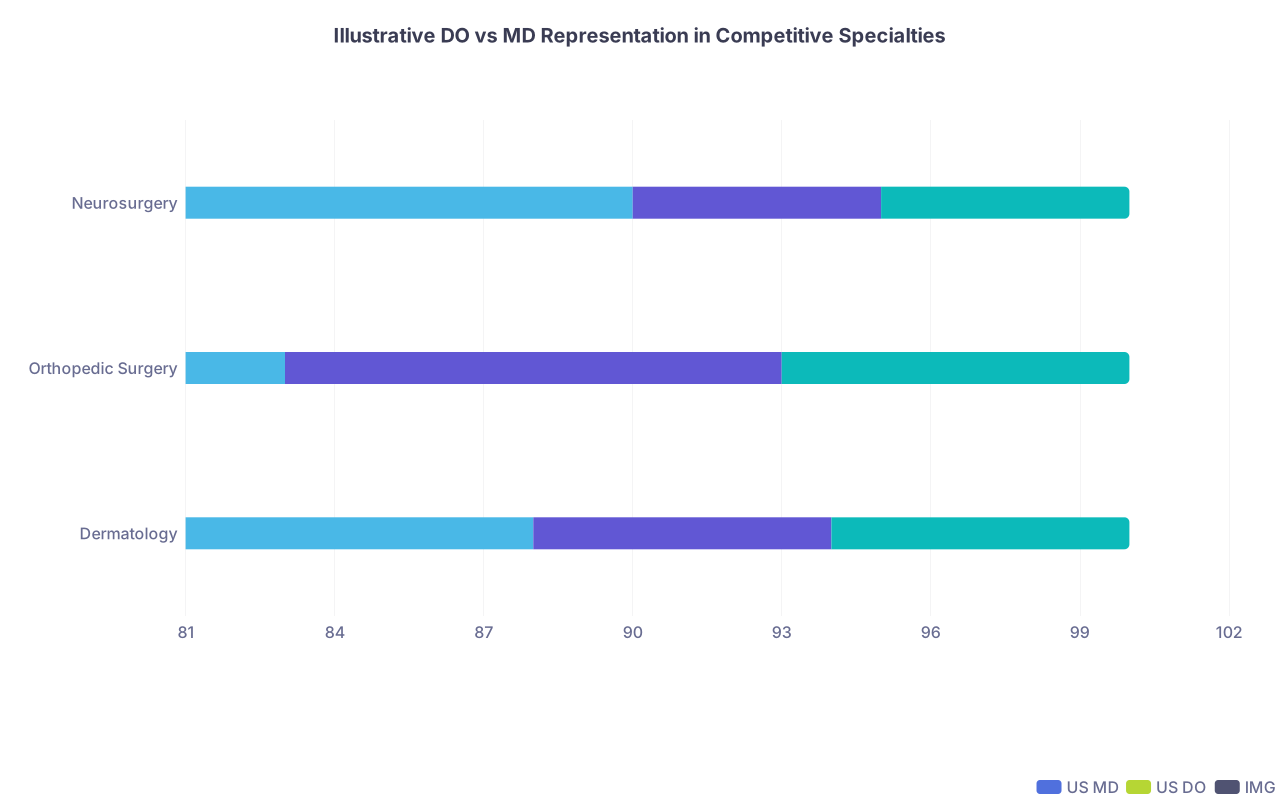
| Category | US MD | US DO | IMG |
|---|---|---|---|
| Dermatology | 88 | 6 | 6 |
| Orthopedic Surgery | 83 | 10 | 7 |
| Neurosurgery | 90 | 5 | 5 |
Numbers vary by year, but the pattern holds: DOs are still a minority in the most competitive fields.
Does this mean “you cannot match derm/ortho/neurosurgery as a DO”? No. That statement is lazy and false.
But the probability landscape is different. Harder. Narrower. And pretending otherwise is how students walk into the wrong school for their goals.
How to avoid this mistake
If you are even considering a competitive specialty:
Pull match data by specialty:
- Look at how many DOs match nationally into that field each year.
- Look at how many programs have zero DO residents.
Talk to:
- A DO resident in that specialty.
- An MD resident in the same specialty. Compare what they had to do to get there.
Ask DO schools directly:
- How many students matched into [your specialty] in the last 5 years?
- Where did they match (community vs university, which regions)?
If a school has graduated thousands of students and one has matched derm in the last decade, do not lie to yourself about your odds. Not impossible. Just heavily stacked.
Pick your battle with your eyes open.
Mistake #4: Assuming Research and Prestige Do Not Matter If You “Work Hard”
This one usually sounds like:
“Residency programs just want someone who works hard and cares about patients. Prestige is overrated.”
Nice story. Not how selection committees operate when they have 600 applications for 4 spots.
Here is the uncomfortable reality:
- School reputation still matters, especially for:
- Competitive specialties
- Academic / university-based residencies
- Research output matters much more in some fields (derm, rad onc, neurosurgery, ENT, ophtho, etc.)
Many DO schools:
- Have limited research infrastructure compared to mid- and top-tier MD schools.
- Do not have large academic hospitals or NIH-funded departments.
- Have fewer faculty doing the kind of research residency programs care about.
That does not mean it is hopeless. But it does mean:
- You will work harder to get the same research numbers.
- You may need to take a dedicated research year.
- You will have to hunt down mentors and projects intentionally.
The mistake is not going DO. The mistake is going DO and assuming “I will just outwork everyone” will fix structural limitations you never bothered to map out.
How to avoid this mistake
When comparing schools (MD or DO), ask:
- How many students publish or present research before graduation?
- Are there structured research programs? Funded summer research?
- Are there active research faculty in your interest area?
- What are the last 5 years of match outcomes in academic vs community programs?
Talk to current students, not admissions marketing.
If you know you care about a research-heavy field, do not pick a school—DO or MD—that treats research like a side hobby.
Mistake #5: Overestimating “I’ll Just Crush Boards and Everything Will Be Fine”
The myth: “Once I get a 250+ on Step 2, no one will care if I am DO.”
Two problems:
- Step 1 is now pass/fail, so Step 2 is heavier, yes, but not magic.
- Boards are not the only filter used by programs.
Programs also look at:
- School name and accreditation history
- Clinical rotation sites and quality
- Letters of recommendation (from which programs / attendings)
- Research, leadership, and other signals of academic engagement
- Perceived “fit” and prior experience with grads of that school
And reality check: getting a stellar Step 2 score from a resource-strapped, rotation-fragmented environment is harder than from a school with robust in-house teaching and strong shelf exam prep.
DO-specific complication
Most DO students also take COMLEX. Some take both COMLEX and USMLE. That adds:
- Extra exam fees
- Extra studying
- Extra stress and scheduling headaches
You will see some DOs do phenomenally on both exams and match exactly where they wanted. But you are seeing survivors, not the full denominator.
How to avoid this mistake
When you think “I will just crush boards,” ask yourself:
- What is this school’s average Step 2 / COMLEX 2 score?
- What is their pass rate on first attempt?
- Do they provide:
- Institutional subscriptions (UWorld, NBME, etc.)?
- Formal dedicated study time?
- Real faculty support vs “here is a PDF, good luck”?
If a school’s answer to board prep is essentially “self-study and figure it out,” then you are signing up to fight with one hand tied, regardless of DO vs MD.
Working hard is not the differentiator. Everyone works hard. Structural support is.
Mistake #6: Believing Location and Lifestyle Do Not Matter “Because It’s Only Four Years”
Another popular lie people tell themselves:
“I will go anywhere. DO or MD, who cares. I will survive four years.”
You might survive. But your performance, mental health, and actual match outcomes will reflect whether you are barely surviving or actually functioning.
I have watched students flame out because:
- They underestimated how isolating it would be to live in a tiny town far from family and support.
- They had spouse/partner constraints that made their school choice borderline impossible.
- They thought frequent moves for core and elective rotations would be “an adventure” and instead it destroyed their study rhythm.
This is particularly common with some DO schools that:
- Are located in very rural areas.
- Use heavily distributed clinical rotations across multiple states.
- Have weaker centralized academic support once students move off the “home” campus.
If you assume “school is school, I can grind anywhere,” you are ignoring how human you actually are.
How to avoid this mistake
When evaluating any school:
Map out exactly where:
- Preclinical years are located.
- Core clinical rotations are done.
- Electives / audition rotations are offered.
Ask students:
- How much time is spent traveling?
- How difficult was it to arrange strong away rotations?
- What does an actual week in third year look like?
A DO school that bounces you between three hospitals in different cities may make it harder to be the applicant you want to be—even if the letters after your name end up the same.
Mistake #7: Using Reddit Anecdotes Instead of Patterns and Probabilities
This one is simple:
- You see one DO who matched derm on YouTube.
- You see one MD who did not match FM on Reddit.
- You build your worldview around those two extreme anecdotes.
You cannot do career planning based on outliers. The match is a game of probabilities, not stories.
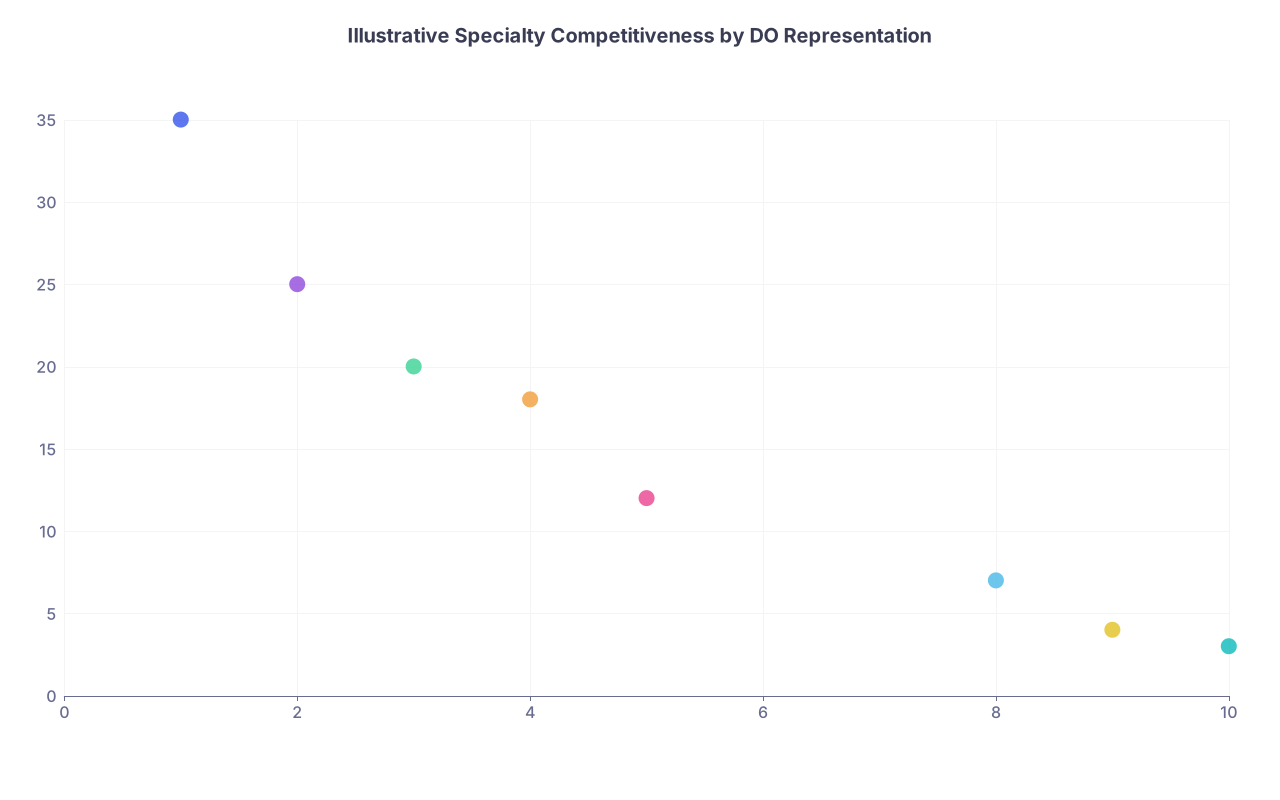
| Category | Value |
|---|---|
| FM | 1,35 |
| IM | 2,25 |
| Peds | 3,20 |
| EM | 4,18 |
| Gen Surg | 5,12 |
| Ortho | 8,7 |
| Derm | 9,4 |
| Neurosurg | 10,3 |
(Interpretation idea: x-axis ~ competitiveness rank, y-axis ~ % of residency spots filled by DOs. The more competitive, the lower DO share tends to get.)
Patterns matter:
- What percent of DOs match into your chosen specialty?
- How many DOs does an average program in that specialty train?
- Which programs have never taken a DO?
If you do not look at trends, you will chase the exception and ignore the rule.
How to avoid this mistake
- Read aggregate data (NRMP, AAMC, AACOM).
- Treat single anecdotes as what they are: interesting stories, not decision frameworks.
- When something sounds too good (“DO vs MD does not matter at all anymore”), assume you are missing fine print.
Mistake #8: Making the Decision Without Talking to Actual Residents on Both Sides
Premeds love to ask other premeds for DO vs MD advice. The blind leading the blind.
Or they talk only to:
- DO students who matched primary care and are (understandably) content.
- MD students at name-brand schools who have no idea what the DO path actually looks like.
You will not get a balanced picture if you never talk to:
- A DO resident in a competitive field who can tell you what hoops they had to jump through.
- An MD resident who can explain how school name and home program connections really helped.
How to avoid this mistake
Bare minimum:
- Find:
- 1–2 DO residents in your potential target specialties.
- 1–2 MD residents in the same or related specialties.
- Ask them:
- “What did you see as the biggest concrete advantage of your degree type?”
- “If you could rewind to premed, what would you do differently?”
- “At your program, do DO vs MD applicants get treated any differently in selection?”
You will hear nuance. Not the black‑and‑white slogans you see online.
Mistake #9: Treating “Becoming a Doctor” as the Only Goal
You will hear this line a lot:
“MD or DO, you are still a doctor. That is all that matters.”
It sounds noble. It is also incomplete.
Yes, if the choice is:
- Never practice medicine
vs - Become a DO and practice family medicine in a community you love
Then DO is an easy call.
But pretending there is zero difference in:
- Range of realistic specialty options
- Likelihood of academic vs community career
- Geographic flexibility for residency
…is how people set themselves up for a nasty mismatch between goals and reality.
If your honest, private goals are:
- “I want to do a research-heavy subspecialty.”
- “I want to match at a major academic center in a top 10 city.”
- “I care about highly competitive fields and prestige.”
Then you have to treat school type, school reputation, and match statistics as serious variables. Not afterthoughts.
That does not mean DO is “beneath you.” It means you should not hide your actual goals from yourself.
How to avoid this mistake
Sit down and write:
- Top 3 specialties you are currently interested in (yes, they may change).
- How much you care about:
- Academic vs community medicine
- Geographic preferences
- Research and teaching
Then check those against:
- DO vs MD match patterns
- Specific schools’ match lists, not just degree type
Pick the path that lines up best with what you actually want, not what sounds least controversial to say out loud.
Mistake #10: Deciding Before You Understand the Timeline and Irreversibility
Last one: treating the MD vs DO choice as if you can easily “switch” later.
You cannot.
Once you matriculate into a DO program:
- You are not later “converting” to MD.
- You are not going to reapply MD during first year without serious ethical and logistical problems.
- Your USMLE / COMLEX path is set. Your school’s reputation is set. Your research infrastructure is set.
Same for MD: once you start, you are not flipping to DO because you suddenly decided OMM is your calling.

| Step | Description |
|---|---|
| Step 1 | Premed |
| Step 2 | Strong MD & DO Options |
| Step 3 | Realistic MD + Robust DO List |
| Step 4 | DO-Focused or Improve Academics |
| Step 5 | Post-bacc/SMP or DO Path |
| Step 6 | Scrutinize Match Data & School Support |
| Step 7 | More Flexibility, Still Check Outcomes |
| Step 8 | Choose School Type & Specific Program |
| Step 9 | Matriculate -> Path Largely Fixed |
| Step 10 | MCAT & GPA Level |
| Step 11 | Career Goals Clear? |
The worst pattern I see:
- Premed makes a vague plan based on vibes.
- Chooses a school mostly on location or “they accepted me first.”
- Only in M2/M3 do they seriously look at match data.
- Realizes too late that the combination of:
- Degree type
- School reputation
- Weak research infrastructure
- Fragmented rotations
has boxed them out of what they actually want.
Fixing that in M3 is almost impossible. The cheap time to think hard is now—as a premed.
Core Takeaways: How Not to Sabotage Yourself on DO vs MD
Keep it simple:
Do not confuse “single match” with “identical outcomes.”
Look at specialty-specific and program-specific match data before making sweeping claims.Be honest about your goals and compare them to reality, not slogans.
Competitive specialties, academic careers, and specific geographies interact differently with DO vs MD.Judge schools, not just letters.
Some DO programs are stronger than weak MDs. Some MDs open doors no DO currently does. Match lists, board scores, research, and clinical sites matter more than marketing.
If you avoid those three mistakes, you will already be operating on a level most premeds never reach. And that alone will save you years of regret and thousands of dollars.