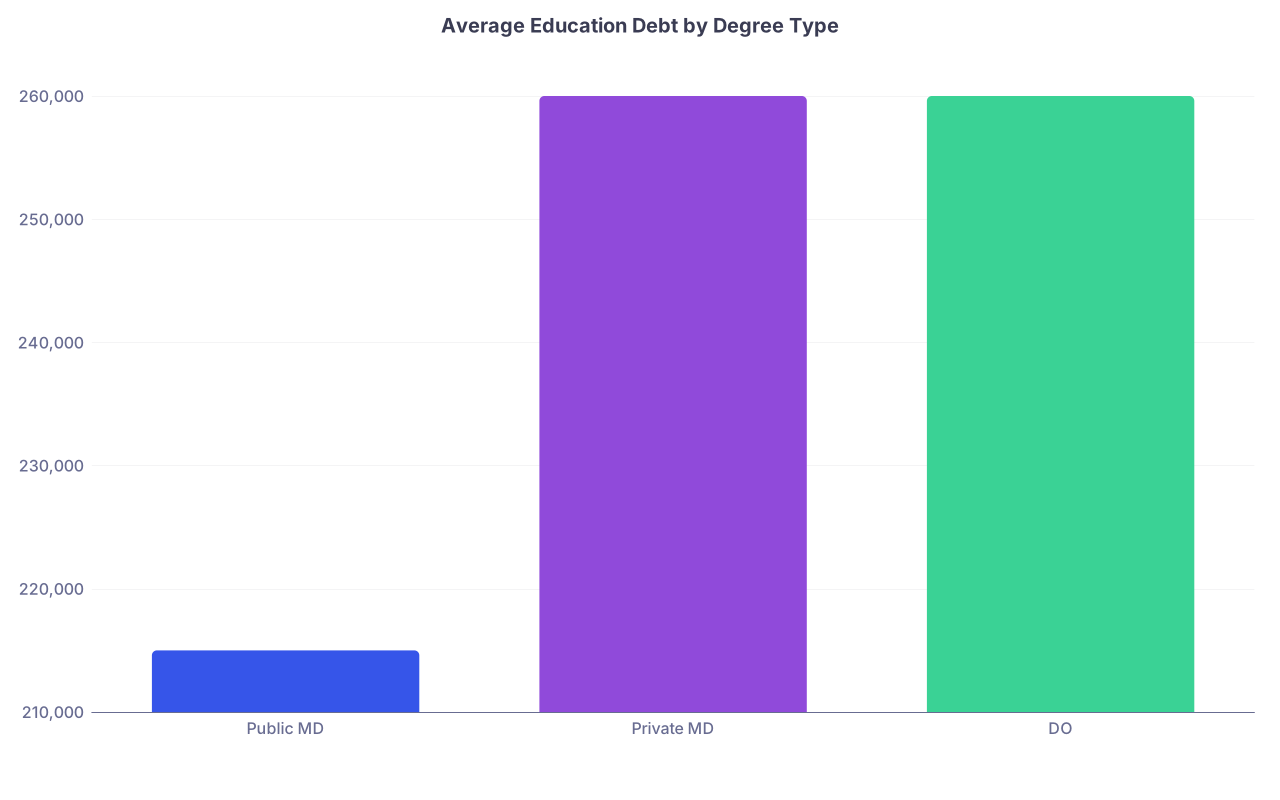
The way most advisors talk about DO vs. MD is sanitized and half-true.
They’ll smile, tell you “Both are doctors,” and then walk back to their office where faculty quietly debate whether to take that DO student for a research project or give the slot to an MD.
I’m going to tell you what actually happens behind closed doors. What’s whispered in committee meetings. What PDs say in group texts after the Zoom session ends. Because you’re making a career-defining decision, and you deserve more than brochure-level honesty.
The First Lie: “DO and MD Are Basically the Same”
They’re not “basically the same.” They’re closer than they used to be, but the paths are still unequal in some key ways.
Yes, legally, DO and MD are both fully licensed physicians in the U.S.
Yes, in most patient interactions, nobody cares what the letters are.
But in training, hiring, and competitive specialties? People care. Quietly. Consistently.
Here’s the subtext you never hear in premed advising offices:
- At many academic MD programs, there is still a default bias toward MD applicants. Not universal, but common.
- In certain specialties, DO applicants are screened out at the program coordinator level using a simple filter: “US MD first.” They rarely say this publicly. They absolutely say it in meetings.
- In some elite institutions, faculty will nod and say, “We consider DOs equally,” then rank almost zero DOs unless they’re absolute outliers.
Does this mean DO is a bad choice? No. It means you cannot treat DO vs MD as interchangeable if you’re aiming for certain doors: derm, plastics, ENT, neurosurgery, competitive academic posts. Those doors open much less often for DO grads, even very strong ones.
And this part your advisor probably won’t say: once you pick DO, your odds in those fields drop the second you enroll. You can fight your way back with stellar performance, but you’re starting a few steps behind.
What Program Directors Actually Look At (That You’re Not Told Early Enough)
You’ve probably heard the official line: “We look at the whole application.”
Reality: PDs (and their residents) sit in a room, throw applications up on a big screen, and make very fast, very practical judgments.
Here’s what they actually talk about, especially at mid- to upper-tier MD programs:
“School?”
That’s often slide one. The logo. MD vs DO is noticed in the first second. They do not pretend it doesn’t matter.“Board scores?”
COMLEX only? Many PDs, especially in competitive fields, quietly toss or de-prioritize DO applications without a USMLE. You’ll never see this in their public statements.“Research and pedigree?”
Someone will say, “This DO candidate is actually really impressive—lots of pubs, strong letters.” The “actually” tells you everything about the baseline expectation.
Here's the pattern I’ve seen on selection committees again and again:
- For MD students, an average candidate at a mid-tier school might still get interviews based on “school reputation” and solid-but-not-amazing stats.
- For DO students, you don’t get the benefit of the doubt. You get interviewed if you’re obviously strong. Not subtle. Obviously.
So if you’re choosing DO, understand this: you are opting into a system where you will have to be clearer, louder, and statistically stronger to get the same look in certain spaces.
Not fair. Just real.
The Real Differences in Training Culture (Not the Marketing Version)
Most premeds think the difference is just “extra OMM classes” for DO schools. That’s the superficial layer.
Here’s what actually feels different once you’re in it:
1. Clinical Rotations and Hospital Access
MD schools, especially older ones, often own or are tightly tied to large academic hospitals. Their students are the default priority. Owns the turf.
DO schools are more variable. A few newer DO schools have solid integrated hospital systems. Many do not. They rely heavily on community hospitals and scattered affiliates. That has consequences:
- Rotation quality can vary wildly. One DO student is at a busy community hospital doing procedures all day. Another is stuck shadowing in a clinic where the attending sees you as a nuisance.
- Some DO students end up traveling constantly during third year. New city every 4–8 weeks, subpar housing, zero stability. Your MD friends stay near campus and complain about parking.
- At some large academic centers, DO students from unaffiliated schools are clearly “visitors,” not the home team. That affects evaluations, research opportunities, and how hard faculty invest in you.
I’ve watched this play out: MD students are offered the niche research elective or specialty clinic exposure first. The DO students, even motivated ones, are recommended “later if space allows.”
2. Faculty Perception and Investment
Here’s the part students sense but can’t quite name.
At many MD schools, faculty came up entirely through MD pipelines. They trained at big-name MD residencies. Their mentors were MDs. DO wasn’t in their ecosystem.
So when a DO student shows up for an away elective, even if they’re strong, some faculty subconsciously lower their expectations—then get surprised when the student is excellent.
You’ll even hear this subtle compliment:
“She’s DO, but honestly she worked like any of our MD students.”
That “but” is what you’re up against.
At DO schools that are primarily community-based, faculty might be great clinicians but less plugged into academic networks. They don’t all have the connections to make two phone calls and get you an away elective at Hopkins or UCSF.
That difference in network is huge. It’s not in the brochure. It absolutely affects your trajectory.
The Truth About Competitiveness by Specialty
Let me crush a myth your advisors often tiptoe around:
You cannot treat all specialties as equally realistic from DO vs MD.
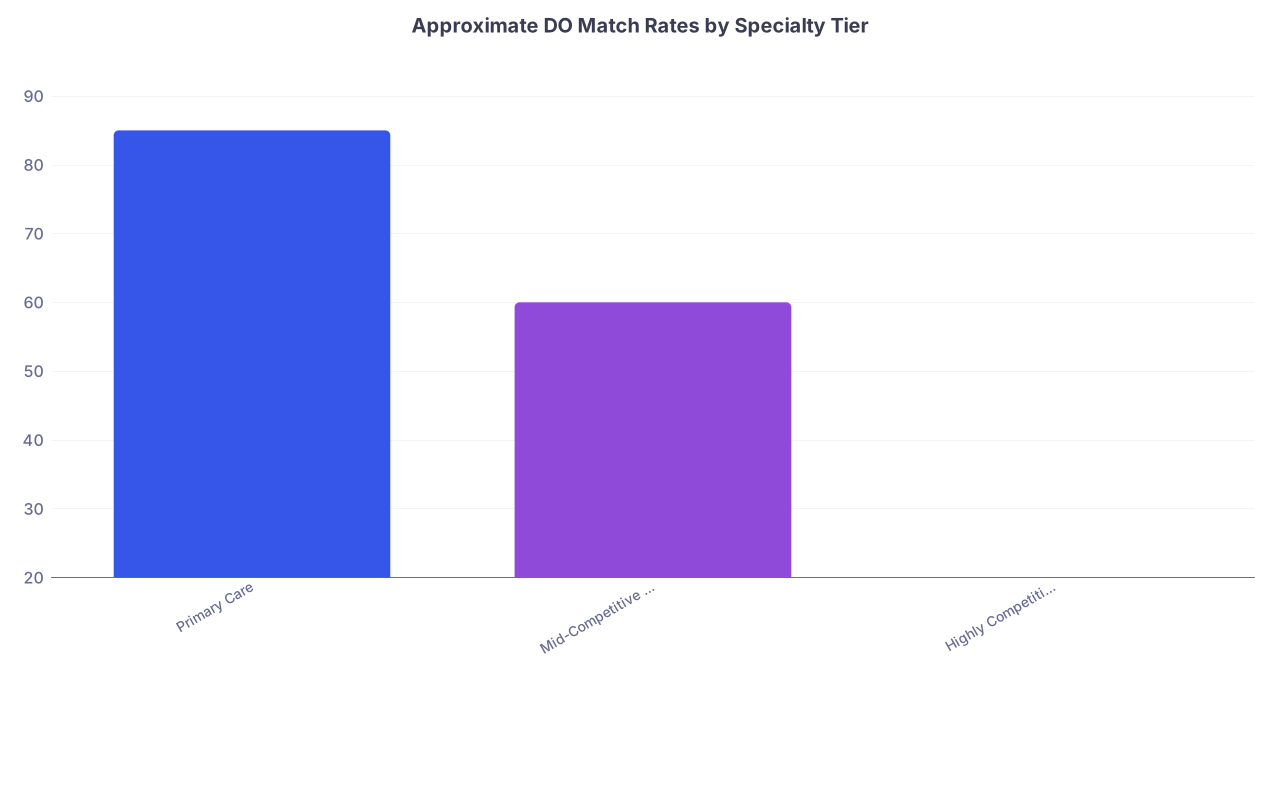
| Category | Value |
|---|---|
| Primary Care | 85 |
| Mid-Competitive (IM, Anes) | 60 |
| Highly Competitive (Derm, Ortho, ENT, Plastics) | 20 |
Those numbers are ballpark, not official. But they’re close enough to what I’ve seen.
Here’s the unspoken consensus in program director circles:
Primary care (FM, IM, peds, psych)
DO vs MD is much closer to equal, especially in community programs. Plenty of DOs dominate in these fields and have fantastic careers.Mid-competitive (anesthesia, EM, some IM subspecialties, OB-GYN, gen surg at non-elite places)
DO applicants can absolutely match, but the bar is higher. Strong boards, strong clinical performance, often a USMLE score, and usually solid home or regional connections.Hyper-competitive (derm, ortho, ENT, plastics, neurosurgery, some urology spots)
DO applicants match here, but they are the exception, not the rule. When a DO gets one of these, there’s usually a story: 260+ USMLE, multiple publications, insane work ethic, or prior connections.
Advisors often say, “You can do any specialty as a DO!”
Behind closed doors, PDs say, “If a DO applicant is going to match here, they have to be a unicorn.”
If you’re dead set on derm or plastics and your only acceptance is DO, I won’t sugarcoat this: your odds just dropped dramatically. You can still try. But you’re choosing the harder path, and you should be doing it with eyes open, not “my advisor said it’s all equal.”
The Part About USMLE vs COMLEX Nobody Explains Clearly
This is the quiet filter that wrecks DO applicants who don’t plan early.
Many DO schools present COMLEX as “equivalent” to USMLE. Some even subtly discourage taking USMLE: more stress, more risk, more cost.
Here’s what the residency selection side actually does:
- Some programs truly do accept COMLEX alone.
- Many more programs say they accept COMLEX, but in practice rank almost no one without USMLE.
- Some competitive programs literally sort the spreadsheet by Step 1 and Step 2 scores. If you don’t have USMLE, you slide to the bottom.
What PDs say in public:
“We accept both COMLEX and USMLE and use a holistic approach.”
What they say in the workroom:
“I don’t know how to interpret COMLEX. Do we have any DOs with USMLE?”
or
“COMLEX 5xx… what does that even mean? Just easier to compare the USMLE folks.”
If you choose DO and you have any thought of a moderately competitive specialty or academic center, you should assume you will need USMLE. Not maybe. Assume.
Does it suck to prepare for essentially two board exams? Yes.
Do many strong DO students do it anyway? Yes. Because they understand the quiet rules of the game.
Where DO Actually Wins (And Why Some Students Are Happier There)
Now the part the MD-worship crowd never admits: for a certain type of student and career, DO is not just “good enough.” It can actually fit better.
Particularly if:
You care about outpatient, longitudinal care.
I’ve seen DO grads absolutely own family med, sports med, primary care, and osteopathic manipulative medicine clinics. They build loyal patient bases. They have autonomy. They’re very happy.You like the idea of manual skills and physical exam as a core identity.
At DO schools where OMM is taken seriously, students graduate with legitimate hands-on skills. They aren’t all magical fix-everything techniques, but they do get patients to say, “No one else ever treated my back like this.” That matters.You want to work in certain geographic regions.
There are pockets in the Midwest and South where DOs run entire hospital systems. The PD is DO, the chair is DO, half the faculty is DO. In those ecosystems, DO vs MD really is almost irrelevant.You’re a nontraditional or lower-stat applicant who still wants to practice medicine.
MD admissions, particularly at U.S. allopathic schools, have become brutal. Many DO schools are more willing to take a chance on a 3.3/505 applicant with a real story, work experience, and grit. You use the opportunity well, you still become a damn good physician.
Faculty at DO schools know this. You’ll hear phrases like:
“We train clinicians, not score machines.”
That’s not a cover. For many of them, it’s a real educational philosophy.
What Your Premed Advisor Won’t Say About Your Stats
Here’s where I’m going to be more honest than 90% of premed offices.
If you’re sitting at:
GPA 3.8+ and MCAT 515+
You are throwing away optionality if you jump on the first DO acceptance in September without waiting to see what MD schools say. You may still pick DO later, but don’t rush out of fear.GPA 3.4–3.6 and MCAT 505–510
MD is not impossible, but it’s uphill. Especially if you’re at a lower-prestige undergrad, have weak clinical experience, or late applications. DO might be your realistic U.S. path without reapplying. An honest advisor should tell you this, but many don’t want that confrontation.GPA below ~3.3 or MCAT <500 (without an exceptional story or reinvention)
U.S. MD is nearly closed unless you dramatically rebuild your record. DO may still take you, but your board performance and work ethic will decide whether you sink or swim later. The degree doesn’t rescue weak fundamentals.
Advisors hate saying, “Your MD chances are low, and DO is probably your best bet.”
So you get vague encouragement instead of real strategy.
If your dream is just “be a physician, see patients, have a stable life,” DO is a perfectly rational and often excellent choice at those mid ranges. If your dream is “I want maximal optionality and a shot at super-competitive stuff,” you should understand what your numbers realistically buy you.
The Reputation Lag Problem (And How It Hits You Later)
There’s another quiet piece you don’t hear until you’re a resident: reputation lag.
Some DO schools have improved dramatically in the last 10–15 years. Better clinical partners. Stronger match lists. More research.
But PDs and attendings trained 20–30 years ago still remember the old version: small, obscure DO schools, weaker clinical rigor, lots of variability. Their mental image is frozen in 1998.
So when they see “DO School X” on your application, they’re not seeing the modern version. They’re reacting to what that name meant when they were residents.
That’s slowly changing as more DO grads become attendings and PDs. But it’s slow. Institutional memory has a long half-life.
I’ve sat in rooms where an older attending sees a DO school name and says, “That place? Are they still weak?” while a younger faculty member says, “Honestly their grads have been solid the last few years.” You watch the generational split in real time.
Your advisor, who might be removed from this environment, rarely sees those under-the-surface attitudes.
How to Decide: The Brutally Honest Framework
Strip away the noise. Here’s the private calculus I walk students through when we talk off the record.
Use these questions:
What specialty range am I truly interested in?
If your current top 3 are all in the hyper-competitive tier and you’re stats-competitive for MD, you should lean hard toward MD or be prepared to become a unicorn DO.Do I want a shot at big-name academic centers?
If “I want to train at MGH, UCSF, Penn, Duke” is a real dream, MD gives you a structurally cleaner path. DO doesn’t make it impossible, but it makes it rare.How risk-tolerant am I with reapplying?
If you’ve been rejected once and you’re burnt out, a DO acceptance in hand is not something to casually toss aside for a speculative MD reapplication—unless your stats clearly improved and you have a plan.What kind of training environment do I value?
Smaller DO school with tight-knit feel and community focus vs large MD academic center with more research but more bureaucracy. Both have upsides. It’s not always about prestige.Am I willing to take USMLE if I go DO?
If the answer is no, and you care about competitive or even mid-competitive specialties, you’re sabotaging yourself before third year. Honestly examine this.
And here’s the thing nobody says:
It’s not just DO vs MD. It’s “this specific DO school vs this specific MD school with this specific cost, location, and clinical network.” A strong DO program may beat a weak, expensive, low-support MD program for many students.
What Actually Matters Once You’re In
Here’s the final twist. Inside residency programs, once you’re past the initial bias and actually working:
- The lazy MD intern and the lazy DO intern are equally disliked.
- The reliable, sharp DO resident is respected more than the entitled “top-20 MD” who can’t own a patient list.
- In the ICU at 2 a.m., no one gives a damn what your diploma says if you can handle the situation and not crumble.
I’ve watched plenty of DO residents outshine their MD co-residents and become the unofficial go-to person on the team. Eventually, the letters fade. Your behavior doesn’t.
But you have to get into the room first. That’s where DO vs MD still isn’t level.

| Step | Description |
|---|---|
| Step 1 | Premed |
| Step 2 | MD School |
| Step 3 | Accept DO |
| Step 4 | More Programs Accessible |
| Step 5 | More Limited Options |
| Step 6 | Clinical Rotations |
| Step 7 | Residency Applications |
| Step 8 | Interview Offers |
| Step 9 | Match Outcome |
| Step 10 | Accept MD? |
| Step 11 | Take USMLE? |
That’s the actual fork in the road. Not just DO vs MD, but DO-with-USMLE vs DO-without, vs MD.
FAQs
1. If I get both MD and DO acceptances, should I ever choose DO?
Yes—occasionally. If the DO school is significantly cheaper, geographically ideal, has strong clinical sites, and you’re aiming for primary care, EM in a community setting, or you really buy into osteopathic training, then picking DO over a low-tier, expensive MD isn’t crazy. But if your goals are uncertain or leaning competitive, MD keeps more doors open. Do not pretend they’re equivalent in that context.
2. I’m already set on DO. What are the 3 things I must do to keep competitive doors open?
One: Treat Step/COMLEX like a sport—train for USMLE early and plan to take it unless you’re absolutely locked into low-competition fields. Two: hunt for strong clinical and research mentors aggressively, including doing aways where MD attendings actually see your work. Three: crush your rotations; outstanding clinical evaluations can override some bias, but “average” will not cut it for highly competitive spots.
3. If I go DO, am I locking myself out of academic medicine?
No, but you are making it harder at high-prestige institutions. DOs can and do become faculty, fellowship directors, even program directors. I’ve worked with them. But you’ll likely need stronger objective markers—board scores, research productivity, clinical reputation—to get the same title at the same institution an MD might reach with slightly less. If your dream is pure academic prestige, MD is the easier runway. If your dream is teaching, leading, and building programs anywhere, DO can absolutely get you there.
You’re standing at an early fork in a very long road. The letters after your name will tilt some doors open and some slightly closed, but they won’t walk the path for you.
Make this decision with your eyes open, not with the glossy version your advisor gives to keep everyone comfortable.
Once you choose, the game shifts: strategy changes from “DO vs MD” to “How do I become undeniably good at what I do?” That next set of moves—Step scores, rotations, letters, real clinical skill—that’s where your future is actually built. But that’s a conversation for another night.