The DO vs MD debate is not theoretical. It absolutely changes how doors open—or stay shut—for you. Anyone who tells you “it doesn’t matter at all” is either naïve, selling something, or hasn’t sat in those conversations where decisions actually get made.
Let me walk you through what really happens behind closed doors, where program directors scroll past your name in ERAS, deans quietly steer certain students in certain directions, and PDs mutter things like, “Strong for a DO” without realizing you can hear them through the thin conference room wall.
This isn’t a “respect all paths” piece. This is: if you’re premed or early in training, where does a DO degree quietly help you, and where does it still hurt—today, in 2026—not in some fantasy future where everything is magically equal?
The Reality Check: How DO vs MD Actually Plays Out
Here’s the blunt truth most premed advisors soften beyond recognition:
- At community hospitals, primary-care-heavy programs, and a lot of mid-tier residencies, a DO and MD are functionally equivalent if your application is strong.
- At certain academic powerhouses, competitive specialties, and research-driven programs, your DO degree is a built‑in handicap you’ll have to overperform to overcome. Not impossible. But absolutely real.
I’ve been in the room when applications are reviewed. The filter is often informal, not written policy. That’s what trips people up. Officially: “We welcome DO applicants.” In practice: “We’ve never actually ranked a DO here.”
Let’s quantify the landscape a bit.
](https://cdn.residencyadvisor.com/images/articles_svg/chart-do-vs-md-representation-in-us-allopathic-residenci-6895.svg "DO vs MD Representation in US Allopathic Residencies")
| Category | Value |
|---|---|
| Primary Care | 40 |
| Non-competitive IM/Surg | 25 |
| Mid-tier Academics | 10 |
| Top Academic Centers | 3 |
| [Competitive Specialties](https://residencyadvisor.com/resources/do-vs-md/how-specialty-gatekeepers-secretly-weigh-do-vs-md-for-competitive-fields) | 5 |
Those numbers are approximate, but they track reality: the higher you climb in prestige or competitiveness, the more the default applicant is MD, and the more a DO has to prove they’re not the stereotype.
Where a DO Degree Quietly Helps You
Let’s start with the upside, because there is one—and it’s not just “holistic medicine” brochures.
1. You’ll Have More Built‑In Second Chances
Behind the scenes, DO schools are often more forgiving on the front end and more flexible on the back end.
Admissions: DO schools will take on applicants who:
- Have imperfect GPAs with a strong upward trend
- Needed a post‑bacc or SMP to recover from a bad undergraduate start
- Have slightly lower MCATs but strong clinical experience or life story
Are they doing this out of pure altruism? No. They’re filling a mission and a market niche: train more physicians (especially primary care), and pick up applicants MD schools passed on.
But here’s where it helps you long-term: faculty and deans at DO schools know many of you were underdogs. They’ve watched students go from 3.1 undergrad disasters to honors-level clinical performance. So they’re more willing to go to bat for you, to pick up the phone and say, “Listen, this student had a rough start academically but is one of our best clinicians. You should interview them.”
MD schools do this for their top 5–10%. DO schools will sometimes do it for their top 20–30%, because they know external bias is real.
2. Access to Leadership Roles Earlier
Here’s something no glossy website tells you: at many DO schools, the leadership bench is thinner. There are fewer students gunning for every faculty research project, committee seat, or student government position.
So the motivated, organized DO student can stack:
- Class officer roles
- National SOMA/AOA positions
- Early teaching assistant gigs
- Meaningful research leadership (not just “data entry #7”)
I’ve seen DO students walk into residency interviews with leadership portfolios that would embarrass many MDs from mid‑tier allopathic schools. That plays very well at community and mid-range academic residencies.
When you combine that with solid clinical performance, you’re the “obvious future chief resident” candidate at a lot of programs.
3. You’ll Be Heavily Recruited for Primary Care and Underserved Positions
This is where DO really shines and people underestimate it.
There are program directors in FM, IM, psych, and EM (yes, still), especially in the Midwest, South, and rural regions, who will actively prefer a solid DO applicant over a lukewarm MD. I’ve literally heard: “The DOs we get are usually hungrier and more teachable.”
The brand for DO in these circles is:
- More mission-driven
- More likely to stay in primary care
- More likely to tolerate less glamorous locations
- Less entitled, more patient-focused
Is that always true? Of course not. But stereotypes work in your favor here.
So if your honest goal is:
- Family medicine
- Internal medicine (community or small academic)
- Psychiatry (outside the top 20 name brands)
- Pediatrics (non-elite program)
- Community emergency medicine
A DO degree is not just “fine.” It can quietly tip things toward you—especially if you’re willing to go where others won’t.
4. DO Culture Often Makes You Tougher
MD students hate hearing this, but I’ve seen it repeatedly.
DO students:
- Fight harder for audition rotations at strong programs
- Travel more, spend more, hustle more for away rotations
- Learn to function in environments where they’re not automatically assumed to be top tier
That creates residents who are used to earning trust instead of expecting it. Some PDs absolutely notice and appreciate this. I’ve heard an IM PD at a large community program say, “My DOs are gritty. They come in, work hard, no nonsense.”
In the trenches, when you’re covering a 30-patient service on day three of intern year, that grit matters more than your degree letters.
Where a DO Degree Quietly Hurts You (and People Lie About It)
Now the part most premed offices sugarcoat.
There are absolutely places and specialties where being DO is a disadvantage. Not fatal. But real.
1. Academic Prestige and Research‑Heavy Programs
The bias here is not subtle. At many big‑name places—think MGH, UCSF, Hopkins, Penn, Columbia—the PDs are not sitting there saying “no DOs allowed” out loud. But the pipeline and culture do that work for them.
The internal monologue you’ll never hear on a Zoom webinar:
- “We have 400+ apps with 260+ Step 2 scores from MDs, top 20 med schools, 10+ pubs, why take the risk on a DO?”
- “I’ve never trained a DO before, not going to figure that out now.”
- “Our chair wants residents who can push R01s, not just see patients.”
So you end up in this situation:
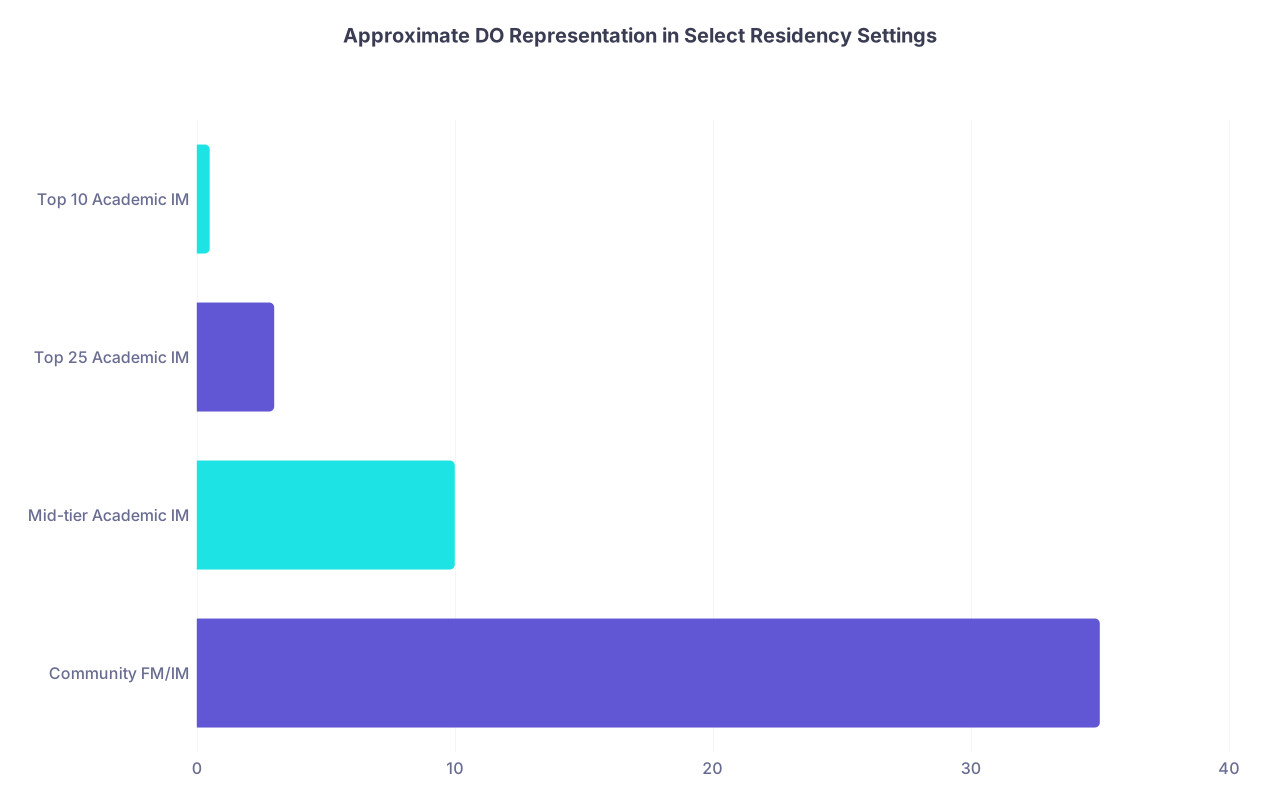
| Category | Value |
|---|---|
| Community FM/IM | 35 |
| Mid-tier Academic IM | 10 |
| Top 25 Academic IM | 3 |
| Top 10 Academic IM | 0.5 |
Are there DOs at big-name academic programs? Yes. I’ve worked with several. But they almost all share:
- Very high Step 2 (think 250+)
- Serious research (often multiple first-author pubs, real projects, not fluff)
- Strong home or away rotation advocates who went to bat for them
If you’re a DO and “I want to be at a big-name academic IM or peds program with strong fellowship placement” is your dream, it’s possible—but you have zero margin for mediocrity. While a mid-range MD can sometimes “coast” into those with good but not spectacular stats, you don’t get that cushion.
2. Ultra‑Competitive Specialties
This is where I see the most damage from bad advising.
I’ve watched premeds with 506 MCATs get told, “Go DO, you can still do derm or ortho if you work hard enough.” That’s malpractice-level optimism.
Here’s the unvarnished reality for DOs in:
- Dermatology
- Plastic surgery (integrated)
- Neurosurgery
- ENT
- Ortho
- Some radiology and anesthesiology programs, especially academic
You’re swimming upstream, hard. The match data quietly confirms it every year, but PD conversations confirm it louder.
I’ve sat in meetings where:
- A DO app with a 250+ Step 2 and research was called “impressive for a DO”
- An MD with similar stats was called “solid candidate, should interview”
- The DO needed one or two strong faculty phone calls to get the same invite
Same numbers. Different baseline expectation.
So what happens in practice?
- Some competitive specialties barely interview DOs at all
- Some will take 1 DO every few years as the “exceptional exception”
- A lot of DOs chasing these fields end up SOAPing or reapplying
Can you match ortho, derm, neurosurg as a DO? Yes. People do. But you need:
- Top‑tier scores (think 250–260+)
- Real research in that field
- Early, strategic audition rotations at DO‑friendly programs
- Mentors who are brutally honest, not cheerleaders
If that’s not you, the “you can do anything with a DO” line stops being empowering and starts being cruel.
3. The Hidden Filter: Faculty Bias and Familiarity
There’s another layer that no one publicly admits: comfort and familiarity.
Many academic attendings:
- Trained in allopathic systems
- Have never worked closely with a DO
- Subconsciously use “MD” as the default mental model of “real doctor”
So even if the institution is technically DO‑friendly, your application gets read through an unfamiliar lens. I’ve heard:
- “What’s this COMLEX thing? Did they take Step?”
- “How does this school rank? I’ve never heard of it.”
- “Are their rotations as rigorous? Do they see enough volume?”
Programs that regularly take DOs have already answered those questions for themselves. Programs that never have? You’re their experiment. People avoid experiments when they’re drowning in apps.
This is why the distribution of DOs is clumpy: lots in some places, nearly none in others.
The Numbers Game: Exams, COMLEX, and Step 2
You can’t talk about DO vs MD without talking about exams. This is a frequent private discussion topic among PDs, and the nuance matters.
1. COMLEX Alone Is Still a Liability in Many Competent Programs
Public line: “We accept COMLEX.”
Private reality:
- Many faculty literally do not understand COMLEX scoring
- PDs have no intuitive feel for “what does 600 actually mean?”
- Some programs will quietly filter “Step 2 required” or “preferred” which basically means “Take it if you want a real shot”
I’ve seen ERAS spreadsheets where the PD says, “Sort by Step 2 score,” and any COMLEX-only applicant drops to the bottom because… there’s no field.
If you’re DO and aiming for anything beyond:
- Community FM
- Community IM
- Lower‑tier psych/peds/EM
You should seriously plan on taking Step 2. The step‑optional fantasy is for people with zero ambition beyond the safest lanes.
2. Step 2 As Your Equalizer
The smartest DO students treat Step 2 as their currency for equivalence.
I’ve heard PDs say:
- “Once they’ve taken Step, I don’t care DO vs MD. Number is number.”
- “If they crushed Step 2 and their clinical evals are good, we’re good.”
Here’s roughly how PDs unconsciously bucket DO Step 2 scores vs MDs for moderately competitive fields (IM, EM, anesthesiology, radiology at decent programs):
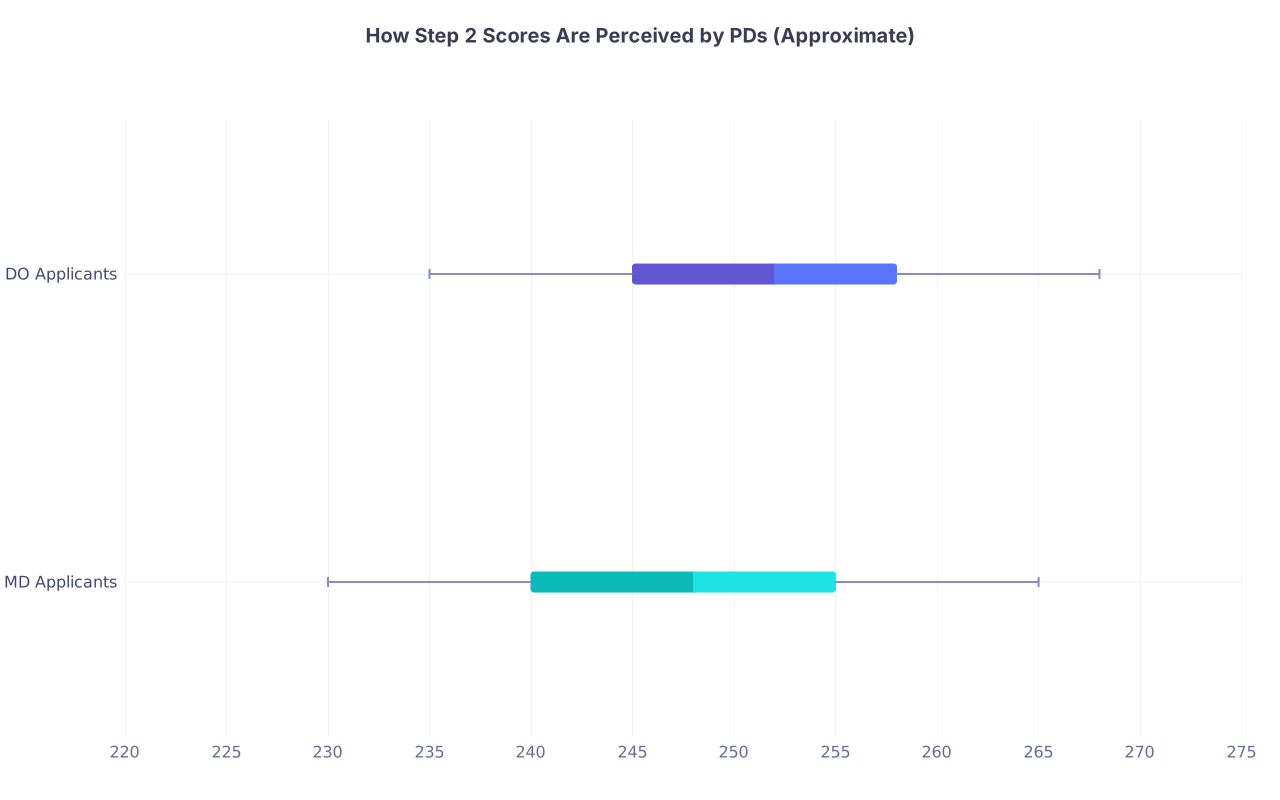
| Category | Min | Q1 | Median | Q3 | Max |
|---|---|---|---|---|---|
| MD Applicants | 230 | 240 | 248 | 255 | 265 |
| DO Applicants | 235 | 245 | 252 | 258 | 268 |
Translation:
- A DO usually needs to be just a bit higher than their MD peers to be perceived as “equally strong” at the same program tier.
- That’s not fair. It’s also not changing soon.
If you’re DO and you’re casually shooting for “above average,” you’re playing the wrong game. You need to be “clearly above.”
Location, Networks, and the Quiet Power of Geography
Another truth no one tells premeds: where your DO school is located changes everything.
Many DO schools are:
- In the Midwest
- In the South
- In less flashy cities and suburbs
Those regions often have:
- Hospital systems already integrated with DO schools
- Longstanding PD familiarity with DO grads
- Established pipelines: X DO school feeds Y residency every year
So if you go to, say, a DO school in Ohio or Michigan, you may find:
- Multiple nearby residencies that know your faculty well
- PDs who know “Oh, we’ve had three great residents from there; let’s look closely”
- Rotations already set up where your evals are understood and trusted
But if you go DO in a region saturated with top‑tier MD schools (Boston, NYC, SF) and your dream is to match at those elite hospitals around the corner? You’ve just chosen to play on hard mode.
There’s a quiet, very real pipeline reality:

| Step | Description |
|---|---|
| Step 1 | DO School |
| Step 2 | Local Community Programs |
| Step 3 | Regional Academic Programs |
| Step 4 | Selective Academic Programs |
| Step 5 | Primary Care Jobs |
| Step 6 | Fellowships & Academic Positions |
Breaking out of that regional pipeline is doable, but it requires:
- Away rotations in the regions you want to match
- Faculty sponsors who will actually make calls
- Scores and performance that justify the “extra risk” to the PD
Who Should Seriously Consider DO… and Who Probably Shouldn’t
This is where people get very defensive, but I’m not interested in protecting feelings. I’m interested in protecting 22‑year‑olds from a lifetime of “I wish someone had told me this.”
You’re a Good Fit for a DO Path If:
- Your dream is primary care, psych, or community-based practice.
- You’re geographically flexible and not obsessed with training at a brand‑name institution.
- Your GPA/MCAT profile is marginal for MD but strong enough for DO (e.g., 3.3–3.5 GPA with a 505–508 MCAT and an upward trend).
- You know you’re hungry, mature, and willing to outwork the average peer to create your own opportunities.
- You want or are at least open to training in the regions where DO schools and residencies are already tightly connected (Midwest, South, some parts of the Northeast).
In that setting, a DO degree is not “settling.” It’s a more realistic on‑ramp that still gets you to being a physician with a good life and good options.
You Should Think Long and Hard Before Committing to DO If:
- Your heart is set on derm, plastics, neurosurgery, ENT, or consistently top‑10 academic environments.
- You’re academically strong and have the metrics to be competitive at MD programs (3.7+ GPA, 512+ MCAT, and you’re willing to wait or improve if needed).
- You care deeply about being at an institution with robust NIH funding, formal physician‑scientist tracks, and a culture where research is currency.
- You’re the kind of person who will always wonder “what if” about academic prestige and ultra‑competitive fields.
It doesn’t mean you cannot reach those from a DO route. But it does mean you’re deliberately choosing the steeper path when a more level one might be available if you retake the MCAT or rework your application and aim MD.
How to Protect Yourself If You’re Leaning DO
If you’re already DO‑bound or very likely to go that route, here’s how people quietly win in that system.
First year:
- Treat your preclinical years like a multi‑year Step 2 prep course. COMLEX alone will not save you.
- Identify faculty with solid residency connections outside the DO bubble. Those are your eventual sponsors.
- Get clarity early: are you a primary care person, or are you actually angling for something more competitive? Your strategy diverges quickly.
Second year:
- Plan to take Step 2 if you’re even considering anything above community primary care. Don’t wait to “decide later” when it’s too late to prep well.
- Start modest research even if your school isn’t research-heavy. Case reports, QI projects, anything to show academic engagement.
Clinical years:
- Crush your core rotations. DO clinical evals matter more because PDs often rely on them to compensate for their lack of familiarity with your school’s brand.
- Choose audition rotations intentionally at DO‑friendly programs in your target field and region. You cannot spray and pray.
Application season:
- Play a slightly lower tier than your ego wants. MDs can reach a bit; DOs have to be realistic plus a few safe cushions.
- Use your faculty aggressively for calls and emails. DO applicants who get those calls straight‑up jump tiers in interview chances.
The Bottom Line: Where DO Helps, Where It Hurts
Let’s strip this down to the bone.
A DO degree quietly helps you when your goals align with what the DO ecosystem already does well: primary care, community practice, regional training pipelines, and programs that value work ethic and humility more than brand name.
A DO degree hurts you when you’re chasing prestige-heavy, research-heavy, or ultra‑competitive specialties at institutions that have little familiarity with DO training and no incentive to take a “risk” on you when they’re flooded with high‑stat MDs.
The more ambitious your specialty and academic goals, the more you will need to overperform as a DO: higher scores, stronger clinical evals, more deliberate networking, and earlier, smarter planning than your MD peers.
Know what you want, understand the real terrain, and then choose your path with your eyes open—not based on slogans, but on how the game is actually played.