It’s late afternoon on your first core rotation. You’re a third-year DO student on internal medicine at a big community hospital that also has MD students from a nearby allopathic school. You finished notes, checked your patients, followed up labs. You’re exhausted.
Your resident says, “We’re doing evaluations tonight; anything you want us to know?”
You freeze. Because you don’t actually know what matters. You don’t know how they really score you. You’re vaguely aware of “Professionalism, Medical Knowledge, Clinical Skills” boxes on some form you’ve never seen, but you also know that MD and DO students do not always get read the same way — even when they’re doing the same work.
(See also: What Happens to DO vs. MD Applications in the First 5 Minutes of Review for more details.)
Let me tell you what actually happens behind that evaluation screen. The stuff no clerkship director puts in a syllabus.
The Hidden Baseline: What Attendings Assume About DO vs MD
Here’s the part no one says out loud: most evaluators walk into your rotation with a mental “default setting” for DO vs MD students. They might not even realize it. But it’s there.
I’ve sat in those meetings. I’ve read those evals. I’ve listened to attendings talk after students leave the room.
The very rough, very unspoken hierarchy at many mixed hospitals looks like this:
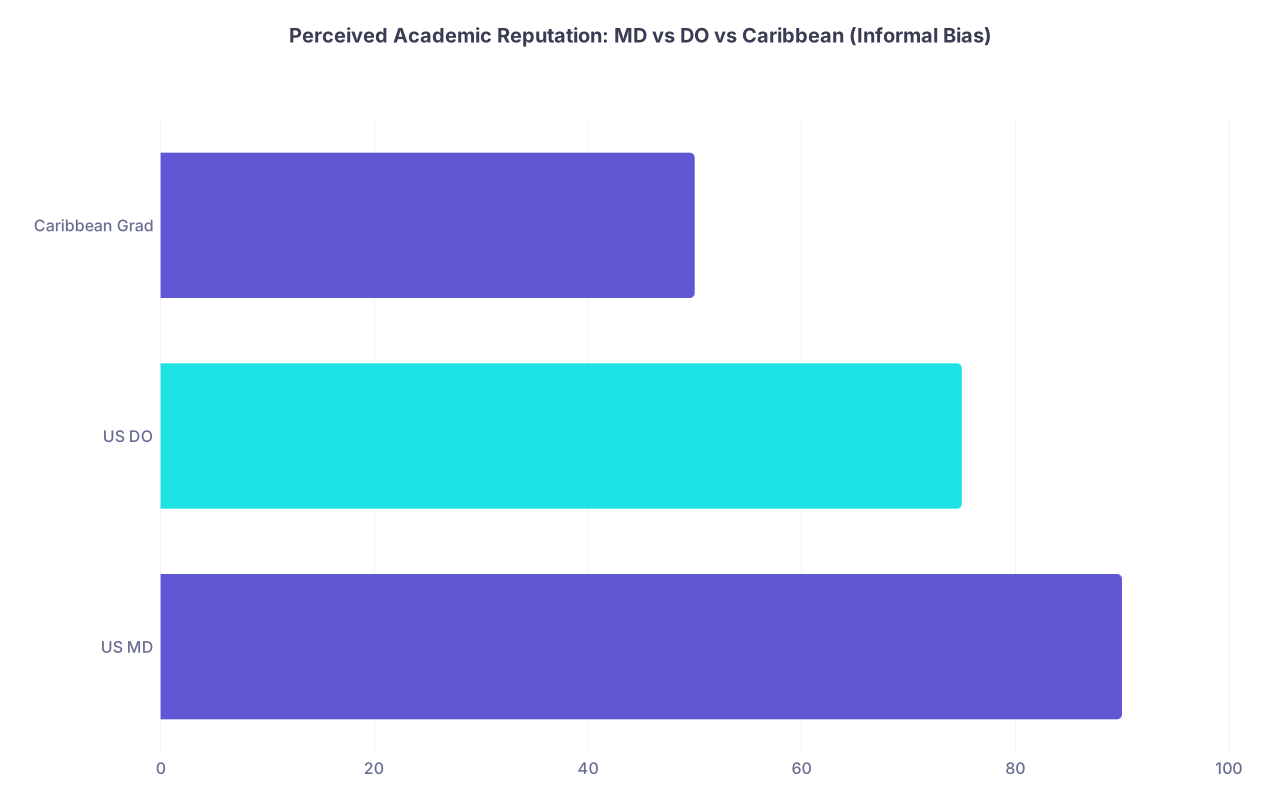
| Category | Value |
|---|---|
| US MD | 90 |
| US DO | 75 |
| Caribbean Grad | 50 |
No one says this on the record. But it colors how your performance is interpreted.
For DO students on core rotations, here’s the real baseline assumption at many (not all) sites:
- “Solid, may be a bit less didactically strong than MDs, but often hardworking.”
- “Boards might be COMLEX only; may not be as strong on Step-style questions.”
- “Osteopathic school… I don’t really know the curriculum; let’s see how they do.”
So DO students are often graded on a “prove it” curve. If you perform equally to the MD student, your evaluator may still think the MD student is “stronger” because they’re fitting the mental image of “top academic pipeline.”
Ugly? Yes. But once you understand that, you can weaponize it.
Because when a DO student comes in prepared, sharp, and reliable, attendings notice more than when an MD student does the same thing. You stand out precisely because they weren’t expecting it.
What Actually Drives Your Core Rotation Grade (Not What the Form Says)
Every school has some polished evaluation form: history-taking, physical exam, presentation skills, medical knowledge, professionalism. You’ve seen the categories. What you haven’t seen is how attendings really decide between “Meets Expectations,” “Above Expectations,” and “Honors.”
Here’s how it actually plays out for DO students.
1. First impressions buy you a grading ceiling
Day one and two set your ceiling. Harsh, but true.
If you show up:
- On time (which in medicine means 10–15 minutes early)
- Dressed like you care (clean white coat, not wrinkled scrubs you slept in)
- With a pen, small notebook, and a working login
- Knowing your patient list by noon
…then in the attending’s head, you’re already in the “can probably honor” lane.
If you’re late once in week one? Not dressed appropriately? Don’t know your own patients on day two? That “honors” box quietly disappears for you. The rest of the rotation becomes an uphill climb back to “good pass.”
I’ve literally heard: “Yeah, she improved, but early on she was lost and unprepared. I’ll give her a solid pass.” That “early on” was two days of chaos. The student never recovered on paper.
For DO students, the bias is this: if an MD is sloppy on day one, attendings often think, “Bad day.” When a DO is sloppy on day one, some attending’s brain goes, “Ah, this is what I expected from a DO school.” They won’t say it. But I’ve seen the differential forgiveness.
2. The “would I let this person see my family?” test
Most attendings make their final call with a gut test: “Would I let this student see my mom alone?”
That’s not about how many diseases you can list. It’s:
- Do you check labs and imaging without being asked?
- Do you follow up on things you said you’d follow up on?
- Do you admit when you don’t know something instead of bluffing?
- Do nurses trust you enough to come to you with questions?
If the answer is “yes” by the end of the rotation, you’re competing for honors. If the answer is “probably not yet,” you get a nice comment like “shows growth” and a middle-of-the-road grade.
This is where DO students can win big. DO schools lean harder into patient communication and bedside manner from day one. Use that. I’ve seen DO students with average test knowledge outperform MDs in the eyes of attendings because they owned the patient relationship.
Attendings care about who the patient trusts. And patients often gravitate to the DO who actually listens and explains.
3. The secret categories: “low maintenance” and “teachable”
Most evaluation forms never say “low maintenance,” but that’s the phrase attendings use when we’re filling these out.
Low maintenance means:
- You don’t create extra work
- You don’t vanish when something needs doing
- You don’t chronically ask questions you could have answered in 20 seconds with the chart or UpToDate
Teachable means:
- You change your behavior after feedback. Once.
- You don’t argue or defend every decision
- You’re allowed to make early mistakes without being written off
In mixed MD/DO environments, here’s the quiet bias: if a DO student is low maintenance and teachable, they are described as “pleasant, great team member, exceeded expectations.” If an MD student acts the same way, they’re described as “solid, expected for their level.”
Same performance. Different baseline expectation.
Your job on cores as a DO student is not to be merely “good.” It’s to shatter the lazy stereotype. You do that by being relentlessly low maintenance and obviously teachable.
What Specific Behaviors Actually Get You Honors (or Kill It)
Let me be very specific. These are the things attendings and residents actually talk about in the workroom when they’re deciding whether to click “honors” or not. Especially for DO students.
Behaviors that push a DO student into the “top” bucket
These come up constantly when faculty praise DO students:
You learn the workflow fast
On medicine: you know when notes are due, when rounds start, where to find vitals, where admit orders live. You ask once, not five times, then you just do it.You own something Not everything. Something. Could be “I’ll always check overnight events and new labs on my patients by 6:45 a.m.” Or “I’ll always write the initial note on new consults we get.” Faculty love ownership.
You link what you read to your patients
Instead of “I read about COPD yesterday,” you say, “For Mr. Smith with COPD, I read that starting triple therapy is recommended when...” That sounds like a resident in training. Attendings love it.You look out for the team
If you see an MD student drowning, you help them even if they’ll be competing with you for honors. That gets back to faculty. Nurses mention it. Residents notice.You use your DO skills strategically, not theatrically
No one wants a show. But when your patient’s post-op back spasm improves because you quietly did some basic OMT and documented it appropriately? That’s memorable. Especially if you explain what you’re doing in plain English.
Behaviors that quietly destroy your grade
These are deadly, especially for DO students trying to overcome bias:
Being “good with patients” but weak on basic knowledge
This combination gets praised in comments (“great with patients”) but punished on the final grade. You’ll see “meets expectations” instead of “above expectations” with a warm blurb — and no honors.Complaining about COMLEX vs Step during the rotation
Let me be blunt. Attendings do not care about your exam drama when they’re drowning in consults. If you start every conversation with “As a DO we have to take…” you sound like you want accommodation more than responsibility.Acting like you’re “behind” because you’re DO
Students say this out loud: “We didn’t really learn this in our DO school.” Even if it’s true for that topic, it’s a terrible move. What attendings hear is: “My school didn’t prepare me as well, and I’m using that as a shield.”Being mysteriously absent
You disappear to “study for COMLEX” during the day. You’re always “checking on a patient” but never where the team actually is. That gets documented mentally, even if not in writing.
Feedback You Hear vs Comments They Actually Write
You’ll get generic feedback: “You’re doing fine.” “Read more.” “Ask more questions.” Useless.
The real data lives in the written evaluation. Let me translate some of the common phrases DO students see and what they mean behind the scenes.
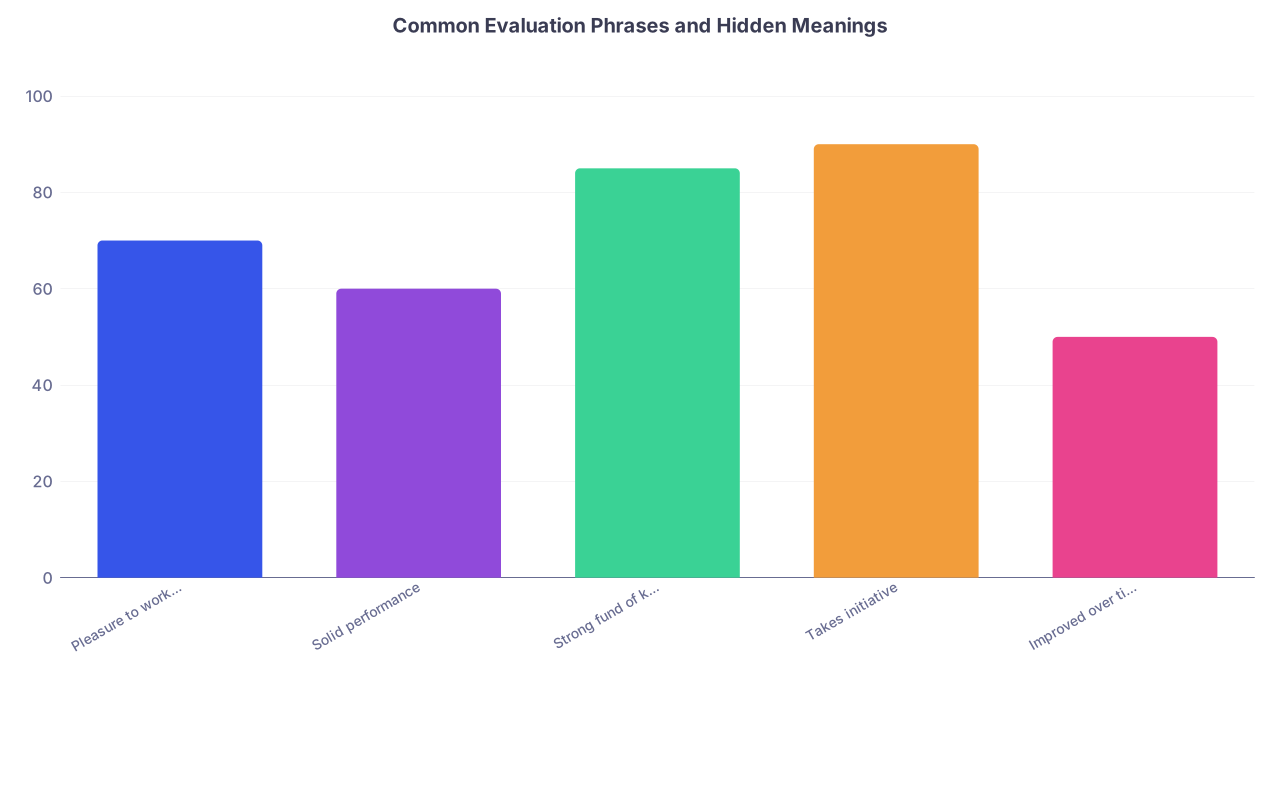
| Category | Value |
|---|---|
| Pleasure to work with | 70 |
| Solid performance | 60 |
| Strong fund of knowledge | 85 |
| Takes initiative | 90 |
| Improved over time | 50 |
Here’s the decode:
“Pleasure to work with”
You were nice, not necessarily outstanding. Often attached to a mid-tier grade.“Solid performance for level of training”
Middle lane. Not a disaster, not a superstar. Usually “meets expectations.”“Strong fund of knowledge”
This is gold. When paired with “takes initiative,” that’s often honors-level.“Improved over time”
Translation: “Started weak.” This comment almost always caps you at a pass. Faculty use it to be kind instead of writing “unprepared at the beginning.”“Would benefit from more independent reading”
This is a safe criticism that usually stands for “your knowledge base was not where it should be.”“Prepared for rounds”
This matters more than you think. That means you knew your patients, had data, and could answer basic questions. Huge plus.
For DO students, there’s one more thing: any mention of “DO skills,” “OMT,” or “osteopathic approach” in your eval is usually a positive — if the rest of your evaluation is strong. It reads as “they bring something extra” instead of “they’re different” when you’ve already proven you’re clinically solid.
How Being DO Specifically Changes the Evaluation Game
Let me separate out the generic med student stuff from DO-specific realities. Because the game is slightly different.
1. You’re sometimes the “unknown quantity”
At MD-heavy academic centers, some attendings have never worked with DO students or haven’t for years. You become the sample size of one for “what DO training produces.”
That’s not fair. It’s also not optional. They will extrapolate from you.
So if you’re the only DO on the team and you’re late, scattered, or clearly behind? Guess what story they tell next time someone brings up DOs.
On the flip side, when you’re sharp, prepared, and teaching the MD student something, attendings remember that. I’ve heard: “The best student I had this year was actually a DO.” That line shows up in promotion letters. It shifts how people view DO schools.
2. COMLEX vs Step filters how they interpret your knowledge
If you didn’t take Step 2 and your program is Step-centric, faculty sometimes quietly watch to see if your clinical reasoning feels “up to par.” They shouldn’t. But they do.
So when you present a patient, they’re subconsciously checking:
- Do you know the guideline-based management?
- Do you think in the “Step question” framework: differentials, next best test, management escalation?
- Do you understand when not to order something?
If you show that kind of thinking, the “but they’re DO” question in their head disappears. Multiple times I’ve seen an attending say, “He didn’t take Step but obviously could have done fine.”
That line matters later when they write letters for residency.
3. OMT can make you look either amateur or advanced
Here’s the harsh truth about OMT on rotations:
- Used indiscriminately, it looks like a parlor trick.
- Used thoughtfully, on the right patient, with explanation and documentation, it screams “added value.”
I’ve seen both.
Bad version: student does OMT on every patient with back pain, explains it poorly, doesn’t chart it correctly, and slows down the team. Attendings roll their eyes. Evaluation says “interested in osteopathic treatment” but grade stays average.
Good version:
Post-op patient with clear musculoskeletal discomfort, no red flags, meds optimized. You ask the resident: “Would you be okay if I offered some gentle OMT to help his paraspinal spasm? I’ll explain it, get consent, and document it in the note.” Patient improves, nursing notices, attending hears about it on rounds. Now your “DO-ness” is a strength, not a quirk.
Tactical Moves for DO Students to Max Out Core Rotation Evaluations
Let’s strip this down to moves that change your evaluation right now.
Before the rotation starts
- Email the coordinator and confirm expectations, hours, and location. DO students sometimes get shuffled to community sites; knowing the rules early helps you hit the ground running.
- Skim the rotation objectives, but more importantly, talk to a MS4 or recent grad from your school who rotated there. Ask, “What does this site actually care about?” That’s the real syllabus.
Week 1: Set your ceiling
- Show up every single day early, dressed like you’re already an intern.
- Learn the EMR workflow in the first 48 hours. Ask the senior resident: “How can I be most helpful in this system?”
- Ask your attending at the end of day two: “How do you like students to present? Problem-based? System-based? SOAP?” Then present exactly that way the next day.
Week 2–3: Prove you’re teachable and reliable
- When you’re corrected once on something, never repeat the same mistake. That “one and done” learning is what makes faculty call you “very teachable.”
- Start anticipating. If every patient with chest pain gets troponins and EKGs, don’t wait to be told after day three. Order what’s appropriate under supervision.
Week 4: Lock in the evaluation
- Ask directly: “Could you give me feedback on what I need to improve to be at the honors level by the end?” Most students never use the word “honors” out loud. You should. It signals that you actually care and that you think you’re capable of it.
- If they say something vague like “read more,” push gently: “Is there anything specific you’d like me to focus on with presentations, notes, or patient care?” Then address that concretely in the next two days and make sure they see it.
How This All Feeds Your Residency Application
Core rotations are your currency for residency. For DO students, they matter even more, especially if:
- Your COMLEX is fine but not spectacular
- You didn’t take Step 2
- You’re coming from a less well-known DO school
Program directors look at rotation comments for signals:
- “Would this person function as an intern or will they be a liability?”
- “Did any faculty go out of their way to call this student exceptional?”
- “Did they stand out at mixed DO/MD institutions?”
They also look at patterns. One mediocre eval is noise. Three rotations in a row saying “solid, pleasant, meets expectations” without one “outstanding” or “among the top students I’ve worked with” comment? That caps how competitive you look for certain specialties.
The unspoken truth: DO students often need a few standout evaluations to offset the generic bias against their school name. That doesn’t mean clawing for perfection on every rotation. It means deliberately aiming to truly crush:
- Medicine or surgery (a big core at a busy site)
- One specialty rotation in your intended field
- One audition or sub-I
You can be average on psych and OB and still match great if your core medicine and your audition rotation evals are glowingly strong.
Years from now, when you’re the senior resident, you’ll barely remember your exact rotation schedules. But you will remember which attendings went to bat for you in their evaluations — and whether you gave them a reason to.