
Most of what you’ve heard about how your DO or MD application is reviewed is fantasy.
(See also: What Residency Committees Really Think About DO vs. MD Applicants for insights into application perceptions.)
Let me walk you through what really happens in those first five minutes when your file hits a human being’s screen—how DO schools handle it, how MD schools handle it, and why the same applicant can look like gold in one pile and dead weight in the other.
I’ve sat in those rooms. I’ve heard the comments you’ll never see in any “official” policy document. And I can tell you: the first five minutes decide whether you get a real look… or you’re basically done.
The Uncomfortable Truth: You’re Pre‑Judged Before Anyone “Holistically Reviews” You
Forget the brochure language about “holistic review.” That’s a second-stage luxury. The first stage is triage.
At both MD and DO schools, a huge chunk of files never get true holistic review. They get screened. Fast. Often by someone with a spreadsheet and a quota.
Here’s the mental model the reviewers are actually using in those first minutes:
- At MD schools: “Can I justify spending time on this file given the volume and our usual numbers?”
- At DO schools: “Is this someone who can succeed academically, won’t fail boards, and seems at least vaguely aligned with osteopathic medicine?”
Same concept, different thresholds, different fears.
Now let’s be precise and lift the curtain.
Minute 0–1: Your File Loads, Your Label Is Set
The moment your application opens, the reviewer has already placed you into one of a few invisible buckets, whether you applied MD or DO.
At MD schools, the first thing that flashes mentally is not your name. It’s this internal conversation:
“Is this an auto-advance, a maybe, or a no shot?”
At DO schools, it’s:
“Is this safe academically, and do they know what DO even is?”
The systems differ a bit, but the behavior is the same: people are drowning in applications and looking for reasons to move quickly.
What shows up first on the screen?
It depends on the school’s system, but typically in those first seconds the reviewer sees:
- Basic demographics (home state, school, major)
- GPA (overall and science)
- MCAT score and breakdown
- Institution attended
- Sometimes a quick indicator of mission fit (state resident, special program, pipeline, etc.)
At many MD schools, personal statements and activity descriptions do NOT get touched in the actual first 2–3 minutes for most applicants. That comes later—and only if you get past the quantitative gate.
DO schools are somewhat more likely to look at your narrative earlier, but only after they’re convinced you’re not a future board-fail statistic.
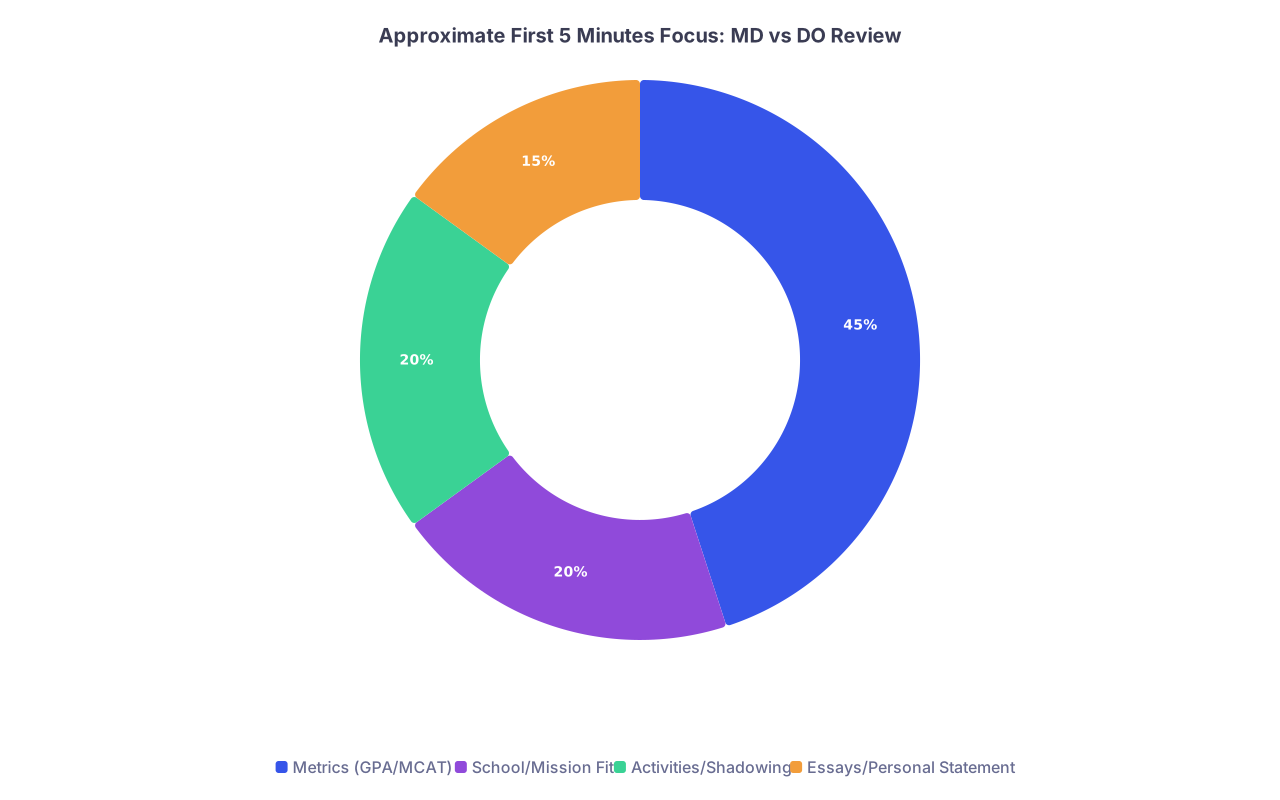
| Category | Value |
|---|---|
| Metrics (GPA/MCAT) | 45 |
| School/Mission Fit | 20 |
| Activities/Shadowing | 20 |
| Essays/Personal Statement | 15 |
That breakdown is more MD-weighted; for DO, the “Activities/Shadowing” and “Essays” buckets creep up earlier, but not by as much as premed forums like to pretend.
How MD Schools Actually Slice You in Minutes 1–3
Let’s start with MD, because the process is more brutally numerical upfront.
The first filter: numbers and context
In many MD admissions dashboards, the first tab is some version of a stats grid. I’ve watched an assistant dean breeze through 20 applications in under half an hour, saying things like:
- “3.2 and 506, out-of-state, no hook. Pass.”
- “3.9, 520, state school. Flag for full review.”
- “Upward trend? Show me the semester-by-semester. Okay, maybe.”
In the first 3 minutes, these are the silent questions:
Are you obviously below our line?
Every school has unpublished soft cutoffs. They will never post them. They use them constantly.For a mid-tier MD program, typical quiet patterns:
- Cumulative GPA under ~3.3 with no outstanding context or story? You’re in the near-automatic “screened out unless something special flags you.”
- MCAT below ~505–508? Same fate unless you’re institutional priority (URM, in-state with strong ties, special program, military, legacy, etc.).
Are you obviously above our line?
3.8+ and 515+ from a decent institution? They’re not rejecting you in 5 minutes. Your risk is being lumped into the army of “strong but generic” applicants.Do your numbers fit a narrative they already like?
MD committees love trends and context:- Harsh major (engineering, physics) plus 3.6–3.7 and 515+? They mentally bump you up a bit.
- Low freshman year (2.9–3.0) with sustained 3.8+ after? They’ll often give you more time.
- Community college transfer with a strong upward climb? That actually gets noticed at more schools than you think—if you’re close to their ranges.
What almost never happens: a 3.1 with a 498 gets “holistically” reviewed at an average MD program. I’ve seen files like that get shut within 45 seconds, no matter how heartfelt the personal statement is.
The “school prestige” bias nobody writes on the website
Yes, there is a real, unspoken hierarchy:
- Ivy / top 20 undergrad: they’ll tolerate slightly lower GPA.
- Mid-level state flagship: baseline.
- Unknown for-profit college, weak science rigor: your GPA is treated as fragile glass.
Nobody will say this on record. But I’ve been in the room when someone said, “3.9 from [tiny obscure college]? Let me see the MCAT before I get excited,” and 3.5 from Michigan or UCLA gets a different reaction.
DO schools care less about this. MD schools care a lot.
Who actually gets a deeper look within the first five minutes?
There’s a group that gets promoted to full-review almost immediately:
- Strong stats in their usual acceptance zone
- In-state or mission-relevant
- Clean transcript (few withdrawals, no repeated F’s)
- No obvious professionalism red flags
For these applicants, the reviewer might scroll to:
- Activities: a quick skim for “real” clinical exposure
- Personal statement: a 15–30 second glance to make sure it’s not a disaster
- Any institutional tags: pipeline programs, special recommendations, etc.
But if your metrics are off their mark, your DO application may survive where your MD application dies in those opening minutes.
How DO Schools Actually Treat You in Those Same 5 Minutes
Here’s where most premeds are clueless. DO admissions is not just “MD but easier.” It’s a different paranoia.
MD programs fear:
- Falling USNWR rankings
- Weak board pass rates reflected in public data
- Losing top candidates to higher-ranked schools
DO programs fear:
- Board failures
- Students not matching into anything
- Applicants who treat DO as a backup and don’t show up committed
So in those same five minutes, a DO reviewer is running a different algorithm in their head.
Step one: board survival check
Yes, they start with GPA and MCAT too. But their internal line is different.
At many DO schools, here’s the very rough, very real pattern:
- ~3.3–3.4 GPA and ~502–505 MCAT: Not competitive at many MD programs, but very much in range for DO, especially with good trends.
- ~3.0–3.2 GPA and 498–502 MCAT: In the “maybe” zone for DO, where experiences and DO alignment actually start mattering.
- Below that: You’d better have strong post-bacc/SMP work and clear reasons for academic redemption, or you’re in serious trouble.
Here’s the key difference: a 3.2/502 that might be auto-declined or barely skimmed at an MD program often gets a real look at a DO school—if you do the next part right.
Step two: “Do they actually understand DO?”
This is where the DO vs MD first five minutes sharply diverge.
I’ve seen this exact exchange on a DO admissions day:
Reviewer: “Stats are fine for us, decent volunteering.”
Other reviewer: “Any DO shadowing?”
First: “None.”
Second: “Pass. They’ll just leave if they get an MD acceptance.”
That’s not rare. That’s standard.
In the first five minutes at a DO school, after they decide you’re not likely to flunk out, they look very quickly for:
- DO shadowing clearly listed
- Any explicit DO physician letter
- Words like “osteopathic,” “holistic,” “OMM/OMT,” “whole-person care” actually appearing in your activities or essays
- Clear signal you didn’t just copy-paste your MD personal statement without adjusting anything
If they see “osteo-what?” vibes, you get mentally downgraded fast.
DO schools are weary of being the backup date. If you read any osteopathic program director’s off-the-record comments, you’ll hear this theme over and over: “We want people who actually want to be here, not just people who struck out MD.”
Show no DO interest, you’re the person they assume will bounce if any MD waitlist moves in March. That’s how you get quietly deprioritized.

| Step | Description |
|---|---|
| Step 1 | Application Opens |
| Step 2 | MD: Stats Screen |
| Step 3 | DO: Stats Screen |
| Step 4 | Quick Reject / Hold |
| Step 5 | Check School Tier & State |
| Step 6 | Quick Scan Activities |
| Step 7 | Flag for Full Review |
| Step 8 | Reject / Strong Rationale Needed |
| Step 9 | Check DO Interest & Shadowing |
| Step 10 | Lower Priority / Waitlist-Fodder |
| Step 11 | Flag for Interview Consideration |
| Step 12 | MD or DO School |
| Step 13 | Above Soft Cutoffs? |
| Step 14 | Board Survival OK? |
| Step 15 | Clear DO Fit? |
What Actually Matters Differently for DO vs MD in Those First Minutes
Let’s get very explicit, because this is where applicants sabotage themselves.
Numbers: same tools, different cut lines
Both DO and MD reviewers are looking at:
- Overall GPA
- Science GPA
- MCAT total and section breakdown
But how they react is different.
For MD:
- Slightly lower CARS or Psych/Soc is usually tolerated if the total is strong.
- A sharply low Chem/Phys can hurt at research-heavy schools that fetishize “strong foundational sciences.”
For DO:
- Section balance matters more as a predictor of board performance. A 505 with a 124 in one section raises eyebrows.
- They might more heavily weight recent performance: last 60 credits, post-bacc, or SMP.
If you’re on the border, MD reviewers often will not dig to find your trend. DO reviewers are somewhat more willing to scroll and check semester-by-semester grades in those first five minutes—especially if your overall GPA is 3.2–3.4 range and your recent work is stronger.
Experiences: same buzzwords, different deal-breakers
For MD programs, in the first five minutes, experiences are mostly a quick scan for:
- Real clinical contact vs fluff
- Any obvious lack of patient exposure
- Massive red-flag gaps (no clinical volunteering at all, nothing recent, years-long holes)
For DO programs, you get that plus:
- DO-specific exposure: shadowing, OMM clinics, osteopathic mentors
- Evidence you can handle being in smaller, sometimes less-resourced environments (they think about this more than you realize)
Here’s a real quote I wrote in a margin on a DO committee review sheet:
“Good stats, but no DO contact, no mention of osteopathic anything in PS or secondary. High risk MD flight.”
That applicant was technically interviewable. We pushed them down the list.
Personal Statements in the First 5 Minutes: Overrated for MD, Underused for DO
Everyone obsesses over their personal statement. But in the first five minutes of MD review, if your stats are weak, the truth is brutal: many reviewers don’t get far enough into your file to care how poetic you are.
Where essays matter early:
- When you are borderline but within sniffing distance of their stats expectations
- When you are DO-bound and they’re hunting for proof you’re genuinely interested in osteopathic medicine
At MD schools:
- The PS might get a 10–30 second skim at first pass.
- They’re scanning for red-flag writing: bizarre tangents, self-aggrandizing tone, obviously rehearsed clichés, or ethical weirdness.
At DO schools:
- A personal statement that explicitly mentions osteopathic principles (without sounding fake) actually pushes you up the mental stack.
- A PS that reads like you just changed “doctor” to “physician” and never once acknowledges DO? That’s a mark against you in those early minutes if your numbers aren’t top-tier.
If you’re applying to both MD and DO and sending the same primary PS, then relying entirely on secondaries to show DO interest, you’ve already handicapped yourself at some DO schools. They’ll see the primary first; some won’t ever get excited enough to dive deep into your secondary.
State Schools vs Private, Old DO vs New DO: The Stuff Nobody Explains
Another piece almost no one outside the room understands: who is reviewing you in those five minutes changes how ruthless or flexible that review is.
At many MD state schools:
- In-state status is a powerful early filter.
- I’ve heard things like: “3.4/506 but in-state, first-gen, strong clinical. Let’s look harder.”
At private MD schools:
- They care about yield and brand.
- They’re more likely to chase the 3.9/521 from Stanford and pass on the 3.6/509 scrapper, because they’re playing ranking and prestige games.
At older, established DO schools (think PCOM, UNECOM, DMU):
- There’s usually a stronger culture of respecting DO identity.
- Lack of DO exposure is a heavier early strike.
- They’re wary of applicants who will try to treat their school as a stepping stone.
At newer DO schools:
- They’re fighting for board pass rates and match stats.
- They’re terrified of admitting people who can’t pass COMLEX/USMLE, because one bad class can cripple them.
- If your GPA/MCAT are borderline, but you show strong recent upward trends and grit, they might give you more early benefit of the doubt than an older MD program would.
So in those first five minutes, at a mid-tier MD school you might be “stats-whacked” before anyone cares who you are. At a newer DO school you might get a second look for the same file—if you’ve done the DO homework.
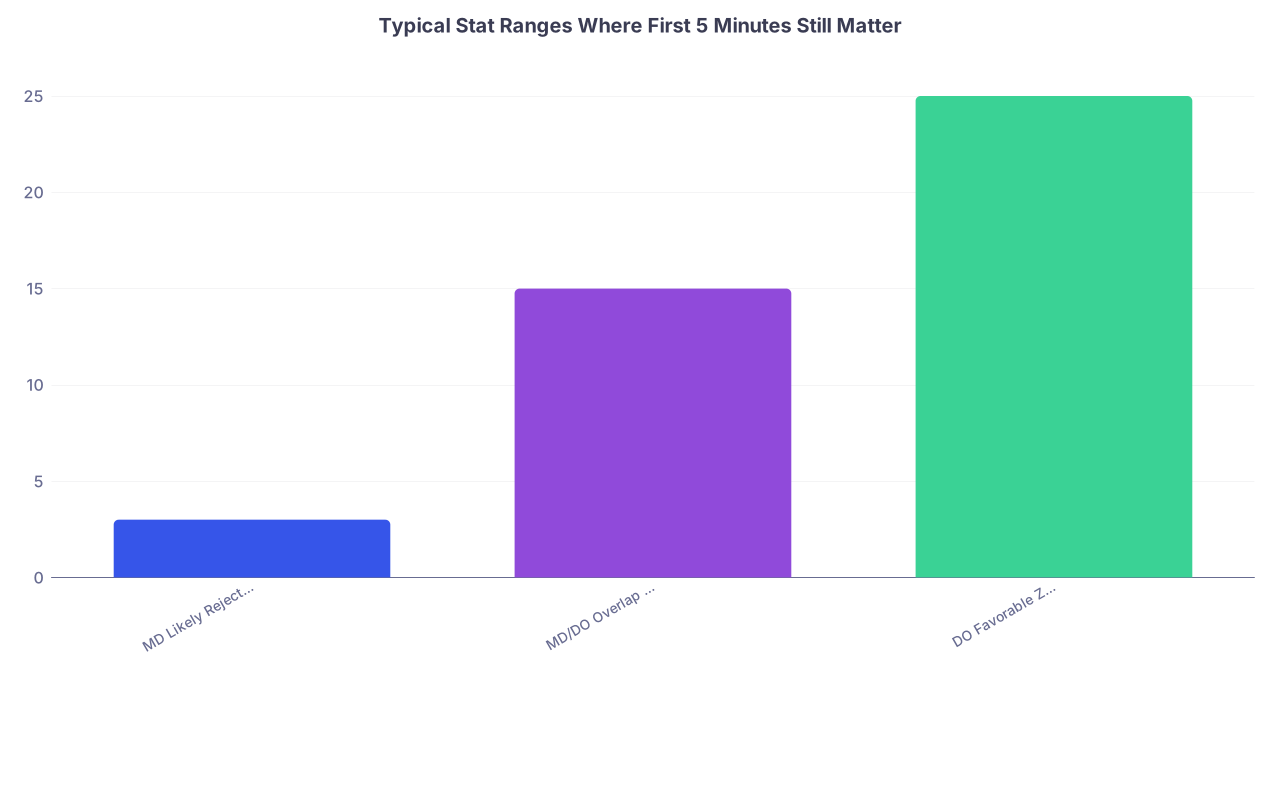
| Category | Value |
|---|---|
| MD Likely Reject Zone | 3 |
| MD/DO Overlap Zone | 15 |
| DO Favorable Zone | 25 |
(Think of those as “how many applicants out of 100 in each band actually get deeper review,” not cutoffs.)
How to Stack the Deck in Those First 5 Minutes (DO vs MD)
If you want your application to survive those five minutes, you need to understand what the person on the other side of the screen is really looking for.
For MD-focused applicants:
- You cannot “write your way out” of severely weak stats at most programs. If you’re far below 3.3 / 505, you’re in fantasy land unless you have a massive story and targeted school list.
- Your upward trend needs to be obvious without a detective. Semester GPAs clearly improving, recent years 3.7+. If that’s true, mention it directly in your secondaries.
- School selection matters more than Reddit admits. A 3.6/510 at Harvard/Stanford-level schools is a 5-second pass for most readers.
For DO-focused or DO-included applicants:
- DO shadowing is not “nice to have.” It’s your ticket out of the “flight risk” bucket.
- Have at least one physician letter from a DO if at all possible. Lack of it doesn’t kill you everywhere, but it absolutely hurts you some places.
- Use the word “osteopathic” where it makes sense. Explain how you see yourself as a DO physician without reciting a brochure. They can sniff out copy-paste philosophy with no substance.
For dual applicants (MD + DO):
- Don’t treat DO like a fallback in your writing. You think they won’t feel it, but they do.
- Adjust secondaries aggressively. Your DO secondaries should read like you actually know the training model, not like you swapped school names.
- If your numbers are near the MD margins, understand that many MD schools will barely glance at you while DO schools will take their time—if you’ve done the DO-specific work.
FAQs
1. If my stats are low for MD but average for DO, do MD schools still “review me holistically”?
In theory, yes. In practice, at many MD schools you’ll get a cursory glance—maybe a couple of minutes at best—unless you have a major institutional hook or unique story. Your DO apps, though, are much more likely to get a true look, especially if you’ve shown real DO interest.
2. Is DO shadowing absolutely required for DO schools?
Not universally required, but functionally critical at many programs. In those first five minutes, lack of DO shadowing often drops you into the “backup applicant” category unless your stats are so strong they’re willing to take the risk you’re just using them as insurance.
3. Will MD schools care if I’ve shadowed DOs instead of MDs?
No one is rejecting you for that. Some MD faculty barely distinguish. What they do care about is whether you’ve had enough real clinical exposure, regardless of the letters after the doctor’s name. But a PS that loudly preaches osteopathic philosophy might read oddly at some MD programs if it feels like you’re anti-traditional medicine.
4. How much does my undergraduate school name matter in these early minutes?
More than anyone will admit publicly. A high GPA from a well-known, rigorous institution buys you some forgiveness on a slightly lower MCAT or a rough semester. A high GPA from an unknown, very small, or for-profit school gets mentally discounted until the MCAT backs it up. DO schools typically weigh this less, MD schools more.
5. Can a great personal statement save me if my numbers are weak?
“Save” is too strong. At MD schools, a brilliant PS might move you from auto-reject to “borderline, maybe full review” if your stats are only slightly below their usual range. At DO schools, a PS that clearly shows genuine DO understanding and commitment can absolutely rescue a borderline file in those first five minutes—but not if your academics scream future board failure.
Key points to walk away with:
First, those first five minutes aren’t a myth; they’re where most fate is decided, and DO vs MD schools are running different silent checklists on you. Second, MD programs are more ruthlessly stats-driven up front, while DO programs blend stats with an early sniff test for genuine osteopathic interest and board survivability. Third, if you’re applying to both, write and plan like each type of school has its own psychology—because on the other side of the screen, they do.