The Back-Channel Talk: DO vs. MD Reputation at Top Academic Centers
It’s 10:30 p.m. You’re on SDN and Reddit, three tabs deep into threads about “DO vs MD chances at MGH/Johns Hopkins/Mayo.” Your brain is a mix of hope and dread. Half the posts say “DOs can do anything MDs can!” The other half are brutal: “Top academic centers basically don’t take DOs.”
You’re trying to decide: push for an MD at all costs? Go DO and “prove them wrong”? Does it actually matter for getting into places like Brigham, UCSF, Stanford, Penn?
Let me tell you what people say in the rooms you never see. In program director meetings. In selection committees. In those “off the record” conversations in the workroom after applicants leave the interview day.
(See also: Unspoken Rules: How DO Students Are Evaluated on Core Rotations for more details.)
Because the public line and the private reality are not the same thing.
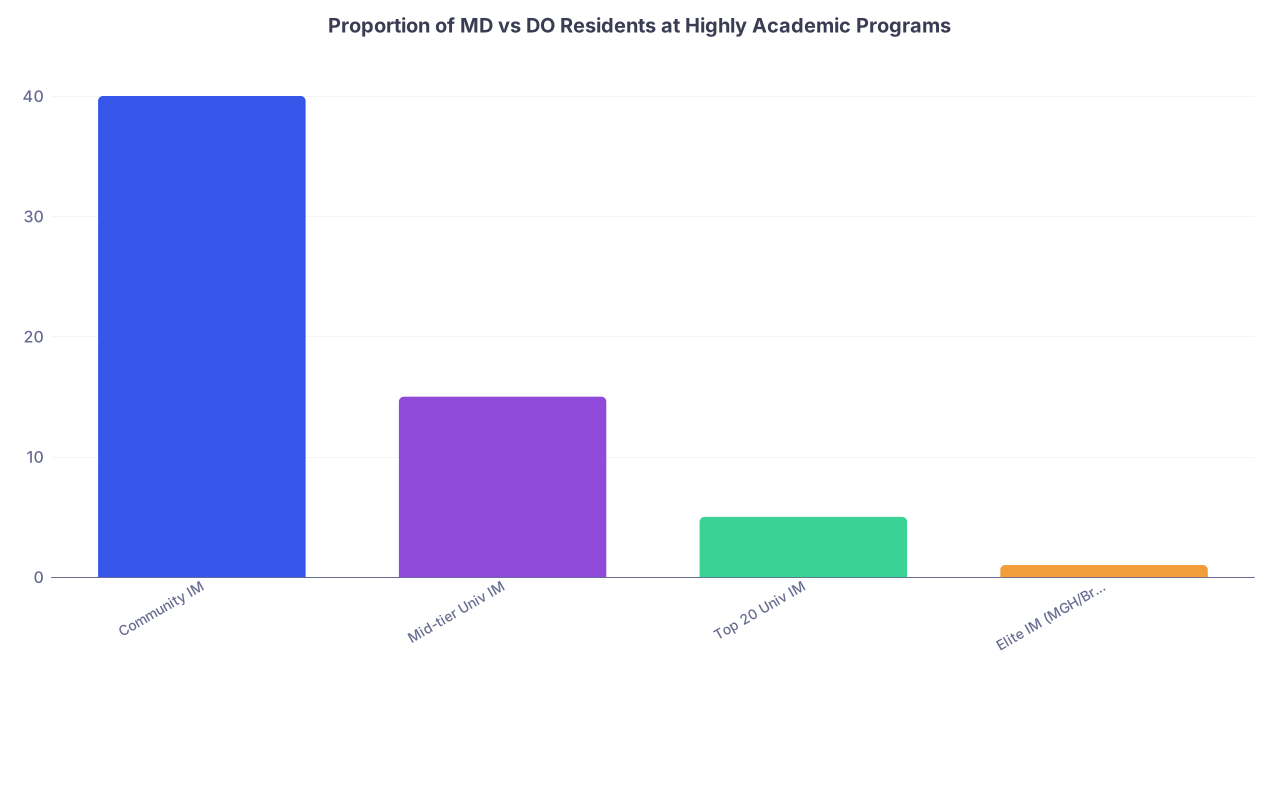
| Category | Value |
|---|---|
| Community IM | 40 |
| Mid-tier Univ IM | 15 |
| Top 20 Univ IM | 5 |
| Elite IM (MGH/Brigham) | 1 |
(Values are approximate “% of class that is DO” I’ve seen in real rosters – not official numbers, but very close to what you’ll actually notice.)
What Faculty Actually Say When You’re Not in the Room
Let’s start with the thing nobody wants to say out loud: bias exists. Not theoretical “maybe there’s some structural bias.” I mean explicit sentences like:
- “We don’t usually take DOs unless they’re exceptional.”
- “If they’re DO and want academic cardiology here, they’d better have a crazy CV.”
- “Our chair wants us to trend more MD/PhD this year.”
I have literally heard all of those in real selection discussions.
At big-name, research-heavy programs, the default mental model is: MD = standard; DO = exception. Not because DO students are bad. The problem is familiarity, pipeline, and old habits.
Here’s the informal hierarchy that still rattles around in many attendings’ heads at elite places:
- US MD from top-20 med school, strong research, AOA
- US MD from solid mid-tier, good scores, some research
- US DO with standout scores + major research or strong connections
- International grads (with huge variability)
Notice where the average DO without extra firepower sits. Not at the bottom, but not treated as the same “default” as MD either.
Now, does every faculty member think this way? No. But enough do that it impacts class composition. When you look at resident rosters at places like MGH, UCSF, Columbia, you don’t see many DOs. That’s not an accident. That’s institutional culture plus back-channel talk adding up over years.
The Real Variables Behind “DO vs. MD” at Top Academic Centers
The mistake premeds make is thinking the degree letters alone decide your fate. They don’t. They just change your starting position in the race.
There are four things that change how your DO vs MD degree is interpreted:
- Specialty competitiveness
- Program tier (true academic vs hybrid vs community)
- Your academic signal strength
- Your mentor/network capital
Let’s walk through how this actually plays out.
1. Specialty: Where the Degree Matters More (And Where It Really Doesn’t)
If you’re premed and saying, “I’m open to anything” — good. But the truth is, by the time you’re a third-year med student, you won’t be “open to anything.” You’ll want something specific. And that specialty choice will magnify or dull the DO/MD bias.
Let me be blunt.
Fields where DO vs MD matters a lot more at top academic centers:
- Dermatology
- Plastic surgery
- Neurosurgery
- ENT
- Ortho
- Radiation oncology
- Highly academic internal medicine (top 10-15 programs)
- Highly academic general surgery (same story)
Pull the resident lists at UCSF Derm, Penn Ortho, MGH Neuro, Stanford ENT. You will see almost no DOs. Maybe one. Maybe none. Year after year.
That’s not because DOs can’t be great in those specialties. It’s because when programs get 800+ insanely qualified MD applicants, they don’t need to go outside their comfort zone.
Fields where DO vs MD matters less, especially beyond the very top tier:
- Family medicine
- Peds
- Psych
- Community or mid-tier internal medicine
- EM (though this is shifting with market saturation)
- Anesthesia (varies by region, but lots of DOs, including at good places)
At a solid university-affiliated IM program (not the “Harvard of the Midwest,” just good, reputable), nobody is panicking about DO vs MD. They care: can you pass boards, function on day 1, and not be a problem?
The “I’m DO and I matched at a university program and I love it!” stories you see online are often from these types of programs. Completely valid. Just not the same ballgame as “I’m DO and matched UCSF Heme/Onc fellowship.”
What Top Academic PDs Actually Worry About With DO Applicants
Here’s the part that doesn’t show up on websites.
Publicly, programs say things like: “We value diversity of training backgrounds” and “We do a holistic review.” And that’s partially true. But privately, when a DO application from someone aiming for a highly academic or competitive spot lands on a program director’s desk, a few silent questions pop up.
I’ve heard them spoken out loud, in various flavors:
- “How strong is their clinical training compared to our usual MD feeder schools?”
- “Do they have any real research? Or just case reports and posters?”
- “Have we had good experiences with grads from that DO school before?”
- “Are they using DO as a stepping stone, or do they actually have academic potential long-term?”
- “Did they take and crush Step 2? Or did they just stick to COMLEX?”
That last one matters more than anyone on social media wants to admit.
At top academic centers, DO applicants are often treated like this: you’re not rejected because you’re DO, but your file is read with the expectation that you must clear a slightly higher bar on objective metrics to be considered equivalent.
Unfair? Maybe. Real? Definitely.
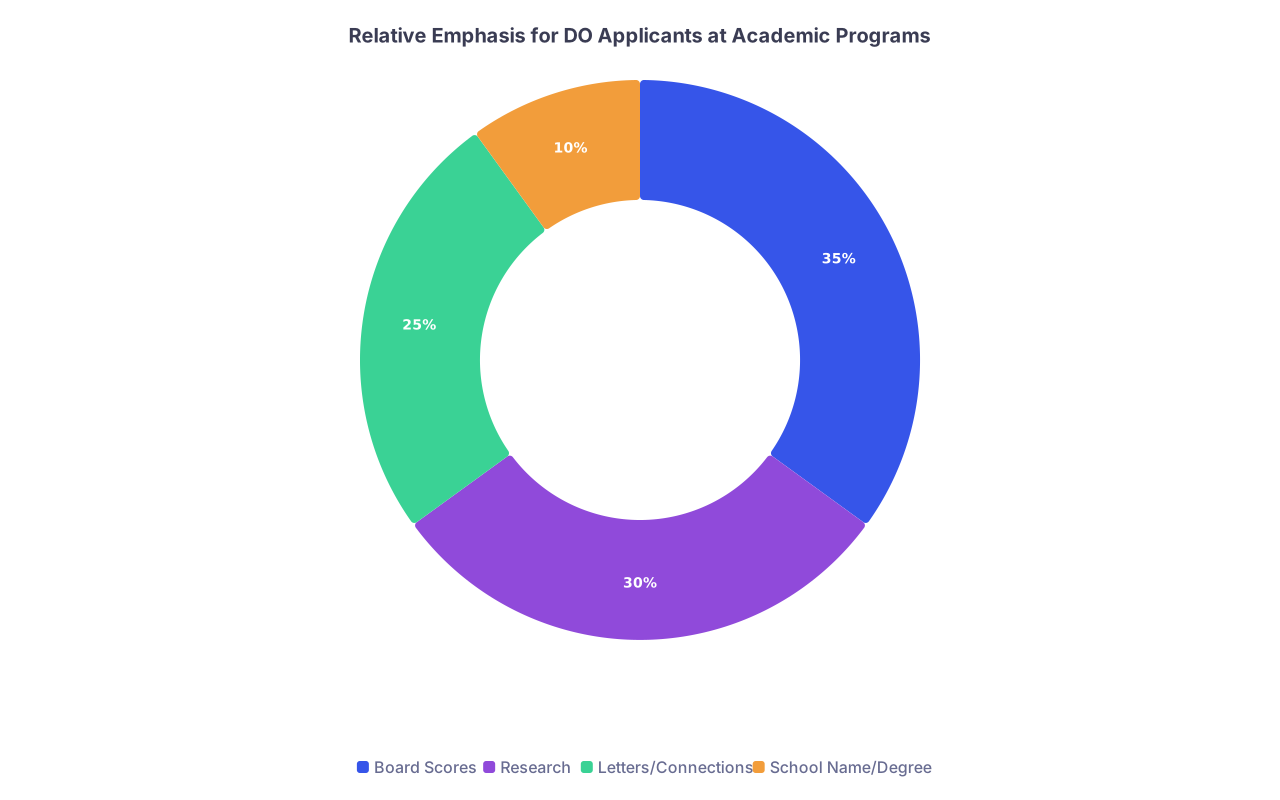
| Category | Value |
|---|---|
| Board Scores | 35 |
| Research | 30 |
| Letters/Connections | 25 |
| School Name/Degree | 10 |
This is how the weighting usually shifts for DO students trying to punch into higher-level academic spaces. MDs get a bit more leeway on the school name alone; DOs don’t.
The Hidden Gatekeepers: Rotations, Mentors, and “Would I Put My Name on Them?”
You want to know what really moves the needle for a DO trying to get into a big-name place? It’s not a personal statement about “osteopathic philosophy.” It’s not the fact you did OMT club. It’s this:
A faculty member at that academic center willing to say:
“I have worked with this student. I would take them in my program. I’d be comfortable putting my name on them.”
That’s the most powerful currency in the whole game.
Here’s what usually has to happen for a DO to crack an elite or near-elite program:
- They arrange an away rotation (sub-I) at that academic center or a comparable one.
- They absolutely destroy that rotation. Early, staying late, truly helpful, not just eager noise.
- They get a letter from a respected attending whose name the program director actually recognizes.
- That attending goes a step further and sends an email or makes a quiet call: “Look out for this applicant.”
I’ve seen DO students go from “probably not getting an interview” to “we’re ranking them to match” based purely on one trusted faculty member going to bat for them.
Flip side: I’ve also seen applications die because nobody in the room knows any faculty from that DO school, and there’s no strong external letter from their away rotations.
If you go DO and you have academic ambitions, this is your currency: real rotations at target institutions + real relationships with faculty there.

| Step | Description |
|---|---|
| Step 1 | DO School |
| Step 2 | Strong Step 2 + Class Rank |
| Step 3 | Early Research Involvement |
| Step 4 | Away Rotation at Academic Center |
| Step 5 | Outstanding Clinical Performance |
| Step 6 | Strong Letter from Known Faculty |
| Step 7 | Faculty Advocates at Rank Meeting |
| Step 8 | Interview and High Rank |
Without that chain, you’re relying on “holistic review” plus blind faith. That’s not a strategy.
The Part Nobody Tells Premeds: Some Doors Really Do Stay Mostly Closed
Let’s stop pretending everything is “equal but different.”
You go to Harvard, UCSF, Penn, Columbia for med school? Doors quietly open. Not always because you’re objectively better, but because your school’s brand and alumni are all over every major academic institution.
You go to a newer or less-known DO school with minimal research infrastructure? You’re starting 30 yards behind in any race that involves:
- NIH-funded labs
- Super-competitive fellowships
- K-award type academic careers
- The same five big-name hospitals you’ll see on every Top Hospitals list
Yes, there are DOs in those worlds. I know some personally. But what you don’t see are the 50 others who were just as smart but couldn’t get the right research, the right mentorship, or the right letterhead to push them upward.
That’s the pipeline problem. Academic medicine is heavily path-dependent. Your med school sets:
- Who you’re around
- What projects fall in your lap
- Which conferences you attend
- Which big-name people casually get copied on your emails
Top academic centers tend to hire and train from the same dozen schools because that’s their ecosystem. DO schools, historically, weren’t built to feed that ecosystem. They were built to train clinicians, often community-focused. That’s changing, slowly, but culture lags behind by a decade or two.
If You’re Premed Right Now: How This Should Actually Affect Your Choice
You’re not on an admissions committee. You’re trying to make one concrete decision: is going DO going to cap my ceiling in a way I can’t realistically fix later?
Here’s the honest breakdown.
When MD is clearly the smarter play
If all of these apply to you:
- You have a realistic shot at a US MD (even lower or mid-tier) with another cycle, a better MCAT, or more deliberate school list.
- You think you might want: derm, ortho, plastics, ENT, neurosurgery, rad onc, or elite academic IM/surgery at the “name-brand” level.
- You care a lot about long-term academic prospects at big-name places.
Then choosing DO without at least trying for MD again is, in my opinion, a self-imposed handicap. Fixable in some cases, but very real.
Not because DO is “bad.” But because the academic system is built on habits and patterns that favor MD pipelines, and you’re volunteering to swim upstream.
When DO can be an excellent, rational choice
If you’re in one or more of these camps:
- You’ve struck out on MD after multiple truly optimized cycles, not lazy applications.
- You’re drawn to primary care, peds, psych, or a non-ultra-competitive field and care more about location or lifestyle than the name on your badge.
- You have family/financial realities that make waiting another cycle brutal.
- You’re okay with an academic or leadership role at a regional or community-affiliated center instead of Harvard/Yale/Stanford-level institutions.
Then DO can absolutely get you where you want to go. With less noise, less waiting, and less emotional wear and tear.
Just don’t lie to yourself: being at a DO school will probably mean you have to work harder to access serious research, high-profile mentors, and top-tier academic branding. For some people, that trade-off is absolutely worth it. For others, it’s not.
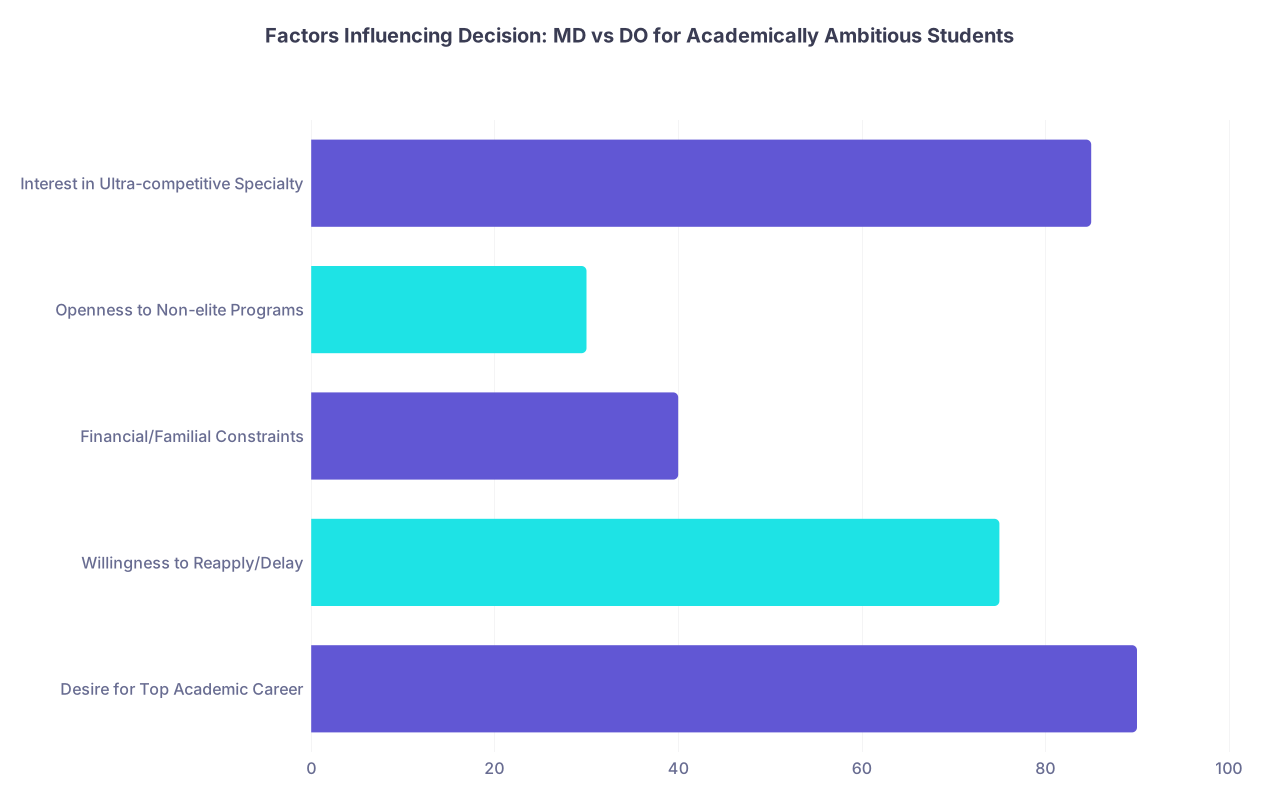
| Category | Value |
|---|---|
| Desire for Top Academic Career | 90 |
| Willingness to Reapply/Delay | 75 |
| Financial/Familial Constraints | 40 |
| Openness to Non-elite Programs | 30 |
| Interest in Ultra-competitive Specialty | 85 |
What To Do If You’re Already DO and Want a Top Academic Path
Let’s say the decision’s made. You’re at a DO school, maybe even a newer one. But your brain lights up when you think about academic cardiology, heme/onc, critical care at a major NCAA-name institution.
You’re not doomed. You’re just in a different game.
Here’s the inside-track strategy I’ve seen actually work for DO students who punched above their “expected” level.
1. Take USMLE Step 2. Crush it. No excuses.
No, COMLEX alone is not enough for many competitive or academic programs, no matter what people say in official statements.
PD back-channel:
“COMLEX scores are fine, but I don’t know how to interpret them compared to our other applicants. Step 2 gives me a number I understand.”
You should treat a high Step 2 (245+) as your entry ticket if you’re aiming high and DO.
2. Attach yourself early to research people who publish — even if they’re not at your home institution
Your DO school might not have massive NIH funding. Fine. But:
- Email MD faculty or researchers at nearby academic centers.
- Ask to help on existing projects, even if you’re doing grunt work at first.
- Take multi-year ownership of something that will realistically yield abstracts and at least one first- or second-author paper.
I’ve watched DOs at newer schools match into solid university IM and then competitive fellowships because they had a serious research thread running from M1–M4 with recognizable co-authors.
3. Plan away rotations like they’re your Super Bowl
If you want academic IM at a real name-brand place, your away rotations should be:
- At that place
- Or at a comparable-level institution where people know each other across institutions
And when you’re there, you act like the resident everyone wishes they had:
- Never disappear
- Anticipate needs
- Read about your patients every night
- Don’t be weirdly performative; just be consistently reliable and sharp
You don’t need to be the loudest. You do need to be the one they can trust.
4. Collect letters that actually move the needle
Three letters from your DO home IM faculty ≠ one letter from a known, respected academic at a major center.
The behind-the-scenes part: PDs skim letterheads before they read the content.
- “Oh, that’s Dr. X from Hopkins. I know her. She doesn’t write strong letters for everyone.”
- Versus: “No idea who this is, never heard of the hospital. Okay…”
Is that meritocratic? Not really. Is it how it works? Yes.

The Quiet Truth: Many DOs End Up Exactly Where They Actually Want to Be
Amid all this talk about top academic centers, here’s something that gets lost: a huge chunk of MDs never go near those places either. They don’t care to. They want a good job, decent hours, a community or regional hospital setting, and a life outside work.
The DO vs MD drama online is disproportionately driven by people obsessed with the top 10% of programs and the shiniest fellowships.
If your real goal is:
- Solid training
- Respectable program
- Room for teaching, maybe a bit of research
- Decent geography and lifestyle
You can absolutely have that as a DO. With less headache than chasing some idealized academic reputation that might not matter nearly as much outside a small academic bubble.
Where you will feel the DO vs MD gap most acutely is when:
- You’re standing next to a Harvard MD on interview day at an elite fellowship
- The “Where did you go to med school?” conversation keeps coming up
- You realize your school’s name doesn’t open as many doors automatically
Some people can live with that and still crush life. Others can’t. Only you know which one you are.

FAQs
1. Can a DO realistically match into a top internal medicine program like MGH, Brigham, or UCSF?
Yes, but it’s rare and you need to be truly outstanding. Think: top of your DO class, strong Step 2 (ideally 245+), significant research with publications, and powerful letters from people those programs respect. Plus, ideally, an away rotation there or at a comparable institution where you impressed people. It’s not impossible, but it’s nowhere close to a level playing field compared with strong MD applicants from known feeder schools.
2. If I’m not sure about specialty yet, should I avoid DO just in case I want something competitive?
If you’re academically strong enough to be competitive for US MD with another cycle or better planning, and you have even a 20–30% suspicion you might want derm/ortho/ENT/plastics/neurosurg or elite academic IM/surgery, I’d lean hard toward MD. Going DO doesn’t “block” those paths, but it makes them much steeper and more fragile. If, on the other hand, you’re okay with peds/FM/psych/mid-tier IM and don’t care about elite brands, DO can be a perfectly rational and smart choice.
3. Do program directors really care whether DOs took USMLE, or is COMLEX alone enough?
At many community and mid-tier university programs, COMLEX-only is fine. At more competitive or academic places, a missing Step 2 score is a silent filter. They won’t tell you that publicly, but I’ve heard the exact sentences: “Hard to compare without a Step 2” and “We usually don’t interview COMLEX-only for our academic track.” If you’re DO and aiming high, you should treat Step 2 as mandatory and aim to absolutely crush it.
4. Can strong research totally overcome DO bias at top academic centers?
“Totally” is a stretch, but strong research can move you from “unlikely to be considered” to “taken seriously.” A DO student with multiple publications, sustained involvement in meaningful work, and letters from big names in the field will get a much longer look than a DO with stellar scores but nothing academic. However, you’re still going up against MDs with the same or better research plus school brand advantage. Research is necessary for some pathways, but not always sufficient.
5. Will being DO limit me from becoming academic faculty at a big university hospital later on?
It can, but not in a hard “no DOs allowed” way. The bigger barrier isn’t the letters after your name; it’s the cascade of where you match for residency, what fellowships you get, and how much research/teaching capital you build. If you do DO → strong university residency → competitive fellowship → productive academic output, you can absolutely end up faculty at a big center. It’s just harder to get on that conveyor belt in the first place than it is from certain MD schools. Once you’re in the system and productive, the degree matters less than your CV.
Years from now, you’ll barely remember the hours you spent doom-scrolling DO vs MD threads. You will remember the few inflection points where you were brutally honest with yourself about what you wanted — and whether you were willing to pay the real, not theoretical, costs to chase it.