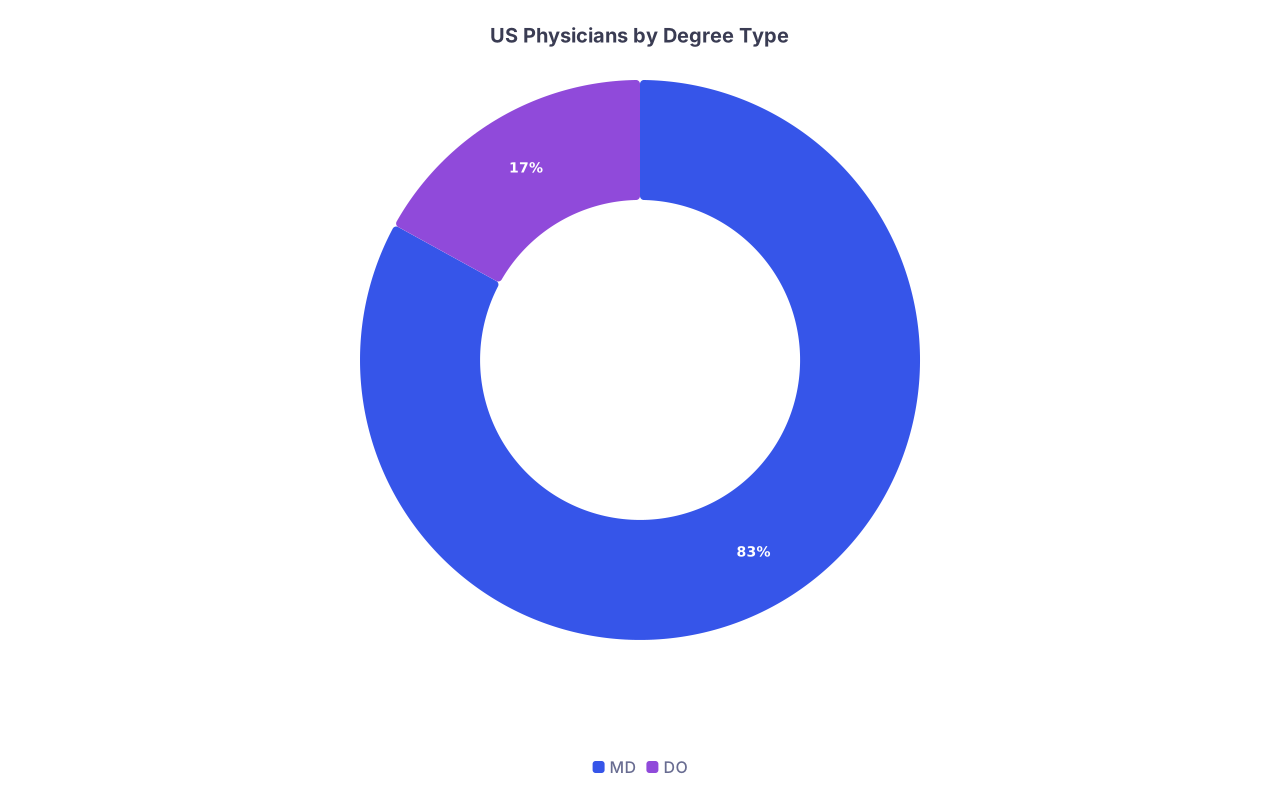
The way program directors compare DO and MD files is not “holistic.” It’s political, inconsistent, and heavily dependent on who’s in the room that year.
Let me walk you through what actually happens behind closed doors when your file hits the table—how your letters, scores, school, and even your degree letters (DO vs MD) are really read, and when they suddenly matter a lot more than anyone wants to admit.
The First Filter: Who Gets Looked At, Who Gets Auto-Dropped
On paper, everyone preaches equity. In the committee room, the first question isn’t “Is this a good future doctor?”
It’s: “Does this file pass our quick screen?”
For most programs, the first pass isn’t the PD sitting thoughtfully at home with a cup of coffee. It’s:
- A coordinator applying filters in ERAS
- An APD scrolling rapidly
- Or a chief resident told: “Flag obvious strongs. Cull the bottom.”
In that filtering step, DO vs MD comes into play in three concrete ways.
(See also: What Happens to DO vs. MD Applications in the First 5 Minutes of Review for insights on application reviews.)
Explicit filters
Some programs straight-up set a “US MD only” filter for certain specialties or tracks. They’re not going to say that publicly. But I’ve been in rooms where the PD says:“Look, for our categorical surgery slots, just don’t bother with DOs this year. We don’t have bandwidth.”
Is that every program? No. But it is not rare. Especially in traditionally competitive fields: ortho, derm, ENT, plastics, some anesthesiology and radiology programs, certain academic IM programs at big-name places.
Step score thresholds that hit DOs harder
Even with Step 1 pass/fail now, Step 2 CK cutoffs still exist. You’ll hear:
“Below 230 is a no.” Or, “We said 240 this year. Too many apps.”If you’re DO with a borderline Step 2, you get less grace. Why? Because when they glance at “School” and see an unfamiliar or lower-profile DO school, they don’t instinctively stretch for you. For a mid-tier US MD with the same score: “Let’s still take a look.”
US MD default trust vs DO “prove it” standard
For average files, MD gets the benefit of the doubt. DO has to earn it.
That’s the quiet reality.A 235 Step 2 from a mid-tier US MD:
“Fine, let’s see the rest.”
(Related: The Quiet Preferences: When Attendings Favor MDs vs. DOs and Why)
A 235 Step 2 from a DO at a mid- or lower-reputation COM:
“Any red flags? Any strong research? Any home program?”
If not, you’ll often be quietly passed over.
Nobody announces that. It’s the unspoken baseline: MD is the default, DO is “we’ll consider if there’s something extra.”
How They Actually Scroll Your File: DO vs MD Side by Side
Picture this. It’s 8:15 PM, late in the interview season ranking period. The PD and APD are in a conference room, half-burned out, going through a shortlist of 60–80 applicants to firm up their interview offers.
Two files come up on the screen:
- Applicant A: US MD, mid-tier school, Step 2 CK 243, honors in medicine, solid but not huge research, decent letters.
- Applicant B: US DO, well-known DO school, Step 2 CK 243, similar clerkship comments, one strong letter from a rotation at an academic center.
On the surface, it looks like a tie. It is not a tie.
Here’s what they actually say out loud in a lot of rooms:
“MD, solid Step 2, looks fine, take.”
“DO… okay, let’s check if anyone here knows this school or any of these letter writers.”
That extra friction is everything.
They’ll click into your school. If it’s a DO school they recognize for sending strong residents in the past (PCOM, UNECOM, AZCOM, DMU, etc.), that helps. If no one in the room has ever worked with graduates from your school? You’re immediately at a minor disadvantage compared to an equivalent MD.
For MD, the default is: “Probably fine.”
For DO, the default is: “Prove that you’re fine.”
No one writes this into their selection criteria. But they behave like it.
The Step Exam Trap: How DO and MD Are Interpreted Differently
Let’s cut through the noise: DO vs MD comparisons are still largely built around Step performance and clinical proof.
Step 1 being pass/fail changed less than you think
For MD students at reputable schools, Step 1 going pass/fail lowered the temperature. PDs now lean more heavily on Step 2, school reputation, and letters.
For DO students, Step 1 going pass/fail did not neutralize the playing field. What happened instead:
- Step 2 CK became the make-or-break metric
- COMLEX alone is often not treated as enough for competitive specialties or academic programs, even if they say “we accept COMLEX”
Behind closed doors you’ll hear:
“Do we have a Step 2 CK?”
“No, only COMLEX.”
“Next.”
Not universally. But frequently enough that you should act as if it’s the rule unless you have evidence otherwise. Especially for anything competitive.
How they really read COMLEX vs Step 2 CK
There’s a quiet hierarchy in many PDs’ heads:
- US MD with Step 2 CK
- DO with Step 2 CK + COMLEX
- DO with COMLEX only
I’ve literally seen spreadsheets with an extra note column: “No CK” flagged in red. Those files get looked at last or not at all once the interview slots are mostly filled.
When comparing you against an MD applicant with a similar Step 2 CK, some PDs mentally “discount” your score a bit because of perceived differences in preclinical rigor and grading. They won’t say it bluntly, but the thought runs like this:
“243 from a strong MD vs 243 from a DO… the MD probably had tougher curves, more competition.”
Is that a universal truth? No. Is that how many academics think? Yes.
So if you’re DO, you don’t aim to “match” the MD average. You aim to beat it clearly. Think: “I want no one in that room to be able to say, ‘eh, borderline.’”
Clinical Rotations: The Part Of Your File That Can Save You
Here’s the good news: once you’re past the score screen, clinical performance and letters start to matter more. And this is where DO students can absolutely outcompete MDs.
The hierarchy of rotations in a PD’s mind
When we scroll your experiences, what pops:
- Rotations at the same institution or affiliated hospitals
- Rotations at well-known academic centers
- Audition/sub-I at that actual program
- Strong narrative comments from attendings we know
Two applicants, similar Step 2, similar grades:
- MD did all rotations at a home MD school, no away rotation at this program.
- DO did a sub-I at this program, crushed it, left an impression on the residents, and has a glowing letter from a core faculty member here.
The DO wins. Easily. I’ve seen PDs say:
“I don’t care that they’re DO. They worked with us, we like them, they function well. Done.”
When you show up in their hospital and perform like a solid intern, the letters and whispered feedback from residents erase a lot of the DO/MD gap.
The harsh reality on unknown DO schools
If your DO program is low-profile and you never rotate at the target institution (or a comparable academic center), the PD has to guess. They glance at your transcript and see “high pass, honors, pass” with no context.
For MD schools, PDs have a mental calibration: “This school gives out a lot of honors,” or “This school is brutal; an HP there is strong.”
For DO schools they rarely see? No calibration. So your written record carries less weight unless you have an external validator: Step 2 CK, a strong away rotation, or letters from people they trust.
Without those, you’re in the “could be fine, but we have 300 others” bucket.
Research, Leadership, and “Fit”: How Bias Quietly Creeps Back In
This is the part no one wants to admit: the same bullet point looks different depending on whether DO or MD is on the top of the page.
Research
Here’s what happens in an academic program selection meeting:
For an MD from a research-heavy school with a couple of poster presentations and maybe one middle-author pub: “Ok, they participated, seems engaged.”
For a DO with that same research output from a DO school not known for research:
“Where did they do this? Is this legit? Any big names on the paper?”
Unfair? Yes. Real? Also yes.
The more academic the specialty and the institution, the more they default-assume MDs are the ones with “serious” research unless something in your file forces them to reconsider.
If you’re DO and you want that kind of program, this is your workaround:
Get involved with research through a known academic center or a faculty name that carries weight. If there’s a recognizable PI at a university hospital on your CV, that changes the tone of the conversation in your favor.
Leadership and extracurriculars
Here’s a dirty secret: most selection committees skim leadership and service. Unless something is striking, it’s noise.
Where it does matter is when they’re deciding whether to stretch slightly outside their comfort zone.
Borderline DO vs solid but unremarkable MD:
- If the DO has compelling, clearly sustained leadership or service with real responsibility (ran a free clinic, regional role in a national org, built a curricular project) and strong letters backing that maturity, the PD might say:
“They’re DO, but this is someone who’s going to show up and work. I like this person.”
If it’s generic: “volunteered, participated, member of X,” it doesn’t move the needle. For anyone.
The Politics: Why Some Programs Avoid DOs Even When They Say They Don’t
Most applicants completely miss the internal politics that shape which files even get discussed.
The faculty culture problem
There are programs where older faculty still say—sometimes out loud in ranking meetings:
“I prefer MDs. I’ve had problems with DOs before. Let’s be cautious.”
Then maybe a younger APD or recent grad says:
“We’ve had some excellent DOs. That’s not fair.”
Who wins depends on who actually holds power in that room. Some PDs will push back and insist on including strong DOs. Others will nod, avoid conflict, and quietly lean MD.
You don’t see that on the website. You feel it in the invite list.
The prior resident effect
This one is huge and almost never discussed publicly.
If a program had:
- One or two weak DO residents in the last 5–10 years who struggled with exams, professionalism, or clinical performance…
Then suddenly, DO scrutiny tightens for years afterward. I’ve literally heard:
“Last time we took a DO from that school, it didn’t go well. Let’s avoid that combination.”
Flip side: if their last DO resident was outstanding—hardworking, clinically sharp, well-liked—future DOs from that same school get an invisible boost.
This is why doing your homework on where graduates from your school have matched matters so much. You’re walking into a pre-existing reputation, good or bad.
How You Stack the Deck In Your Favor As A DO (Or MD Who’s Not At A Big-Name School)
You cannot change the letters after your name. You can absolutely change how your file lands in that room.
If you’re DO
You need to think in terms of removing excuses:
- Get a solid Step 2 CK score. Not “ok.” Solid. You want PDs to say, “Whatever bias I had, this score forces me to look harder.”
- Arrange clinical rotations where your performance can be seen and talked about by people with reputational weight. Home program in your specialty is gold. Audition sub-Is are critical for competitive fields.
- Target programs that have historically taken DOs, ideally from your school. They’ve already jumped the psychological barrier.
- Translate COMLEX → Step language in your ERAS by also including Step 2 CK whenever humanly possible. Don’t leave them guessing.
If you’re MD but not from a big-name school
You’re not automatically safe either. For you, the comparison isn’t MD vs DO; it’s “generic MD vs standout DO.”
If you underperform on Step 2 CK and have average clinical evaluations, a sharp DO with a better score and stronger letters will absolutely leapfrog you at a lot of programs. The MD label buys you initial trust, not immunity.
What Actually Happens On Rank Day: DO vs MD Once Interviews Are Done
Once interviews are over, something interesting happens: DO vs MD matters less than you think for people they’ve actually met.
During rank meetings, comments are about:
- “Great on interview, good fit.”
- “Residents liked them.”
- “Seemed quiet, not sure they’ll handle our volume.”
- “Strong clinically on their sub-I.”
Only occasionally: “They’re DO—any concerns?”
And usually someone who worked with you says, “No, they were excellent.” End of story.
Once you’ve broken into the interview and especially if you’ve rotated there, the letters after your name fade into the background. At that point, it’s personality, perceived work ethic, and how you handled questions about weakness, failure, or difficult cases.
The hard part is getting into that room in the first place. That’s where DO vs MD and all the quiet biases really live.

| Step | Description |
|---|---|
| Step 1 | Application Submitted |
| Step 2 | Standard Filter |
| Step 3 | Extra Scrutiny |
| Step 4 | Often Screened Out |
| Step 5 | Review Clinical & Letters |
| Step 6 | Higher Interview Priority |
| Step 7 | Compare to Pool |
| Step 8 | Interview Invite |
| Step 9 | Post-Interview Ranking |
| Step 10 | DO or MD? |
| Step 11 | Scores & School OK? |
| Step 12 | Step 2 CK? Strong Score? |
| Step 13 | Rotated With Us? |
The Quiet Equation PDs Are Using In Their Heads
If you want the unvarnished formula many PDs are using, it looks something like this:
For MD:
- School reputation
- Step 2 CK
- Class rank/honors
- Letters
- Rotations
- Interview / fit
For DO:
- Step 2 CK (heavier weight)
- COMLEX (for patterns)
- School reputation (big variability)
- Rotations, especially at MD/academic centers
- Letters from recognized names
- Interview / fit
The same components, just weighted differently. MDs get more “trust credit” on the earlier steps. DOs need more concrete performance to be viewed the same way.
Is this changing? Slowly. Generational turnover on faculty helps. More DOs in academics helps. But if you’re applying in the next few years, this is still the landscape you’re walking into.
Know it. Then plan like a strategist, not a victim.
Years from now you will not remember how many nights you spent worrying about whether your degree letters were enough. You’ll remember the specific doors you forced open anyway.