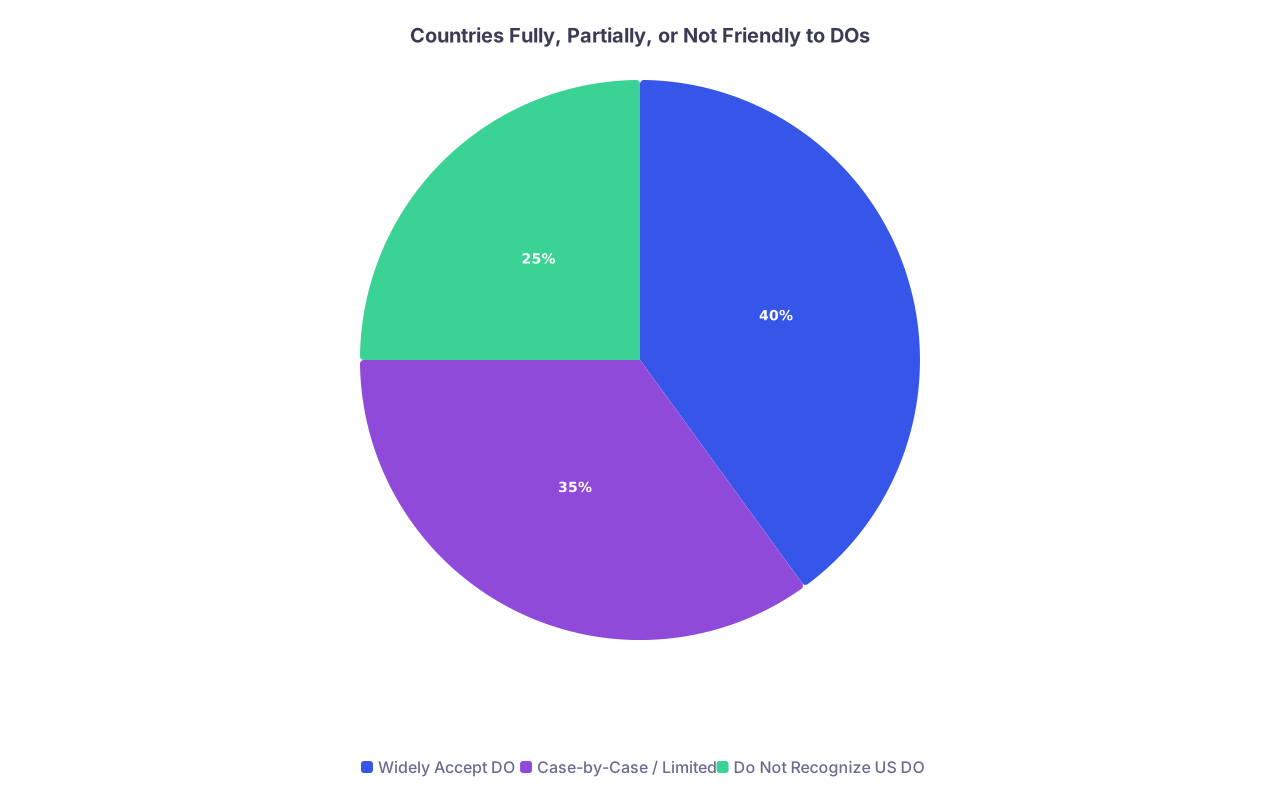
Only 28% of premeds who say they’re “open to DO” can accurately name even three countries where DOs are treated identically to MDs.
That gap between fear and facts is why so much nonsense spreads in forums and from “a friend of a friend in residency.” Let’s fix that.
Let me be blunt: if your long‑term, non‑negotiable dream is “I must be able to easily work clinically in any country on Earth,” then yes — DO can close a few doors or at least make some of them harder to open.
But that’s a very different statement from the lazy myth you keep hearing: “Choosing DO kills your chances of working abroad.” That’s simply wrong.
Here’s what the data and actual licensing rules say, country by country — not what someone’s anxious cousin posted on Reddit.
The Big Picture: Where DOs Stand Globally
Start with the core fact almost everyone misses: U.S. DOs are fully licensed physicians in the United States with the same practice rights as MDs in all 50 states. International acceptance flows from that reality and from one key decision:
In 2018, the World Federation for Medical Education (WFME) recognized the U.S. DO (via COCA accreditation) as equivalent to MD‑granting schools for international accreditation purposes.
That decision is why, structurally, more doors have opened in the last 5–7 years, not fewer.
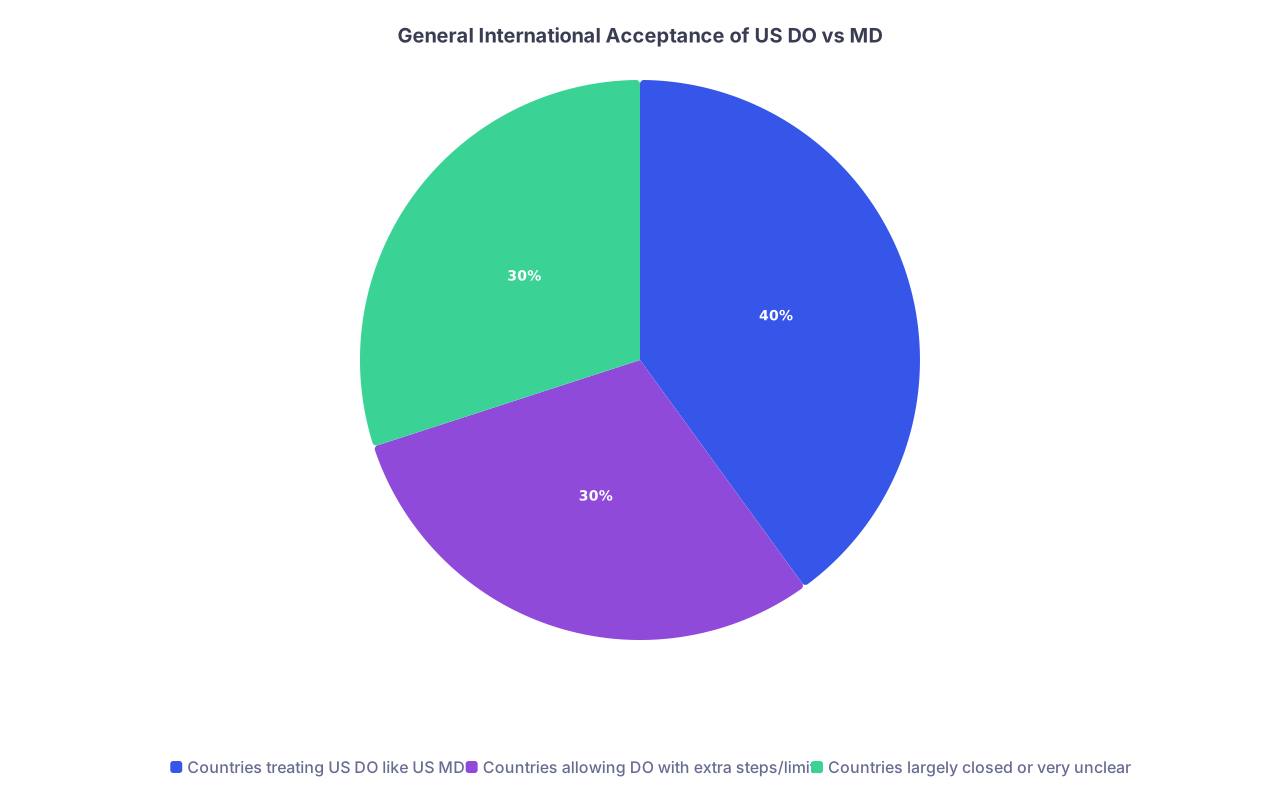
| Category | Value |
|---|---|
| Countries treating US DO like US MD | 40 |
| Countries allowing DO with extra steps/limits | 30 |
| Countries largely closed or very unclear | 30 |
Are those exact numbers? No. But ballpark, that’s the landscape:
- A large chunk of countries: treat U.S. DO ≈ U.S. MD, often with the same exam/registration process
- Another group: technically possible but more bureaucracy, case‑by‑case evaluation, or institutional confusion
- A final group: effectively closed or not worth the pain unless you have citizenship or extreme patience
The problem is not that “DO is useless abroad.” The problem is that most people never bother to look at specific laws, medical councils, and real precedents.
So let’s do that.
Anglophone Countries: Where the Myths Are Loudest
These are the countries U.S. students obsess over the most. And ironically, they’re where the misinformation is the worst.
United Kingdom (GMC) – Mixed, Changing, But Far From “Impossible”
The UK has two completely different things that get conflated:
- UK “osteopaths” – non‑physician manual therapy professionals. Different degree. Different regulator (HCPC/GOsC).
- U.S. DO physicians – fully trained doctors. Different universe.
The General Medical Council (GMC) regulates doctors. The key question is simple: can a U.S. DO get GMC registration as a doctor?
Answer: yes, with caveats.
- The GMC explicitly lists the U.S. DO degree from COCA‑accredited schools as an acceptable primary medical qualification for certain pathways, especially when combined with recognized post‑grad training (e.g., ACGME residency).
- Historically, there’s been more friction and more case‑by‑case assessment for DOs than for U.S. MDs. Some DOs have needed to demonstrate equivalence, provide detailed curricula, or rely on postgraduate qualification pathways (e.g., Membership exams via Royal Colleges + U.S. specialty board certification).
- Anecdotally, I’ve seen U.S. DOs practising as consultants in the NHS — usually people who completed U.S. residency + fellowship, then moved after board certification.
Does DO “close the UK”? No. It makes it more annoying and slower. If you’re dead‑set on long‑term UK practice, MD is still the smoother road, but DO is not an automatic no.
Canada – The Reality No One Wants to Hear
You’ll hear, “Canada doesn’t recognize DOs.” That’s outdated and also oversimplified.
There are two separate issues:
- Residency training in Canada as a DO
- Practising in Canada after U.S. DO + U.S. residency
For residency:
Canadian match is brutally competitive for IMGs. For all practical purposes, both U.S. DO and U.S. MD grads applying to Canadian residency are treated as IMGs, not CMGs. DO doesn’t uniquely “kill” you; being a non‑Canadian school grad does.
For practice:
Provincial Colleges of Physicians and Surgeons are what matter. Several provinces have pathways that recognize U.S. DOs who completed ACGME residency, often as “U.S.‑trained physicians” rather than as osteopaths. But:
- It’s not uniform across all provinces
- It’s often more paperwork than for MDs
- You almost always need full American board certification plus sometimes Royal College equivalency routes
Translation: If you’re Canadian and your dream is to train and practise in Canada, go to a Canadian MD school if you can. But if you’re asking, “Does DO forever block me from ever working in Canada?” — no, not absolutely. It’s just more constrained and messy.
Australia & New Zealand – DO = Doctor, But Don’t Expect Red Carpets
Australia’s Medical Board and New Zealand’s Medical Council care more about:
- Is your school recognized/ accredited?
- Have you completed an accredited residency in a comparable health system?
The WFME recognition of COCA‑accredited DO schools significantly improves your standing. U.S. DOs with ACGME training can and do get licensed, usually under the same broad pathway as U.S. MDs.
You’ll still jump through the standard hoops:
- AMC (Australia) or MCNZ (New Zealand) assessment of qualifications
- Possibly exams or work‑based assessments depending on pathway and specialty
- Proof of recency and scope of practice
But the key myth — “Australia will only ever see you as a non‑physician osteopath” — is wrong for U.S. DOs. That confusion mostly hits UK or local osteopathy grads, not U.S. physicians.
Middle East (UAE, Qatar, Saudi, etc.) – Variable but Often Pragmatic
These health systems import a ton of foreign doctors. What they care about tends to be:
- Specialty board certification (ABIM, ABFM, ABS, etc.)
- Years of experience post‑board
- Training from a “recognized” country (U.S., UK, Canada, Australia, Western Europe)
U.S. DO + ACGME residency + U.S. board certification usually passes that smell test.
Is there sometimes extra explanation? Yes. Will some HR person confuse DO with non‑physician osteopath? Also yes. But once your paperwork hits the central authority and they see U.S. board‑certified physician, you’re usually treated like MD.
Europe (Non‑UK): Where Things Get Much Harder
Here’s where DO really does narrow options, and MD isn’t a magic bullet either.
Most continental European countries:
- Prioritize EU/EEA degrees
- Tie licensing to specific listed medical schools and EU frameworks
- Have language requirements you can’t hand‑wave away
- Often use rigid credentialing rules that don’t adapt quickly to U.S. DO nuances
Examples:
- Germany: Bureaucratic nightmare even for U.S. MDs. For DOs, you’re looking at equivalence assessments, translations, variable Länder (state) rules, and a system built around EU harmonization, not U.S. credentials. Possible? Maybe. Straightforward? No.
- France, Italy, Spain: Generally favor EU grads. Non‑EU degrees (including U.S. MD, let alone DO) go through heavy case‑by‑case review. Language, national exams, and local politics all matter more than DO vs MD.
- Nordic countries: Similar story. You’re an outsider regardless.
Here’s the key point: if your mission is “I want to be a hospitalist in Berlin” or “cardiologist in Paris,” the biggest problem isn’t DO vs MD. It’s that you’re not an EU grad and you probably don’t speak the language at a professional level.
Does DO add another layer of ambiguity? Yes. Does MD suddenly open Europe magically? Not really.
Asia: Case‑by‑Case Reality, Not Forum Lore
Asia is a continent, not a monolith. The rules vary wildly.
- Singapore: Has a finite list of recognized foreign medical schools. Historically more MD‑oriented. Some flexibility through postgraduate specialist registration, but MD is safer. DO here may indeed close doors.
- Hong Kong: Similar list‑based thinking. Again, U.S. MD from a big‑name school + strong specialty boards stand a better chance than DO.
- Japan, South Korea: Very insular systems. They expect local degrees and language proficiency. Your main barrier isn’t your degree type; it’s being foreign, period.
- India, Pakistan, Philippines: These countries export more physicians than they import; returning or going to practice there as a U.S. DO is usually about citizenship and local licensing exams. DO can be misunderstood, but American residency and board cert carry weight.
Bottom line: If you’re targeting a specific Asian country, you need to look up that country’s Medical Council rules directly. And yes, in some, MD will clearly be simpler than DO.
Africa & Latin America: Less About Letters, More About Pathways
A lot of physicians going to these regions are doing:
- Short‑term or long‑term mission work
- NGO/aid organization roles
- Academic collaborations
- Industry/PH roles rather than full independent local practice
In those settings, sponsoring organizations often treat U.S. DO and U.S. MD equivalently. The local ministry may technically license you as a foreign doctor under special provisions or limited scopes.
For outright emigration with full local licensure (e.g., becoming a permanent physician in Brazil or South Africa), the degree letters again take a back seat to:
- Citizenship/residency
- Local exam rules
- Language
- Recognition of U.S. residency and boards
DO adds confusion but rarely serves as the main blocker. It’s just one more hoop.
What Actually Matters More Than DO vs MD for International Options
This is the piece almost nobody on TikTok mentions.
Three factors massively outweigh DO vs MD:
Residency training quality and type
- ACGME‑accredited residency in a core field (IM, FM, surgery, peds, anesthesia, EM) plus U.S. board certification is your main currency abroad.
- Weak or non‑standard training kills options faster than three extra letters ever will.
Citizenship and visa status
- An EU passport makes Europe 10x easier, regardless of whether you’re DO or MD.
- Canadian citizens with U.S. DO + U.S. residency often navigate Canadian licensing better than non‑Canadians with fancy MD degrees.
Language and location flexibility
- Willing to learn German at C1 level and take local exams? You can overcome almost anything.
- Only willing to work in English‑speaking Western nations? Now degree nuances start to matter more.

| Step | Description |
|---|---|
| Step 1 | US Medical Grad |
| Step 2 | Limited Global Options |
| Step 3 | Broader Country Choices |
| Step 4 | Visa & Licensing Barriers |
| Step 5 | Language + Exams |
| Step 6 | Final Country Options |
| Step 7 | Residency Type? |
| Step 8 | Citizenship & Region |
Notice what’s not in the center box: DO vs MD.
Does it influence the branches? Sometimes. But it rarely decides the entire tree.
Strategic Advice: When DO Is Fine, When MD Is Safer
If you’re still reading, you probably want an actual stance, not more “it depends.”
Here’s mine.
Choosing DO is usually fine if:
- Your primary goal is to live and practise in the U.S.
- You’re open but not fixated on working abroad
- You’re interested in primary care, IM, EM, anesthesia, PM&R, psych, etc.
- You’re willing to accept that if you later want to move to a more rigid system (e.g., Singapore, Germany, France), you may have to fight harder than an MD grad
Choosing MD is the safer bet if:
- You already know you want long‑term practice in Europe, Singapore, or very policy‑rigid systems
- You’re extremely mobile and want maximal “option value” internationally
- You’re applying broadly and can reasonably be competitive for both U.S. MD and DO, and you anticipate a high likelihood of emigrating later
The mistake I see constantly: premeds with a 3.3 GPA and 506 MCAT agonizing over whether DO will stop them from becoming an attending cardiologist in Switzerland someday — when their actual near‑term risk is never getting into any med school.
Get into medical school. Survive. Match into a solid residency. That sequence opens 90% of realistic doors. The last 10% — the hyper‑specific country + specialty combinations — is where DO vs MD really bites.
Summary: What the Data Actually Shows
- U.S. DOs are increasingly recognized as equivalent to MDs by major global bodies and many national regulators, especially when paired with ACGME residency and U.S. board certification.
- DO may complicate — but rarely completely block — options in the UK, Canada, Australia/NZ, and parts of Asia and the Middle East; Europe is difficult for any non‑EU grad, and DO doesn’t magically ruin what MD would easily secure.
- For most students whose primary goal is U.S. practice, DO does not “close doors internationally” in any meaningful, practical way; obsessing over hypothetical foreign jobs is often a distraction from the real challenge: becoming a competent, board‑certified physician first.
If you want guarantees in every country on earth, do not choose medicine at all. The system is too political for that. But if you want a realistic, evidence‑based sense of risk? DO is a lot more global than the myths give it credit for.