“DOs aren’t real doctors” is not just wrong. It’s lazy, outdated, and directly contradicted by the way modern medicine actually works.
If you’re premed and still hearing this from relatives, Reddit, or the loud guy in your orgo lab, you’re getting 1990s gossip in a 2026 world. The system has changed. The myth hasn’t caught up.
Let’s walk through what’s true, what’s propaganda, and what actually matters for your career.
Where This Myth Really Came From (And Why It Lingers)
The idea that DOs are “less than” MDs did not fall from the sky. It grew out of three things: history, protectionism, and people repeating stuff they never bothered to fact‑check.
Early osteopathic medicine started in the late 1800s with a strong manual therapy focus and a philosophical reaction to overuse of surgery and drugs. Back then, state licensing was a mess, many schools (DO and MD) were low quality, and the whole house of medicine was trying to define standards. MD organizations, especially the AMA, fought hard to exclude DOs from hospitals and licensure. That was political, not scientific.
Fast‑forward.
Every state now licenses DOs as full physicians. The military commissions DOs exactly like MDs. Insurance panels credential them the same way. Hospitals grant the same privileges. Your attending in surgery, EM, or cardiology might well be a DO and you wouldn’t know unless you squint at the badge.
So why does the myth still exist?
Because:
- People confuse history with current reality.
- They don’t understand how training, accreditation, and board exams work.
- They’ve heard garbage like “DOs are like chiropractors” and never checked.
Let’s quantify the present instead of recycling old prejudice.
| Category | Value |
|---|---|
| MD | 88 |
| DO | 12 |
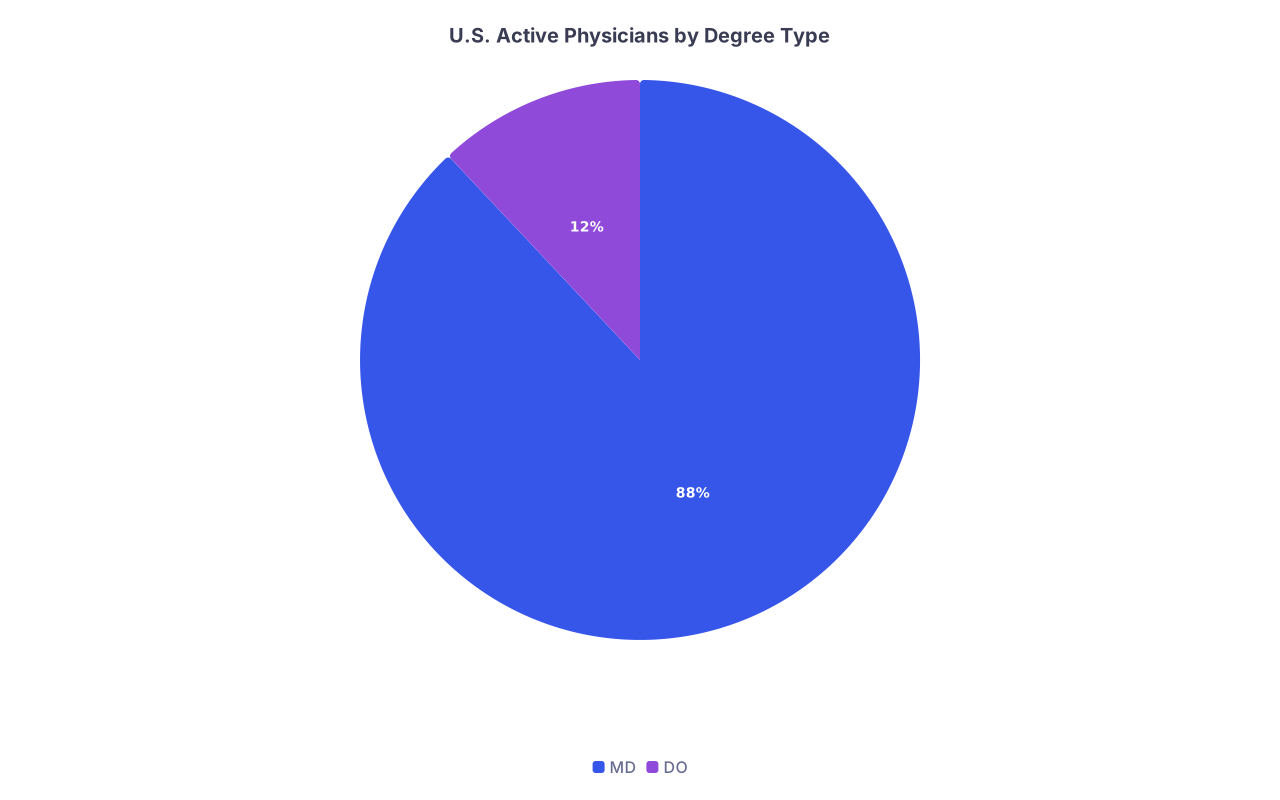
About 11–12% of practicing U.S. physicians are DOs now, and that proportion keeps climbing. That’s not fringe. That’s built into the system.
Legal and Clinical Reality: DOs Are Fully Licensed Physicians
Here’s the part a lot of loud critics conveniently ignore: in the eyes of the law and of hospital systems, DOs and MDs are functionally equivalent.
Both:
- Complete 4 years of medical school (accredited by separate but parallel bodies: LCME for MD, COCA for DO).
- Pass national licensing exams (USMLE for MD pathway, COMLEX for DO pathway; many DOs now take USMLE as well).
- Match into the same residency programs under one accreditation system.
- Get the same state medical license type: physician and surgeon.
- Can prescribe medications, perform surgery, and become attendings, chairs, program directors, deans.
This is not theoretical. It’s written into state medical practice acts and reflected in how credentialing actually occurs.
You know who doesn’t care about this MD vs DO debate? Credentialing committees checking if you finished an ACGME‑accredited residency, passed your boards, and aren’t a malpractice disaster.

| Step | Description |
|---|---|
| Step 1 | Premed |
| Step 2 | LCME-Accredited MD School |
| Step 3 | COCA-Accredited DO School |
| Step 4 | USMLE Exams |
| Step 5 | COMLEX Exams |
| Step 6 | ACGME Residency Match |
| Step 7 | Fellowship/Practice |
| Step 8 | MD or DO School? |
Notice the convergence: ACGME residency. Same system. Same accreditation.
The “Quality” Question: Admissions, Boards, and Outcomes
This is where people try to get clever and say: “Okay, technically they’re doctors, but DO programs are lower quality.”
Let me cut through that.
Are DO and MD schools identical? No. Are DO students uniformly weaker? Also no. The truth is more nuanced and less flattering to everyone’s egos.
On average:
- MD schools have higher median MCAT and GPA cutoffs.
- DO schools are somewhat more forgiving of nontraditional paths, lower GPAs, career changers.
- Many DO students could’ve gone MD at lower‑tier schools or Caribbean programs and chose DO in the U.S. instead.
That’s input metrics. What you actually care about as a patient or future physician is output: Can they compete on standardized exams and perform clinically?
Millions of data points say yes.
DO students pass COMLEX at high rates. A large and growing number also take USMLE and do perfectly fine. Residency directors care far more about:
- Your Step 2 / COMLEX 2 score
- Your clinical performance and letters
- Your interview
- The reputation of your residency, not your med school
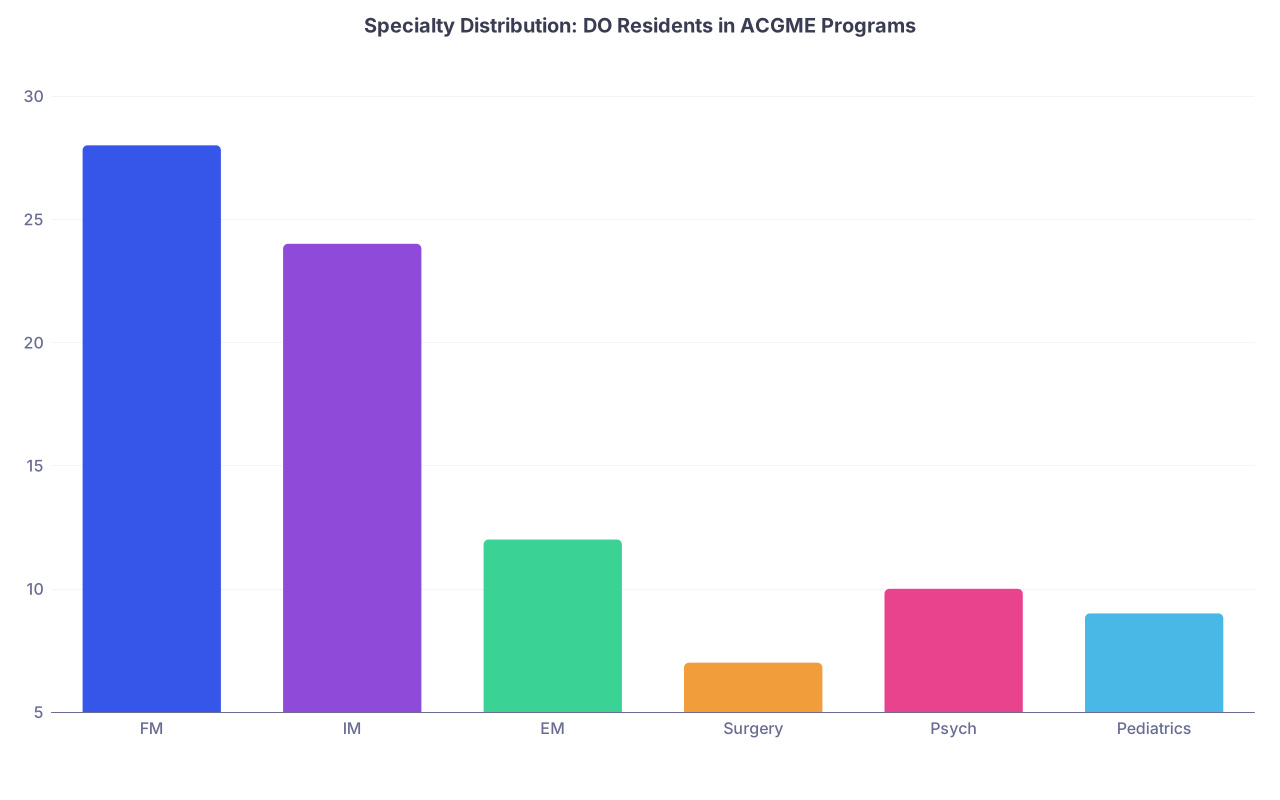
Let’s look at where DOs actually end up.
| Category | Value |
|---|---|
| FM | 28 |
| IM | 24 |
| EM | 12 |
| Surgery | 7 |
| Psych | 10 |
| Pediatrics | 9 |
Are DOs overrepresented in primary care? Yes. But:
- There are DOs in orthopedic surgery, neurosurgery, derm, ENT, radiology, anesthesia, EM, etc.
- Many of them are at big‑name programs: Cleveland Clinic, Mayo, large university hospitals, community powerhouses.
- The limiting factor in competitive specialties is not “DO vs MD” alone; it’s board scores, research, networking, and timing.
If you’re a DO with a 260+ Step 2, strong letters, and real research, you will absolutely match into competitive specialties. Is the path marginally steeper in some fields? Yes. Is that the same thing as “not a real doctor”? No. It’s just the system being conservative and slow to shed stigma.
The Single Accreditation System: The Myth’s Quiet Death Blow
The myth took a fatal hit when ACGME (historically MD‑centric) and AOA (osteopathic) residencies merged into a single accreditation system.
Before 2020:
- There were “AOA‑only” residencies that primarily or exclusively trained DOs.
- Many MDs didn’t interact with DOs in training, so stereotypes persisted and self‑reinforced.
After the merger:
- All new residency programs are ACGME‑accredited.
- DO and MD grads apply through the same Match to the same programs.
- Program directors now evaluate DO and MD applicants together.
Translation: the market has been forced to compare them side by side. And guess what? Programs keep matching DOs. In large numbers.
| Category | Value |
|---|---|
| 2018 | 6000 |
| 2019 | 6500 |
| 2020 | 7000 |
| 2021 | 7500 |
| 2022 | 8000 |
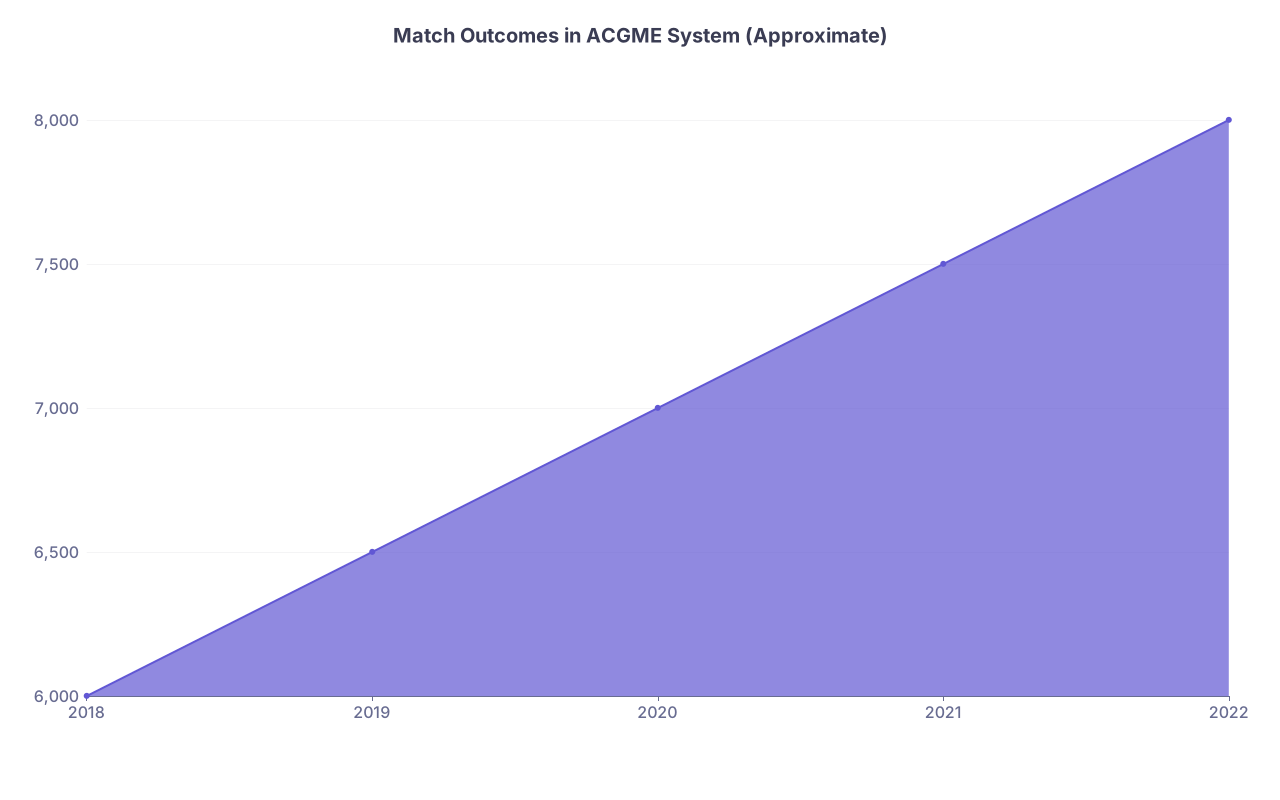
Those are rough numbers for DO applicants participating and matching in the NRMP each year. The direction is what matters: up.
Residency programs are ruthlessly pragmatic. If DO residents were consistently worse clinicians, more likely to fail boards, or unsafe, programs would quietly stop ranking them. That’s not happening.
I’ve seen the opposite. Program directors saying, “Our DO residents are some of our strongest – they work hard, they’re grounded, they’re good with patients.”
Not a slogan. Actual feedback.
“But DOs Do That Weird Alternative Stuff, Right?”
Here’s where the myth gets cartoonish.
Osteopathic schools teach Osteopathic Manipulative Medicine (OMM/OMT). That’s about 200–300 extra hours in most curriculums on musculoskeletal diagnosis and hands‑on techniques. Some DOs use it heavily in practice. Many use it rarely or not at all once they specialize.
What DOs do not do, structurally, is homeopathy, energy healing, crystals, or whatever else people try to glue onto the word “osteopathic.”
The osteopathic philosophy talks about:
- Treating the whole person
- Emphasizing structure and function
- Supporting the body’s inherent ability to heal
On paper, that sounds “alternative” to people who haven’t read any modern MD mission statements, which say the same things in different words.
In reality, a DO hospitalist managing sepsis will write for cefepime, norepi, and ICU transfer exactly the same as an MD. An osteopathic orthopedic surgeon fixing your ACL will use the same screws, the same arthroscope, the same rehab protocol.
If you’re imagining some mystical hand‑waving instead of evidence‑based medicine, you’re thinking of YouTube pseudoscience, not U.S.‑trained DOs.
Are there fringe DOs peddling nonsense? Yes. There are also MDs doing functional medicine scams, anti‑vax talks, and fad hormone clinics. Degree letters don’t immunize against bad judgment.
The relevant question isn’t “MD or DO?” It’s “Is this physician practicing within evidence and standard of care?”
What Actually Matters for Premeds: Strategy, Not Ego
You’re not just arguing online; you’re trying to plan a career. So let’s talk about how this myth should and should not shape your decisions.
Here’s the blunt version.
If your stats are strong enough for a wide range of MD schools, including your state school and a few mid‑tiers, and you don’t care about OMM or the osteopathic philosophy, then MD‑only is reasonable. You don’t need DO.
If your GPA is dented, your MCAT is okay but not spectacular, you’re a late bloomer, or you’d otherwise be staring at Caribbean schools, then U.S. DO schools can be a significantly safer, smarter path.
Caribbean vs DO is not a close contest. Caribbean schools often have:
- Massive class sizes
- Lower match rates
- Higher attrition
- Less clinical access in the U.S. early on
DO schools have:
- U.S. clinical rotations
- Strong match numbers into core specialties
- Increasing representation in competitive fields
If you tell me you’d rather go offshore MD than U.S. DO only because of the two letters, that’s ego talking, not career planning.
| Factor | U.S. DO School | Caribbean MD School |
|---|---|---|
| Location | United States | Outside U.S. (offshore) |
| Accreditation | COCA (recognized in U.S.) | Varies; limited U.S. oversight |
| Clinical Rotations | Primarily U.S. hospitals | Mixed; often fewer core U.S. sites |
| Match Rate (U.S.) | Generally high, especially in PC | Lower overall, varies widely |
| Residency Perception | Increasingly mainstream | Frequently scrutinized by PDs |
I’ve seen smart students tank their careers chasing “MD only” and ending up in unstable Caribbean programs with terrible outcomes, when they could’ve become excellent DO physicians in the U.S.
Patients Don’t Care (And If They Say They Do, Watch What They Do)
The final nail in this myth’s coffin is brutally simple: patient behavior.
Most patients:
- Don’t know the difference between MD and DO.
- Don’t check your board certification before booking.
- Care about: whether you listen, explain well, help their symptoms, and don’t make them wait three hours in a lobby.
There are occasional patients who say, “I only want an MD.” I’ve also seen the reverse: chronic pain patients actively seeking DOs for manipulative therapy. But these are the exception, not the rule.
On any given clinic schedule in a large system, patients see whomever has the first available appointment. They come back if they like you. They don’t come back if you treat them like numbers. Your communication skills, empathy, and clinical competence are going to matter orders of magnitude more than two letters on your badge.
And here’s the honest truth: plenty of patients have had outstanding care from DOs without ever realizing it. Because it felt exactly like seeing “a regular doctor.” Because that’s what it was.
The Bottom Line: What the Data Actually Shows
Strip away the noise and you’re left with this:
- DOs are fully licensed physicians, trained under rigorous standards, practicing in every major specialty. The law, hospitals, and residency systems treat them as such.
- Differences between MD and DO are now mostly about admissions profiles, some philosophy, and OMM training – not about being “real” versus “fake” doctors.
- For premeds, obsessing over MD vs DO often distracts from the real variables: your stats, your match strategy, your willingness to work, and your long‑term goals.
If someone still claims “DOs aren’t real doctors,” they’re not just wrong. They’re telling you they haven’t kept up with how modern medicine actually works.